
Local Marketing in Ireland: A Practical Guide for SMEs
Table of Contents
Most small businesses in Ireland already know they need to be visible locally. What they rarely get is a straight answer on where to start, what it costs, and which tactics actually move the needle in a market this size. This guide is written for SME owners and marketing managers across the Republic and Northern Ireland who want practical steps, not theory. ProfileTree, a Belfast-based digital agency, works with businesses on exactly this problem, and the approach below reflects what tends to work for firms trading in towns and cities from Cork to Derry.
Local marketing in Ireland is part digital and part community. A business can do everything right on Google and still lose to the competitor whose owner sponsors the local GAA club and is known by name on the high street. The two sides reinforce each other. Get the digital basics in place, keep them consistent, and tie them to the relationships you already have locally.
Why local search matters in Ireland, from Dublin to Derry
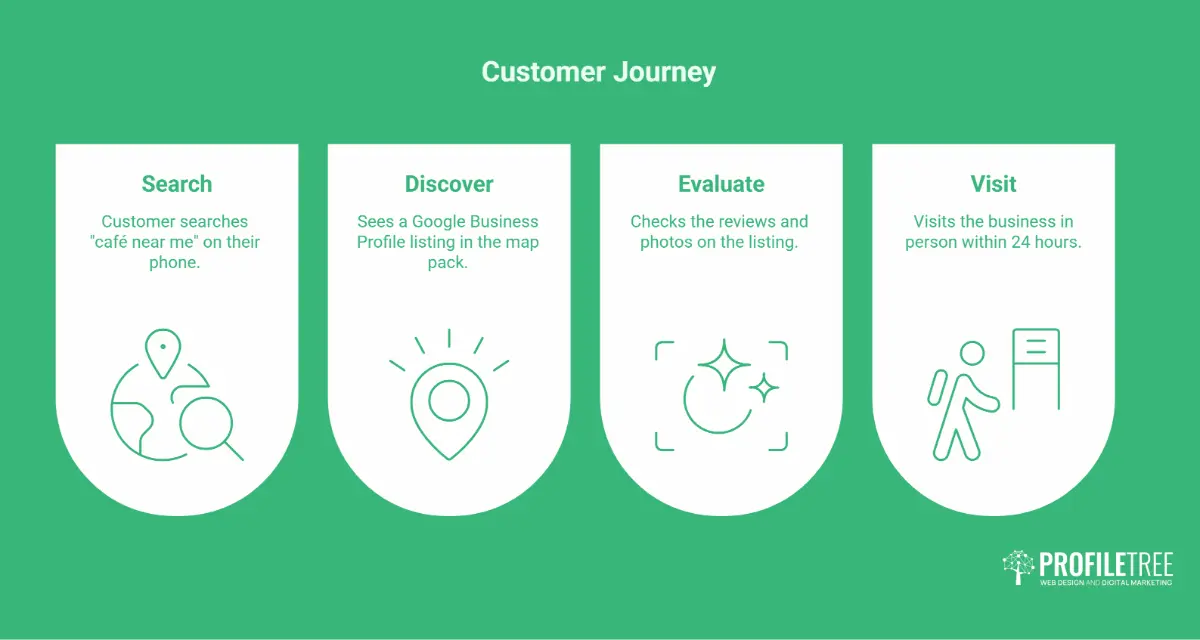
When someone searches for a service near them, they are usually ready to act. Google’s own research through Think with Google found that 76% of people who run a “near me” search on a phone visit a business within 24 hours. That intent is the whole point of local marketing. You are not chasing awareness; you are catching people at the moment they want to buy.
The Irish market has its own shape. Searches split between .ie and .co.uk depending on whether the business sits in the Republic or Northern Ireland, and the directories that carry weight differ on each side of the border. Rural businesses face a different challenge again: footfall is seasonal, tied to tourism along routes like the Wild Atlantic Way, and the “near me” radius can stretch for miles rather than streets. A one-size guide written for Dublin retail will not serve a craft producer in Donegal.
The practical takeaway is to define your own catchment before spending a euro. A city-centre cafe competes within minutes. A specialist consultancy might serve a whole county or trade nationally. That decision shapes everything that follows, from the keywords you target to whether you need separate location pages at all.
Setting up your Google Business Profile properly
Your Google Business Profile is the single most important local asset you control, and it is free. It feeds the map pack, the listing that shows your hours and reviews, and increasingly the answers that AI search tools give when someone asks for a recommendation. A profile that is claimed, verified, and kept current does most of the heavy lifting for local visibility.
Start with consistency. Your business name, address and phone number need to read identically here, on your website, and across every directory you appear in. Search engines treat that consistency as a trust signal, and small mismatches (a “St” on one listing and “Street” on another) chip away at it. This groundwork is unglamorous, which is exactly why so many businesses skip it and lose ground they did not need to. If you would rather hand the technical side to someone, this is the kind of work covered by professional local SEO setup.
Beyond the basics, the profile rewards activity. Add real photographs of your premises and work rather than stock images. Post updates about offers or events. Pick accurate primary and secondary categories. Respond to every review. For businesses that want to run this in-house, ProfileTree also delivers digital training so your own team can manage the profile confidently rather than relying on an agency indefinitely.
Why Apple Maps and Bing matter too
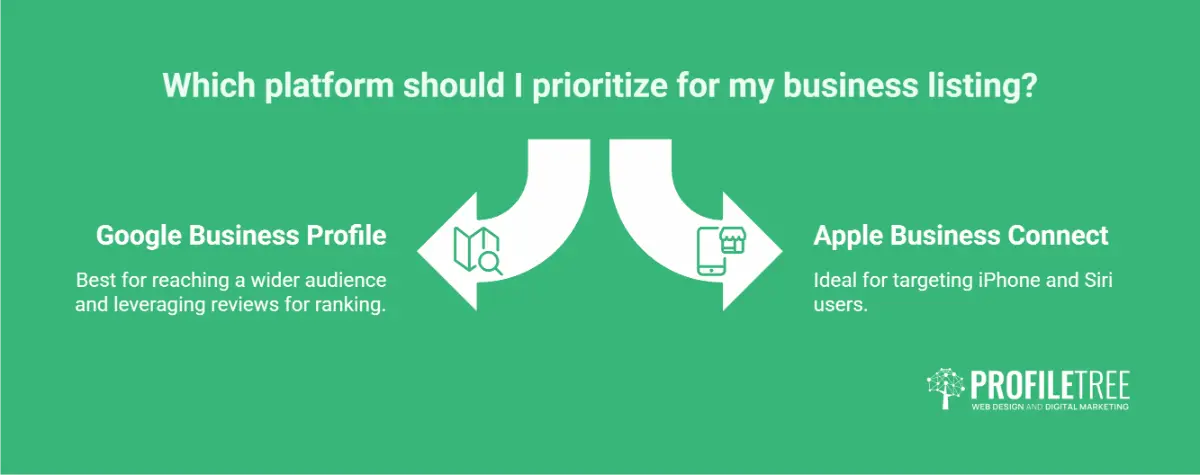
Google dominates, but it is not the only map. Apple Maps draws a meaningful share of iPhone users, and its integration with Siri and other Apple services means a missing or wrong listing costs you those customers entirely. Claim your profile through Apple Business Connect and keep the same details consistent there. Bing matters more than its market share suggests, because it feeds answers into other tools, so a quick listing there is worth the half hour it takes.
Managing reviews without it taking over your week
Reviews influence both whether a customer chooses you and how well you rank locally. The aim is a steady flow of genuine, recent reviews and a visible habit of responding to them. A business that replies to feedback, good and bad, reads as one that is paying attention.
Build review requests into the points where customers are already happy: after a completed job, at the end of a good meal, on a follow-up email. A QR code on a receipt or a table card lowers the friction. Keep within Irish consumer protection rules by never paying for or incentivising fake reviews. For negative reviews, reply publicly and briefly, then take the detail offline. In a small community, how you handle a complaint is often more visible than the complaint itself.
“Consistent review management is not about reputation alone. Irish businesses that reply to feedback quickly and properly tend to see stronger customer engagement than those who let reviews sit unanswered.”
Ciaran Connolly, Director, ProfileTree
Combining digital reach with Irish community life
This is where Irish local marketing differs from the textbook version. Community trust carries weight here that no amount of paid advertising replicates. GAA club sponsorships, a presence in local Facebook and WhatsApp community groups, a stall at the town festival: these build the kind of recognition that turns a search result into a chosen supplier.
The trick is to connect the offline goodwill to your online presence. Photograph the event you sponsored and post it to your profile. Encourage the customers you meet in person to leave a review. Share local content that has nothing to do with selling, because being a known part of the community is itself the marketing. A consistent social media marketing presence keeps those community relationships warm between the moments people actually need you.
Video carries this especially well. A short clip introducing the team, showing how something is made, or covering a local event does more for trust than a page of text. ProfileTree produces this kind of content and offers video marketing for businesses that want video as part of the plan rather than a one-off.
Irish marketing grants and supports
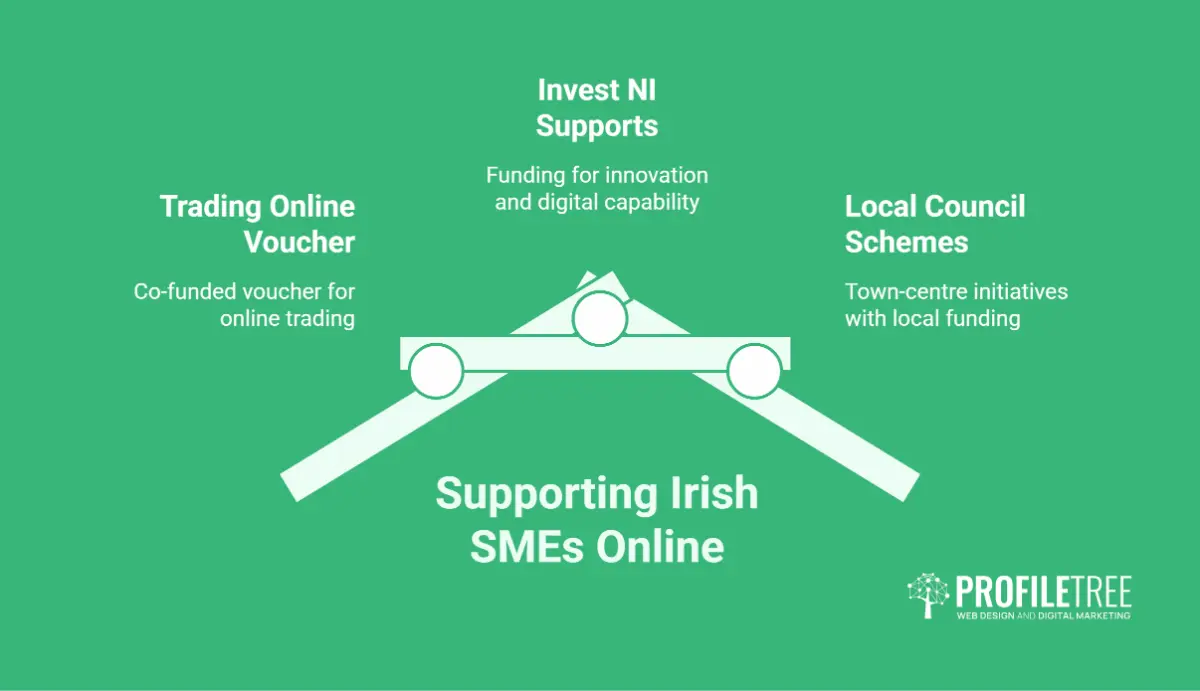
Funding exists to help SMEs build their online presence, and it is the most underused part of the local marketing toolkit. In the Republic, the Local Enterprise Office Trading Online Voucher offers co-funding toward developing or improving your online trading, which can cover website work and related digital marketing. The voucher typically funds half the cost up to a set maximum, with eligibility tied to business size and trading history.
In Northern Ireland, Invest NI runs supports aimed at innovation and growth that can extend to digital capability, and local councils sometimes run their own schemes. The detail changes, so check the current criteria directly before you build a plan around any one grant.
Grant money often funds the foundational build rather than ongoing activity, which makes it a sensible moment to get the structure right. That can mean a new website design that is built to rank locally from the start, or a planned approach to the whole effort through proper digital strategy rather than spending the voucher on disconnected pieces.
| Support | Region | Funding model | Best for |
|---|---|---|---|
| Trading Online Voucher (LEO) | Republic of Ireland | Co-funded, up to a set maximum | Building or improving online trading |
| Invest NI supports | Northern Ireland | Varies by programme | Innovation and digital capability |
| Local council schemes | Both | Varies locally | Town-centre and community initiatives |
Local SEO and the directories that matter in Ireland
Beyond Google, a set of Irish and UK directories carry citation value: consistent listings across them reinforce your business details and help local ranking. Golden Pages remains relevant in the Republic, alongside general directories and any industry-specific platforms your trade uses. In Northern Ireland, UK directories apply. The job is less about quantity and more about consistency: the same name, address and phone number everywhere.
This is steady, ongoing work rather than a one-time task, and it sits naturally alongside broader digital marketing activity. Reliable hosting and site upkeep matter here too, because a slow or broken website undermines every listing that points to it; ProfileTree covers that side through hosting and management.
| Feature | Google Business Profile | Apple Business Connect |
|---|---|---|
| Reach | Largest share of local searches | iPhone and Siri users |
| Reviews | Central to local ranking | Less prominent |
| Cost | Free | Free |
| Priority | Set up first | Set up second |
Content marketing that builds local authority
Locally relevant content is what separates a business that ranks from one that simply exists online. Neighbourhood guides, coverage of local events, answers to the questions your customers actually ask: this is the material that earns links, gets shared in community groups, and increasingly gets cited by AI search tools when someone asks for a local recommendation.
The mistake most businesses make is treating content as occasional rather than ongoing. A single blog post does little. A steady programme of useful, specific, locally grounded material compounds over months. For firms that lack the time or in-house writers, this is where a content marketing partner earns its keep. AI tools are also reshaping how this content gets found, and ProfileTree advises on AI for marketing as part of that.
One note on branding trends in Ireland: the businesses building durable local brands are leaning into genuine local identity rather than generic polish. Customers respond to a brand that clearly belongs to their place. That authenticity is harder to fake than a slick logo and worth far more.
What does local marketing cost in Ireland?
Most agencies avoid this question. Being straight about it builds more trust than dodging it. For Irish SMEs, ongoing local marketing retainers commonly fall somewhere between a few hundred and a couple of thousand euro a month, depending on scope. A sole trader maintaining a Google Business Profile and posting occasionally sits at the low end. A growing business running content, ads, video and ongoing SEO sits higher.
The variables that move the cost are scope (how many channels), competitiveness (a Dublin solicitor faces more competition than a rural tradesperson), and whether you do the work in-house or outsource it. There is no single right answer. A business with time and a willing staff member can do a great deal with a grant-funded website and free tools. A business short on time usually finds an agency cheaper than the customers it loses by being invisible.
Planning your year around Irish seasonal peaks
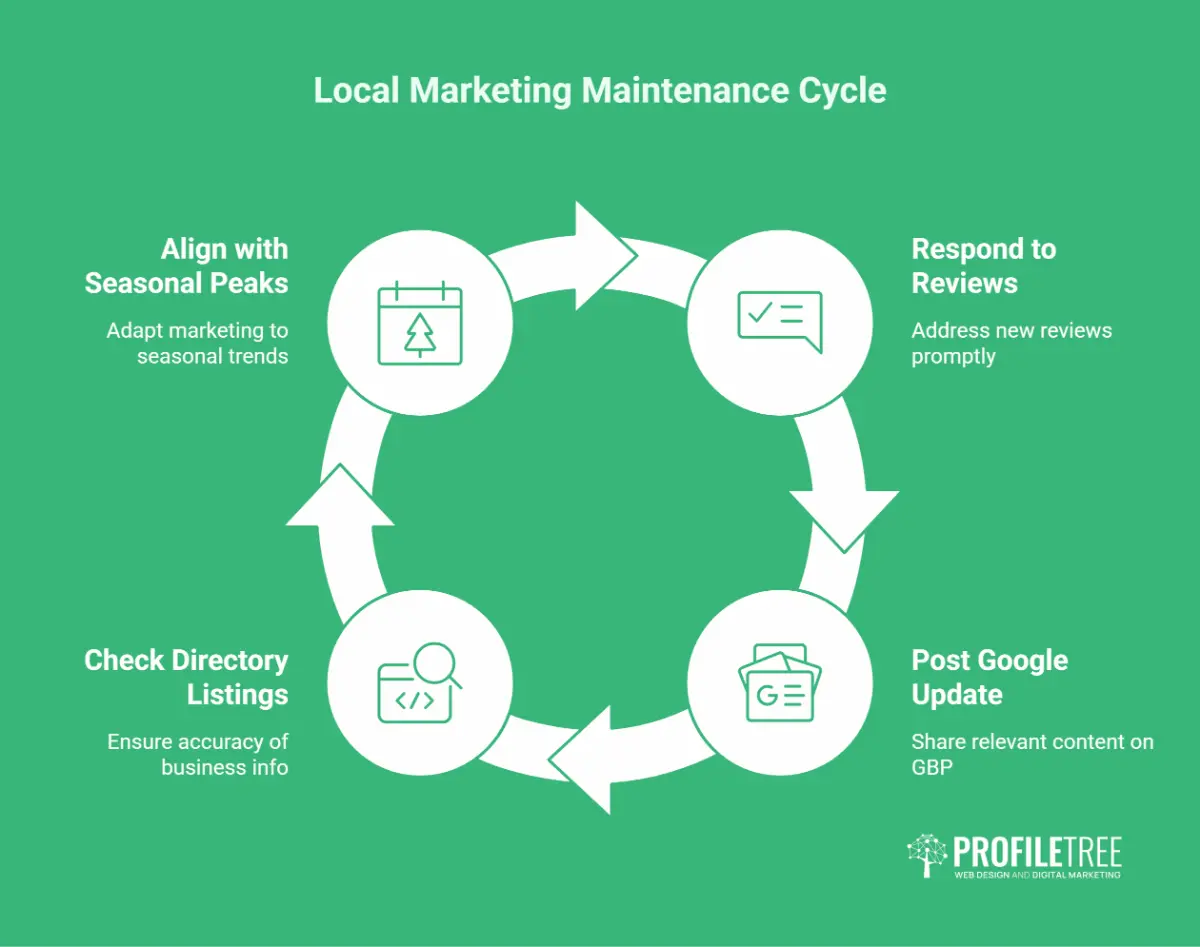
Local marketing works better when it follows the rhythm of the Irish year. Build a simple calendar around the moments your customers are already thinking about: St Patrick’s Day in March, the summer tourism season, back-to-school in September, and the run into Christmas. Add the local events specific to your town. You do not need a campaign for every month, just a plan that puts effort where the attention already is.
Keep a light maintenance routine alongside it: respond to reviews weekly, post to your profile monthly, and review your listings every quarter for accuracy. Fifteen minutes a week of upkeep beats an annual scramble.
Where to start
If you do nothing else, claim and complete your Google Business Profile, fix your name, address and phone number so they match everywhere, and start asking happy customers for reviews. Those three steps cost nothing and put you ahead of most local competitors. From there, build content steadily, tie your digital presence to your real community involvement, and check what grant funding you qualify for before paying out of pocket for the foundations.
Local marketing in Ireland rewards businesses that treat it as a long relationship with their place rather than a quick campaign. The digital tools are the same ones available to everyone. The advantage comes from using them consistently and pairing them with the local trust you are best placed to earn.
Frequently asked questions
How can I promote my business locally for free in Ireland?
Claim and complete your Google Business Profile, keep your business details consistent everywhere they appear, and ask satisfied customers for reviews. Add free listings on Apple Business Connect and Bing. Join and contribute to local Facebook and community groups. None of this costs money, and together it covers the basics of local visibility. The cost is time and consistency rather than budget.
What is the Trading Online Voucher and who is eligible?
The Trading Online Voucher is a Local Enterprise Office scheme in the Republic of Ireland that co-funds the cost of developing or improving your online trading, typically covering half the cost up to a set maximum. Eligibility is tied to business size and trading history, and businesses usually need to attend a short information session first. Check the current criteria with your local LEO before planning around it, as the terms are reviewed periodically.
Does local SEO work differently in Northern Ireland versus the Republic?
The principles are the same, but the details differ. Businesses in the Republic tend to use .ie domains and Irish directories like Golden Pages, while Northern Irish businesses use .co.uk domains and UK directories. The grant options differ too, with the Trading Online Voucher in the Republic and Invest NI supports in the North. Google Business Profile and review management work identically on both sides of the border.
What are the best social media platforms for Irish customers?
Facebook remains strong for local community engagement, particularly through town and area community groups where word of mouth travels fast. Instagram suits visual businesses like retail, hospitality and trades showing finished work. LinkedIn matters for professional services and B2B. The right mix depends on your customers, but most local Irish SMEs see the most local engagement from Facebook.
How long does local marketing take to show results?
Paid ads can drive enquiries within days, but they stop the moment you stop paying. Local SEO and content build more slowly, with meaningful movement usually taking three to six months and compounding after that. Reviews and Google Business Profile improvements can show faster, sometimes within weeks. Set expectations around a few months for organic results rather than immediate returns.
How should I handle a negative Google review for my Irish business?
Reply publicly, calmly and briefly, thank the person for the feedback, and offer to resolve the issue offline. Do not argue in the public reply. In a small community, prospective customers judge you more on how you respond than on the complaint itself. A measured reply to a bad review often does more good than the review does harm.