
AI-Enhanced Local Search: A Playbook for UK and Irish SMEs
Table of Contents
AI-enhanced local SEO is changing how customers in Northern Ireland, Ireland, and the UK find the businesses nearest to them. Search no longer works by matching a string of words on a page. It reads your Google Business Profile, checks your reviews, compares your details across directories, and then decides whether to recommend you in a map pack or in an AI-generated answer.
This playbook is built for SME owners, not for enterprise marketing teams with dedicated technical staff. It covers the practical side of AI-enhanced local SEO: auditing your current presence, fixing the citation errors that quietly cost visibility, generating local schema, and adapting tools built for the US market to UK and Irish directories. There’s no magic fix here. AI speeds up the work, but a person still needs to check what it produces before it goes live.
Most of what’s written about this topic comes from US agencies, and it shows. American directories, American spelling, and American assumptions about how postal addresses work don’t map cleanly onto a business in Newry, Derry, or Cork. That gap is exactly where a lot of SMEs lose ground without realising it, since a US-built tool will happily generate content and schema that looks fine until you check it against a UK postcode or an Irish Eircode.
Why AI-Enhanced Local SEO Is Replacing the Old Playbook
Local search has moved from keyword matching to entity association. Google and AI assistants try to work out who your business is, where it operates, and whether other sources agree, before they decide to recommend you. For a plumber in Derry or a cafe in Belfast, that means your reputation across the web now matters as much as the words on your homepage.
From Keyword Strings to Local Entities
An entity is something a search engine recognises as real: a business name tied to a location, a category, and a set of attributes. When those signals line up across your website, your profile, and the directories that mention you, Google trusts the picture and shows you more often. When they conflict, it hedges. A clear, well-structured website gives both Google and AI models a reliable source to read from, which is one reason web design and technical SEO sit closer together than owners often assume. A site that’s fast, has clean headings, and states the same business name and address as your Google Business Profile gives an AI model far less room to get confused.
How AI Answer Engines Handle “Near Me” Searches
AI Overviews and voice assistants weigh a mix of signals when deciding which local business to put forward: how close you are to the searcher, how consistent your details are across the web, and the tone of your reviews. None of this is a keyword trick. It rewards businesses that keep their information accurate and earn genuine feedback over time, which is exactly what AI-enhanced local SEO is designed to test for. A searcher asking an assistant, “Which solicitor near me is open on Saturdays?” is asking a conversational question, not typing a keyword phrase, and your content needs to answer that question directly rather than just mentioning the service and the town.
The SME Audit: Benchmarking Your AI-Enhanced Local SEO Presence
Before changing anything, you need a clear picture of where you stand today. An AI-enhanced local SEO audit doesn’t need to be expensive or technical to start; it needs to be consistent and require a person to read the results properly. Profile management sits within our digital strategy work at ProfileTree, but the steps below are ones any owner can run themselves.
AI-Powered Google Business Profile Audits
Start by searching your own business name, address, and phone number across Google, then ask ChatGPT, Claude, or Perplexity to recommend a business like yours in your town. Note any wrong details they return. Check your major directory entries against your live website, and where they differ, correct the source record rather than just your own page. A full SEO audit from our team follows the same logic at a larger scale, checking technical health alongside these local signals.
Reading Customer Sentiment at Scale
Reviews now feed directly into how AI assistants describe your business, so reputation has become a search task as much as a customer service one. AI tools can summarise the themes in your reviews quickly, showing what customers praise and what frustrates them. Acting on those themes improves the experience and the signal AI models read, though someone still needs to write the actual reply. Our AI chatbots can handle first-line questions so your team has time to answer reviews properly instead of rushing them.
Turning the Audit Into a Fix List
An audit is only useful once it becomes a short, prioritised list of fixes rather than a spreadsheet nobody opens again. Group what you find into three buckets: wrong details that need correcting at the source (an old phone number, a closed branch still listed), missing details that are quick to add (opening hours, categories, photos), and structural issues that need a developer or a wider strategy conversation, such as a site that doesn’t state your address in plain text anywhere.
Working through the first two buckets yourself is realistic within a week or two for most single-location SMEs. The third bucket is where it’s worth bringing in outside help, since it tends to touch the website itself rather than just the profile.
In a small business, this usually falls to whoever already owns marketing, which is often the owner. That’s fine as a starting point, but it’s worth naming one person as responsible for the monthly check described below, even if it’s a fifteen-minute task on a Friday, because a job with no named owner is the one that quietly stops happening after the first busy month.
Solving AI Citation Drift Across the UK and Ireland
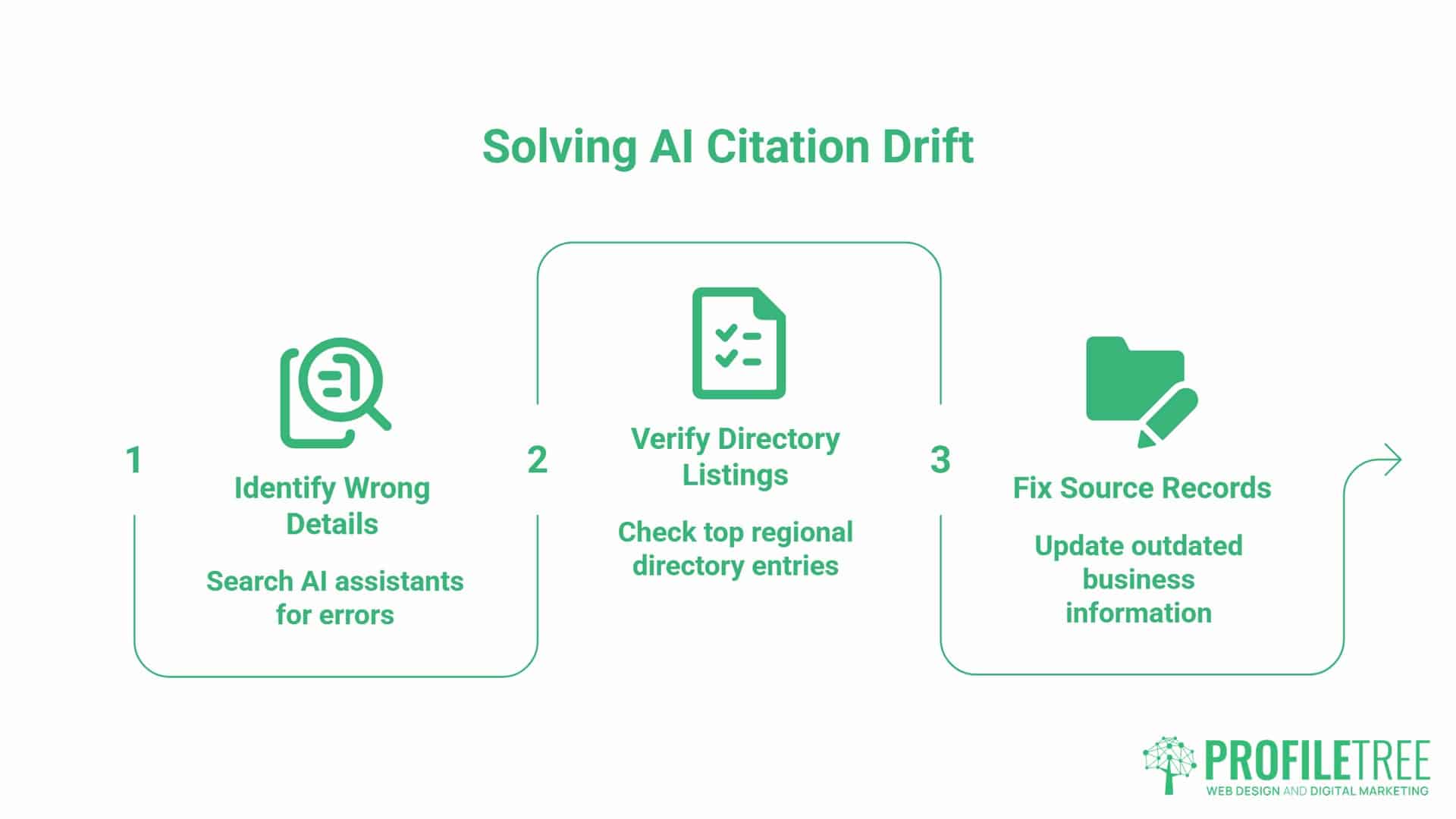
AI citation drift happens when a model learns your business details from outdated scraped data and repeats them. If you moved premises, changed your number, or rebranded, an assistant may still hand a customer the old information. This is a trust problem, and it’s one of the areas where generic AI-enhanced local SEO advice, most of it written for the US market, falls short for businesses here. Almost every guide on this topic assumes the AI’s answer is broadly accurate. In our experience working across Northern Ireland, Ireland, and the UK, that assumption doesn’t hold up nearly as often as it should.
Why AI Models Get Regional Details Wrong
Large language models build their picture of a business from many sources, crawled at different times. An old directory listing, a cached page, or a stale aggregator record can all feed in. Because a model blends sources rather than checking one, a single wrong record can surface long after you’ve fixed your own site.
This is a particular problem across Northern Ireland and the Republic of Ireland, where models trained mostly on US and GB data can confuse Derry with Londonderry, or apply a UK postcode format to an address that needs an Eircode instead. A business that serves customers on both sides of the border faces this twice over, since it needs both address formats to be correct in the same profile without one overwriting the other.
The Regional Directory Checklist: Yell, Golden Pages, and NI-Specific Citations
Alongside Google, the directories that carry weight here are ones most AI SEO advice ignores: Yell, Thomson Local, and Scoot in the UK, Golden Pages in Ireland, plus regional and sector-specific listings. When you use a tool built for the US market, tell it explicitly to format UK postcodes and Irish Eircodes correctly, and to check citations on these regional directories rather than only the American ones it defaults to.
Blasting your listing across hundreds of low-quality directories used to be common advice. It does more harm than good now, because every extra record is another chance for a detail to drift. A smaller set of accurate, authoritative listings is worth more than volume.
A Simple Monthly Citation Check
You don’t need a paid platform to keep on top of this, though one becomes worth it once you’re managing more than a handful of locations. Once a month, search your business name and address on Google, then ask two or three different AI assistants to recommend a business like yours nearby. Write down anything they get wrong. Check that figure against your top three or four directory listings, fix the source record where it’s wrong, and move on. It takes twenty minutes and catches most drift before a customer ever notices it.
Content and Regional Authority: Writing for AI-Enhanced Local SEO
Competing on AI-enhanced local SEO content isn’t just about publishing more pages. It’s about proving, with detail a generic model can’t invent, that you actually operate where you say you do. Google’s Information Gain thinking applies here just as much as it does anywhere else: a page that reads like every other AI-generated local page on the same topic has little reason to be the one that gets cited or clicked.
Beyond Generic AI Text: Local Lived Experience
AI can draft a location page outline in seconds, but it can’t describe the one-way system outside your Belfast unit or the fact that your Derry customers ask about parking before they ask about price. That detail is what separates a page that reads as genuinely local from one that reads as a template with a town name swapped in.
Our content marketing team builds this local detail into copy so a page still reads as written by someone who knows the area, not as an AI first draft with the edges left rough. A short paragraph naming an actual local landmark, a specific parking arrangement, or a genuinely local phrase does more for trust, and for AI citation, than another generic line about “friendly, professional service.”
“Search engines and AI tools can copy a template. They can’t fabricate ten years of knowing which Belfast streets flood after heavy rain, or which Derry client always asks the same question first. That local knowledge is the one thing that will keep a business visible once every competitor is using the same AI tools,” says Ciaran Connolly, founder of ProfileTree.
Building Hyper-Local Pages Without a Thin Content Penalty
A trade serving twenty towns across Greater Belfast or Yorkshire can’t publish twenty near-identical AI-written pages without risking a thin content penalty. Use AI to build the structural outline and the initial research, then add genuine local detail, real photos, and unique service notes by hand. A rough rule of thumb: if you could swap the town name on a page and nobody would notice, it needs more local detail before it goes live, not a different AI prompt. Teams that want to run this process confidently in-house, rather than sending every page out, tend to get more from it after some structured digital training on how to brief and check AI output.
The Hybrid Workflow Behind Good AI-Enhanced Local SEO
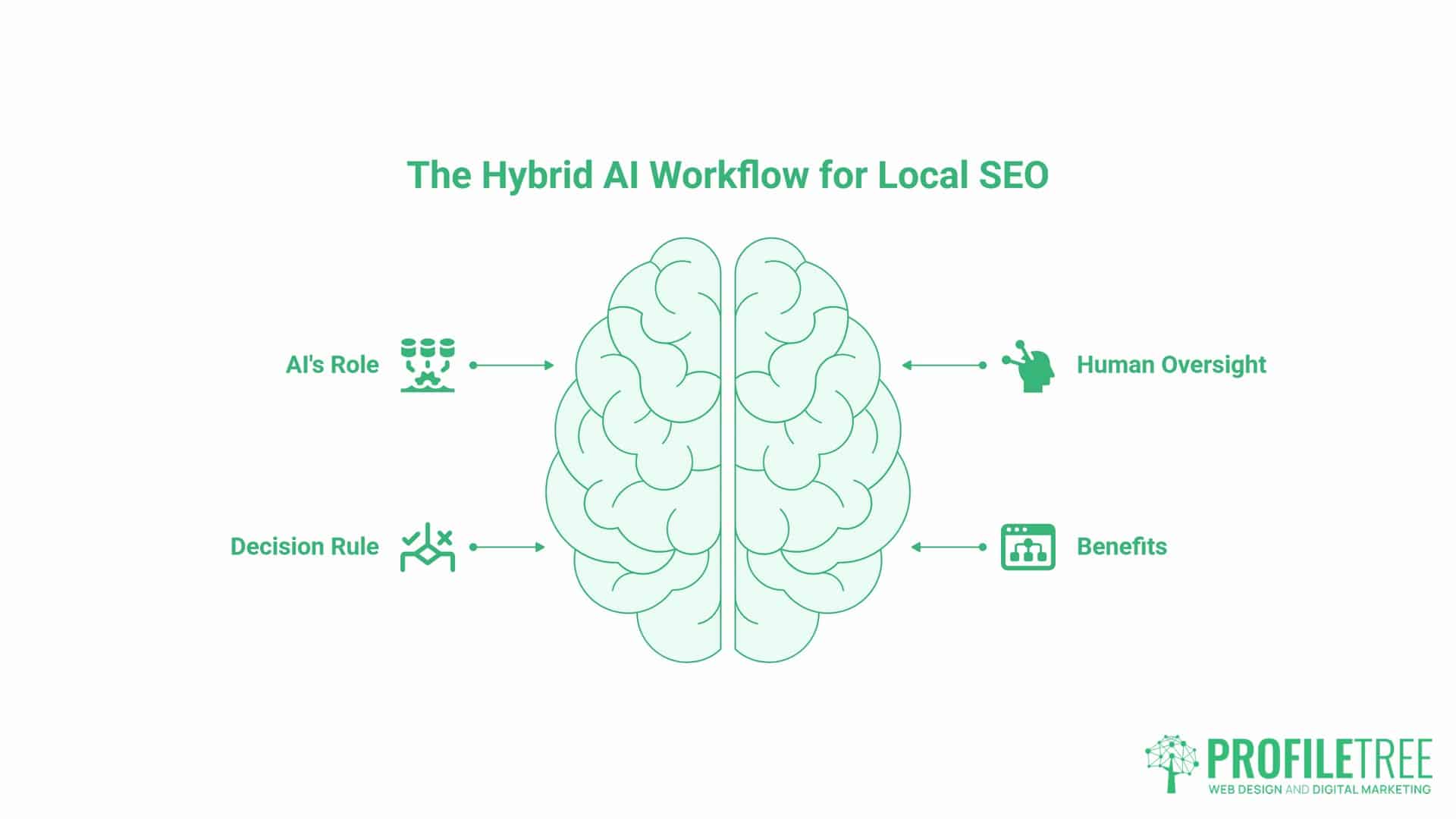
The businesses winning at AI-enhanced local SEO aren’t the ones avoiding AI, and they aren’t the ones publishing whatever it produces unedited either. They’re the ones who know exactly where the line sits, and who’ve built a routine around that line rather than deciding it fresh every time.
Where to Let AI Take the First Pass
AI handles repetitive, data-heavy tasks well: drafting schema fields, sorting reviews by sentiment, spotting a missing opening hours field, or producing a first draft outline for a new location page. These are places where speed matters more than judgement, and where a clear first draft saves real time. A tool can also flag patterns a busy owner might miss, such as a cluster of reviews all mentioning the same wait time issue in the same month.
Where a Person Needs to Check the Work
Brand voice, local nuance, and anything touching legal or regulatory claims (pricing, guarantees, health and safety wording) need a person to read them before they go live. This is also where a wider AI transformation project earns its keep, not by replacing judgement but by setting up the workflow so AI drafts land in front of the right person before publishing, rather than going straight to the website.
A Simple Decision Rule for SMEs
If a mistake would cost you money, a customer, or a regulator’s attention, a person checks it before it publishes. If a mistake would cost you five minutes to fix later, AI can run ahead, and you can review it in a batch. A schema field is cheap to fix if it’s wrong; a review reply that misreads a genuine complaint is not. Applying that one rule consistently does more for AI-enhanced local SEO than any tool subscription.
Traditional local SEO versus AI-enhanced local SEO:
| Area | Traditional local SEO | AI enhanced local SEO |
|---|---|---|
| Keywords | Exact-match phrases in copy | Entity clarity and natural language |
| Directories | Volume of citations | Accuracy across a trusted few |
| Reviews | Star count | Sentiment and response quality |
| Data | On-page text | Structured schema as source of truth |
| Content | Manual page writing | AI draft plus human localisation |
Technical Groundwork for AI-Enhanced Local SEO
None of the above matters much if the site behind it is slow, poorly structured, or missing the data search engines need to trust it. A perfect Google Business Profile sitting in front of a broken website still leaves an AI model with a weak second source to check your details against.
Schema Markup for Local Entities
A schema is structured data that states the facts about your business, name, address, phone, opening hours, and price range, in a format search engines and AI models read first. You can ask an AI tool to draft a LocalBusiness JSON-LD block from your exact details, but treat that output as a first draft. Validate it with Google’s Rich Results Test, confirm every field matches your live site, and have a developer place it correctly. Google’s own LocalBusiness structured data documentation sets out the fields it expects, and it’s worth checking directly rather than relying on a summary.
Getting the schema right is partly a build task, which is why it tends to sit with our website development service rather than being a copy-and-paste job. A field that’s technically valid but out of step with your live site (an old opening time, a service you no longer offer) can do more harm than having no schema at all, since it gives a confident, wrong answer rather than none.
Core Web Vitals and AI Crawlers
AI crawlers work through a site much like Google’s own crawler does, and a slow, cluttered page gives them less of your content to work with in the time they spend on it. Core Web Vitals (loading speed, visual stability, and responsiveness) remain a baseline requirement rather than a nice-to-have. For sites we host, this sits alongside ongoing hosting and site management, so speed and uptime get checked as routine rather than only after something goes wrong.
What Comes Next for AI-Enhanced Local SEO
The next shift is predictive rather than reactive. As AI models get better at forecasting search demand by season, weather, or local event, businesses that keep clean, structured, and current data will be the ones a model can confidently recommend ahead of a spike in demand, not just during it.
A takeaway that updates its menu and hours ahead of a bank holiday, or a garden centre that posts about frost protection before the first cold snap, gives a model a reason to surface it proactively rather than waiting to be asked. That’s what AI-enhanced local SEO increasingly rewards: not a single fix, but data kept current as a habit. None of this replaces the fundamentals above. It simply raises the reward for getting them right early and raises the cost of leaving a profile untouched for months at a time.
Bringing It Together
AI hasn’t replaced local SEO fundamentals. It has raised the cost of getting them wrong. Keep your details consistent everywhere, give AI clean and structured data to read, earn and answer real reviews, and adapt tools built for the US market to the UK and Irish directories that actually carry weight here. Use AI to move faster, and keep a person checking the output before it goes live.
Google’s own documentation on AI features in Search confirms there are no special requirements for appearing in AI Overviews beyond the same fundamentals that have always mattered. Do that, and your business stays visible whether a customer searches Google directly or asks an AI assistant for a recommendation. Start with the audit, fix what it turns up, and treat the monthly check as routine rather than a one-off project.
Frequently Asked Questions
Is AI-enhanced local SEO safe for small businesses?
Yes, provided a person reviews the output before it is published. Google doesn’t penalise a page for being drafted with AI, but it does target thin or unhelpful pages, and unedited AI output can hand a customer the wrong opening time or address.
How does AI improve my Google Business Profile?
It speeds up review sentiment analysis and photo tagging, and it can draft posts and replies for you to check. The profile itself still needs someone to keep the details up to date.
Do I still need a local SEO agency if I use AI?
Most owners still benefit from an agency for strategy, regional nuance, and catching citation drift that AI tools don’t flag. AI handles the repetitive tasks; a person still needs to set the direction and check the output. For businesses managing several locations, that oversight tends to matter more, not less.
What is AI citation drift?
It’s when an AI search model repeats outdated business details it learned from old scraped data, such as a former phone number or address. The inconsistency confuses both AI systems and search algorithms, and can quietly lower your local visibility.
How does AI change “near me” searches?
It makes the query more conversational, so a searcher might ask an assistant directly instead of typing a short phrase. Consistency and reputation now matter more to being recommended than exact keyword matches do.