
Video Marketing Campaign: UK Strategy and ROI Guide
Table of Contents
Video marketing is not a trend that businesses can afford to monitor from a safe distance. It is now the primary format through which buyers research, compare, and decide, and the businesses that treat it as a bolt-on afterthought are consistently outperformed by those that plan campaigns with the same rigour they apply to paid media or SEO.
This guide covers the full lifecycle of a video marketing campaign: from goal-setting and pre-production through to distribution, measurement, and the emerging AI workflows that are reshaping how content is made. Where figures appear, they are drawn from named research sources so you can assess their relevance to your own market.
What Is a Video Marketing Campaign?
A video marketing campaign is a planned series of video assets or a single centrepiece video supported by derivative content designed to achieve a defined business objective over a set period. It differs from ad hoc video content in that every element, from the script to the distribution channel to the success metric, is chosen in relation to a specific outcome.
The keyword is “campaign.” A single product video is not a campaign. A campaign has a start date, a target audience, a channel strategy, a budget, and a way of measuring whether it worked.
For SMEs in the UK and Ireland, this distinction matters because resources are finite. A business that produces one strong, strategically distributed video will typically see better returns than one that publishes ten disconnected clips with no clear purpose.
The 4 Stages of a Successful Video Marketing Campaign
The most durable framework for a video marketing campaign follows four stages: goal setting, pre-production, distribution, and analysis. Each stage informs the next, and skipping or compressing any of them tends to create problems that cost more to fix than they would have to prevent.
Stage 1: Goal Setting and Audience Definition
Every effective video campaign begins with two decisions: what you want to achieve, and who you are trying to reach. These are not interchangeable. A brand awareness campaign for a 35-to-55-year-old professional audience requires a different format, length, and platform from a conversion-focused campaign targeting the same demographic.
Common campaign objectives include:
- Brand awareness: Reaching new audiences who have not previously encountered your business. Success is measured in reach, view count, and brand recall.
- Lead generation: Encouraging viewers to take a specific action — filling in a form, booking a call, downloading a resource. Success is measured in conversions and cost per lead.
- Customer education: Explaining how a product or service works, reducing pre-sale friction. Success is measured in engagement rate and downstream conversion lift.
- Retention and loyalty: Keeping existing customers engaged through updates, tips, or community content. Success is measured in repeat purchase rate and churn reduction.
Once the objective is set, define your audience with enough specificity to make production and distribution decisions. “SME owners in Northern Ireland considering their first website redesign” is a workable audience definition. “Business owners” is not.
Stage 2: Pre-Production and the AI-Enhanced Scripting Workflow
Pre-production is the stage where most campaigns either succeed or fail. The shoot itself is surprisingly forgiving; a well-prepared production can accommodate minor changes. A poorly planned one cannot be rescued in the edit.
The pre-production phase covers: scripting, storyboarding, location or talent sourcing, equipment planning, and scheduling. For most SME campaigns, the script is the critical deliverable.
Where AI genuinely helps in pre-production: AI tools are now useful at specific points in the scripting and planning process. Tools like ChatGPT or Claude can help structure a brief, generate initial draft scripts for iteration, and suggest shot lists based on a concept. Storyboarding software with AI generation capabilities can quickly visualise scenes.
Where human judgement remains essential: Brand voice, emotional nuance, and the accuracy of any claims about your business or industry cannot be delegated to AI. A script that sounds plausible but contains factual errors about your product is more damaging than no video at all. Every claim in a script should be reviewed by someone with domain knowledge before it goes to production.
At ProfileTree, the pre-production process for client video campaigns includes a discovery session to establish messaging priorities before a single word of script is written. This step consistently reduces revision cycles and keeps production on budget.
Stage 3: Production and Distribution
Production considerations for UK businesses:
The most common mistake SME decision-makers make is conflating production quality with production cost. Audio quality is non-negotiable — poor audio will cause viewers to abandon a video regardless of how good the visuals are. Camera quality is more forgiving than most people expect, particularly for social-first content where compressed formats reduce the visible difference between a smartphone and a broadcast camera.
A useful heuristic: spend your production budget on sound first, then lighting, then camera. A video shot on a modern smartphone with a dedicated lapel microphone and a softbox light will outperform a video shot on a professional camera in a noisy, poorly lit room.
Distribution: a matching platform to the objective
The choice of distribution channel should follow directly from your audience and objective definition, not from personal preference or what competitors are doing.
| Platform | Best For | UK Benchmark CPM |
|---|---|---|
| YouTube | Long-form education, SEO, brand authority | £4–£10 |
| B2B awareness, lead generation, recruitment | £20–£40 | |
| TikTok / Instagram Reels | Broad awareness, younger demographics | £3–£8 |
| Facebook / Meta | Retargeting, local business awareness | £5–£15 |
CPM ranges are indicative estimates based on industry reporting for the UK market. Actual costs vary by sector, targeting, and campaign period.
YouTube remains the most strategically valuable platform for most UK SMEs running educational or service-based campaigns. It is the second-largest search engine in the world, and a well-optimised video can generate organic views for months or years after publication, unlike paid social placements, which cease once the budget runs out.
For B2B campaigns, LinkedIn’s targeting precision by industry, seniority, company size, and geography makes it the most cost-effective channel for reaching specific decision-makers, despite its higher CPM. A campaign targeting finance directors at mid-size manufacturing firms in the UK is not practically achievable on any other platform at a comparable scale.
Stage 4: Post-Campaign Analysis and ROI Measurement
The metrics you track should connect directly to the objective you set in Stage 1. View count is a meaningful metric for awareness campaigns; it is largely irrelevant for conversion campaigns.
Metrics by objective:
- Awareness: Views, reach, brand lift (measured via survey), share of voice
- Lead generation: Click-through rate, cost per lead, form completions, conversion rate
- Education: Watch time, completion rate, downstream conversion lift
- Retention: Re-engagement rate, click-throughs to product or support content
Watch time and completion rate are consistently underused by SME marketers. A video with 10,000 views and a 20% average completion rate has delivered less than a video with 2,000 views and an 85% completion rate, measured by the amount of your message that actually reached the audience.
UK Video Marketing Costs: What to Budget in 2025
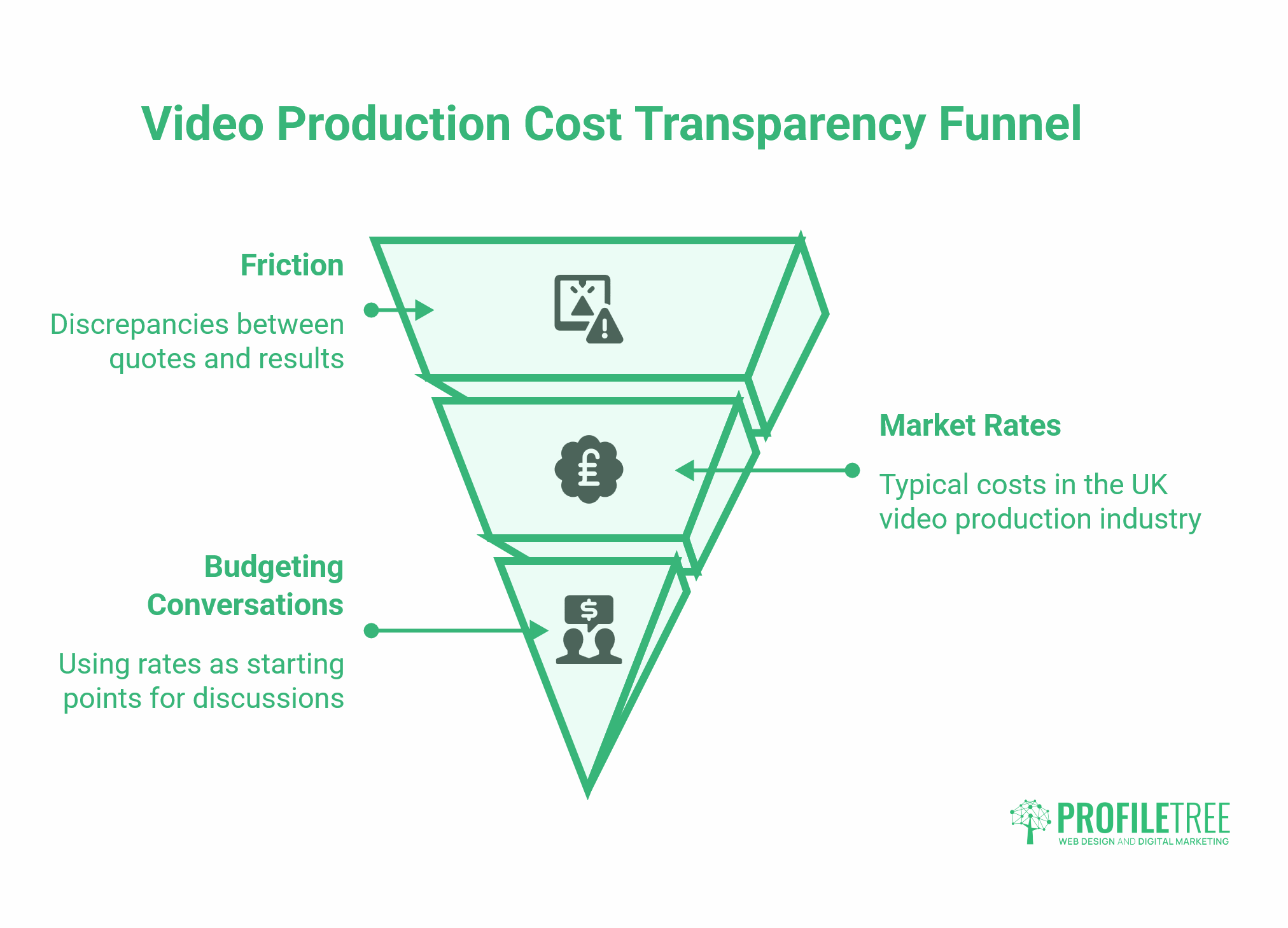
Cost transparency is rare in the video production industry, and the gap between quoted prices and actual delivered results is a persistent source of friction for SME clients. The figures below reflect typical market rates for UK video production in 2025; they are starting points for budgeting conversations rather than fixed benchmarks.
Tier 1: Social-First and Low-Fi Production (£500–£2,500)
At this budget level, you are typically working with a one or two-person crew, a single shooting day, and in-house or template-based editing. This tier covers talking-head explainers, simple product demonstrations, social media shorts, and staff-produced content with basic post-production.
The risk at this tier is not the production quality; audiences on social platforms are accustomed to lo-fi content, and authenticity often outperforms polish. The risk is a lack of strategic input before the shoot, resulting in content that looks fine but lacks a clear objective or call to action.
Tier 2: Mid-Range Corporate and Explainer Content (£3,000–£10,000)
This is the working range for most SME brand videos, explainer animations, and case study films. At this budget, you can expect a professional crew, scripted and directed content, location or studio shooting, motion graphics or basic animation, and a structured edit with multiple revision rounds.
For most UK businesses producing a hero video or a service explainer for their website, this tier delivers sufficient quality to compete with larger competitors without requiring an enterprise marketing budget.
Tier 3: High-End Brand and Campaign Films (£15,000+)
At this level, you are typically commissioning broadcast-quality content: multi-day shoots, actors or high-profile talent, cinematographer-led photography, full post-production with colour grading and sound design, and often a media buying strategy to sit alongside the creative.
This tier is appropriate for product launches, national brand campaigns, or content designed for paid placement at scale. For most SMEs, Tier 2 represents the optimal balance between production quality and return on investment.
Video Marketing Campaign Examples: UK and Ireland
The most useful campaign examples for UK SMEs are not Apple, Nike, or Dove. They are businesses operating at comparable scale, in comparable markets, facing comparable resource constraints.
B2B professional services: A Northern Ireland accountancy firm ran a six-video series explaining Making Tax Digital, published across YouTube and LinkedIn over three months. Each video targeted a specific question from their client base. The series generated consistent organic search traffic and measurable enquiries attributed to video engagement — without any paid media spend.
E-commerce product campaign: A UK-based food brand used a combination of recipe videos on Instagram Reels and longer tutorial content on YouTube to support a new product launch. The short-form content drove awareness; the longer YouTube content ranked organically for relevant search queries and provided the depth needed to convert interested viewers.
Service business lead generation: A Belfast-based trade business used a three-video sequence, a process explainer, a customer testimonial, and an FAQ video embedded on their website and distributed through email to existing contacts. Enquiry volume from the website increased in the months following publication.
These are not fabricated case studies. They are representative patterns from the kinds of campaigns that deliver measurable results at the SME scale, without the budgets or brand recognition of multinational examples.
Platform Breakdown: Where to Distribute Your Video in the UK
Distribution strategy is often an afterthought in video campaigns, planned after production has finished and budget has been spent. This is backwards. The platform you are targeting should inform your aspect ratio, video length, caption requirements, and call-to-action format from the very first day of pre-production.
YouTube: The Long-Tail SEO Play
YouTube is the platform most consistently underused by UK SMEs for organic marketing. A video optimised with a specific title, description, and transcript can rank in both YouTube search and Google search for months or years. The long-tail SEO opportunity is significant: queries like “how to [specific process] for [specific industry]” are frequently answered by video results on Google, and competition for these queries is often lower than for equivalent text-based searches.
ProfileTree’s YouTube marketing guide covers the optimisation steps in detail titles, descriptions, chapter markers, thumbnail strategy, and the use of transcripts for search indexing.
LinkedIn: B2B with High Intent
LinkedIn video content reaches professionals when they are actively thinking about their work. Organic reach for native LinkedIn video (uploaded directly to the platform rather than shared as a YouTube link) is significantly higher than for text posts in most sectors. For B2B campaigns targeting specific industries or roles, LinkedIn’s targeting options make it the most precise paid distribution channel available.
TikTok and Instagram Reels: High Reach, Short Attention
Short-form video on TikTok and Reels can generate substantial reach at low cost, but the format demands a specific approach. The first two to three seconds must create an immediate reason to keep watching. Content that works on YouTube or LinkedIn typically does not translate directly to these platforms without significant recutting.
For SMEs with limited production resources, TikTok and Reels are most useful for building top-of-funnel awareness in consumer markets and are less suited to complex B2B sales cycles, where buyers need more information than 60 seconds can convey.
Legal and Compliance: ASA Regulations for UK Video Adverts
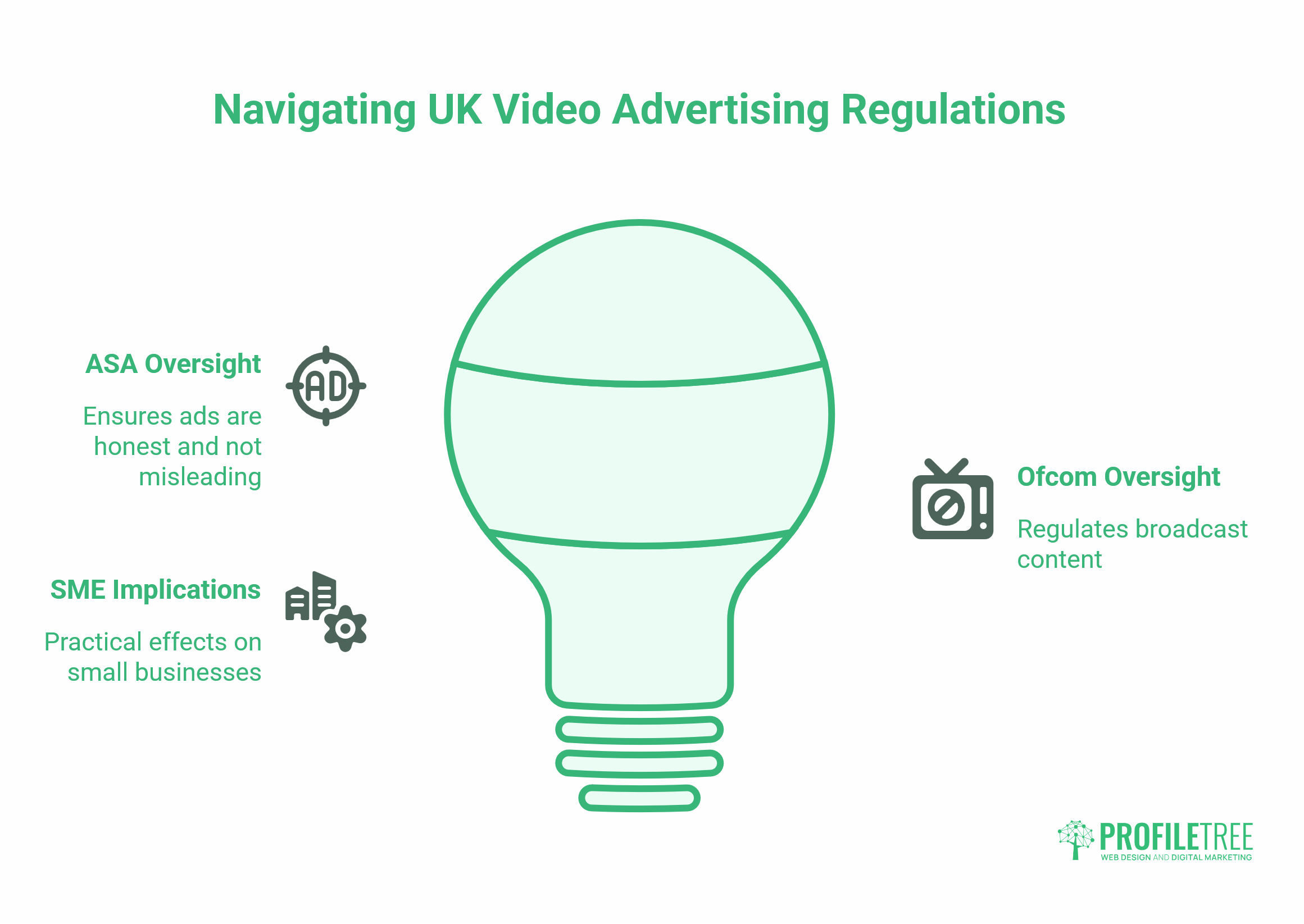
This section is absent from most video marketing guides, and it matters. UK video advertising is regulated by the Advertising Standards Authority (ASA), with broadcast content also subject to Ofcom oversight. The practical implications for SME marketers include:
Paid social video: Any video paid for and placed as an advertisement must be clearly identifiable as advertising. The ASA has issued guidance specifically for social media, requiring clear labelling for sponsored content and influencer posts. The label must appear at the start of the content, not buried in a description.
Health and financial services: These sectors face additional restrictions. Claims about financial products, health outcomes, or regulated services must comply with FCA or MHRA rules in addition to ASA standards. If your business operates in either sector, a compliance review of video scripts before production is not optional.
Music and third-party content: Using copyrighted music without a licence in video campaigns is a consistent source of avoidable cost and disruption. YouTube’s Content ID system will detect unlicensed music and can monetise the video in favour of the rights holder or block it entirely. For paid media, unlicensed use exposes you to legal liability. Budget for licensed music from the outset; royalty-free music libraries have improved significantly in quality and are cost-effective for most campaign budgets.
The Future of Video: Integrating Generative AI into Your Campaign
Generative AI is changing the economics of video production at specific workflow points, and understanding where it adds genuine value is more useful than either uncritical adoption or reflexive scepticism.
Where AI currently delivers tangible value in video workflows:
- Transcription and captioning: Tools like Descript and Otter produce accurate transcripts quickly, improving accessibility, supporting YouTube SEO through searchable captions, and enabling the repurposing of long-form content into written formats.
- Script drafting and iteration: AI can generate initial script structures for iteration, significantly reducing the time between brief and first draft. Human review and brand-specific refinement remain essential.
- B-roll generation: Text-to-video tools like Sora and Runway can now produce usable B-roll footage for specific scenes where stock footage is inadequate or location shooting is impractical.
- Post-production efficiency: AI-assisted editing tools can identify the strongest takes, remove silences, and generate rough cuts, reducing the time editors spend on first-pass assembly.
Where human production retains clear advantages:
On-screen talent, brand voice, complex storytelling, and content where credibility depends on visible authenticity still require human involvement. A CEO interview conducted on location communicates trust in a way that an AI avatar cannot replicate for most audiences. The question is not whether to use AI, but which specific workflow stages benefit from it, given your objectives and audience.
As Ciaran Connolly, founder of ProfileTree, puts it: “The businesses getting the most from AI in video production are the ones using it to remove friction from the parts of the process that don’t need human judgment, transcription, first-draft scripting, caption generation and investing the time they save into the parts that do.”
How to Measure the Success of a Video Campaign
Measurement should be planned before production begins, not after the video has been published. The KPIs you select should directly align with the objective defined in Stage 1.
A practical framework by campaign goal:
| Campaign Goal | Primary KPI | Secondary KPIs |
|---|---|---|
| Brand awareness | Reach / unique views | Share rate, brand lift survey |
| Lead generation | Cost per lead | CTR, form completion rate |
| Customer education | Completion rate | Watch time, downstream conversion |
| Retention | Re-engagement rate | Repeat view, click-through to product |
The vanity metrics trap:
View count is the most reported metric and among the least useful for assessing whether a campaign delivered business value. A video with 50,000 views and no measurable downstream effect has delivered less than a video with 500 views that generated 20 qualified enquiries. Build your reporting framework around the metric closest to your business objective, and treat view count as context, not conclusion.
Video Marketing Campaign: Common Mistakes to Avoid
Producing without distributing: Many businesses invest significantly in production and allocate nothing to distribution. A high-quality video that nobody sees has no return on investment. Distribution, whether organic, paid, or earned, should be budgeted alongside production.
Treating YouTube as a hosting service: Uploading to YouTube without optimising titles, descriptions, chapter markers, or transcripts wastes the platform’s search potential. YouTube is a search engine; treat it like one.
One video, one use: A single shoot can typically yield a hero video, several shorter social cuts, a set of still images, and a written transcript that supports a blog post. This kind of content atomisation significantly improves the return on production spend.
Ignoring audio: Poor audio quality is the single most common reason viewers abandon video content before the end. Budget for a dedicated microphone before upgrading camera equipment.
Conclusion
A video marketing campaign that delivers measurable results is built on decisions made before the camera is switched on: clear objectives, a defined audience, a realistic budget, and a distribution plan that aligns with the platform and the goal. ProfileTree works with businesses across Northern Ireland, Ireland, and the UK at every stage of this process, from strategy and scripting through to production, distribution, and performance analysis. If you are planning your first campaign or reviewing the performance of existing video assets, get in touch with our team to discuss what’s realistic for your goals and budget.
FAQs
What is a video marketing campaign?
A video marketing campaign is a planned series of video assets built around a defined business objective, target audience, and distribution strategy. Every production decision, format, length, platform, and call to action is made in relation to a specific, measurable goal.
How much does a video marketing campaign cost in the UK?
UK production costs range from around £500–£2,500 for social-first content, £3,000–£10,000 for mid-range corporate or explainer videos, and £15,000 or more for high-end brand films. For most SMEs, the mid-range tier delivers the best balance between quality and return on investment.
What are the 4 stages of video marketing?
The four stages are goal setting and audience definition, pre-production (scripting, storyboarding, planning), production and distribution, and post-campaign analysis. Skipping or compressing pre-production is the most common cause of campaigns running over budget or missing their objectives.
How do I measure video marketing ROI?
Tie your measurement to the campaign’s original objective: cost per lead for lead generation, reach, and brand lift for awareness, and completion rate for education campaigns. View count is a useful context, but should not be treated as a primary performance metric.