
Email Marketing Platforms: How to Choose the Right One for Your Business
Table of Contents
Email marketing still does the heavy lifting for most SMEs: it nurtures leads, brings buyers back, and keeps a brand front of mind for a fraction of the cost of paid social. The harder question is not whether to use it, but which platform to build on. There are dozens of options, the pricing pages are written to confuse, and most comparison lists rank tools by who pays the biggest affiliate commission.
This guide takes a different line. It walks through eleven established email marketing platforms, what each one is genuinely good at, and roughly what they cost in pounds, then sets out a clear way to match a platform to your business size and goals. ProfileTree, a Belfast-based digital marketing agency, sets up and runs email systems for businesses across Northern Ireland, Ireland, and the UK, so the recommendations here lean on what actually holds up once a campaign is live rather than what looks good on a feature checklist.
A quick orientation before the details. Pricing below is shown in GBP. Where a vendor publishes only in US dollars, the figure is converted at an approximate rate and marked as such. Check the live pricing page before you commit, as vendors change tiers often and currency rates fluctuate. If you want help mapping email into a broader plan, ProfileTree’s digital marketing strategy services cover how email fits alongside SEO, content, and paid channels.
What email marketing platforms actually do
An email marketing platform is software that lets a business send targeted, measurable emails to a list of contacts, including newsletters, promotions, product updates, and automated sequences triggered by what someone does. The platform handles the parts you cannot reliably handle in a normal inbox: list management, consent and unsubscribe handling, deliverability, templated design, and reporting on who opened, clicked, and bought.
Most campaigns follow the same shape regardless of which tool runs them. List building means collecting contacts through signup forms, lead magnets, or checkout, with clear consent recorded against each subscriber. Segmentation splits the list by behaviour, demographics, or purchase history so messages stay relevant rather than going to everyone at once. Content creation is building the email itself, usually with a drag-and-drop editor and reusable templates. Automation sends the right message at the right time without manual effort: welcome series, abandoned-cart reminders, post-purchase follow-ups. Analytics tracks open rates, click-through rates, and conversions to improve the next send.
The differences between platforms come down to how well they handle each of those five jobs, how much they cost as your list grows, and how cleanly they connect to the rest of your stack. For a fuller grounding in the mechanics before you pick a tool, ProfileTree’s guide to using email effectively covers the fundamentals, and the email statistics by industry breakdown show what open and click rates look like in practice across different sectors.
Eleven email marketing platforms compared
The eleven platforms below cover the realistic range for SMEs, from free starter tools to enterprise systems. Each entry sets out what the tool is good at, who it suits, and indicative GBP pricing. Where a section delves into automation, that is the area most likely to separate a tool that scales from one you outgrow within a year.
Mailchimp
Mailchimp is a broad marketing platform built around email, with social posting, landing pages, automation, and a customer-journey builder layered on top. Its strength is approachability: the drag-and-drop editor and pre-built templates let a non-specialist launch a decent campaign quickly, and the reporting is clear enough to act on without a data background.
It suits small to medium businesses, particularly those looking for one tool for multiple tasks. The free plan covers up to 500 contacts and 1,000 monthly sends. The Essentials plan starts at roughly £10 per month (around $13), Standard at about £16 per month (around $20) with stronger automation, and the Premium plan from roughly £275 per month (around $350) for up to 10,000 contacts with priority support.
Constant Contact
Constant Contact leans into event management, surveys, and social posting alongside email, making it a good fit for organisations that run a lot of in-person activities: clubs, nonprofits, associations, and local service businesses. The editor is straightforward, and the template library is large.
Pricing starts at around £9 per month (about $12) for the Core plan, with the Plus plan at roughly £63 per month (about $80), adding automation, pop-up forms, and richer e-commerce tools. A 60-day trial lets new users test before paying. It is a sensible option for owners who want to handle their own marketing without a steep learning curve.
Brevo
Formerly Sendinblue, Brevo combines email with SMS, WhatsApp marketing, landing pages, automation, and a built-in CRM. It quotes a 99% deliverability rate and prices by email volume rather than contact count, which can work out cheaper for businesses with large lists they email infrequently.
The free plan allows 300 emails a day. The Starter plan costs about £19 per month (around $25) for 5,000 emails per month, and the Business plan costs roughly £51 per month (around $65) with advanced automation. Enterprise pricing is custom. Brevo suits small and medium businesses, e-commerce shops, and marketers who want multiple channels in one place.
HubSpot Email Marketing
HubSpot is an all-in-one platform spanning marketing, sales, and service, with email sitting inside a larger CRM. The email tool offers a drag-and-drop builder, segmentation, A/B testing, and analytics, and the tight CRM link means content can be personalised from contact data.
HubSpot suits businesses that want email and sales tightly joined, and that expect to grow into the wider platform. The free tier is genuinely usable for getting started; enterprise features climb steeply from there, with Marketing Hub Enterprise pricing from roughly £1,900 per month (around $2,400). The cost only makes sense once you are using the CRM and sales tools as well, not for email alone.
AWeber
Founded in 1998, AWeber is one of the longest-running tools in the category and is aimed at small businesses, bloggers, and solo operators. It covers email, automation, landing pages, and basic e-commerce, with a drag-and-drop builder, autoresponders, segmentation, and detailed reporting.
The free plan supports up to 500 subscribers and 3,000 emails a month. The Lite plan starts at about £16 per month (around $19.99) for up to 500 subscribers, Pro from roughly £24 per month (around $29.99) for up to 2,500, and Unlimited from about £40 per month (around $49.99) for up to 5,000, with larger tiers available. It is a dependable, no-surprises choice for smaller senders.
BookYourData
BookYourData is not a campaign builder; it sits a step earlier in the pipeline as a B2B lead-data source. It lets users build custom contact lists filtered by job title, industry, company size, location, and revenue, with real-time email verification to keep bounce rates and sender-reputation damage down.
Pricing is pay-as-you-go from around £0.31 per lead (about $0.39), with no subscription, and the data exports into tools like Mailchimp and HubSpot. It suits businesses doing B2B outreach and cold email, where the quality of the underlying list matters as much as the campaign tool. Used carefully and with proper consent handling, it can feed a wider system; used carelessly, it is a fast route to deliverability problems, so treat list provenance seriously.
GetResponse
GetResponse is an all-in-one tool built around email and automation, with a landing-page builder, webinar hosting for up to 500 attendees, and strong workflow capabilities. The webinar feature is unusual in this category and makes it attractive to coaches, course creators, and B2B teams that run live sessions.
Its Shopify integration also makes it a reasonable fit for retail. The Basic plan starts at about £15 per month (around $19), with autoresponders and landing pages. Plus, from roughly £39 per month (around $49), it adds automation and webinars. Professional, from about £78 per month (around $99), offers deeper segmentation. Max is custom-priced.
ActiveCampaign
ActiveCampaign is built for automation depth, combining email, CRM, and machine-learning features to drive customer-journey workflows. Advanced segmentation, A/B testing, and detailed analytics make it a strong fit for businesses whose value comes from nurturing contacts over time rather than one-off blasts.
It suits small and mid-sized businesses in e-commerce and professional services. The Lite plan starts at about £12 per month (around $15), Plus from roughly £39 per month (around $49) with landing pages and web push, Professional from about £62 per month (around $79) with omnichannel automation, and Enterprise from roughly £114 per month (around $145). The automation builder is among the most capable here, which is the main reason teams choose it.
ConvertKit (Kit)
ConvertKit, now branded Kit, is built for creators: bloggers, authors, course instructors, and YouTubers who rely on email sequences to grow an audience. It favours simplicity over breadth, with clean automation, customisable templates, and landing pages.
The free plan covers up to 2,000 contacts and 15,000 emails a month. The Creator plan starts at about £23 per month (around $29) for up to 3,000 contacts, and Creator Pro starts at roughly £62 per month (around $79) for up to 10,000 contacts, with subscriber scoring and advanced reporting. If your business runs on content and a personal brand, it is one of the more focused options.
Klaviyo
Klaviyo is an e-commerce specialist, built to pull customer data from a store and turn it into personalised email and SMS. Advanced segmentation, product-recommendation logic, and automations for abandoned carts and post-purchase follow-ups are its core strengths, with deep integration with Shopify, WooCommerce, and Magento.
The free plan supports up to 500 contacts and 500 emails a month. The Email plan starts at about £16 per month (around $20) for up to 500 contacts, and the combined Email and SMS plan starts at roughly £27 per month (around $35), with SMS credits and push notifications. For online retailers, the revenue-attribution reporting alone often justifies the cost.
Zoho Campaigns
Zoho Campaigns offers segmentation, automation, landing pages, A/B testing, and consent management, and connects tightly to Zoho CRM and the wider Zoho suite. It is well-suited to small businesses already using other Zoho tools, where keeping everything in one ecosystem reduces friction.
The free plan covers up to 2,000 contacts and 20,000 emails a month. Paid plans start from around £2.40 per month (about $3) for Standard with unlimited emails and dynamic content, and roughly £3 per month (about $3.75) for Professional with workflow automation. An Agency plan with client-management features is custom-priced. On raw cost, it is one of the most competitive options in the category.
Choosing a platform by business size
Business size is the single most useful filter when narrowing the field. The right tool for a 400-contact local service business is rarely the right tool for a retailer with 40,000 customers. The groupings below match platforms to where most SMEs actually sit.
Small businesses
Small businesses need professional features without complexity, on a budget that usually sits between £20 and £100 a month for lists under 5,000 contacts. Mailchimp’s free tier and clear interface make it a common starting point. Constant Contact suits those who want strong support and a deep template library. ConvertKit is well-suited for content creators and solo operators, and AWeber offers reliable automation at a competitive price.
Medium businesses
Growing businesses, typically spending £100 to £500 a month on lists between 5,000 and 50,000 contacts, need stronger segmentation and multi-step automation. Brevo offers good value with SMS built in. GetResponse adds webinar hosting. ActiveCampaign brings serious automation and CRM features, and Klaviyo is the standout for e-commerce that needs advanced, behaviour-driven segmentation.
Agencies and multi-client setups
Agencies managing several clients need multi-account control, white-label or co-branded options, and reporting clean enough to present to clients. ActiveCampaign supports multiple accounts and white-labelling, Constant Contact runs a reseller programme, and HubSpot offers a structured partner programme with training. The deciding factor is usually how billing and reporting scale across combined client volumes.
This is also the point where outside help earns its keep. Picking a platform is the easy part; configuring deliverability, segmentation, and automation so it performs is where most setups go wrong. ProfileTree works with businesses across all of these categories throughout Northern Ireland, Ireland, and the UK, and the agency’s experience across different business sizes shapes which platform it recommends for a given set of needs and growth plans.
Ciaran Connolly, founder of ProfileTree “Most SMEs we work with do not have a platform problem, they have a setup problem. The tool they already pay for can usually do far more than they are using, the list is poorly segmented, and nobody has touched the automation since the welcome email. Get those three things right and the choice of vendor matters a lot less than people think.”
How to choose: a practical framework
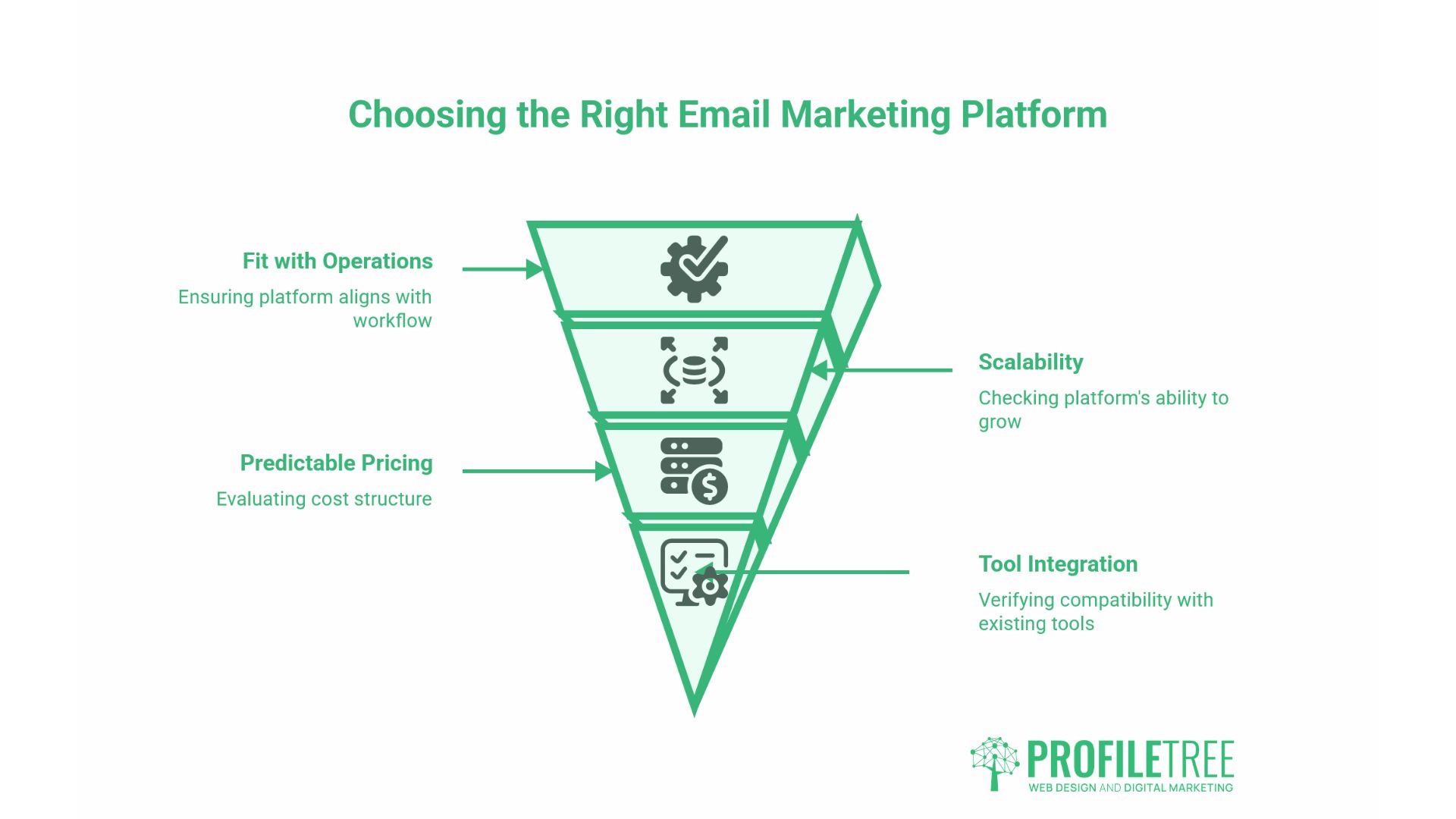
Start with the job, not the brand. The best platform is the one that fits how your business actually works, scales with your list at a price you can predict, and connects to the tools you already use. Run a candidate through these five questions before you commit.
What will it cost at scale, not on day one?
Entry pricing is the marketing; the real number is what you pay once your list grows. Most platforms step up sharply at thresholds like 1,000, 10,000, and 50,000 contacts, and a tool that looks cheap at 500 contacts can become the most expensive option at 20,000. Map your expected list size over the next two years and price the platform at that point, not today.
How deep is the automation?
Basic platforms send scheduled newsletters and a simple welcome email. Stronger ones run conditional, multi-step journeys that react to behaviour. If your value comes from nurturing contacts over weeks or months, automation depth should outweigh almost everything else. ProfileTree’s work on automated email workflows and the wider business automation statistics shows where automation moves the numbers and where it is oversold.
Does it integrate with your stack?
An email tool that does not talk to your CRM, e-commerce platform, or website creates manual work and data gaps. Check for native integrations with the systems you already run before you choose, not after. Klaviyo and Shopify, HubSpot and its own CRM, Zoho Campaigns and Zoho CRM are examples of pairings that remove friction when matched correctly.
Is it compliant for UK and Irish audiences?
If you market to people in the UK or the Republic of Ireland, consent, data handling, and unsubscribe management must comply with the UK GDPR and the equivalent EU rules. The platform provides the tools; compliance is still your responsibility. The UK regulator, the Information Commissioner’s Office, sets out the direct marketing rules in detail, and the way you collect consent matters as much as the platform you collect it on. ProfileTree’s guidance on GDPR-compliant web forms and on customer data privacy in digital marketing covers the practical side. Businesses marketing across the UK-EU border should also factor in the post-Brexit changes to UK digital marketing.
Can your team actually run it?
A powerful platform nobody uses is worse than a simple one that gets used. Match the tool to the skill level of whoever will run it day to day. If that person also writes the emails, the quality of the copy will drive results more than any feature; ProfileTree’s copywriting services exist to fill that gap. Where the bottleneck is skills rather than tools, structured digital marketing training often pays back faster than upgrading the platform.
Integration, migration, and management
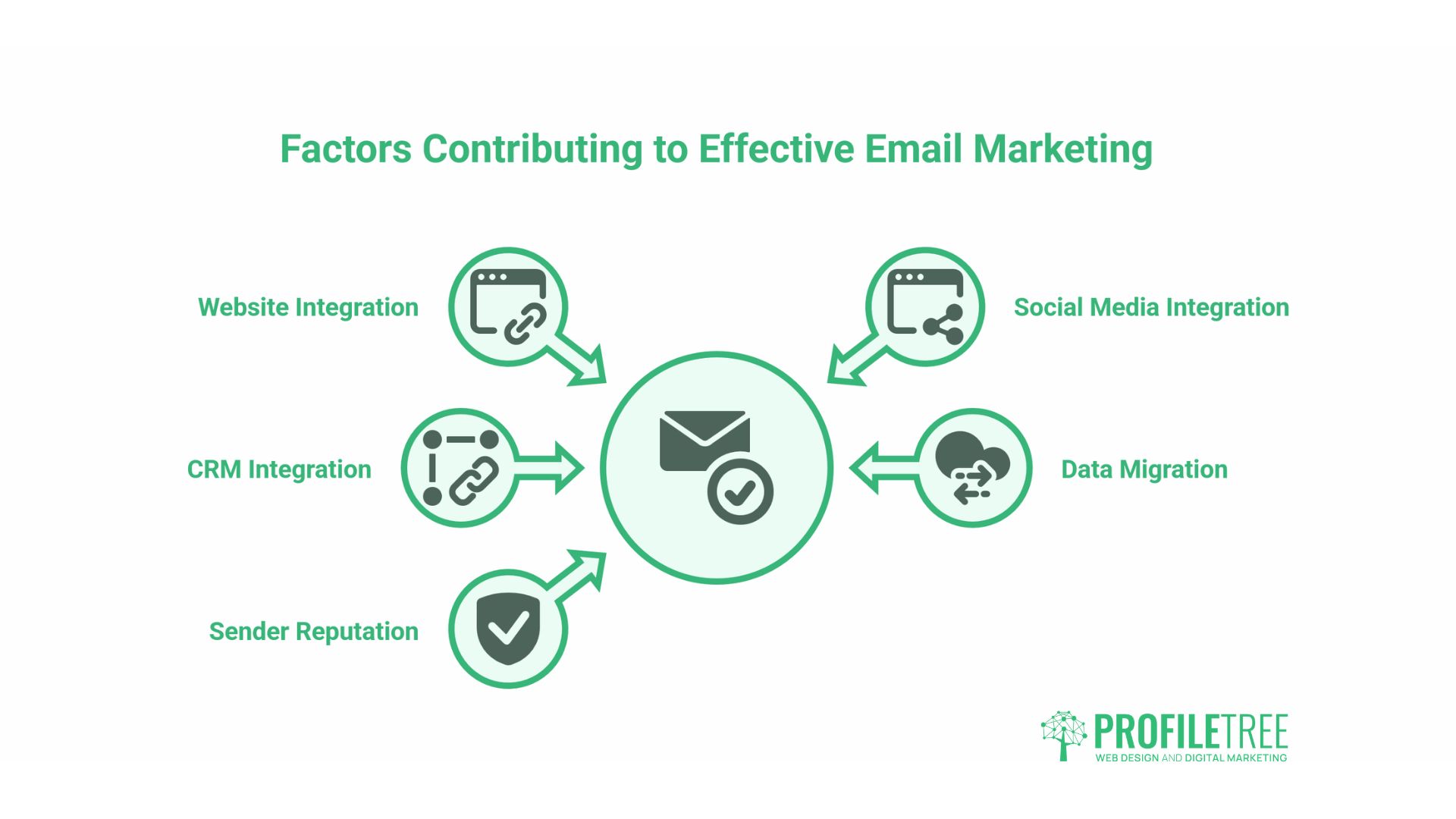
The platform is one piece of a larger system. Email performs best when it connects cleanly to the website, social channels, and CRM, and when the move onto it is handled without losing data or damaging sender reputation.
Connecting email to the rest of your marketing
Signup forms need to sit where visitors actually convert, landing pages need to match the campaigns that drive to them, and blog content can be distributed through email to keep a list warm between promotions. On the data side, lead scoring, sales notifications, and lifecycle automation depend on the email tool and CRM sharing information rather than running in parallel. ProfileTree’s web development and digital marketing teams build these connections so the email system supports the wider business rather than sitting off to one side.
Switching platforms without losing data
Migration is the part most comparison lists ignore. Moving subscribers, templates, and automation logic to a new tool carries real risks: lists can be corrupted, consent records can be lost, and a new sending IP can land in spam folders before it earns trust. A safe migration exports clean, de-duplicated data, rebuilds automations deliberately rather than forcing an import, and warms up the new sending reputation gradually. Plan it as a project, not an afternoon task, and test on a small segment before moving the full list.
Getting the technical foundations right
Whatever platform you land on, the basics determine whether email reaches the inbox: properly configured SPF, DKIM, and DMARC records; ongoing list hygiene to remove dead contacts; and templates that render correctly on mobile. These are the points businesses most often skip during setup, and they matter more than any single feature. This is where bringing in help early prevents expensive cleanup later.
Matching the platform to your business
There is no single right answer, only the right fit. A small service business with a few hundred contacts is well served by Mailchimp, Constant Contact, or AWeber. A content-led business should look hard at ConvertKit. A growing company needing automation will get more from ActiveCampaign, Brevo, or GetResponse, and an online retailer should start with Klaviyo. Enterprises with complex needs move toward HubSpot or the heavier systems above.
Weigh your goals, budget, list size, and the skill of whoever will run it, then price the platform at the size you expect to reach, not the size you are today. Get those decisions right, and email remains one of the most cost-effective channels available to any SME. If you would rather have the choice made and the system built for you, ProfileTree’s digital marketing team can handle platform selection, setup, and the ongoing campaigns.
FAQs
What is the best free email marketing platform?
Mailchimp, Brevo, and Zoho Campaigns have the most usable free tiers. The right one depends on whether your limit is list size or sending volume.
Which platform is best for a small business in the UK?
Mailchimp and Constant Contact suit ease of use; AWeber and ConvertKit suit solo operators. The bigger question is whether the consent handling meets UK GDPR, which all of them do when set up correctly.
How much should email marketing software cost?
Most small businesses pay £10 to £100 a month, depending on list size. Costs rise at contact thresholds, so price the platform at the list size you expect within two years.
Can I keep my subscribers when I switch platforms?
Yes, provided you hold valid consent records. The export and import is straightforward; the risk is in deliverability, so use a staged migration with a warm-up period.