
Social Media for Market Research: A Practical Guide for SMEs
Table of Contents
Social media for market research has changed what is possible for smaller businesses. Where audience intelligence once required commissioned surveys and expensive focus groups, it can now come from monitoring the conversations your potential customers are already having in public, in real time, at very little cost. For SMEs across Northern Ireland, Ireland, and the UK, that shift matters.
The challenge is not access to data. Most businesses already sit on more social data than they know what to do with. The challenge is having a clear enough process to turn what you observe into decisions that actually change how you market, position, and sell. This guide covers that process from start to finish: what social media market research involves, how it compares to traditional methods, a practical six-step framework, platform selection for a UK and Irish context, and how findings connect to your wider marketing strategy.
What Is Social Media Market Research?
Social media market research is the process of gathering data about your audience, your brand, and your competitors by monitoring and analysing what people say and do across social platforms. It draws on two distinct approaches that are often confused with each other.
Social listening is the broader, more strategic discipline. It involves tracking mentions, conversations, hashtags, and sentiment across platforms, not just your own channels, to build a picture of how a topic, brand, or industry is discussed publicly. Social monitoring is narrower: it tracks what happens on your own accounts, such as comment volume, reply patterns, and tagged mentions. Both feed into social media market research, but listening gives you richer competitive and audience intelligence.
Where social media research becomes genuinely useful for SMEs is at the intersection of brand health and competitive intelligence. You can identify the pain points your target audience discusses most, which competitor activities drive engagement, the questions your potential customers ask before making a purchase decision, and which content formats consistently perform in your category. All of that feeds into better-informed decisions about content, product positioning, and digital marketing.
How Social Media Research Compares to Traditional Methods
Traditional market research methods, focus groups, telephone surveys, and commissioned studies have real value. They provide structured, representative samples and are well-suited for testing specific hypotheses before a product launch or a major brand change. What they do not offer is speed, scale, or the kind of unfiltered, unprompted data that social media provides by default.
The table below summarises the practical trade-offs for a typical SME context.
| Factor | Traditional Research | Social Media Research |
|---|---|---|
| Cost | High (agency fees, incentives, panels) | Low to zero for native tools; moderate for paid platforms |
| Speed | Weeks to months | Real-time to 24 hours |
| Sample size | Controlled, representative | Large but self-selecting |
| Data type | Prompted responses | Unprompted, organic behaviour |
| Depth | High for qualitative methods | Variable; depends on platform and query |
| Legal complexity (UK/IE) | Standard data protection rules apply | GDPR and UK Data Protection Act apply to scraping and storage |
| Competitive intelligence | Limited | GDPR and the UK Data Protection Act apply to scraping and storage |
The compliance point is worth pausing on. While publicly visible posts may seem freely available for research purposes, how you collect, store, and process that data is governed by the GDPR in Ireland and the UK Data Protection Act 2018. Automated scraping of user data, even from public profiles, sits in a legally uncertain territory without appropriate consent or legitimate interest justification. The ethics and legalities of digital marketing apply here as much as anywhere else. If you are building a social listening programme for a client-facing or compliance-sensitive business, it is worth checking your approach against ICO guidance before scaling up data collection.
For most SMEs doing research manually through platform-native tools, reading public posts and comments, running polls, and monitoring their own channel analytics, these risks are minimal. The issues arise when automated tools scrape and store large volumes of data.
Is Social Media Research Qualitative or Quantitative?
This question comes up frequently, and the honest answer is: it is both, but in different proportions depending on how you use it.
Quantitative data from social media includes engagement rates, follower counts, share of voice percentages, post reach, and average sentiment scores. These are measurable and comparable over time. They tell you what is happening. Qualitative data comes from reading the actual comments, threads, and conversations, understanding tone, context, recurring frustrations, and the specific language your audience uses. This tells you why it is happening.
The most productive approach treats social media research as a qualitative-at-scale method. You are reading real, unprompted human reactions at a volume no traditional focus group could replicate. But you need to be careful not to over-index on numbers. A post with 200 comments is not necessarily more valuable than one with 20 if the 20 comments contain a consistent, specific complaint that reveals a genuine product or service gap. For a more detailed breakdown of how to formally assess and classify content data, the guide on content analysis covers the methodological framework in depth.
When designing a research programme, decide in advance which questions you need quantitative answers to (share of voice versus competitors, sentiment shift over a quarter) and which need qualitative depth (why customers phrase their concerns a certain way, what objections appear before a purchase decision). Use platform analytics for the former and manual reading or AI-assisted categorisation for the latter.
A Six-Step Framework for Social Media Market Research
The following process applies to a self-managed SME research project lasting four to six weeks. Each step feeds the next; skipping the early stages tends to produce data that is interesting but not actionable.
Step 1: Define What You Actually Need to Know
Start with a specific question, not a general ambition. “Understand our audience better” is not a research objective. “Identify the three most common objections potential customers raise before enquiring about our service” is. The more precisely you frame the question, the easier it is to know when you have answered it.
Write down two or three research questions before you open a single platform. Common useful questions for SMEs include: What language does our target audience use to describe the problem our service solves? How do people talk about competitors in our category? What content performs best in our sector, and why? What do customers say they wished they had known before buying in our category?
Step 2: Choose Your Platforms Based on Where Your Audience Actually Is
Different platforms serve different research purposes. LinkedIn is the strongest source of B2B audience intelligence in the UK and Ireland: industry conversations, job title patterns, sector-specific concerns, and professional sentiment are all visible there in a way they are not on consumer-facing platforms. Facebook Groups, particularly local business groups in Northern Ireland and Ireland, often host candid conversations among SME decision-makers that LinkedIn’s professional context suppresses. Reddit, particularly niche subreddits related to your industry, provides unprompted, anonymous feedback that is often more honest than what appears elsewhere.
Instagram and TikTok are more relevant for B2C research and brand sentiment than for B2B intelligence. X (formerly Twitter) remains useful for tracking sector news and real-time public reaction to industry events, though activity levels in UK and Irish B2B contexts have declined since 2023.
Pick two or three platforms to focus on rather than trying to monitor everything at once. Depth of research on fewer platforms produces better insight than thin coverage of many.
Step 3: Set Up Your Listening Parameters
Before you start collecting data, define what you will and will not track. This includes: your brand name and common misspellings; your competitors’ brand names; category keywords (the terms your audience uses to describe the problem your product or service solves); and location modifiers if local search patterns are relevant to your business.
Native platform tools are a reasonable starting point. LinkedIn’s search function, Facebook’s Groups search, and Instagram’s hashtag and keyword search all allow manual monitoring without additional cost. For more systematic tracking, tools such as Mention, Brand24, or Talkwalker Alerts offer entry-level plans that suit SME budgets. The social media analytics tools guide covers the free and low-cost options in detail.
Step 4: Gather Data Systematically Over a Fixed Period
A four-week monitoring window is usually sufficient for an initial research project, though topics that are genuinely time-sensitive (a product launch, a competitor campaign) may warrant a shorter, more intensive burst. Document what you find in a consistent format: the platform, the date, the content type, the engagement level, and a brief summary of the sentiment and substance.
Resist the urge to draw conclusions during the collection phase. The pattern you notice in week one may look very different once you have four weeks of data alongside it. Confirmation bias is a real risk in qualitative research; you tend to notice examples that support what you already suspect and overlook contradictions. Systematic documentation reduces that risk.
Step 5: Analyse for Patterns, Not for Volume
Once the collection window closes, read back through everything you have gathered and look for recurring themes rather than individual high-performing posts. The post with the most shares is not necessarily the most useful data point. A pattern of five separate comments, across different posts and platforms, all raising the same specific concern about a competitor’s pricing model, is far more actionable.
Group your findings by research question. For each question you set in Step 1, what does the data actually say? Separate what you observed from what you are inferring. “Several commenters expressed frustration with the complexity of onboarding” is an observation. “Our audience wants a simpler onboarding process” is an inference, and it is useful, but it should be labelled as such rather than presented as a direct finding. Real-time analytics with AI tools can accelerate this pattern-recognition step significantly for larger datasets.
Step 6: Translate Findings into Decisions
Research that does not change anything is just an interesting document. Before you close the project, map each significant finding to a potential action. This does not need to be a formal report; a simple three-column table works well: observation, business implication, recommended action. If you are presenting findings to a client or to senior stakeholders, this format gives them something concrete to respond to, rather than a list of social media observations they may not know what to do with.
The actions that typically follow social media market research include: adjusting the language used in website copy and paid ads to match how the audience naturally describes their needs; repositioning content to address objections identified during research; identifying topics for a content marketing programme based on recurring questions; and flagging competitor gaps that represent a genuine opportunity for differentiation.
Platform Selection: A Practical Guide for UK and Irish SMEs
Choosing where to focus your research depends on your sector, your target audience, and what type of intelligence you are trying to gather. The following breakdown is specific to the UK and Irish business context rather than generic global advice.
LinkedIn for B2B Intelligence
LinkedIn remains the most useful platform for B2B social media market research in the UK and Ireland. The combination of job title data, company pages, industry-specific hashtags, and the relatively professional nature of public posts enables tracking of what decision-makers in specific sectors are discussing. LinkedIn’s native analytics, available to page administrators, also provide useful demographic data on who is engaging with your content: industry, seniority, location, and company size. For Northern Ireland and Irish SMEs targeting other businesses, this level of audience specificity is difficult to replicate on any other platform.
Facebook Groups for Local Business Insight
Facebook’s group network, despite reduced overall engagement on the main feed, remains active in niche and local business communities across Northern Ireland and Ireland. Local business owner groups, sector-specific communities, and regional networking groups often contain candid discussions about supplier relationships, service quality, pricing expectations, and technology adoption that do not appear in more formal research contexts. These groups require membership to access, but most are open to genuinely relevant requests to join.
Reddit for Unfiltered Category Research
Reddit is underused as a research tool by UK and Irish SMEs, partly because it is perceived as a US-centric platform. In practice, subreddits covering specific industries, software categories, and professional disciplines contain the kind of honest, detailed, anonymous discussion that is extremely valuable for understanding what your audience really thinks. If your business operates in technology, professional services, e-commerce, or any sector with an active online community, it is worth checking whether relevant subreddits exist and how active they are.
X (Twitter) for News and Sentiment Tracking
X remains a reasonable tool for tracking real-time sentiment around specific industry events, regulatory changes, or public news that affects your sector. Boolean search queries, combining keywords with modifiers such as “near:” for location or “-filter: retweets” to reduce noise, allow fairly targeted research without a paid tool. Its value for ongoing audience research has decreased in most B2B contexts in the UK and Ireland, but for businesses where public sentiment shifts quickly (financial services, retail, hospitality), real-time monitoring still has a place.
Using AI to Analyse Social Data
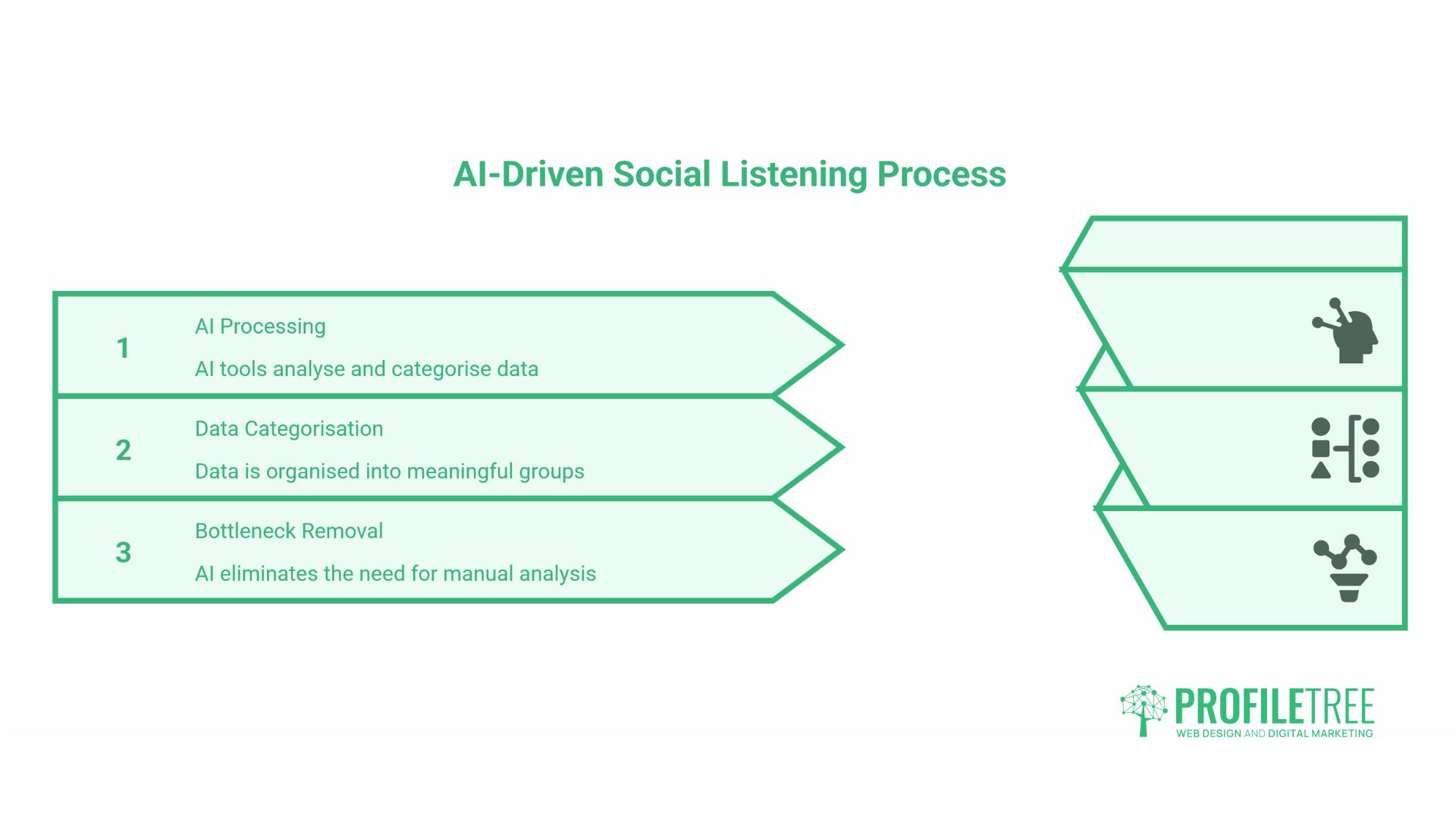
One of the most significant changes to social media market research in the last two years is the availability of AI tools that can process and categorise large volumes of text-based data. This matters for SMEs because it removes the bottleneck that previously made serious social listening impractical without a dedicated analyst.
The basic approach is straightforward. Export the data you have collected (comments, post text, review content) into a structured format, then use an AI assistant to identify recurring themes, classify sentiment, and surface patterns. You can prompt it to group comments by topic, flag objections versus positive endorsements, or identify the specific language clusters that appear most often around a given subject. This is not a replacement for careful human reading of the most significant findings, but it dramatically reduces the time required to process a month’s worth of monitoring data.
What AI tools do not do reliably is detect sarcasm, regional dialect nuance, or the cultural context that changes the meaning of otherwise neutral language. A comment from a Northern Irish business owner using “dead on” as an expression of approval reads very differently to a sentiment algorithm trained on American English data. Human review of the flagged content is essential, particularly for anything that feeds into a client-facing document or a significant business decision. Combining AI categorisation with human interpretation is more accurate than either alone.
“The businesses that get the most from social listening are the ones who treat it as an ongoing intelligence practice, not a one-off project. The real value compounds over time, as you start to see how your audience’s language and concerns shift in response to changes in your market.”
From Research Insight to Digital Strategy
Social media market research is most valuable when it directly informs what you do next with your digital presence. The findings from a well-run research project typically span several areas of digital strategy.
Audience language that surfaces through social research often reveals a mismatch between how a business describes its services and how potential customers talk about their needs. Closing that gap in website copy, meta descriptions, and paid ad copy is one of the most direct routes from research insight to improved performance. The same language patterns also feed directly into an SEO keyword strategy: if your audience consistently uses a phrase you have never included in your content, that is a missed ranking opportunity.
Content decisions benefit from social research in an equally direct way. If monitoring reveals that a recurring question in your sector is consistently answered poorly by existing content, that is the clearest possible brief for a new article, video, or guide. A content gap identified through audience research is a more durable reason to create a piece of content than any keyword tool output, because it reflects a genuine unmet need rather than search volume alone. For SMEs building a social media marketing programme alongside their content output, research insights help align both channels around the same audience priorities.
Competitor intelligence gathered through social monitoring can inform decisions about positioning, pricing, communication, and service presentation. If a competitor’s audience consistently raises a specific complaint, it is an opportunity to address that concern proactively in your own content and service descriptions, before a potential client discovers it the hard way. This type of intelligence is difficult to gather through traditional research methods, but is relatively straightforward to build into a regular social monitoring practice.
For businesses that have completed a research project and identified a gap between what they now know about their audience and their current digital output, the next step is typically a more structured conversation about digital strategy. ProfileTree works with SMEs across Northern Ireland, Ireland, and the UK to build content, SEO, and social media programmes that are grounded in real audience intelligence rather than generic best-practice templates. For teams that prefer to develop this capability in-house, the agency’s digital training programme covers social listening, analytics interpretation, and content strategy as practical skills rather than theoretical frameworks.
Conclusion: Social Media for Market Research
Social media market research provides SMEs with a cost-effective route to audience intelligence previously accessible only to larger organisations with research budgets. The key is treating it as a structured process rather than occasional browsing: clear objectives, systematic data collection, pattern-based analysis, and a direct line from findings to decisions. For businesses across Northern Ireland, Ireland, and the UK, the platforms and tools required are already available. What is most needed is a cleaner process for using them.
FAQs
What is the difference between social listening and social media market research?
Social listening is the method of monitoring what people say about your brand, competitors, and category across platforms. Social media market research is the broader process of applying that method, alongside polls and analytics, to answer specific business questions.
Is social media research qualitative or quantitative?
Both. Engagement metrics and sentiment scores are quantitative; reading comment threads and identifying recurring objections is qualitative. The most effective approach uses quantitative data to identify where to look and qualitative analysis to understand what you find.
Which social media platform is best for market research?
For B2B research in the UK and Ireland, LinkedIn is the strongest source of professional-context data. Facebook Groups are well-suited for local business intelligence, and Reddit provides honest, unfiltered feedback in sectors with active online communities.
What are the advantages and disadvantages of social media market research?
The main advantages are speed, low cost, and unprompted data closer to genuine opinion than survey responses. The main limitations are that social audiences are not a representative sample, tone requires careful interpretation, and bulk data collection raises GDPR considerations in the UK and Ireland.