
Voice Search Optimisation: The UK Technical Guide!
Table of Contents
Voice search has moved well past the experimental stage. Siri, Alexa, and Google Assistant now field billions of queries every month, and the businesses that appear in those spoken answers are not there by accident. They have adapted their content, their technical infrastructure, and their local SEO to match the way people actually speak.
For UK and Irish businesses, that adaptation carries an extra layer of complexity: regional dialects, GDPR obligations around voice data, and a B2B audience that uses voice in ways most generic guides do not address.
This guide covers the fundamental differences between voice and text search, the four technical pillars that determine whether your site gets cited, how to handle UK dialect variation, and how to measure voice traffic inside GA4. It also includes a schema markup reference and a practical checklist to work through before publication.
How Voice Search Differs from Text Search Now
Understanding why voice queries behave differently from typed ones is the foundation of every optimisation decision that follows. The gap between the two modes is wider than most SEO guides acknowledge, and it has direct consequences for keyword research, content structure, and the schema types you deploy.
Query Length and Natural Language Processing
Typed queries are compressed. A user searching for a plumber in Belfast might type “plumber Belfast” and let Google fill in the gaps. The same user speaking to a smart speaker says, “Who is a reliable plumber near me in Belfast?” That sentence is roughly four times longer, structured as a question, and anchored in conversational phrasing rather than keywords.
This shift reflects how natural language processing (NLP) has matured. Modern AI assistants parse intent from full sentences rather than matching isolated keywords. Google’s NLP models assign semantic weight to the relationship between words, which means “nearest chemist open now” and “pharmacy open near me” resolve to the same intent cluster even though the surface-level vocabulary differs. Content that only targets the compressed keyword form misses the spoken version entirely.
The practical implication: write heading-level questions in full sentences and answer them in the first sentence beneath the heading. That structure maps directly to how AI assistants extract featured snippets for voice responses.
Intent Signals and the Conversational Query
Voice queries carry stronger local and transactional intent than their typed equivalents. Research from across the industry consistently shows that a substantial share of voice searches are local (“near me”, “open now”, “closest”) and that the conversion window is short. A user asking their phone,e “Where can I get a website built in Northern Ireland?” is further down the decision funnel than someone typing “web design agency” into a browser.
For businesses with physical locations or defined service areas, this is the most commercially valuable property of voice search. The SEO strategies that work for voice local queries share significant overlap with Google Business Profile optimisation: consistent NAP data, verified categories, and regular review activity all feed into whether an AI assistant selects your business as the spoken answer.
Content should be written to match the full question, not to target isolated terms. FAQ sections structured as natural questions, answered directly and concisely in the opening sentence, are the primary mechanism for capturing this traffic.
The Role of Featured Snippets and Position Zero
Voice assistants do not read out a list of ten results. They select one answer, usually from the featured snippet or the top-ranked result, and present it as the definitive response. This makes position zero the only position that matters for voice, rather than just a desirable bonus.
Winning a featured snippet requires a specific content pattern: a direct answer to a clearly stated question, delivered within the first 40 to 60 words of a section, followed by supporting detail. Bullet points and numbered lists are particularly effective because search engines can extract and read them linearly. Tables that compare two options also perform well, especially for “what is the difference between” voice queries.
Ciaran Connolly, founder of ProfileTree, notes: “Achieving prominence in voice search results often hinges on how well a quick answer is crafted. When you optimise content to address specific queries directly, you demonstrate an understanding of user needs that both search engines and AI assistants reward.”
The Four Pillars of Voice Search Optimisation
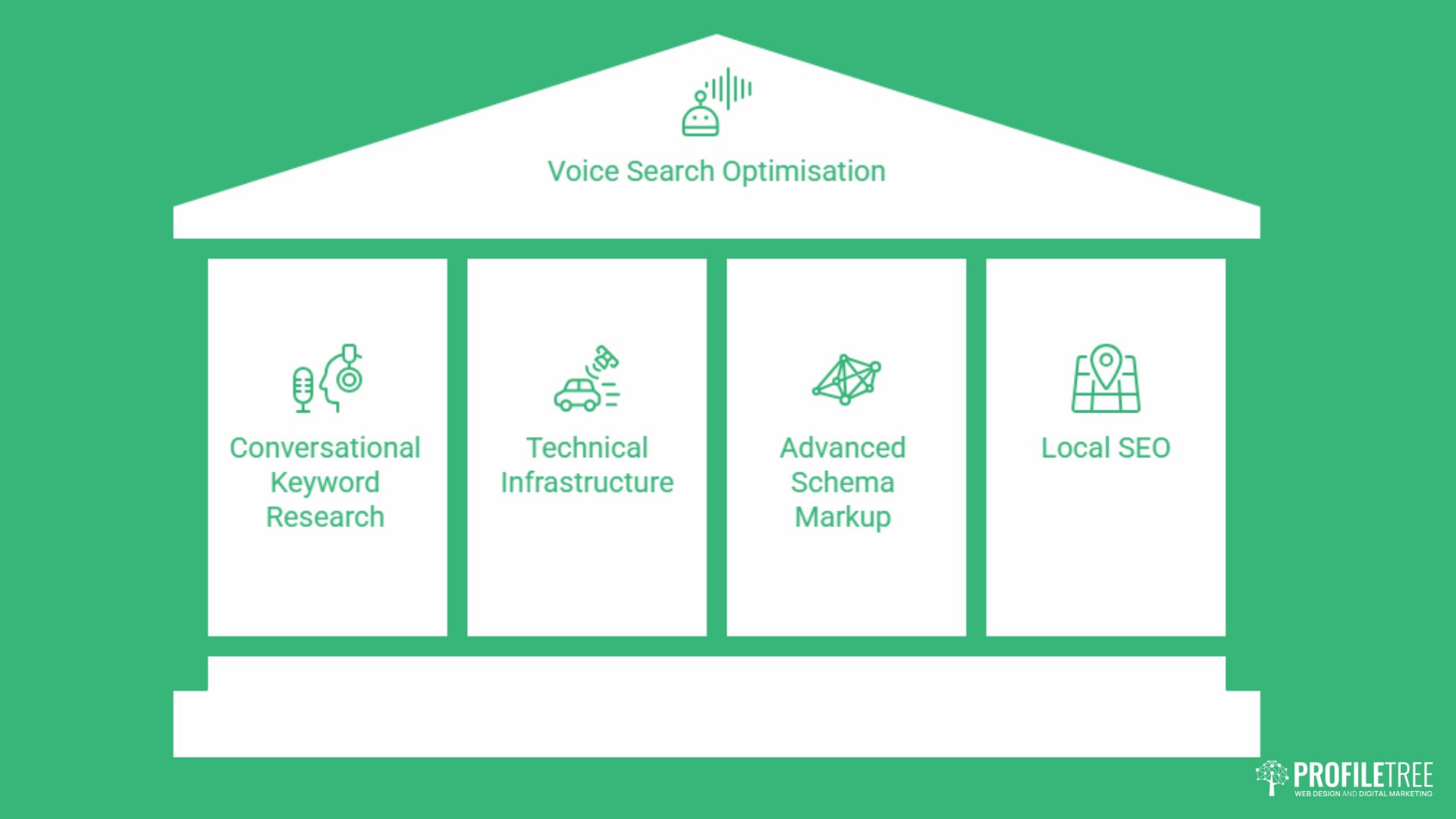
Ranking for voice queries is not a single-variable problem. It requires four interconnected technical and editorial disciplines working in parallel. Miss one and the others deliver diminishing returns. The pillars below cover conversational keyword research, site speed, schema markup, and local SEO as an integrated system rather than a checklist of independent tasks.
Pillar 1: Conversational Keyword Research
Conversational keyword research starts by separating phatic expressions from intent queries. Phatic speech is social filler: “Hey Siri”, “OK Google”, “actually”. Intent queries carry the real information needed. The phrase “What time does the pharmacy on Botanic Avenue close?” is a pure intent query with location, entity, and time as distinct signals. Effective research isolates those signals and builds content that answers each one.
The most productive source for conversational keyword discovery is People Also Ask (PAA) data. PAA questions are phrased exactly as users type or speak them, which makes them reliable proxies for voice query patterns. Tools like Google Search Console filtered for queries of seven words or more also surface the long-tail, question-format terms that voice traffic tends to generate.
For Northern Ireland and Irish businesses specifically, search behaviour around professional services, trades, and local retail follows predictable patterns: “Who does [service] in [town]?”, “How much does [service] cost in Northern Ireland?”, “Is [business name] open on Sundays?” Building content sections that answer each pattern type directly gives you repeatable coverage across a wide query set. To explore how content strategy connects to search behaviour, ProfileTree’s content marketing services explain the approach in practice.
Pillar 2: Technical Infrastructure and Core Web Vitals
Voice search results are pulled disproportionately from fast-loading pages. Google’s documentation is explicit that page experience signals, including Core Web Vitals, influence which pages are selected for featured positions. A site that loads in under 2.5 seconds on mobile has a materially better chance of being cited in a voice answer than one that loads in five seconds, everything else being equal.
The three Core Web Vitals metrics most relevant to voice optimisation are Largest Contentful Paint (LCP), Interaction to Next Paint (INP), and Cumulative Layout Shift (CLS). LCP measures how quickly the main content loads; INP measures responsiveness to user interaction; CLS measures visual stability. All three can be monitored through Google Search Console’s Core Web Vitals report and PageSpeed Insights.
Mobile optimisation sits within this pillar too. The majority of voice searches happen on smartphones, which means responsive design is not optional. A site that renders poorly on a 375px viewport is effectively invisible to voice users. ProfileTree’s website development work routinely addresses these technical benchmarks as part of the build process, because retrofitting performance onto a poorly structured site is always more expensive than building it in correctly from the start.
Pillar 3: Advanced Schema Markup for Voice
Schema markup is the technical mechanism that tells search engines what your content means, not just what it says. For voice search, two schema types carry the most weight: FAQPage and Speakable.
FAQPage schema wraps your question-and-answer sections in structured data that search engines can parse independently of the surrounding content. When a voice assistant needs to answer “How do I set up Google Business Profile?”, it looks for structured answers in FAQPage markup before it reads the page body. Implementing the AQPage schema correctly requires pairing each Question entity with a concise Answer entity, with the answer text matching or closely paraphrasing what appears on the page.
Speakable schema is less widely implemented, which makes it a genuine competitive advantage for sites that use it. It marks specific sections of a page as suitable for text-to-speech delivery, signalling to Google Assistant and Bing’s voice results which passages are structured for spoken consumption. The markup uses a CSS selector or XPath to point at the relevant HTML elements. Google’s Rich Results Test validates Speakable implementation and confirms whether the marked sections meet the format requirements.
A third schema type that matters for local businesses is LocalBusiness markup. Combined with a fully verified Google Business Profile, the LocalBusiness schema tells AI assistants your name, address, phone number, opening hours, and service categories in a machine-readable format. This is the data layer that sits behind “near me” voice answers. ProfileTree’s digital strategy work includes schema implementation as a standard deliverable on site builds and audits.
Pillar 4: Local SEO and “Near Me” Query Dominance
Local intent is the dominant signal in voice search. A significant share of voice queries include “near me”, a specific location name, or an implicit local modifier such as “open now” or “today”. For small and medium businesses in Northern Ireland, Ireland, and the wider UK, this is where the commercial return on voice search investment is highest.
The ranking factors for local voice answers are well-documented: a complete and verified Google Business Profile, consistent NAP (name, address, phone) data across all directories, a strong volume of recent reviews, and locally-relevant content on the associated website.
Cities and towns across Northern Ireland, from Belfast to Derry and beyond, each carry distinct local search patterns, which means content that references specific locations, local landmarks, and regional services outperforms generic national content for voice queries in those areas. For a sense of the geographic spread relevant to Northern Ireland’s digital economy, Northern Ireland cities illustrate the regional diversity that local SEO must account for.
Beyond Google Business Profile, local citations on directories like Yell, Thomson Local, and industry-specific registries reinforce the NAP consistency that AI assistants rely on to verify business information before surfacing it in a spoken answer. ProfileTree’s SEO services include local citation building as a core component of voice-ready optimisation programmes.
Solving the Dialect Gap: Optimising for UK and Irish Accents
Most voice search guides treat “English” as a single, uniform language. For businesses in Belfast, Dublin, Glasgow, or rural Wales, that assumption creates a significant gap between what users actually say and what the content is optimised to capture. Regional dialects, vocabulary choices, and phonetic patterns all influence how AI assistants interpret spoken queries, and content that only addresses standard English misses a meaningful share of local voice traffic.
How Regional Vocabulary Affects Search Results
The difference between “Where’s the nearest chemist?” (common in Northern Ireland and Scotland) and “Where is the pharmacy?” (more prevalent in standardised English) is not trivial to a voice AI. Google’s NLP models have become sophisticated at resolving synonym clusters, but semantic matching is not perfect, particularly for highly localised vocabulary that appears infrequently in training data.
For businesses in Northern Ireland, common vocabulary divergences include: “wee” as a modifier (a “wee bakery near me”), “till” for ATM, and trade-specific terminology that differs from UK-wide usage. Including the local vocabulary form naturally in content, alongside the standard English equivalent, gives the NLP model enough co-occurrence data to map both to the same intent. This is not keyword stuffing; it is writing in the way local users actually speak.
Phonetic matching is a separate layer. Voice assistants must interpret spoken audio before they query an index. Accents that deviate significantly from the model’s training distribution can produce transcription errors, particularly for place names. “Armagh”, “Tyrone”, “Derry”, and “Strabane” all have pronunciation patterns that differ from what a model trained predominantly on received pronunciation might expect. Businesses in these areas benefit from content that reinforces the correct spelling alongside natural prose use of the place name, giving the model disambiguation signals.
B2B Voice Search: The Overlooked Opportunity
The majority of voice search content focuses on B2C scenarios: finding a restaurant, checking a pharmacy’s opening hours, and ordering a taxi. B2B voice search receives far less attention, yet it is a growing behaviour pattern among professionals who use voice assistants during commutes, between meetings, and when their hands are occupied.
A procurement manager researching digital marketing agencies might say, “Who does digital marketing for manufacturers in Northern Ireland?” while driving. A finance director might ask,k “What does an AI implementation project cost for a company with 50 employees?” These are high-value commercial queries with specific, answerable structures. Content that addresses them in FAQ format, with direct answers, sits at the intersection of voice optimisation and B2B lead generation.
ProfileTree’s AI training programmes for SMEs frequently address this use case, showing business teams how to structure their own content so it appears when professional buyers use voice to research suppliers. The approach mirrors what this article demonstrates: question-led sections, concise opening answers, and supporting detail that builds credibility beyond the initial snippet.
GDPR and Voice Data Privacy for UK Businesses
Voice search carries data privacy implications that text search does not. When a user speaks a query through a smart speaker or phone assistant, the audio is processed by the platform (Google, Amazon, Apple) before any search action occurs. Under UK GDPR, businesses that deploy voice-enabled features on their own websites, such as chatbots with speech input or in-store kiosks with voice navigation, must treat that audio data as personal data and apply the same obligations that govern any other personal data processing.
For most businesses, the GDPR exposure sits with the platform provider rather than the site owner; a user asking Google Assistant about your business is not creating a data relationship with you. The risk increases when a business deploys its own voice interface. In that scenario, a lawful basis for processing must be identified, a retention period must be set, and users must be informed of how their voice data is handled. ProfileTree’s AI chatbot services are built with these obligations as a design requirement, not an afterthought.
Measuring Voice Search Performance in GA4
Tracking voice search traffic accurately is one of the most asked and least clearly answered questions in voice SEO. GA4 does not label sessions as “voice searches”, which leads many practitioners to conclude the data is untrackable. It is not. It requires a proxy methodology that identifies voice-likely traffic through a combination of query characteristics, device type, and session behaviour.
Identifying Voice-Likely Traffic Through Custom Dimensions
The most reliable proxy for voice search traffic in GA4 involves filtering organic sessions by three simultaneous conditions: mobile device type, query length of five words or more, and question-format queries (those beginning with who, what, where, when, why, or how). Sessions that satisfy all three conditions are statistically overrepresented by voice searches relative to the general organic population.
To implement this in GA4, create a custom dimension that captures query string data from Search Console integration. Go to Admin, then Data Streams, and confirm that the Google Search Console connection is active. In the Explorations section, build a Free Form report with the dimensions “Session default channel group”, “Landing page”, and “Search query” (sourced from Search Console). Apply a filter for queries containing “what”, “where”, “who”, “how”, or “why” and a secondary filter for mobile sessions. The resulting segment approximates your voice search traffic with reasonable accuracy.
ProfileTree’s digital strategy team uses this methodology when running voice search audits for clients, comparing the voice-proxy segment against the broader organic segment to identify which pages over-index for conversational traffic and which are missing it entirely.
Conversion Tracking for Voice-Initiated Sessions
Voice search sessions tend to convert differently from typed-query sessions. Because voice queries carry stronger local and transactional intent, the conversion window is often shorter, but the path to conversion may involve a device switch: a user asks a voice question on their phone, clicks through to the site, then completes the enquiry on a desktop later. Standard last-click attribution misses this behaviour.
GA4’s data-driven attribution model handles cross-device journeys more accurately than Universal Analytics did, provided Google Signals is enabled, and users are signed in to their Google accounts across devices. For businesses where phone calls are the primary conversion mechanism, connecting a call tracking solution to GA4 via the Measurement Protocol allows voice-initiated sessions that result in phone calls to be attributed correctly.
Key metrics to monitor for voice-proxy traffic: organic conversion rate by device type, average session duration for question-format queries, and bounce rate on pages that rank for featured snippets. A high bounce rate on a featured snippet page is not always negative; if users find their answer in the snippet and do not need to visit the page, the session-level data will look poor even though the voice answer was served successfully.
Connecting GA4 Data to Voice Search Improvements
Measurement only creates value when it drives decisions. A monthly review of voice-proxy traffic should answer three questions: which pages are attracting conversational queries; which of those queries are converting; and which high-impression conversational queries are generating clicks but no conversions. The third category, deep impressions with low conversion, is usually a content-intent mismatch. The page ranks for a voice query, but does not give the user the specific answer they spoke the question to get.
Resolving that mismatch typically requires adding a dedicated FAQ section, restructuring the opening paragraph of the relevant section to lead with the direct answer, or implementing FAQPage schema so the structured answer appears in the search result rather than requiring a click. ProfileTree’s digital marketing programmes include a quarterly content audit component that identifies exactly these patterns and prioritises fixes by commercial impact.
The Future of Voice: LLMs, Generative AI, and What Changes Next
The voice search landscape of 2026 is already different from what practitioners optimised for in 2023. Large language models (LLMs) have been integrated into every major voice assistant platform, which changes both the type of answers users receive and the content signals that influence which sources those answers draw from.
How LLMs Are Changing Voice Answer Behaviour
Traditional voice search matched a spoken query to a search index and read out the featured snippet. LLM-powered assistants synthesise answers from multiple sources, which means the spoken response may draw from your content without directing the user to your URL. This is both a challenge and an opportunity.
The challenge is attribution. If a user asks Google Assistant,t “How much does web design cost for a small business in Belfast?” and the assistant synthesises an answer from five sources without naming any of them, your site may have contributed to the answer without receiving a measurable visit. This is the same pattern that AI Overviews create in text search, and it requires rethinking what “ranking success” means for voice content.
The opportunity is that LLMs favour sources with clear authorial credentials, consistent factual accuracy, and structured content. Sites that publish well-evidenced, specifically cited content from named authors with verifiable expertise are more likely to be selected as synthesis sources than anonymous, thin pages. The voice assistant evolution already demonstrates how rapidly this synthesis capability is advancing, which makes investing in content authority now a long-term competitive asset rather than a short-term tactical fix.
Voice Commerce and the SME Opportunity
Voice commerce, transactions initiated or completed through voice interfaces, is expanding fastest in the UK market among consumers aged 25 to 44 who already use smart speakers regularly. For SME retailers and service businesses, the near-term opportunity is not in building a full voice commerce interface but in optimising the pre-purchase research stage: the point where a potential customer asks “Who sells X in Y area?” or “Is Z business taking bookings?”
Businesses that appear in those spoken pre-purchase answers capture the customer at the moment of intent, before the buying decision is made. This requires the local SEO and schema foundation described in Pillar 4, combined with product and service information structured in a way that AI assistants can extract and relay accurately. ProfileTree’s AI-enhanced marketing services are increasingly focused on helping SMEs position themselves within AI-generated answers, including voice commerce discovery.
Voice Search SEO Checklist for 2026
The following covers the technical and editorial requirements that a voice-ready page should meet before publication. Work through it systematically rather than treating individual items as optional.
Content structure: Each major section opens with a direct, 40- to 60-word answer to a stated question. FAQ sections use natural question phrasing. No section relies on the reader having read the previous section to make sense of it.
Technical: LCP under 2.5 seconds on mobile. CLS score below 0.1. FAQPage schema implemented and validated in Google’s Rich Results Test. LocalBusiness schema presents complete NAP data. Speakable schema applied to the most answer-dense sections of the page.
Local: Google Business Profile verified and complete. NAP data consistent across the site, GMB profile, and top-tier directories. Content references specific service areas rather than generic national coverage. For businesses in Northern Ireland and Ireland, local vocabulary and place name variations are addressed within the relevant content sections.
Measurement: GA4 Search Console integration active. Custom exploration built to segment voice-proxy traffic. Conversion events are configured for the primary CTA type (enquiry form, phone call, or booking). Monthly review cadence set. To understand how blog versus vlog formats perform within a voice-first content strategy, this comparative guide covers the format-specific considerations in detail.
Conclusion
Voice search is a technical discipline as much as a content one. The businesses that capture spoken queries are those that have combined conversational content with fast-loading pages, structured schema, and locally-grounded SEO.
If your site is not appearing in voice answers today, the gaps identified in this guide are the place to start. Talk to ProfileTree about building a voice-ready SEO strategy for your business.
FAQs
Is voice search still relevant for UK businesses now?
Yes, and more so than in previous years. The integration of large language models into Siri, Google Assistant, and Alexa has made voice answers more accurate and more frequently used for local and professional queries. UK adoption of smart speakers is among the highest in Europe, and mobile voice query volume continues to grow quarter on quarter. For any business with a local service area, voice search represents a commercial traffic channel that merits specific technical investment.
What is the best schema type for voice search? The
FAQPage schema is the highest-impact starting point because search engines extract FAQ answers directly for voice responses. Speakable schema is the more specialised option, marking specific content sections as suitable for text-to-speech delivery. The LocalBusiness schema is essential for any business with a physical location or defined service area. Implement all three where applicable rather than treating them as alternatives.
How do I rank for “near me” voice searches?
Ranking for “near me” voice queries requires a combination of a fully verified and optimised Google Business Profile, consistent NAP data across all major directories, a strong and recent review profile, and locally-relevant content on the associated website. The AI assistants that serve “near me” answers draw from the same signals as Google Maps local results, so the two optimisation efforts are effectively the same programme. ProfileTree’s SEO services include local voice optimisation as a defined service component.
Do I need a separate keyword list for voice search?
Not a separate list, but a differently-structured one. Voice keywords are the question-format expansions of your existing target terms. “SEO agency Belfast” becomes “Which SEO agency should I use in Belfast?” and “What does SEO cost for a small business in Northern Ireland?”. The intent clusters are the same; the language patterns differ. Building FAQ sections from these question-form expansions addresses both typed and spoken versions of the same query simultaneously.
Does website speed affect voice search rankings?
Yes, materially. Voice results are disproportionately drawn from fast-loading pages, and Google’s documentation explicitly ties page experience signals to featured position eligibility. A site with poor Core Web Vitals is working against itself in voice search, even if the content is well-structured. LCP under 2.5 seconds on mobile is the primary benchmark to target.