
The Power of Video Quality: Trust, Engagement and SEO
Table of Contents
Video quality decides whether a viewer stays or scrolls past within the first few seconds. For SMEs across the UK and Ireland, the visual and audio standard of a clip now shapes brand trust, watch time and where a page lands in search results.
This guide moves past the usual checklist of resolution numbers. It looks at why quality reads as a trust signal to UK buyers, how search and AI systems grade video, what the regional viewing data shows, and where the real budget priorities sit for smaller teams.
You will find practical benchmarks, a platform reference table, a short audit checklist and answers to the questions business owners ask most. The aim is simple: help you spend on the elements that change results, and skip the ones that do not.
Why Video Quality Reads as Trust to UK Buyers
Video quality works as a trust signal long before a viewer judges the message. In the UK and Irish markets, where audiences tend to value transparency over glossy hyperbole, a clean, well-lit clip says the business is established and credible. A grainy, muffled one quietly suggests the opposite. The link between production standard and perceived reliability is now a commercial concern, not an aesthetic one.
The First Five Seconds Decide Retention
Most viewers form an opinion before any words land. Sharp footage and clear audio keep them watching; soft focus and uneven sound push them away. That early drop-off matters because watch time feeds directly into how platforms rank and recommend content.
Retention is not only about the opening, though. A consistent standard across the whole clip keeps attention from fraying halfway through, which is where many SME videos quietly lose their audience. A strong first frame followed by a dip in lighting or sound undoes the early goodwill, and viewers rarely give a second chance.
The practical takeaway for smaller teams is that consistency beats peaks. A clip that holds a steady, professional standard throughout will usually outperform one with a polished intro and a ragged middle, because platforms read the full session, not just the hook.
Authenticity Beats Over-Production
High quality does not mean expensive gloss. UK audiences often distrust footage that feels staged or over-polished, reading it as marketing rather than substance. The goal is clear: professional footage that still feels genuine, a balance that suits smaller brands well.
This is where a considered approach to video marketing services pays off, matching production values to the audience rather than chasing the highest specification for its own sake.
The distinction is practical, not philosophical. A founder speaking plainly to a well-lit camera with clear sound reads as honest and capable. The same message wrapped in stock footage, sweeping music and heavy colour grading can read as a sales pitch the viewer did not ask for. For UK and Irish SMEs, the first version usually converts better because it matches how local buyers expect a trustworthy supplier to behave.
Low Quality Is a Brand Liability
Poor footage does measurable damage. It lowers brand recall, weakens conversion and undercuts the credibility a business has built elsewhere. For a service company competing on trust, a weak video can cost more than no video at all, because it actively contradicts the impression the rest of the brand works to create.
There is also a comparison effect. When a viewer scrolls past a competitor’s clean clip and lands on a grainy one, the gap is obvious and unflattering. In sectors where buyers are already cautious, that single comparison can be enough to lose the enquiry before any conversation starts.
Once trust is established through a visual standard, the next question is technical: what specifications actually deliver that standard without waste.
The Technical Benchmarks That Matter
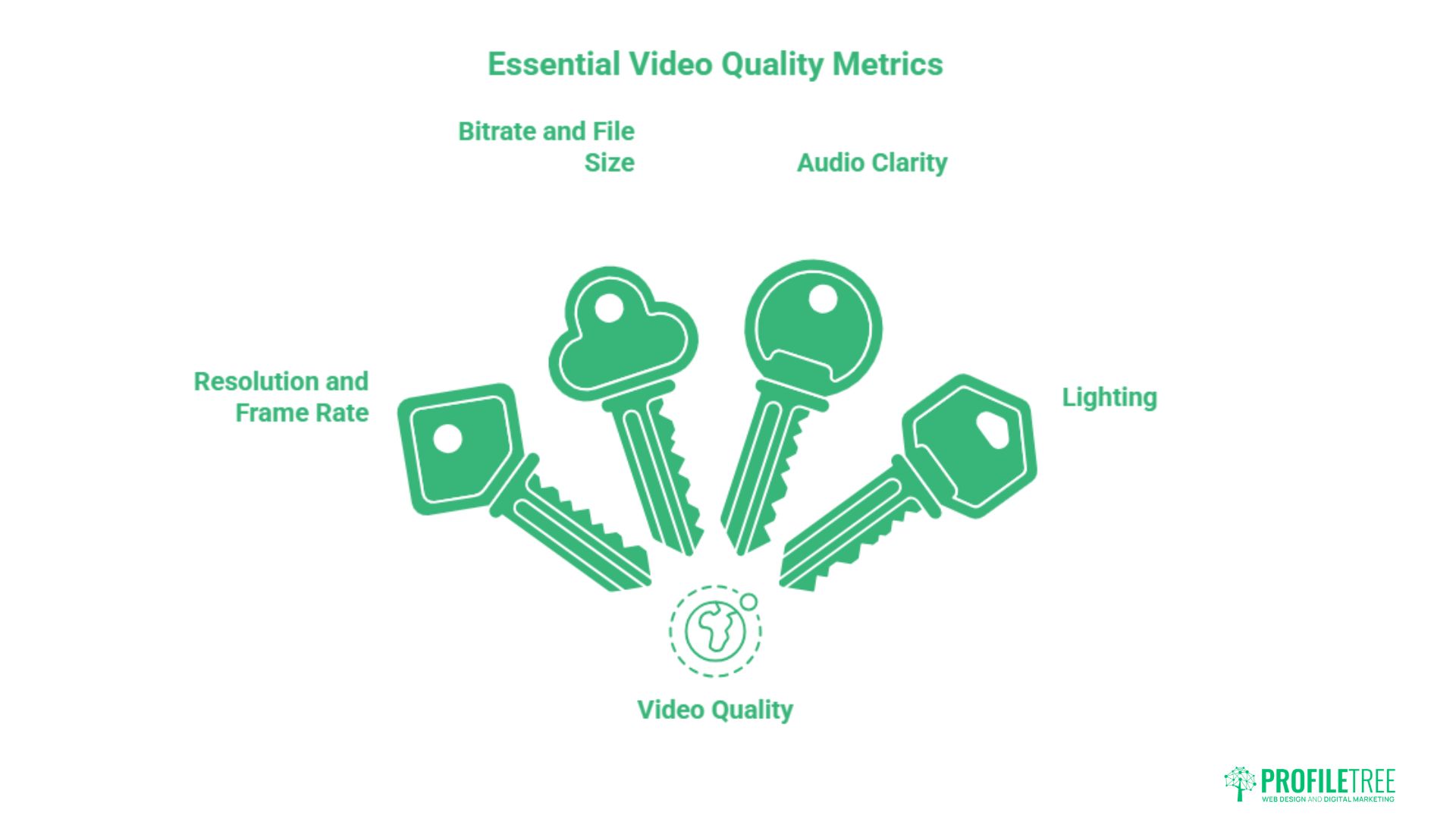
Resolution, frame rate, bitrate and audio clarity are the four levers behind every quality of video judgment a viewer makes. Understanding what each one does and where the point of diminishing returns sits stops SMEs from overspending on numbers that no one notices.
Resolution and Frame Rate
Higher resolution, such as 1080p or 4K, sharpens detail and makes footage easier to watch. For most UK business video in 2026, 4K is the practical ceiling: 8K offers four times the detail of 4K but brings file sizes and infrastructure demands that rarely justify the cost for SMEs.
Frame rate, measured in frames per second, governs how smooth motion looks. Standard talking-head and brand content sit comfortably at 24 to 30 fps; 60 fps suits fast movement like product demos or sports.
Bitrate and File Size
Bitrate is the amount of data carried per second, and it does much of the heavy lifting for perceived quality. A higher bitrate holds detail, but pushing it past a sensible point inflates file size with no visible gain. Balancing bitrate against bandwidth keeps playback smooth on real-world connections.
Adaptive bitrate streaming solves much of this automatically, adjusting quality to each viewer’s connection so the picture holds without buffering. It is one of the most useful tools for reaching mobile audiences on limited data, and most major hosting and streaming platforms now handle it without manual setup.
For an SME, the lesson is to stop thinking about a single export file and start thinking about delivery. A correctly prepared master file lets platforms serve the right version to each viewer, which protects both the experience and the bandwidth budget.
Audio Clarity Carries More Weight Than Expected
Viewers forgive a slightly soft image far sooner than poor sound. Muddy dialogue or background hiss breaks attention almost instantly, which is why a decent microphone often improves a video more than a camera upgrade does.
Treating audio as a first-class part of the production, rather than an afterthought, lifts the whole piece. Quality footage and clean sound together set the standard that broader content marketing services are built on.
Lighting Sets the Perceived Standard
Lighting often does more for perceived quality than the camera itself. Even flattering light makes an inexpensive kit look professional, while harsh or uneven light makes premium gear look amateur. For SMEs shooting on a budget, a soft, well-placed light source is one of the highest-return investments available.
Natural light works well when controlled, but it shifts through the day and across seasons, which makes consistency hard. A simple, repeatable lighting setup keeps a brand’s videos looking coherent over time, which matters as much as any single clip looking good.
How Search and AI Systems Grade Your Video
Video quality has moved from a user-experience metric to a technical SEO one. Search engines and AI answer tools now use signals tied to visual fidelity, watch time and structured data to decide which content to surface and cite for businesses, which turns production standard into a discoverability factor.
Watch Time Feeds the Algorithm
Platforms treat sustained watch time as a vote of confidence. High-quality footage holds viewers longer, which signals relevance and earns wider distribution. This is the loop that makes quality compound: better production, longer retention, broader reach.
Low-quality video breaks the loop early. Viewers leave, the signal weakens, and the content sinks regardless of how strong the underlying message was. The frustrating part for businesses is that a genuinely useful video can fail purely on production standards, never getting the distribution that would have proven its worth.
This reframes quality as an investment in reach rather than vanity. Every improvement that lifts retention, clearer audio, steadier framing, better pacing, compounds through the recommendation system into views the business would not otherwise have earned.
AI Search Tools Favour High-Fidelity Sources
AI-driven search increasingly references video when answering queries, and it leans toward sources where the visual and audio data are clean enough to interpret reliably. Clear footage, accurate captions and consistent metadata make a video easier for these systems to read and recommend.
Pairing strong video with a sound technical setup matters here. Working this into a wider digital strategy plan keeps the production and the indexing signals aligned rather than treated as separate jobs.
The shift is worth understanding in plain terms: an AI system that summarises a topic will reach for sources it can parse confidently. A muddy clip with no transcript gives it little to work with, while a clean video with accurate captions and a clear description offers structured, quotable material. Quality, in this sense, is a discoverability decision made at the production stage.
Captions, Transcripts and Accessibility
Captions and transcripts widen the audience and feed search engines readable text that describes the footage. They help deaf and hard-of-hearing viewers, support people watching without sound, and give crawlers structured context. Accessibility and discoverability turn out to be the same investment.
The regional picture adds another layer, because where and how people watch shapes which of these signals matter most.
Regional Viewing Trends Across London, Dublin and Belfast
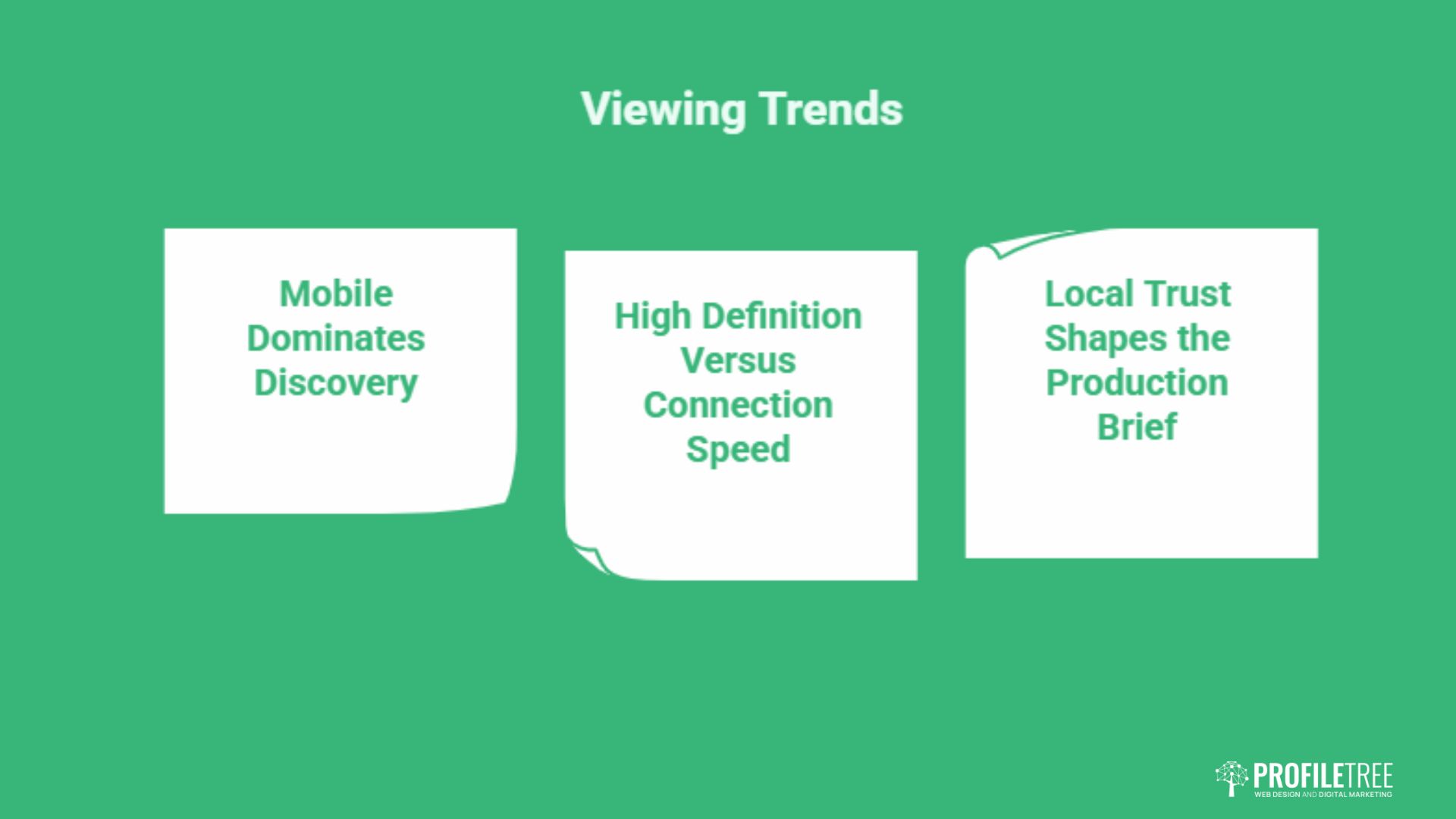
Video consumption habits are not uniform across the UK and Ireland, and the differences affect how SMEs should produce and publish. Mobile-first viewing, connection variability and local trust expectations all change the brief depending on the audience and the city.
Mobile Dominates Discovery
For this topic, mobile draws the bulk of impressions, which tells you most viewers meet the content on a phone first. Vertical-friendly framing, large on-screen text and strong audio matter more on a small screen than raw resolution does.
Desktop still has its place for longer, considered viewing, but the discovery moment is overwhelmingly mobile. Producing for that reality is no longer optional for local businesses. A video that only works full-screen on a laptop misses most of the people who would have found it.
This changes the brief in concrete ways. Subtitles become essential rather than optional, because a large share of mobile viewing happens with the sound off. Pacing tightens, since phone viewers decide faster. And framing has to survive a small screen, which rewards close shots and clear composition over wide, detail-heavy scenes.
High Definition Versus Connection Speed
Across regional UK and Irish networks, connection speed varies enough that a single heavy file frustrates as many viewers as it impresses. Adaptive delivery and sensible compression let a video stay sharp on fast connections and watchable on slow ones.
Local audiences in Belfast, Dublin and London reward content that loads cleanly and respects their data. For deeper context on the regions themselves, this guide to Northern Irish cities is a useful reference.
Local Trust Shapes the Production Brief
Regional audiences respond to footage that feels recognisably local: real places, plain speaking and an absence of hard sell. A video that looks expensively generic can land worse than one that is clearly grounded in its community.
Connecting that local feel to a broader plan, including how short clips are deployed, keeps the work coherent. Trends in short-form video show how regional brands use brief, high-quality clips to build that recognition quickly. A 30-second clip filmed locally, with clear sound and a recognisable setting, often earns more trust than a longer, costlier production that could have come from anywhere.
Sustainable Quality and a Practical Audit
High-resolution video carries an environmental cost that UK and EU businesses with social responsibility goals increasingly track. Quality and sustainability can coexist when the export and delivery settings are chosen with care rather than defaulted to maximum.
The Carbon Cost of 8K Streaming
Every step up in resolution increases the data transferred and the energy used to stream it, multiplied across thousands of views. Pushing 8K when 4K or 1080p would serve the audience just as well, adding avoidable load with no commercial return.
Choosing the right resolution for the platform and audience is a genuine efficiency gain, not a compromise. It often improves load times, too, which helps both viewers and search performance. A 1080p clip that loads instantly frequently serves a brand better than a 4K file that stutters on a regional connection.
For businesses reporting on social responsibility, this is also a defensible position to document. Specifying delivery resolution by platform, compressing sensibly and avoiding 8K where it adds nothing, all reduce data transfer in ways that are easy to measure and explain.
Restoring and Upscaling Existing Footage
Older, low-resolution clips need not be discarded. AI upscaling tools can lift footage to a more usable standard, though they work best as a recovery measure rather than a substitute for shooting well in the first place. The results have limits, especially with very degraded source material.
Knowing when to upscale and when to reshoot is a judgment call that a structured approach to AI video tools can help inform.
A Quick Video Quality Audit
Before publishing, run a short check covering the essentials that viewers and algorithms both notice.
| Check | What good looks like |
|---|---|
| Resolution | 1080p or 4K, matched to the platform |
| Frame rate | 24 to 30 fps standard, 60 fps for motion |
| Audio | Clear dialogue, no background hiss |
| Lighting | Even, the subject is clearly visible |
| Captions | Accurate, synced, included by default |
| File delivery | Adaptive or compressed for mobile |
Run through this list, and most quality of experience problems surface before a video ever reaches an audience.
Platform Specifications at a Glance
Different platforms reward different settings, so a single export rarely suits them all.
| Platform | Aspect ratio | Recommended resolution |
|---|---|---|
| YouTube | 16:9 | 1080p to 4K |
| 1:1 or 16:9 | 1080p | |
| TikTok | 9:16 | 1080p |
| Instagram Reels | 9:16 | 1080p |
“For the SMEs we work with across Northern Ireland and Ireland, video quality is really about trust. A clear, well-made clip tells a customer the business takes itself seriously, and that judgement happens in seconds,” says Ciaran Connolly, founder of ProfileTree.
Conclusion
Video quality now shapes trust, retention and search visibility in equal measure, and the businesses that treat it as a strategic input rather than a finishing touch are the ones that get cited and remembered. Focus your budget on clear audio, sensible resolution and accessible delivery rather than chasing the highest numbers. Want a video that earns attention and ranks? Talk to ProfileTree about video today.
All prices and figures in this guide are indicative UK examples and correct at the time of writing; use them as a benchmark rather than fixed quotations.
FAQs
Does video quality actually affect SEO?
Yes. Higher quality holds viewers longer, and that watch time signals relevance to search and AI systems. Clear footage with accurate captions is also easier for those systems to read and cite, which supports rankings over time.
Is 8K necessary for business videos in 2026?
No. For most UK businesses, 4K is the sweet spot, and 1080p still performs well. 8K adds file size and infrastructure demands that rarely justify the cost for typical SME content.
How does video quality affect mobile users on limited data?
Adaptive bitrate streaming adjusts quality to each viewer’s connection, so the picture stays watchable without buffering. Good quality should not mean huge files; sensible compression keeps clips sharp on mobile.
Can I improve old, low-resolution videos?
To a point. AI upscaling can lift older footage to a more usable standard, but it works best as a recovery measure. Heavily degraded source material limits how much can be restored.
Why do my high-quality videos look blurry on LinkedIn?
Platform compression is usually the cause. Exporting at the recommended resolution and bitrate for that platform, rather than a generic setting, gives the compression less to strip away.