
Rebranding Strategy: The 4-Step Digital Guide for UK SMEs
Table of Contents
Most businesses that rebrand get the order wrong. They start with a new logo, brief a designer, update their social media headers, and then wonder why nothing feels different six months later. A rebranding strategy that works starts somewhere less glamorous: data. What does your current brand actually communicate? Where does it fall short? What do customers think you do, versus what you actually do best?
This guide outlines a four-step rebranding strategy for UK and Irish SMEs, covering the audit, strategic repositioning, digital build, and launch. At each stage, you will find practical guidance on the digital elements that most rebranding articles skip entirely: SEO migration, website architecture, content overhaul, and the internal communication that makes or breaks a rebrand at the execution stage.
The case studies at the end draw on well-documented public examples, including some notable failures, because understanding what went wrong is often more instructive than reading about what went right.
Rebrand vs. Brand Refresh: Which Does Your SME Actually Need?
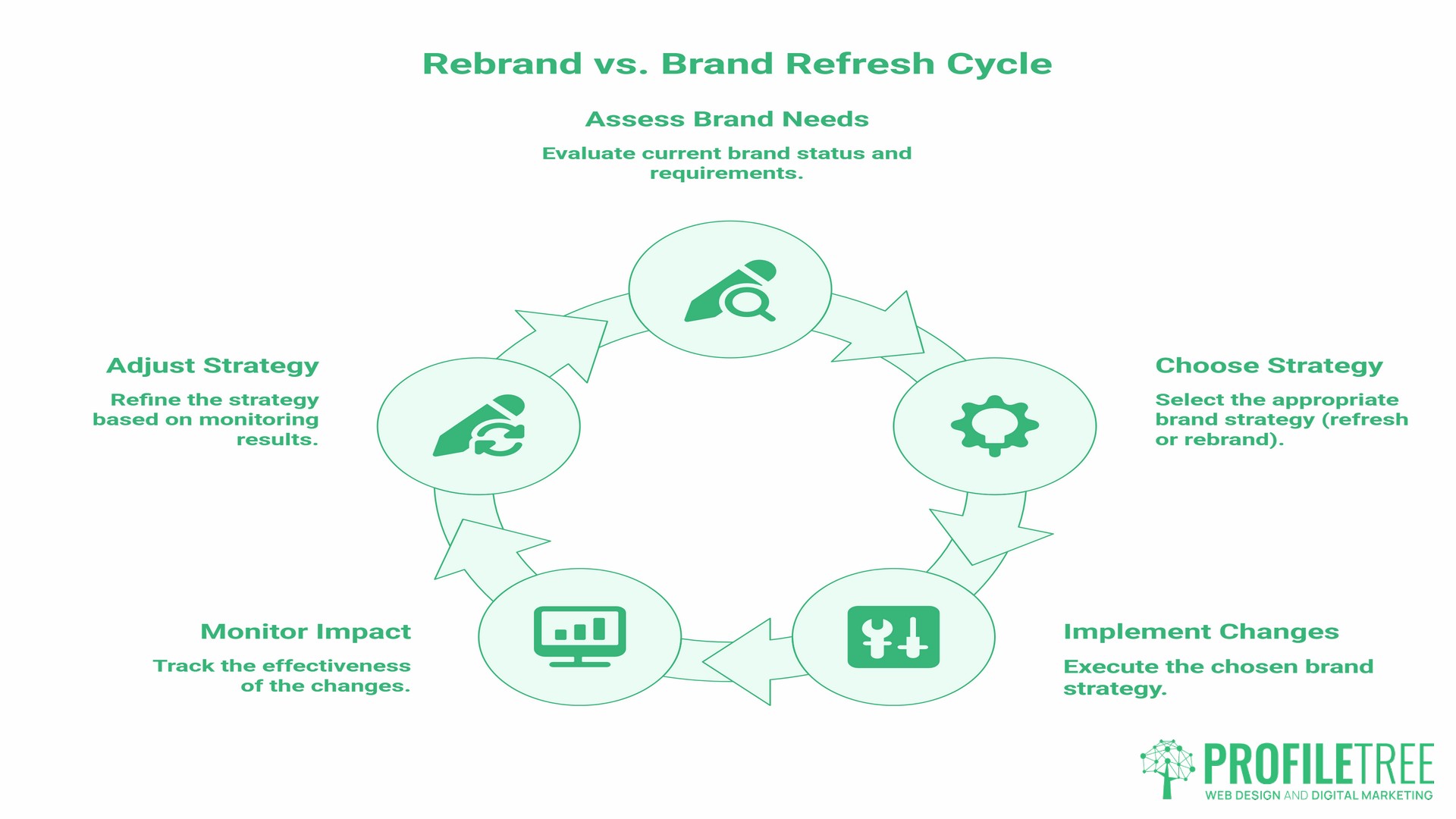
Before committing to a full rebranding strategy, it is worth being precise about what you are actually doing. A brand refresh and a full rebrand are very different exercises, and confusing them leads to either wasted budget or under-investment.
| Visual Refresh | Partial Rebrand | Full Rebrand | |
|---|---|---|---|
| What changes | Logo, colours, fonts | Name, tagline, messaging, some visuals | Positioning, name, identity, digital presence, content |
| Typical timeline | 4 to 8 weeks | 3 to 5 months | 6 to 12 months |
| Website impact | CSS updates, new imagery | New templates, updated copy | Full redesign and rebuild |
| SEO risk | Low | Medium | High without migration plan |
| Appropriate for | Dated visuals, no strategic shift | New audience, slight pivot | Merger, serious reputation issue, category change |
A visual refresh is often the right call for SMEs that have solid positioning but an outdated presentation. A full rebrand is necessary when the positioning itself is the problem: the market has moved, the audience has changed, or the brand is carrying associations it cannot shed.
Get this distinction wrong and you either spend significantly on a full rebrand when a refresh would have done the job, or you spend modestly on new visuals and find the underlying problem unchanged.
Why Businesses Rebrand: The Genuine Triggers
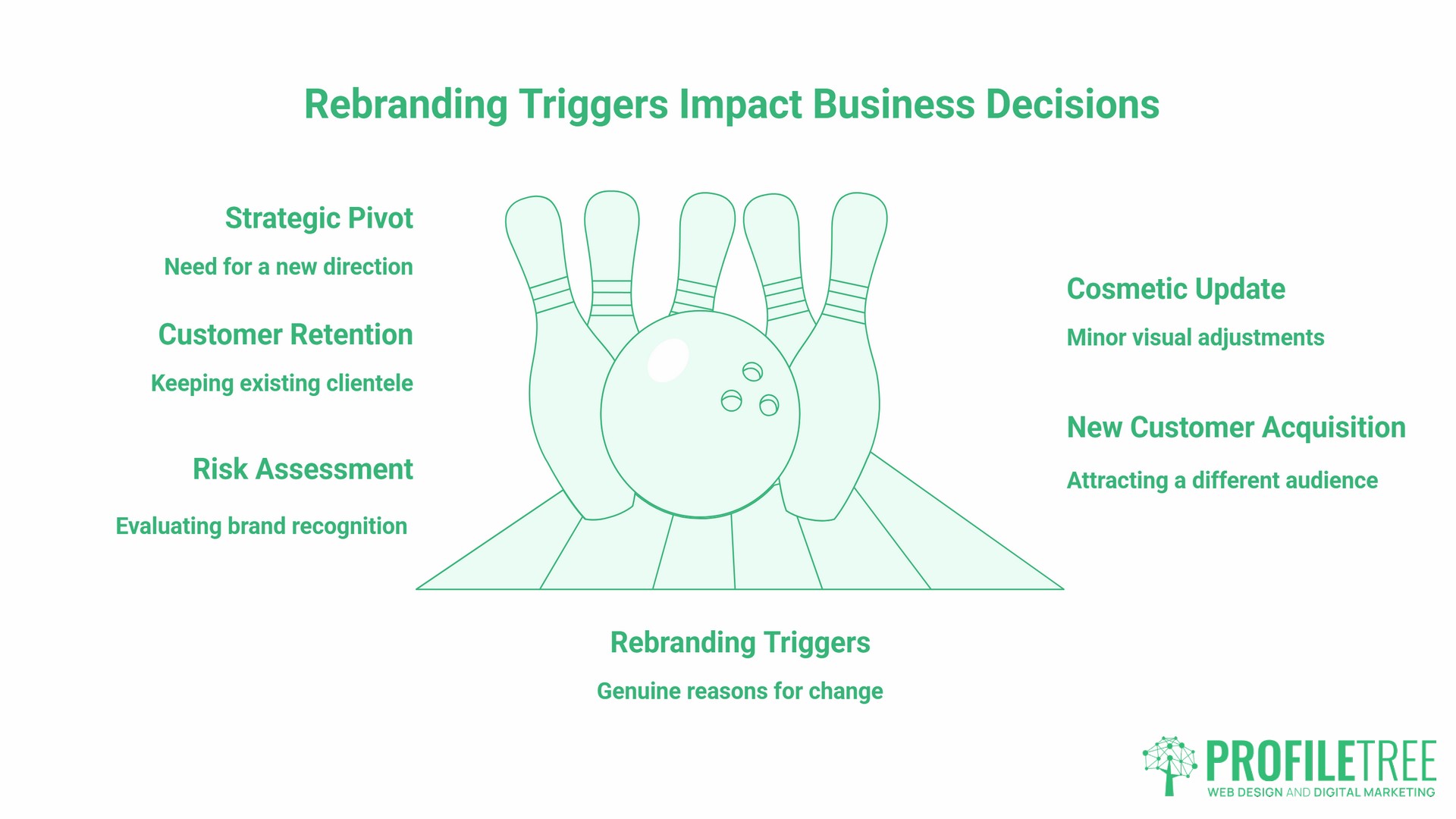
Understanding the motivation behind a rebranding strategy matters because it shapes every decision that follows. The trigger determines whether you need a strategic pivot or a cosmetic update, whether you need to retain existing customers or win new ones, and how much risk you can afford to take with established brand recognition.
The most common genuine triggers are:
- Changing competitive landscape. A market that looked very different three or four years ago may have attracted new entrants, or existing competitors may have repositioned aggressively. When your positioning starts to describe the category rather than differentiate within it, a rebrand is likely overdue.
- Audience shift. A business that built its brand around one customer profile and then expanded into a different segment often finds its original identity becomes a barrier rather than an asset. The brand signals expertise to the original audience but communicates nothing relevant to the new one.
- Merger or acquisition. When two businesses with distinct brand identities come under common ownership, one of them typically has to change. This is one of the few rebranding scenarios with a hard deadline.
- Reputation repair. A period of negative reviews, a public relations incident, or an association with something the business has moved on from can make a rebrand a commercial necessity rather than a strategic choice.
- Growth aspirations. Some businesses outgrow their original positioning. A firm that started as a local provider and now operates nationally may find its brand still reads as local, even when the capability is not.
Step 1: Audit the Current Brand Before Touching Anything
The first step in any rebranding strategy is an honest assessment of what you currently have. This is not creative work. It is diagnostic work, and it should be driven by data rather than intuition.
Conduct a Brand and Digital Audit
A brand audit has two layers. The first is the perception layer: how customers, prospective customers, and current employees describe the business when asked. Customer surveys, sales call recordings, and review data are all useful inputs here. The second is the asset layer: everything the brand currently owns, including the website and social media profiles, email templates, presentations, and printed materials.
For most UK and Irish SMEs, the asset audit surfaces a consistency problem. The website may reflect one visual identity, the LinkedIn page another, and the sales materials a third. A rebranding strategy cannot succeed if the starting inventory is incomplete.
Audit Your SEO Before Changing a Single Word
This is the step most rebranding guides leave out entirely. Before any creative work begins, export your current search visibility data. Which pages are ranking? Which queries are sending traffic? Which backlinks point to your current domain or specific URLs?
This matters because a rebrand that involves changing page URLs, restructuring site architecture, or rewriting heavily indexed pages can erase months or years of SEO equity within weeks. The solution is a redirect map: a documented plan for every URL that will change, with a 301 redirect pointing from the old address to the new one. Without this, search engines treat the new pages as entirely new content, and the old rankings effectively disappear.
If the rebrand involves a domain change, which is uncommon but does happen when a company name changes, the risk is amplified. Domain migrations require careful technical planning to preserve link equity and avoid a significant traffic drop in the months following launch. This is an area where working with an experienced SEO team pays for itself quickly.
Set Measurable Objectives
Vague objectives produce vague outcomes. “Improve brand perception” is not a goal. “Increase direct search queries for our new company name by 40% within six months of launch” is a goal. Specific, measurable targets give you something to evaluate the rebrand against and prevent scope creep during the project.
Step 2: Build Your Rebranding Strategy
With the audit complete, the second phase is strategy. This is where the creative and positioning work happens, but it should be grounded in what the audit revealed rather than starting from a blank sheet.
Define a New Brand Position
Brand positioning is not a tagline. It is the answer to a precise question: who are you for, what do you do for them, and why should they trust you over the alternatives? A clear positioning statement shapes every subsequent creative decision, including visual identity, messaging, and the channels you prioritise.
For UK and Irish SMEs, positioning often benefits from being more specific rather than broader. A general “digital agency” positioning faces competition from hundreds of providers. A “digital agency for professional services firms in Northern Ireland” competes with far fewer and speaks directly to a defined audience.
Develop the Visual Identity and Brand Voice
Visual identity covers the logo, colour palette, typography, and imagery style. Brand voice covers tone, vocabulary, and the personality that comes through in written and verbal communication. Both need to be documented in a brand guidelines document that every team member and external supplier can reference.
One point worth making clearly: visual identity is not the same as brand strategy. Many businesses treat the logo redesign as the rebrand itself. It is not. The logo is the most visible output of the rebranding strategy, but it is not the strategy.
Consistency in brand voice across every customer touchpoint is one of the most underrated factors in brand recognition. A business that communicates with warmth and directness on its website but formally and stiffly in email follow-ups creates a fractured experience that undermines trust.
Plan the Content Migration
A rebranding strategy that involves repositioning almost always requires a content audit as a parallel workstream. If the website has 50 or 500 published articles written under the old positioning, some of that content will need updating to reflect the new brand direction, target audience, and messaging.
This is not simply a matter of updating the header logo. It involves reviewing what topics the content covers, whether those topics still align with the new positioning, and which pages require substantive rewriting versus minor updates. Developing a brand strategy properly means accounting for the content layer, not just the visual one.
Step 3: Execute the Digital Rebrand
The execution phase is where the rebranding strategy becomes tangible. For most SMEs, the website is the most visible and consequential output of this phase. It is where the new brand identity is fully expressed and where most customers will form their first impression of the repositioned business.
Rebuild or Redesign the Website
The question of whether to rebuild from scratch or redesign within the existing structure depends on the extent of the repositioning. A visual refresh can often be achieved with template updates and new imagery. A full rebrand, particularly one involving a new audience or a significant change in service offering, generally requires a ground-up redesign.
“When businesses ask us about rebranding, the website conversation usually starts too late,” says Ciaran Connolly, founder of ProfileTree. “The site architecture, the page structure, the way services are described and organised: all of that needs to reflect the new positioning from day one. If you launch a new brand identity but the website still tells the old story, you create a credibility gap that takes months to close.”
Key website considerations during a rebrand include the information architecture (how services, products, and content are structured and navigated), the copywriting (does every page speak to the new audience in the new voice?), and the technical SEO setup (redirects, canonical tags, structured data, and page speed).
Update Every Digital Touchpoint
The website is the anchor, but it is not the only digital asset that carries the brand. A rebranding strategy execution checklist for digital assets typically includes:
- Google Business Profile (name, description, images, and category)
- Social media profile images, cover images, and bios
- Email signatures and templates
- LinkedIn company page
- Google Search Console (if the domain changes, the property needs to be re-verified)
- Any third-party directory listings where the business name or visual identity appears
Missing items from this list create inconsistency. A customer who sees the new brand on the website but the old logo in a Google Maps result is left uncertain which version is current.
Announce the Rebrand with Video
The announcement is its own creative challenge. A brand relaunch campaign that explains why the business has rebranded, what has changed, and what customers can expect tends to perform significantly better than a simple logo reveal.
Video is the most effective format for a relaunch communication. A short brand story film, a founder statement, or an overview of what has changed gives the audience something to share and respond to. For businesses that have not yet used video strategically, a rebrand announcement is a natural first project. ProfileTree’s team produced a walkthrough of the rebranding strategy process covering the communication phase in depth:
Train Your Team
Employees who do not understand the new brand or do not know why the change was made cannot represent it consistently. Internal communication should precede the public launch, not follow it. A short training session covering the new positioning, the key messages, and the updated visual identity gives every team member the context they need to act as brand ambassadors rather than confused bystanders.
ProfileTree’s digital training programme includes brand communication workshops for teams navigating significant digital or brand changes.
Step 4: Protect Your SEO and Measure the Rebrand
The fourth step in the rebranding strategy is often treated as a formality. It is not. The weeks and months immediately following a brand relaunch are when traffic anomalies, ranking fluctuations, and customer confusion are most likely to surface. Active monitoring during this period catches problems early.
Implement and Verify Redirects
Every URL that has changed needs a working 301 redirect. Check these systematically after launch by crawling the site with a dedicated tool rather than clicking through manually. Common failure points include redirect chains (where URL A redirects to URL B, which redirects to URL C, losing link equity at each step), soft 404s (pages that return a 200 status but display “page not found” content), and internal links that still point to old URLs.
Track the Right Metrics
A rebranding strategy is not complete until you can measure whether it worked. The metrics worth tracking depend on the original objectives, but typically include:
- Branded search volume: Are more people searching for the new company name over time?
- Organic traffic trends: Did traffic drop post-launch, and if so, is it recovering on the expected trajectory?
- Direct traffic: an increase suggests growing brand recognition
- Conversion rate: Has the rebrand improved or harmed the rate at which visitors take action?
- Social mentions and sentiment: how are customers and prospects talking about the brand since the relaunch?
Gather Feedback and Adjust
No rebranding strategy lands perfectly. Customer feedback, sales team observations, and data from the first 90 days will surface areas that need adjustment, whether it is a piece of messaging that isn’t landing, a visual element that is being misread, or a customer segment reacting differently than anticipated. Build in a structured review point at 30, 60, and 90 days post-launch.
What UK and Irish Businesses Need to Know: Regulatory Basics
A rebrand that involves a company name change requires more than creative work. In the UK, a new trading name or company name should be checked against the register at Companies House and, if the name is to be trademarked, submitted to the UK Intellectual Property Office (IPO). Trademark registration protects against competitors using the same or a similar name, and is a practical step for any business investing significantly in a new brand identity.
In Ireland, company name changes are registered through the Companies Registration Office (CRO). If the business trades under a name different from its registered company name, that trading name should also be registered.
Neither process is complex, but both take time. A name that cannot be legally protected or registered poses a significant risk to the entire rebranding investment, so both checks should be completed before the brand is publicly launched.
Rebranding Strategy Examples: What Worked and Why
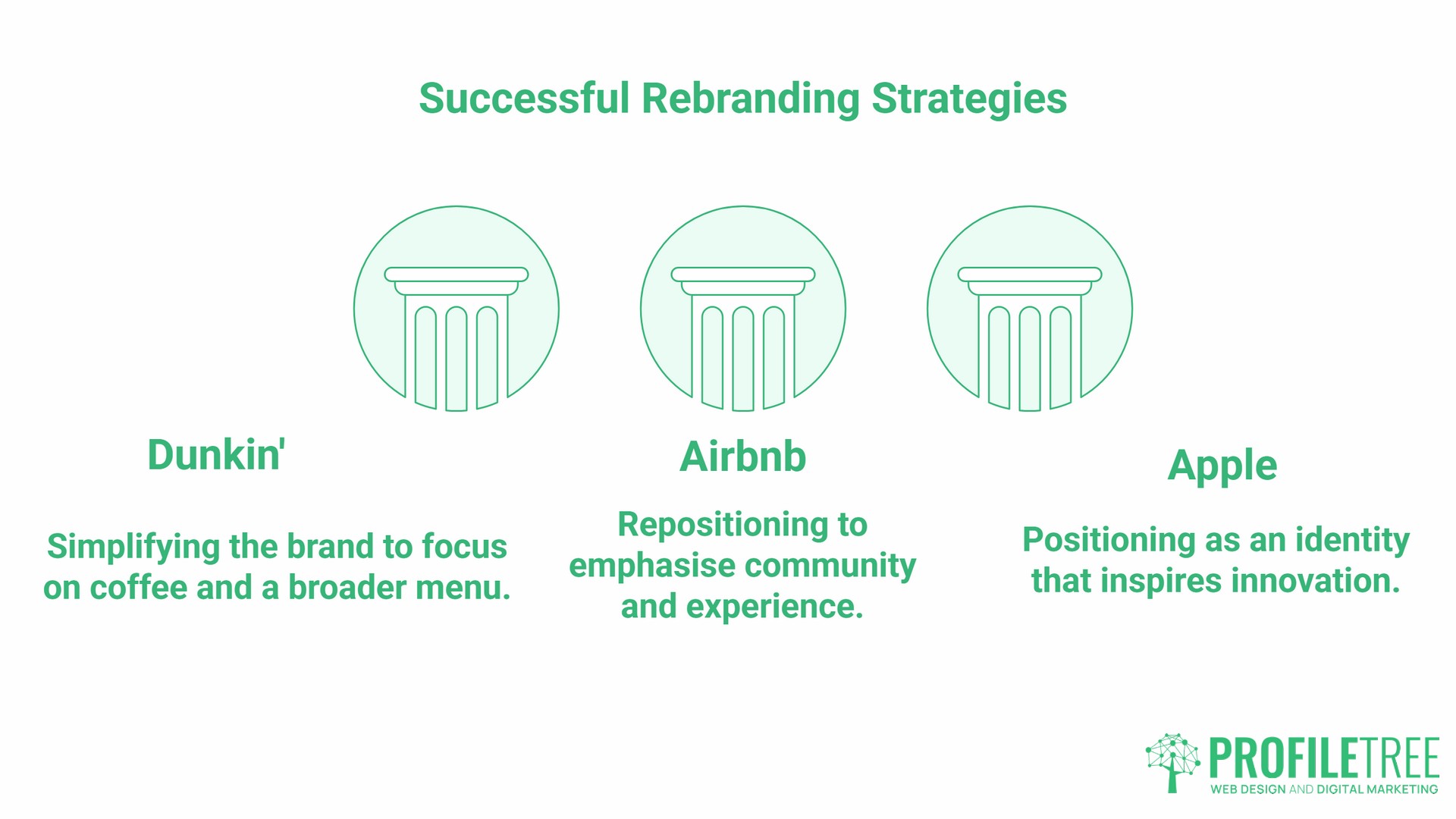
The most instructive rebranding examples are not always the most successful ones. They reveal the decision-making behind the strategy.
Dunkin’: Simplifying Around the Core Product
Dunkin’ Donuts dropped “Donuts” from its name to reflect a broader menu and a heavier focus on coffee. The visual identity was refreshed at the same time, and the messaging shifted consistently across all channels. The strategy worked because the name change reflected a genuine product evolution rather than a cosmetic decision.
Airbnb: Repositioning Around Community
Airbnb introduced a new logo and repositioned from “home rental service” to “belong anywhere,” emphasising community and experience. The rebranding strategy succeeded because it was backed by product changes and a communications campaign that gave the new positioning meaning. A new logo without that context would have achieved nothing.
Apple: Positioning as Identity
Apple’s “Think Different” rebranding under Steve Jobs in the late 1990s is routinely cited as one of the most effective corporate rebrandings in history. The positioning was not about features; it was about who the customer wanted to be. The subsequent product launches gave that positioning substance.
Rebranding Strategy Failures Worth Understanding
Gap: Six Days and Reversed
In October 2010, Gap replaced its iconic blue box logo with a minimalist redesign. The new logo went live without any explanation, advance communication, or customer engagement. Within 24 hours, a protesting Twitter account had gathered thousands of followers, and a “make your own Gap logo” site generated almost 14,000 parody versions, according to The Branding Journal. After six days, Gap reverted to the original logo. The problem was not the new design itself; it was the lack of a strategic rationale communicated to the people most closely attached to the brand.
Tropicana: When Customers Cannot Find You on the Shelf
In January 2009, Tropicana replaced its signature orange-with-a-straw packaging with a minimalist redesign. Customers could not recognise the product in stores. According to Ad Age’s reporting of data from the period, sales of the Tropicana Pure Premium line fell 20% between January and late February 2009, a drop that cost the brand tens of millions of dollars. Tropicana reverted to the original packaging within two months. The lesson is that brand recognition is partly a function of visual familiarity, and familiarity is disrupted when packaging changes without warning.
New Coke: Measuring the Wrong Thing
Coca-Cola replaced its original formula in 1985 with “New Coke,” based on taste-testing data that actually measured the wrong thing: preference in a single-sip test, not emotional attachment to a product people had been drinking their entire lives. The backlash was swift enough that Coca-Cola reintroduced the original formula within a few months as “Coca-Cola Classic.” Data is only as useful as the question it is answering.
RadioShack: A Name Change Without a Strategy
RadioShack rebranded as “The Shack” in 2009 to modernise and appeal to younger customers. The new name did not address the underlying product and positioning problems the business faced. Renaming a struggling business does not resolve its commercial struggles; it adds the cost of a rebrand to an already difficult situation.
The pattern across most rebranding failures is the same: creative changes without strategic grounding, or strategic changes without adequate communication to the people most affected by them.
Ready to plan your rebranding strategy? Get in touch with ProfileTree to talk through the digital steps involved.
Frequently Asked Questions
What is the difference between a brand refresh and a full rebrand?
A brand refresh updates visual elements such as the logo, colour palette, and typography while maintaining the core positioning and audience. A full rebrand changes the strategic positioning, often including the name, target audience, messaging architecture, and digital infrastructure. A brand refresh typically takes four to eight weeks; a full rebrand for an SME typically runs three to six months when the digital build is included. The right choice depends on whether the positioning itself is the problem or only its presentation.
Will rebranding hurt my Google rankings?
It can, if the technical migration is handled poorly. The most common cause of a post-rebrand traffic drop is URL changes without 301 redirects. When pages move to new addresses without redirects, search engines treat the new pages as new content, and the accumulated authority of the old pages is effectively lost. A structured redirect map, verified after launch, significantly reduces this risk. Domain migrations add complexity and should be carefully planned with SEO expertise.
How long does a rebranding strategy take for a UK SME?
A visual refresh with digital updates takes four to eight weeks. A partial rebrand involving new messaging and website updates takes three to five months. A full rebrand, including a new website build, content migration, and SEO planning, typically takes 6 to 12 months. Businesses that try to compress full rebrands into shorter timescales often cut the research and audit phases first, which tends to produce a launch that is visually polished but strategically unconvincing.
Do I need to register my new brand name with the UK IPO?
Registering a trademark with the UK Intellectual Property Office is not a legal requirement, but it is advisable for any business investing significantly in a new brand identity. A registered trademark gives you legal recourse if a competitor uses the same or a similar name. The application process takes several months and should be initiated before the public launch, not after. In Ireland, the equivalent body is the Intellectual Property Office of Ireland.
How do I choose a rebranding agency in the UK or Ireland?
Look for an agency that treats digital execution as part of the brief, not as a separate workstream. A rebrand that produces a new logo and brand guidelines but does not address the website, content, SEO migration, or launch communications is a partial solution. Ask specifically how the agency handles website migration, URL changes, and SEO continuity. An agency that separates creative and digital tends to produce rebrands in which the strategy and execution do not connect.
How do I announce a rebrand to customers?
Announce internally first so your team understands the change before customers do. For the external announcement, explain why the rebrand happened and what it means for customers. Video performs well for brand announcements because it allows founders or leadership to speak directly to the audience. Email your existing customer base directly rather than relying on them to notice the change through social media.