
Having a Website That Works: A Practical Guide for SMEs
Table of Contents
Most small businesses in Northern Ireland, Ireland and the UK now accept that having a website matters. Fewer understand what a professionally built one actually does, beyond sitting on the internet and looking presentable. A website, when built and managed correctly, is the single most controllable asset in your digital strategy. It drives search visibility, qualifies leads before they ever contact you, and keeps working while you’re not. This guide covers what having a website genuinely delivers for SMEs, and what separates a site that performs from one that simply exists.
Why Social Media Alone Leaves Your Business Exposed
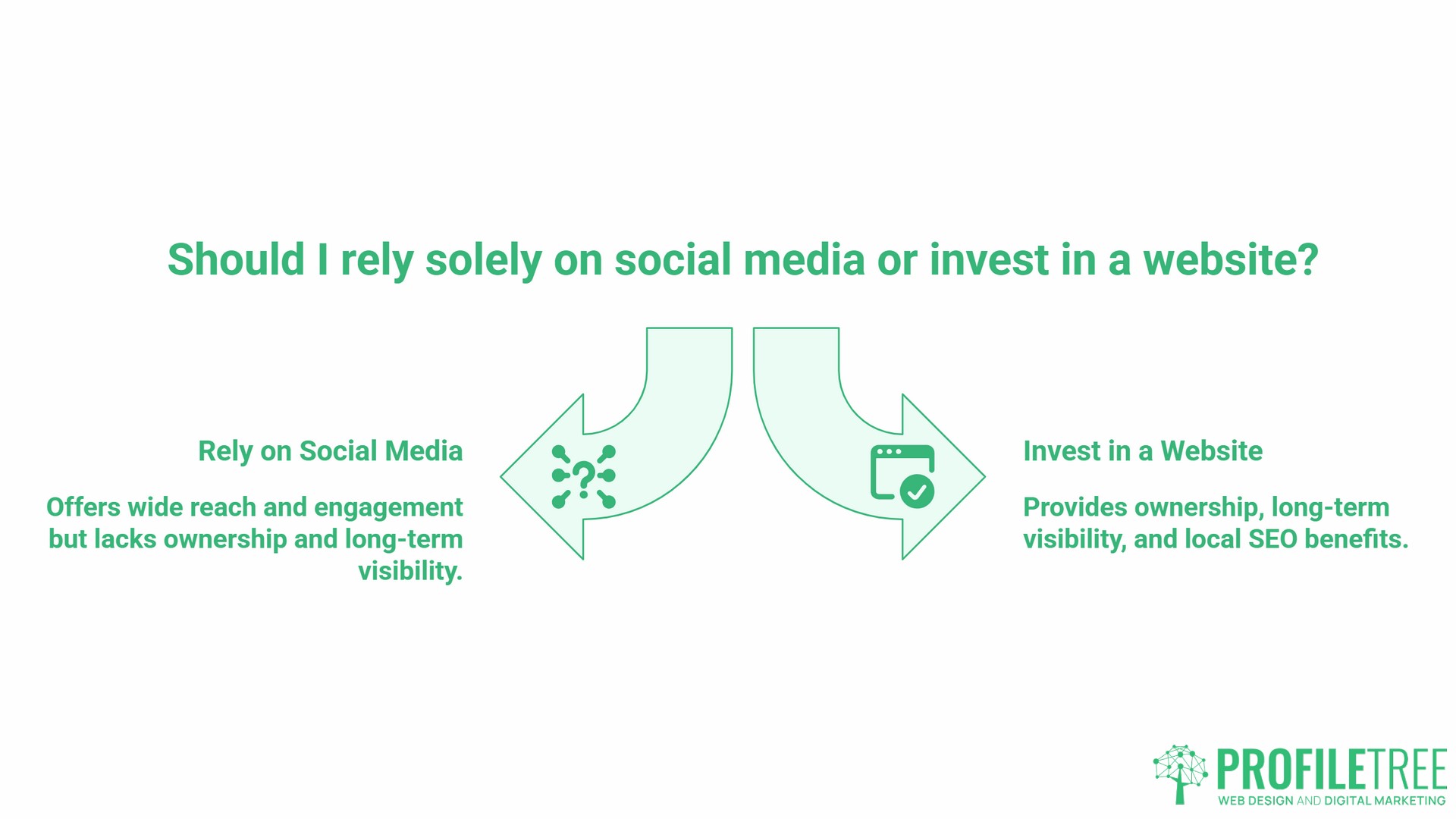
Having a website gives your business something that no social media account can: ownership. Your Facebook page, Instagram profile and LinkedIn presence exist on platforms you do not control. Algorithms change, reach collapses overnight, and accounts get restricted without warning. When that happens, businesses built entirely on social channels have no fallback.
A website is an owned asset. The content you publish there stays indexed in Google for months or years. A post on Instagram has a shelf life measured in hours. That difference matters enormously for SMEs trying to build consistent visibility rather than chase short-term engagement.
This is not an argument against using social media. It remains a valuable distribution channel. The point is that social platforms should feed traffic back to your website, not replace it. Businesses that invert this relationship, treating social as their primary presence, are building on rented land.
The Visibility Gap for Local Businesses
For businesses in Belfast, Dublin, Cork, Edinburgh or Manchester, your website is the primary route to appearing in local search results. When someone searches for a plumber in Derry, a solicitor in Galway or a web design agency in Belfast, Google serves results from indexed websites. Social media profiles appear occasionally, but they cannot compete with a well-structured site optimised for local intent.
Local SEO, the practice of making your site visible to people searching in your area, depends entirely on having a site to optimise. Without one, you are absent from the most commercially valuable searches your potential customers are making.
1. Professional Web Design: The Foundation Your Visibility Is Built On
Design gets judged on how a site looks. Google judges it on how a site behaves. Those two assessments overlap less than most business owners expect, which is why attractive websites routinely underperform ugly ones in search results. The three factors below are where design decisions turn into ranking outcomes, for better or worse.
How Design Decisions Affect Search Rankings
Google’s ranking systems assess far more than keywords. Page speed, mobile responsiveness, layout stability and ease of navigation all feed into how a site is evaluated. A poorly built website can contain excellent content and still rank badly because the technical foundation undermines everything above it.
When ProfileTree works with SMEs on web design projects, the brief is always twofold: build something that works well for visitors and is structured so search engines can read it clearly. Those two goals align more often than they conflict. A site that loads quickly, adapts cleanly to mobile screens and presents content in a logical hierarchy serves both.
The alternative, a DIY site builder template with no attention to code quality, page speed or structured data, often looks acceptable on the surface while performing badly where it counts.
Mobile-First Indexing in the UK and Ireland
Google indexes the mobile version of your site first. This has been the standard since 2019, yet a significant number of SME websites in the UK and Ireland still deliver a degraded mobile experience: text too small to read, buttons too close together, images that stretch or crop incorrectly on smaller screens.
Having a genuinely mobile-optimised website is not optional for visibility. It is the baseline. A responsive web development approach builds this in from the start rather than treating mobile as an afterthought.
UX, Bounce Rate and What Google Infers
When visitors land on a page and leave immediately, Google infers that the page did not satisfy the search intent. High bounce rates on commercial pages are a signal, not the only one, but a meaningful one, that something is wrong. That something is usually a combination of slow loading, unclear layout or content that does not match what the visitor was looking for.
Good UX design reduces this friction. Clear headings, readable type sizes, obvious calls to action and a logical content flow all contribute to visitors staying longer, clicking further and converting at a higher rate.
2. SEO: Turning Your Website into a Discovery Tool
A website nobody finds may as well not exist. SEO is the work that closes the gap between the site existing and the site being discovered by people actively searching for what you sell. For SMEs it breaks into three connected areas: what happens on each page, what happens locally, and what accumulates over time.
On-Page SEO and Search Intent
On-page SEO covers the elements within your direct control: page titles, meta descriptions, heading structure, keyword usage, internal linking and content depth. Each of these signals tells Google what a page is about and how relevant it is to a given search query. Getting them right consistently, across every service page, blog post and location page on your site, is what separates sites that rank from sites that don’t.
ProfileTree’s SEO services are built around this connection between content quality and technical structure. The two cannot be separated: well-written content on a poorly structured site underperforms, and a technically clean site with thin content is equally limited.
Local SEO: Capturing Customers in Belfast, Dublin and Beyond
Local search intent is one of the highest-value traffic types available to SMEs. When someone searches for a service with a location attached, “accountant Belfast”, “web design Dublin”, “digital marketing agency Northern Ireland”, they are typically close to a decision. They are not browsing; they are evaluating.
Appearing in these results requires a combination of on-site signals (local keywords, consistent NAP data, location-specific content) and off-site signals (Google Business Profile, local citations, reviews). Having a website gives you the foundation to build both. Without it, local SEO is not possible.
For businesses serving multiple towns or regions across Northern Ireland, Ireland or the UK, location pages, individual pages optimised for each service area, can substantially extend the reach of a single website.
Content Strategy as a Visibility Engine
A website without a content strategy is a static brochure. One with a properly planned content marketing approach compounds its visibility over time. Each article, guide or case study that is published and indexed adds to the site’s topical authority. Over months, this creates a body of work that ranks across a broader range of relevant queries, driving traffic that no amount of social posting could replicate.
3. AI Search and Brand Visibility
Search results now carry a layer above the blue links, and it is drawn from a smaller pool of sources. That changes what visibility means for a small business. Ranking tenth was always worth something; being uncited in an AI answer is worth nothing at all. Here is what determines which side you land on.
How AI Overviews Change the Visibility Picture
Google’s AI Overviews now appear above standard organic results for a growing proportion of searches. These summaries pull from indexed websites, specifically from pages that are structured clearly, written authoritatively and marked up with appropriate schema. For SMEs, this represents a new tier of visibility: appearing not just in the blue links but in the AI-generated answer at the top of the page.
The sites most likely to be cited in AI Overviews are those that cover topics with genuine depth, answer specific questions directly and use structured data to make their content machine-readable. A site built with this in mind, clean semantic HTML, FAQ schema, and well-organised heading hierarchies positions you to benefit from this shift rather than be bypassed by it.
Owned Visibility vs. Algorithm Dependency
AI systems like Perplexity, ChatGPT and Google’s own Gemini pull from the open web. They cite websites, not social profiles. A business that publishes original, well-structured content on its own domain builds brand associations in AI training data that social content simply cannot. As AI-assisted search becomes the dominant way people find information, a domain carrying substantive, indexed content is increasingly the price of entry.
“The businesses that will be cited by AI search tools are those that have built genuine authority on their own domain,” says Ciaran Connolly, founder of ProfileTree. “That means original content, clear structure and a site that has been built to be read by machines as well as people.”
4. Your Website as a Marketing Hub
Most SMEs run their channels in parallel: social here, email there, ads somewhere else, each measured on its own terms. The alternative is to treat every channel as a feeder into one destination you control. The sections below cover how that works in practice, and what changes when you organise around it.
Integrating Digital Channels Around One Owned Asset
The most effective digital marketing strategies use a website as the central hub. Social media posts, email campaigns, paid search ads and YouTube content all serve one purpose in this model: driving qualified traffic back to pages you own, where you control the experience and capture the lead.
A website structured this way changes how you think about every other channel. An email newsletter that links back to a detailed guide on your site is more valuable than one that dead-ends at a social profile. A YouTube video that directs viewers to a service page generates leads. A paid search ad that lands on a well-optimised page with a clear call to action converts at a measurable rate.
ProfileTree’s digital marketing strategy work with SMEs across Northern Ireland, Ireland and the UK is built around this hub model. The website is not one of many channels; it is the destination that every other channel feeds.
Video Content and Website Integration
Video is one of the most effective content formats for both engagement and SEO. Embedding video on relevant service and blog pages increases time on page, which is a positive signal for rankings. It also gives visitors a richer experience of your business than text alone.
ProfileTree produces and publishes video content for SMEs through video production and YouTube marketing services. When that content is embedded on a well-optimised website page, it serves two functions simultaneously: it improves the page’s engagement metrics and extends the video’s reach through organic search.
Analytics: Knowing Your Customer Better Than Your Competitors Do
A website gives you first-party data. Every visit, every page view, every click tells you something about who your customers are, how they found you and what they are looking for. Social platforms offer limited, increasingly restricted versions of this data. Your own site, connected to Google Analytics and Google Search Console, gives you the complete picture.
This data feeds everything: which services to prioritise, which content to produce, which pages need improvement and where your marketing budget is most productively spent. SMEs that use this data consistently make better decisions than those operating on instinct alone.
5. What a Professional Build Delivers for SMEs: Cost vs. Long-Term Value
The question most SME owners ask is what a website costs. The more useful question is what it returns, and over what period. A site is not a one-off purchase like a van or a laptop; it is an asset that either compounds in value or quietly depreciates, depending on how it was built and what happens after launch.
Where Builder Platforms Reach Their Limit
Website builder platforms are designed for speed and simplicity, not for search performance. The trade-off is real. Many generate bloated code that slows page loading, offer limited control over technical SEO elements and create dependency on a third-party platform you do not own.
For a business with no immediate growth ambitions and a very limited budget, a DIY site can be a reasonable starting point. For any SME serious about using their website as a visibility and lead generation tool, the technical limitations of builder platforms create a ceiling that becomes increasingly hard to break through as the business grows.
A professionally built website on WordPress, for example, gives you full control over page speed optimisation, schema markup, URL structure, internal linking and every other technical element that affects how your site performs in search. That control is what makes the investment worthwhile over time.
How Having a Website Reduces Customer Acquisition Costs
A website that ranks for relevant search terms generates inbound leads without ongoing spend. Unlike paid advertising, which stops the moment the budget runs out, organic search traffic continues to arrive as long as the page remains indexed and relevant. For SMEs with limited marketing budgets, this compounding return on a one-time investment is one of the most efficient uses of money available.
The arithmetic is what makes this compelling at SME scale. Work it out for your own business: take the monthly enquiries a well-ranked service page could realistically generate, apply your actual close rate, and multiply by your average customer value. For most service businesses, a single page ranking on the first page for a high-intent local query covers its build cost within the first year and keeps producing after that.
GDPR, UK-GDPR and Trust Signals in the UK and Ireland
Having a website in the UK or Ireland comes with legal obligations: a GDPR-compliant privacy policy, a clear cookie consent mechanism and transparent data handling practices. These are not optional. Beyond compliance, they serve a commercial function: they signal to visitors that your business is legitimate, accountable, and professional.
For businesses in Northern Ireland operating under both UK-GDPR and, in some contexts, the EU’s GDPR framework, getting this right matters more than it might in other markets. ProfileTree builds GDPR compliance into every site from the outset rather than adding it as an afterthought.
10-Point Visibility Audit for SMEs
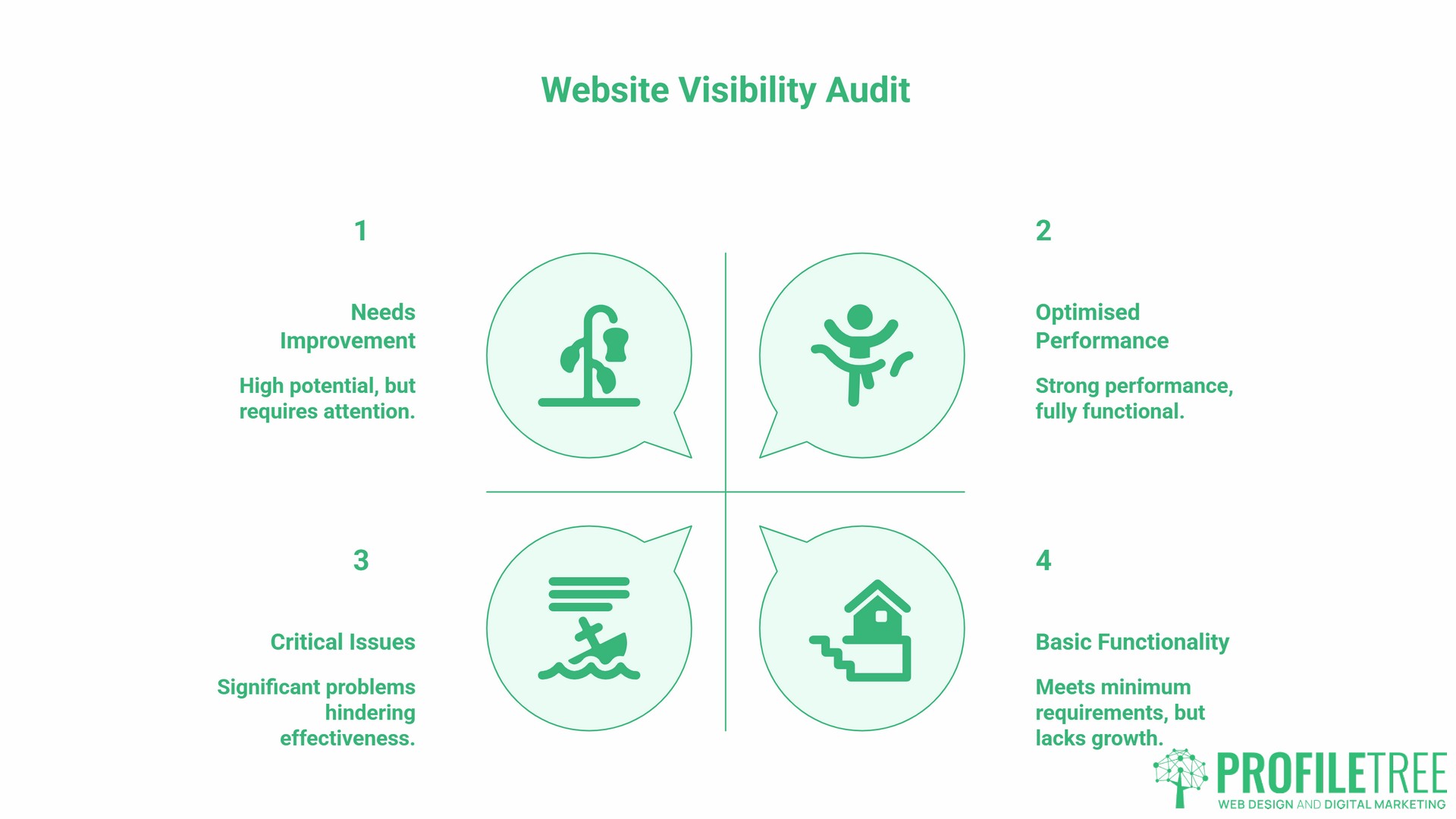
Use this checklist to assess where your current site stands.
- Does your site load in under three seconds on mobile?
- Is your site indexed by Google (search your domain in Google to check)?
- Does each service page target a specific, relevant search query?
- Is your Google Business Profile connected and up to date?
- Does your site have a clear, accessible privacy policy that meets UK-GDPR requirements?
- Are your contact details visible on every page?
- Does your site include customer testimonials or verifiable social proof?
- Is there a content strategy producing new indexed pages at regular intervals?
- Does your site use structured data (schema markup) on key pages?
- Are your analytics configured so you can measure which pages generate enquiries?
If you answered no to more than three of these, having a website is not enough. How it is built and maintained is what determines whether it works.
Having a website is the starting point, not the finish line. The SMEs that get the most from their online presence are those that treat their site as an active asset: built on a solid technical foundation, optimised for the searches their customers are making, kept fresh with new content and connected to every other channel in their marketing strategy. If yours is not doing that yet, the gap between what your site currently does and what it could do is worth closing.
ProfileTree works with SMEs across Northern Ireland, Ireland and the UK on web design, SEO, content strategy and digital marketing. Get in touch to talk through what your site needs.
Frequently Asked Questions
Do I really need a website if my Facebook page is busy?
A busy Facebook page is valuable, but it does not replace a website. Facebook controls your reach, can change its algorithm at any time and can restrict or remove your account. Your website is an asset you own outright. Content published on your site can rank in Google for years; a Facebook post disappears from feeds within hours. For any business that relies on search visibility or wants to generate leads independently of a third-party platform, having a website is not optional.
How much does a professionally built website cost for a small business?
Costs vary widely, and any agency quoting a single figure without asking questions is guessing. What drives the number is scope: page count, whether e-commerce or booking functionality is needed, how much content has to be written from scratch, and whether the site integrates with systems you already run. A brochure site for a service business sits at the lower end. A site with online payments, customer accounts or multi-location structure sits well above it. Ask for a breakdown by component rather than a single total, so you can see what is driving the cost and what could be phased.
Should I rebuild my site or improve the one I have?
Improve first, in most cases. A full rebuild resets whatever search authority the current domain has earned, and the risk of losing rankings during migration is real. Rebuild when the underlying platform blocks something you need, when page speed cannot be fixed without changing the foundation, or when the design is old enough to cost you credibility with visitors. If the problem is content quality, unclear navigation or missing service pages, those are fixable on the site you already have at a fraction of the cost.
How do I know if my website is actually generating enquiries?
Configure conversion tracking in Google Analytics 4 for every enquiry route: contact form submissions, phone-number taps on mobile, and email link clicks. Then check the landing page report to see which page each converting visitor arrived on, rather than which page they submitted from. Those are often different, and the arrival page is the one doing the work. If you cannot answer this question today, that is the first thing to fix, because every other decision about the site is being made blind.