
US Holiday Marketing: A Strategic Guide for UK and Irish SMEs
If you sell to American customers, or you’re planning to, the US holiday season is the highest-stakes period in the commercial calendar. Black Friday, Cyber Monday, Thanksgiving, and Christmas collectively generate more consumer spending than any other period of the year. For UK and Irish SMEs, the opportunity is real, but the execution requires more than posting a discount code and hoping for the best.
This guide sets out a practical framework for planning and running US holiday marketing campaigns that work: from building the right technical foundations on your website, to timing your SEO, content, and paid activity correctly. ProfileTree works with SMEs across Northern Ireland, Ireland, and the UK on exactly these challenges, and this guide reflects the planning approach we apply with clients preparing for peak-season trading.
Table of Contents
The US Holiday Calendar: Key Dates and the Cyber Five
The US holiday marketing season does not begin in November. Search interest for gift- and deal-related queries begins to climb in late September and peaks in the first two weeks of December. If you are only thinking about your campaign in October, you are already behind the curve on SEO.
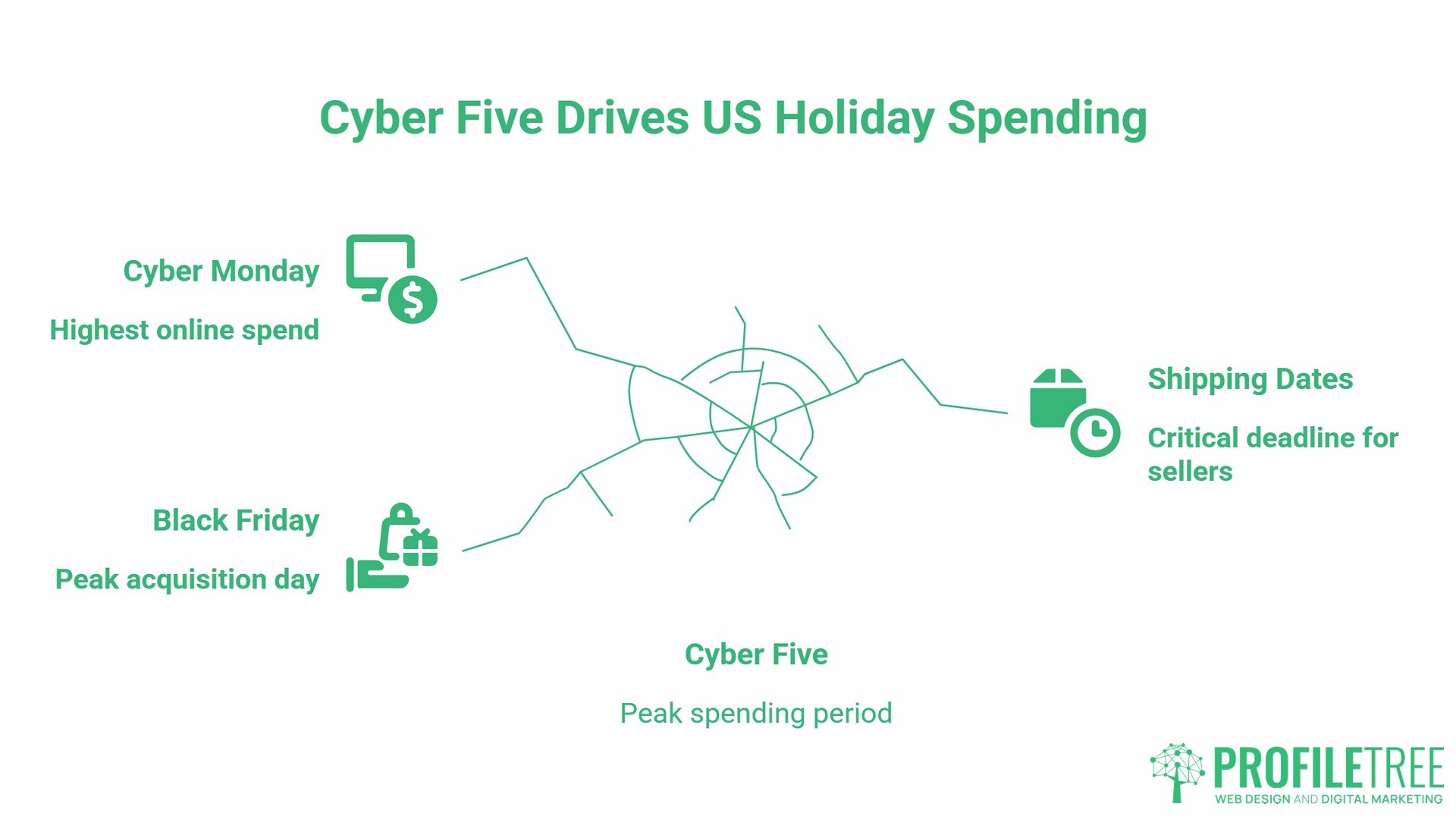
The period marketers refer to as the Cyber Five runs from Thanksgiving Thursday through to Cyber Monday. Adobe Analytics recorded $44.2 billion in US online spending across the Cyber Five period in 2025, up 7.7% on the previous year. For UK and Irish sellers, this is the window where an optimised digital presence can generate meaningful revenue from American customers, provided the groundwork has been done.
Here are the key US holiday dates that should sit in every marketing calendar:
| Date (2025) | Event | Relevance for UK/Irish SMEs |
|---|---|---|
| 31 October | Halloween | Seasonal content; strong e-commerce window |
| 11 November | Veterans Day | B2B pause; low commercial relevance for international sellers |
| 28 November | Thanksgiving | Cyber Five begins; launch Black Friday campaigns |
| 29 November | Black Friday | Peak acquisition day; requires full campaign readiness |
| 30 November | Small Business Saturday | Strong positioning opportunity for SMEs |
| 1 December | Cyber Sunday | Often overlooked; strong mobile traffic day |
| 2 December | Cyber Monday | Historically the highest online spend day |
| 3 December | Giving Tuesday | Brand values and CSR content opportunity |
| Mid-December | Last International Shipping Dates | Critical communication deadline for non-US sellers |
| 25 December | Christmas Day | Campaign wind-down; email open rates high |
| 1 January | New Year’s Day | Self-gifting and resolution campaigns begin |
The October creep
American consumers begin holiday shopping earlier each year. Adobe’s holiday data shows that spending in October has increased year over year as consumers respond to early promotional activity from major retailers. For SMEs targeting US audiences, this means your SEO work, landing pages, and content assets need to be live by September at the latest. Paid campaigns can be activated later, but organic visibility takes time to build.
Cultural and Content Localisation for US Audiences
One of the most common mistakes UK and Irish businesses make in US holiday marketing is treating American customers as though they share the same cultural reference points and purchase motivations. They do not, and the differences matter more than most marketers account for.
Translation versus localisation
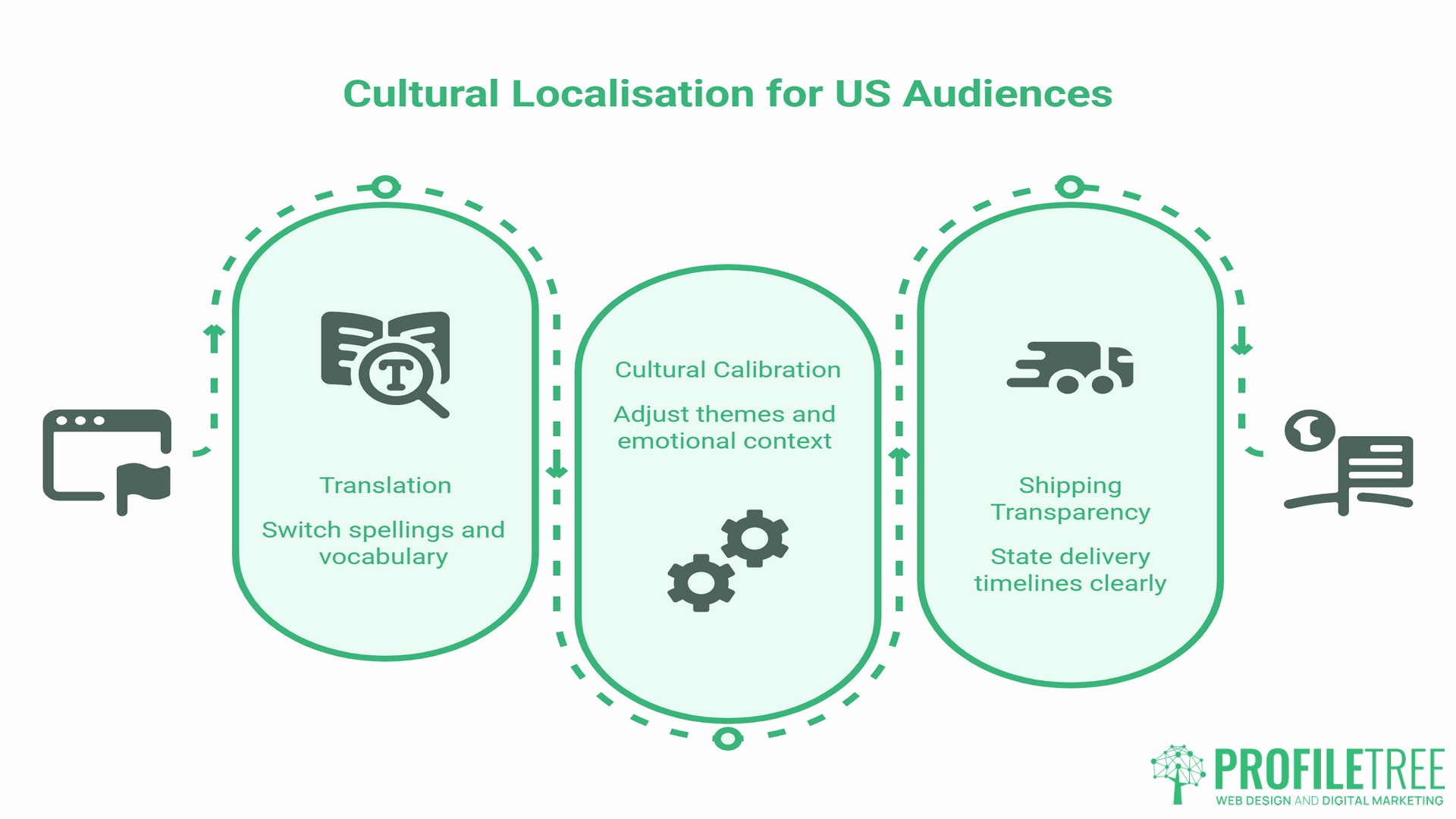
Translation means switching British spellings to American ones. Localisation means rethinking the emotional and cultural context of your messaging entirely. Some practical examples:
| UK Term | US Equivalent |
|---|---|
| Jumper | Sweater |
| Trainers | Sneakers |
| Autumn | Fall |
| Post | |
| Bank Holiday | Federal Holiday |
| Boxing Day | No equivalent |
Beyond vocabulary, tone differs. American holiday marketing tends to be warmer, more expressive, and more explicitly grateful in its messaging. Thanksgiving, in particular, carries cultural weight that British Christmas does not map onto. A campaign built around family, generosity, and community will land better during Thanksgiving than one built solely around deals and discounts.
If you are producing content marketing or video content for a US holiday campaign, this cultural calibration should happen before a word is written or a frame is filmed. ProfileTree’s content team handles localisation as a separate stage from production, precisely because getting it wrong wastes everything that comes after.
Managing shipping expectations as a trust signal
International shipping is where many UK and Irish sellers lose American customers who were ready to buy. Being transparent about delivery timelines, rather than burying them in the footer, turns a potential objection into a trust signal. A landing page that prominently states “Order by 10 December for guaranteed pre-Christmas delivery to the US” does more commercial work than a discount banner that says nothing about when the product will arrive.
Website and Technical Preparation for Peak Traffic
Before any US holiday marketing campaign goes live, your website needs to be ready for a traffic surge. Black Friday and Cyber Monday drive sharp, concentrated spikes in visitor numbers. A site that performs well under normal conditions can still fail under peak load if the underlying technical setup has not been stress-tested.
The technical pre-flight checklist
Work through these areas before your campaign launches:
- Page speed: Google’s Core Web Vitals sets 2.5 seconds as the threshold for a good Largest Contentful Paint score. Run your key landing pages through Google PageSpeed Insights and address the top issues. Image compression and server response time are usually the quickest wins.
- Mobile optimisation: Adobe’s holiday data consistently shows that mobile devices account for the majority of browsing during the Cyber Five, even when desktops still drive a higher share of final purchases. Your pages need to be fully functional and fast on a 4G connection.
- Checkout process: Each additional step increases abandonment. If your checkout requires account creation before purchase, consider offering a guest checkout option. Payment methods matter too; American customers expect to see PayPal, Apple Pay, and major US card networks.
- Hosting capacity: Shared hosting plans with fixed bandwidth limits can result in your site going offline at the worst possible moment. If you are running paid campaigns that will drive significant traffic volume, speak with your hosting provider to see whether your current plan can handle the peak.
- Currency and tax display: US customers expect to see prices in USD. If your store displays GBP without an automatic conversion option, expect high exit rates.
ProfileTree’s web development team works with SME clients ahead of peak trading periods to resolve exactly these issues. If you are planning a US-facing campaign for the first time, a technical website audit several months before launch is time well spent.
Stress-testing your checkout
Cart abandonment during peak periods is expensive. The Baymard Institute’s research, aggregated across thousands of studies, places the average e-commerce cart abandonment rate above 70%, and that rate climbs during high-traffic events when site performance degrades. Testing your checkout end-to-end on mobile before Black Friday, not on the day itself, is the difference between a campaign that converts and one that leaks revenue at the final step.
SEO Strategy for Holiday Visibility
US holiday marketing success on organic search requires a different approach to your everyday SEO work. Seasonal keywords behave differently: they have high competition, short windows of peak intent, and require content to be indexed and established before the demand spike arrives.
Seasonal keyword research
Generic terms like “Black Friday deals” are dominated by major retailers and aggregator sites. The opportunity for SMEs lies in specificity. Think in terms of your product category combined with the seasonal intent: “Black Friday skincare UK brands,” “Cyber Monday handmade gifts,” “Christmas gifts for photographers.” These longer, more specific phrases carry genuine purchase intent and face far less competition from national retailers.
Google Trends is a practical, free tool for identifying when interest in a specific holiday term begins to climb. If you can see that searches for a term start rising in early October, your content needs to be published in September. Organic rankings take time to establish; publishing a Black Friday landing page in late November is too late for it to rank meaningfully.
Building holiday hub pages
Rather than creating new content every year that competes with itself, the more effective long-term approach is building a permanent holiday hub page for each key event. A page at a stable URL such as /black-friday/ or /holiday-deals/ accumulates link equity and indexing authority over time. You update the content before each season rather than starting from scratch.
This is the same structural logic that underpins ProfileTree’s approach to content marketing strategy for clients: building evergreen assets that compound in value rather than disposable posts that spike and fade.
Schema markup for seasonal content
Adding FAQ schema and HowTo schema to your holiday pages increases the chance of appearing in People Also Ask boxes and AI Overviews. These are disproportionately valuable during the holiday season when search results pages are heavily contested. Your SEO services should include schema implementation as standard for any seasonal landing page.
Tactical Execution Across Black Friday and Cyber Monday
Black Friday: acquisition before the discount
The instinct for most businesses on Black Friday is to offer the largest discount they can sustain. The more useful frame is to think about acquisition: who do you want to reach, what will make them buy from you rather than a larger competitor, and how will you retain them after the sale?
For SMEs, the answer is rarely the deepest discount. It is specificity, trust, and a buying experience that a mass-market retailer cannot replicate. Starting your Black Friday campaign earlier in the week, with targeted email sequences to existing customers and retargeting ads to recent site visitors, will consistently outperform a single-day social post.
Key tactical points:
- Launch email campaigns to your existing list on the Monday before Thanksgiving, not on Friday itself
- Use countdown timers in email headers to create genuine urgency without fabricating scarcity
- Extend your offers into the weekend rather than ending on Friday; many consumers deliberately delay purchasing to see if deals remain
- Prepare a specific landing page rather than directing traffic to your homepage
Small Business Saturday: the SME positioning opportunity
Small Business Saturday falls on the day after Black Friday and is a genuine opportunity that many international sellers overlook. American consumers actively seek out independent and small business alternatives on this day. If your brand story connects to craft, independence, or ethical production, your US holiday marketing on Small Business Saturday can cut through the noise that your budget cannot compete with on Black Friday.
Cyber Monday: digital-first conversion
Cyber Monday is historically the highest single-day online spending event in the US. The intent is almost entirely digital: consumers are looking for online deals, not in-store experiences. This is the day to focus on your conversion rate, not your awareness spend.
Practical priorities for Cyber Monday:
- Run flash deals at set times throughout the day (mid-morning and early evening US Eastern time tend to perform well)
- Use customer data from earlier in the Cyber Five to send personalised follow-up emails to visitors who browsed but did not purchase on Black Friday
- Free shipping, if your margin allows it, is one of the most consistent conversion drivers for US customers purchasing from international sellers
Christmas, New Year, and What Comes After
Christmas: emotional marketing and the logistics deadline
Christmas is the longest window in the US holiday marketing calendar, and the tone shifts from the urgency-driven Cyber Five to something more emotional. Gift-giving, family, and experience are the themes that American Christmas marketing tends to centre on.
For international sellers, the hard deadline is your last recommended shipping date for pre-Christmas delivery. This date should be prominent on every product page, the homepage, and in every email from late November onwards. Missing this deadline is not just a logistics problem; it is a trust problem that affects whether that customer returns.
“Real success comes from connecting with your customers on an emotional level during the festive season,” says Ciaran Connolly, founder of ProfileTree. “The businesses that retain holiday customers year after year are the ones that treated the sale as the start of the relationship, not the end.”
New Year: the self-gifting and resolution window
January in the US is often treated by marketers as a post-season dead zone, but it represents a genuine revenue opportunity. Three patterns drive it: self-gifting with money received as Christmas presents, resolution-driven purchasing (fitness, learning, productivity), and end-of-sale purchasing by those who missed December deals.
Retargeting campaigns for visitors who browsed during the Cyber Five but did not convert are highly cost-effective in January, when competition for ad inventory drops sharply. Email sequences to customers who purchased in November and December, focused on complementary products or loyalty incentives, are similarly well-timed.
B2B holiday marketing: the end-of-year budget window
Most US holiday marketing guides focus exclusively on B2C. B2B businesses have their own seasonal pattern: the end-of-financial-year budget spend in December, when purchasing managers are working through remaining budgets before year-end. For agencies, software providers, and professional services firms targeting US clients, a campaign focused on “use your remaining budget on X” in late November and December can be more effective than a Black Friday promotion.
ProfileTree’s digital marketing strategy services include campaign planning for both B2C and B2B seasonal activity.
Video content and YouTube for seasonal campaigns
Video is one of the most effective formats for US holiday marketing, both for organic reach and for paid campaign creative. Short-form product demonstrations, behind-the-scenes content, and gift guide videos all perform well during the holiday season on YouTube, Instagram, and TikTok.
The practical advantage for SMEs is that video content produced for one channel can be repurposed across multiple placements: a YouTube video can become a website embed, an email campaign asset, and a social clip. The production investment works harder when the distribution plan is built before filming begins.
ProfileTree’s video production team works with clients on seasonal content as part of integrated campaigns, ensuring that what is filmed is genuinely usable across every channel in the plan.
Putting Your US Holiday Marketing Plan Together
The gap that most UK and Irish SMEs fall into is treating US holiday marketing as a US version of their existing Christmas campaign. It is not. The calendar, cultural context, shipping logistics, and consumer behaviour patterns are different.
What the underlying framework shares with any effective seasonal campaign is: start early, get the technical foundations right, build content that serves genuine search intent, and plan your channel activity as a joined-up sequence rather than a series of disconnected posts.
ProfileTree works with SMEs across Northern Ireland, Ireland, and the UK on the full spectrum of what that requires: web development for peak-traffic readiness, SEO and content strategy for seasonal visibility, and digital marketing campaign planning for the Cyber Five and beyond. If you are planning your first US-facing campaign or looking to improve on a previous year’s results, speak to the ProfileTree team about where to start.
Frequently Asked Questions
When should I start planning a US holiday marketing campaign?
For SEO and content, you need to start four to six months before your target dates. A Black Friday campaign requires landing pages and supporting content to be indexed and building authority from September at the latest. Paid media campaigns can be activated four to six weeks out, but the creative and targeting strategy should be built alongside the organic work, not separately from it.
What are the Cyber Five?
The Cyber Five is the five-day period running from Thanksgiving Thursday through to Cyber Monday. It represents the peak concentration of US consumer spending across the year. Adobe Analytics recorded $44.2 billion in US online spending across the Cyber Five in 2025, up 7.7% on the previous year. For international sellers, it is the highest-priority window in the US holiday marketing calendar.
How can a UK or Irish SME compete with US brands during Black Friday?
Not by matching discounts. The competitive advantage for SMEs is specificity and service: a more relevant product selection, a more personal buying experience, and a clearer brand story than a mass-market retailer can offer. Focus your US holiday marketing on the audience that your brand is genuinely built for, and position your offer around what makes you different rather than how much you can cut prices.
Do I need a US-specific website to rank in US search results?
Not necessarily, but you do need to signal geographic intent clearly. For international sellers, using hreflang tags to specify language and regional targeting, creating US-specific landing pages with genuinely differentiated content, and ensuring your site loads quickly for US-based visitors are the three most important technical factors. A subdomain or subfolder structure (for example, /us/) can help Google understand which content is intended for which audience, but it is not mandatory for smaller sites with a clear single-language offering.
Is social commerce important for US holiday marketing?
Yes, and it is growing. TikTok Shop and Instagram Shopping have become significant purchase channels during the US holiday season, particularly for discovery-driven categories like gifts, fashion, and home goods. For SMEs, the opportunity is in content that educates or entertains while showcasing the product: gift guide videos, unboxing content, and how-I-use-this formats all perform well. Short-form video should be part of any US holiday marketing plan that targets consumers under 45.
What is Giving Tuesday, and should I include it in my campaign?
Giving Tuesday falls on the Tuesday after Cyber Monday and is a global movement encouraging charitable giving and community action. For B2C brands, it is an opportunity to align with a cause that matters to your audience: donating a percentage of sales, spotlighting a charity partner, or simply communicating your brand values. For B2B firms and agencies, it offers a way to be present in the conversation during a noisy week without competing on price. It works best as a genuine expression of what your business cares about rather than as a promotional vehicle.
How do I handle returns for US customers when shipping from the UK?
Returns are one of the most under-addressed topics in US holiday marketing guides. American consumers have been conditioned by major retailers to expect easy, often free returns. For international sellers, a clear and simple returns policy stated upfront, with an honest explanation of the process and timeline, does more to build trust than a vague “returns available” note in the footer. Consider whether a US-based returns address through a third-party logistics partner is commercially viable at your volume, as this removes the largest friction point for American customers.