
Compliance Risks in Social Media Marketing: A UK Guide for Businesses
Table of Contents
Social media compliance is the practice of keeping your marketing within the legal, regulatory, and platform rules that govern what brands can say and do across channels like Facebook, Instagram, TikTok, LinkedIn, and X. For UK businesses, the stakes rose sharply in 2025 when the Competition and Markets Authority gained the power to fine companies directly for consumer law breaches, without going to court first.
This guide sets out the main social media compliance risks UK businesses face, the regulators behind them, and the practical steps that keep campaigns on the right side of the line. It is written for marketing managers, business owners, and in-house teams who need a working checklist rather than a legal treatise.
What Social Media Compliance Actually Covers
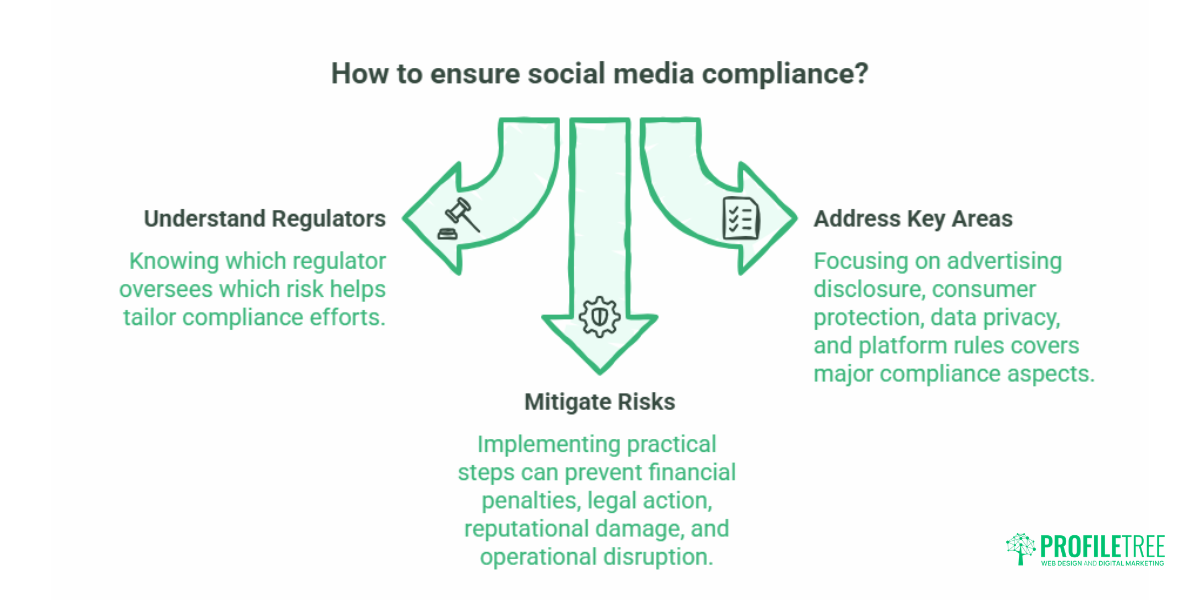
Social media compliance refers to adherence to the legal, ethical, and regulatory standards that apply when you create, distribute, and promote content on social platforms. It spans four broad areas: advertising disclosure, consumer protection, data privacy, and platform-specific rules. Get any one of them wrong and the consequences land in the same place.
The fallout from non-compliance tends to fall into four categories:
- Financial penalties. Regulatory fines under UK-GDPR can reach £17.5 million or 4% of annual worldwide turnover, whichever is higher.
- Legal action. Claims from consumers, competitors, or regulators.
- Reputational damage. Lost trust that costs far more than any fine.
- Operational disruption. Account suspensions or ad rejections that halt active campaigns.
Most UK SMEs will never face a maximum fine. The realistic risk is a regulator investigation, a public ruling, or a suspended ad account at the worst possible moment in a campaign. That is the risk worth managing.
Who Regulates Social Media Marketing in the UK
Four bodies do most of the work, and they oversee different things.
| Regulator | What it covers on social media | Maximum penalty |
|---|---|---|
| ASA (Advertising Standards Authority) | Ad content, honesty, #Ad disclosure under the CAP Code | Public rulings, ad removal, referral to Trading Standards |
| CMA (Competition and Markets Authority) | Consumer protection, fake reviews, and hidden endorsements under the DMCC Act 2024 | Direct fines up to 10% of global turnover |
| ICO (Information Commissioner’s Office) | Data, cookies, tracking pixels under UK-GDPR and PECR | Up to £17.5 million or 4% of global turnover |
| FCA (Financial Conduct Authority) | Financial promotions on social media | Enforcement action, bans on promotions |
Knowing which regulator owns which risk is the first step to building a workable compliance process. A misleading product claim is an ASA and CMA matter. A tracking pixel firing before consent is an ICO matter. The same campaign can touch all four.
Privacy and Data Protection Risks
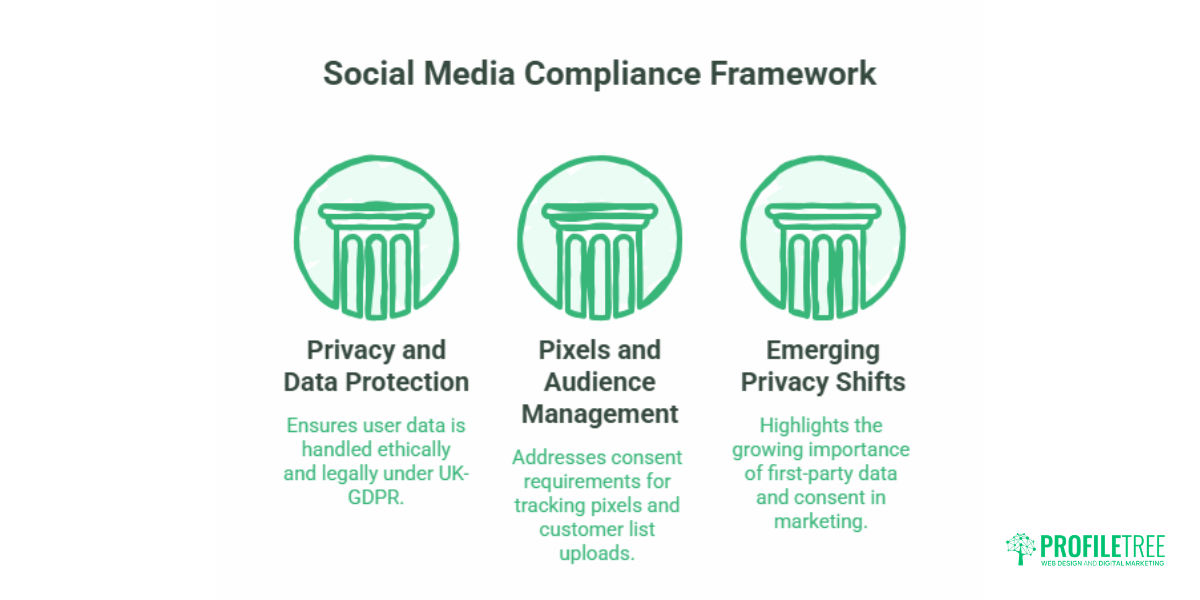
Social media marketing runs on user data, and that puts it squarely under UK-GDPR. Targeted advertising, custom audiences, and retargeting all rely on collecting and processing personal information, which means consent and transparency are not optional extras.
Common violations are familiar to anyone who has audited a campaign:
- Collecting personal data without clear, informed consent.
- Firing tracking cookies or pixels before the visitor has agreed.
- Sharing or uploading customer lists to ad platforms without a lawful basis.
The fix usually starts on your own website rather than on the social platform. A compliant cookie consent banner that actually blocks non-essential tracking until the visitor accepts, a clear privacy policy that explains how data is used, and marketing systems that are reviewed as the rules change. This is where the social campaign and the website meet, and where a poorly configured site quietly creates exposure that the marketing team never sees. Teams that struggle with this often benefit from a structured review, and our GDPR compliance checklist walks through the practical steps for small businesses.
Pixels, Custom Audiences, and Consent
If you run Meta or LinkedIn ads, you are almost certainly using tracking pixels and uploading customer lists to build audiences. The ICO’s position is that pixel tracking needs consent under PECR, and that customer list uploads need a lawful basis under UK-GDPR. Both are easy to get wrong because the technical setup often happens during website development and is rarely revisited.
A quick audit question for any campaign: does your pixel fire before or after the consent banner is accepted? If it fires before, you have a problem. Getting the website built and hosting setup right at the technical level is what makes the difference, because consent management has to be wired into the site, not bolted on afterwards.
Emerging Privacy Shifts
Privacy-focused changes such as Apple’s App Tracking Transparency framework have already altered how businesses track behaviour across apps, and the direction of travel is towards more consent, not less. Marketers who build campaigns around first-party data and clear consent are better placed than those still relying on broad third-party tracking.
Misleading Advertising and the #Ad Rules
In the UK, the ASA enforces the CAP Code, which requires marketing to be legal, decent, honest, and truthful. Misleading claims or unclear promotions breach the code, and on social media, the most common breach is undisclosed advertising.
Examples of practices that draw ASA’s attention:
- Exaggerated claims about what a product or service does.
- Hidden costs or unclear eligibility for a discount or offer.
- “Bait-and-switch” promotions where the advertised item is not actually available as described.
When You Must Use #Ad
Any content you have paid for, incentivised, or controlled needs a clear, upfront label. That covers paid posts, gifted products, free services, event invites, loans of equipment, and affiliate arrangements. The disclosure has to be visible before the user interacts with the post, which means it cannot be buried at the end of a caption behind a “more” link or lost in a block of hashtags.
A few rules that consistently hold up:
- Label paid partnerships clearly with #Ad or #Advert, placed where it is seen first.
- Platform tools like Instagram’s “Paid Partnership” tag help, but the ASA does not always treat them as sufficient on their own.
- Gifts and freebies count as incentives and need the same disclosure as cash payments.
Influencer Compliance and Shared Liability
Influencers reach targeted audiences efficiently, but transparency is where campaigns fall down. The important point for brands: you cannot outsource your legal responsibility. The ASA and CMA hold the brand responsible alongside the creator, and in practice, the brand usually carries the greater share of reputational and commercial risk even when a third-party creator commits the breach.
That makes the influencer contract a compliance document, not just a commercial one. Clear clauses on disclosure, approval of content before it goes live, and the right to require corrections protect the brand. Building these into a wider social media marketing process is far cheaper than managing a response after the fact.
The DMCC Act 2024: Direct Fines Change the Calculation
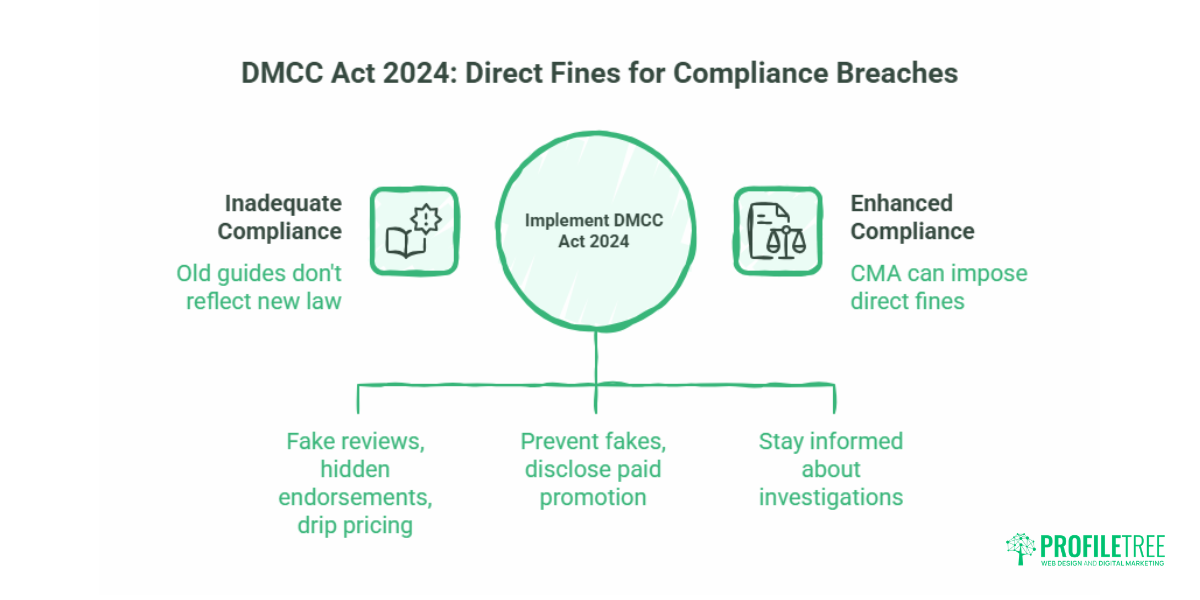
The single biggest shift in UK social media compliance is the Digital Markets, Competition and Consumers Act 2024. Since 6 April 2025, the CMA can decide for itself that a business has breached consumer law and impose a fine of up to 10% of global annual turnover, without first going to court. That is a genuine change in the risk profile, and most older compliance guides have not caught up with it.
The Act replaced the Consumer Protection from Unfair Trading Regulations 2008 and introduced specific bans that matter for social marketing:
- Fake and misleading reviews. Submitting, commissioning, or facilitating fake reviews is now prohibited, as is publishing reviews without reasonable steps to prevent fakes.
- Hidden endorsements. Concealed incentivised reviews and undisclosed paid promotion fall directly within scope.
- Drip pricing. Headline prices that hide mandatory charges added later in the journey are banned.
In November 2025, the CMA opened its first formal investigations under the new regime and sent advisory letters to 100 businesses across sectors, including travel, events, and delivery. The early focus has been on pricing practices, but the message to brands is clear: the powers are now being used.
“The most common compliance failure we see with UK SMEs isn’t deliberate, it’s invisible. A tracking pixel firing before consent, a gifted post with no #Ad label, an old testimonial nobody checked. None of it looks like a risk until a regulator asks the question.”
Ciaran Connolly, Founder, ProfileTree
Intellectual Property and Content Rights
Social campaigns lean on visuals, music, and video, and using any of them without permission creates an IP infringement risk. The three recurring problems are copyright violations from unlicensed images, video, or music; trademark misuse involving another brand’s logo or distinctive design; and reposting user-generated content without the creator’s permission.
The mitigations are straightforward in principle. Commission original content or use properly licensed media libraries. Get written consent before reposting user content, and credit the creator. Train the marketing team so the people making daily posting decisions understand where the lines sit. Original visual content also performs better in search, which is one reason commissioning bespoke imagery and video production tends to pay back twice.
AI-Generated Content and Ownership
AI tools now produce a large share of marketing text and imagery, and the ownership and copyright status of that output remains legally unsettled. The practical risks are twofold: AI may reproduce protected material, and synthetic media such as AI avatars or voiceovers may need disclosure under advertising rules. Brands adopting these tools need a clear internal policy on what gets disclosed and who owns the liability. Putting that policy in place is part of any sensible AI adoption process, rather than something to work out after a campaign has already run.
Consumer Protection and Transparency
The DMCC Act regime requires businesses to avoid misleading consumers, which means being upfront about costs, availability, and terms. On social media, the common failures are hidden fees in subscription offers, inflated product descriptions, and promotional offers with unclear conditions.
Affiliate marketing carries its own transparency duty. When you promote affiliate links, consumers must know there is a financial incentive behind the recommendation. Presenting an affiliate promotion as an impartial review is both an ethical problem and a legal one. Disclose the relationship plainly.
Accessibility and Inclusivity
People with a range of abilities use social platforms, and ignoring accessibility both excludes a meaningful part of your audience and creates potential exposure under equality law. The common gaps are predictable: missing alt text on images, video without captions or transcripts, and poor colour contrast that makes text hard to read.
The fixes are mostly procedural. Use the built-in alt text tools on platforms like Instagram and X, add subtitles to videos, and test designs for readability before they ship. Accessible content also reaches more people and tends to perform better, so the business case runs in the same direction as the compliance case. The same accessibility standards should apply to the website behind your campaigns, which is a web design consideration as much as a social one.
Platform-Specific Rules
Each platform sets its own advertising guidelines on top of the law, and breaching them can mean account suspension or ad rejection, regardless of whether you have broken any UK rules. Facebook restricts misleading or sensationalised content, TikTok prohibits ads for certain regulated industries, and X enforces its own policies on political content.
The practical approach is to assign clear ownership of platform-policy monitoring within the team, keep a working relationship with platform account managers where you have them, and review live campaigns regularly rather than setting and forgetting. Policies change without much notice, and a campaign that was compliant at launch can drift offside.
Internal Risk: Employees and Brand Representation
Staff social activity reflects on the business, and while employee advocacy can extend reach, it needs clear guidelines. The risks are inadvertent sharing of confidential information and posts that reflect badly on the brand.
A written social media policy for employees, combined with regular training on brand representation and online conduct, handles most of this. This is one of the areas where digital training earns its keep, because the people creating and approving content daily are the ones who need to recognise a compliance risk before it goes live, not after.
What Non-Compliance Actually Costs
The financial maximums are real but rarely reached. The more common costs are the investigation itself, the public ruling, and the disruption.
For data breaches, the ICO can fine up to £17.5 million or 4% of global turnover. The largest UK examples show how the framework works in practice: British Airways was fined £20 million in 2020 for a 2018 breach affecting around 400,000 customers, and Marriott International was fined £18.4 million the same year. Both started as far larger proposals before mitigation reduced them.
For consumer law breaches under the DMCC Act, the CMA can now fine up to 10% of global turnover directly. For most SMEs, the realistic exposure is a proportionate fine, an enforcement notice, or the reputational hit of a public ruling. None of those is cheap, and all of them are avoidable with a working compliance process.
Building a Compliance Process That Holds Up
Compliance is not a one-off audit. It is a repeatable process built into how campaigns are planned, approved, and reviewed. Three habits make the biggest difference.
Continuous education keeps the team current as the rules shift, which they have done significantly in the past two years. A pre-publication sign-off step catches the disclosure label that was forgotten and the claim nobody sourced. And periodic audits across active campaigns surface the slow-burn risks, like a tracking pixel that was reconfigured during a site update and now fires before consent.
For UK SMEs without an in-house compliance reviewer, this is often where an agency partner adds the most value: running the sign-off process, keeping the website’s consent setup correct, and training the team so the checks become second nature. A considered digital strategy treats compliance as part of campaign management, not a separate chore bolted on at the end.
Conclusion
Social media compliance has moved from a legal footnote to a core part of running campaigns in the UK. The DMCC Act 2024 gave the CMA direct fining power; the ICO’s data penalties remain substantial, and the ASA continues to act on undisclosed advertising. The businesses that manage this well are the ones that treat compliance as a process: clear disclosure, proper consent, trained staff, and regular review. Get those four right, and the rest follows.
Frequently Asked Questions
Does the ASA regulate social media marketing?
Yes. The ASA applies the CAP Code to social media advertising and acts on misleading claims and undisclosed paid content. It can issue public rulings and refer persistent breaches to Trading Standards.
When do you need to use #Ad on social media in the UK?
Whenever content is paid for, gifted, incentivised, or controlled by the brand. The label must be clear and visible before the user interacts with the post, not hidden at the end of a caption or in a block of hashtags.
What is the maximum fine for non-compliant social media marketing in the UK?
Under the DMCC Act 2024, the CMA can fine up to 10% of global annual turnover for consumer law breaches. For data breaches, the ICO can fine up to £17.5 million or 4% of global turnover, whichever is higher.
Who is responsible if an influencer fails to disclose a paid post?
Both the brand and the influencer are held responsible. In practice, the brand usually carries the greater commercial and reputational risk, which is why disclosure clauses in influencer contracts matter.
Does using a platform’s “Paid Partnership” label satisfy UK law?
Not always on its own. The ASA requires disclosure to be clear and prominent. If a platform label is easily missed, brands should supplement it with a written #Ad label.