
Integrated Payment Solutions: A Guide for UK and Irish SMEs
Table of Contents
Integrated payment solutions are one of those topics where the gap between what a business owner needs to know and what most guides actually cover is surprisingly wide. The top results explain what integrated payments are, list a few providers, and move on. What they rarely address is the operational reality for a business trading in the UK or Ireland: the GBP/EUR complexity, the specific accounting software that most SMEs here actually use, the regulatory picture after Brexit, or the fact that a payment system is only as reliable as the website it runs on.
Whether you are running a WooCommerce store in Belfast, a multi-location hospitality business in Dublin, or a service company that invoices clients across the border, the decisions involved in choosing and integrating a payment solution are the same decisions that affect your cash flow, your reconciliation workload, and the experience your customers have at the most important moment of the transaction. Getting those decisions right matters more than picking the provider with the lowest headline rate. Read on for the practical questions: how integrated systems actually function, what to look for in a UK or Irish context, where the hidden costs sit, and how your website infrastructure affects whether the whole thing performs as it should.
What Are Integrated Payment Solutions?
An integrated payment solution connects your payment processing directly to the other software your business runs on. Instead of a standalone card terminal that operates in isolation, the payment system communicates with your point-of-sale (POS) software, e-commerce platform, accounting package, and inventory system in real time.
When a customer pays, the transaction is recorded automatically across all connected systems. Stock levels update. The sale appears in Xero or Sage without anyone having to enter it. Reconciliation at the end of the day takes minutes rather than an hour of cross-referencing terminal receipts against accounting entries.
Integrated vs Standalone: What Changes
A standalone terminal processes payments and nothing else. It produces a Z-report at day’s end, and someone manually transfers that data into the accounting system. Errors creep in. Reconciliation lags. Refunds and chargebacks require manual adjustment across multiple records.
An integrated system does the same job with a closed data loop. Payment data flows automatically into your financial records the moment the transaction completes. For a business processing 30 or more transactions a day, the time saved is substantial. For a business operating across two currencies or multiple sales channels, it is not optional.
Integrated vs Embedded Payments
These terms are sometimes used interchangeably, but they describe different things. Integrated payments connect an existing payment gateway to your business software via an API. Embedded payments go further: the payment capability is built directly into a software platform as a native feature, so the merchant never leaves the platform’s interface to process a transaction. Shopify Payments and Wix Payments are examples of embedded payments. Stripe or Worldpay connected to WooCommerce is an integration. For most UK and Irish SMEs, the practical difference comes down to flexibility: integration gives you more control over provider choice, while embedded solutions trade flexibility for simplicity.
How Integrated Payment Processing Works: The Data Loop
Understanding the technical flow helps when you are evaluating whether a solution will work with your specific software stack.
The basic sequence runs like this: a customer initiates payment through your checkout (online or in person), the gateway encrypts and transmits the payment data to the acquirer, the acquirer requests authorisation from the card network, and the issuing bank approves or declines. That authorisation then triggers a return signal that updates your POS, e-commerce platform, inventory, and accounting records simultaneously.
The integration layer sits between your gateway and your business software. It is usually managed through an API provided by the payment processor. The quality of that API and how well it integrates with the specific software you use are the single most important technical factors in whether integration works well in practice.
What This Means for Your Website
For businesses taking online payments, the payment experience is part of the website experience. A poorly integrated checkout, a gateway that redirects customers to a third-party domain mid-purchase, or a payment page that does not work well on mobile are all design and development problems as much as payment problems.
Ciaran Connolly, founder of ProfileTree, puts it plainly: “The checkout is not a separate system bolted onto a website; it is part of the user journey, and if the design, speed, or trust signals break down at that stage, you lose the sale regardless of how good the product is.” Getting the technical integration right requires the same attention to UX as the rest of the site demands.
The Benefits for UK and Irish SMEs
The operational case for integrated payment solutions is straightforward. The regional case is less well covered, and it matters for businesses operating on either side of the Irish border or trading across the GBP/EUR divide.
Automated Reconciliation
Manual bank reconciliation is one of the most time-consuming administrative tasks for SME owners. Cross-referencing card terminal totals, online payment records, refunds, and chargebacks against your accounting software at month-end is genuinely tedious and error-prone. Integration eliminates most of it. Transactions post directly to your ledger; your accountant works from clean, current data rather than correcting entry errors.
Real-Time Cash Flow Visibility
When payment data automatically flows into your accounting software, your cash flow picture is always up to date. For businesses using Xero, QuickBooks, or Sage, integration means your dashboard reflects actual trading in real time rather than with a lag of several days. That visibility changes how owners make decisions about stock, staffing, and supplier payments.
Reduced Transaction Errors
Manual data entry between a terminal and an accounting system introduces errors at a steady rate. Transposed digits, missed refunds, and miscounted batch totals all require time to find and correct. Automated data transfer between payment and accounting systems removes most of that error surface.
Better Customer Experience at Checkout
A well-built, integrated checkout is faster and requires less customer input. Fewer steps, no redirects to unfamiliar domains, visible security signals, and a clean mobile display all reduce cart abandonment. For any business where a meaningful share of purchases happens on mobile devices, these are not cosmetic issues.
The UK and Ireland Cross-Border Consideration
Businesses operating across the Northern Ireland-Republic of Ireland border face a specific complexity that most payment guides written for global or US audiences do not address. Dual-currency support (GBP and EUR), settlement accounts in both currencies, and compliance with both FCA regulation and Central Bank of Ireland requirements affect which providers are practical choices. A solution built for the US market and technically available in the UK may not handle the GBP/EUR settlement relationship, the VAT treatment across jurisdictions, or the local accounting software integrations that most Irish and Northern Irish SMEs rely on.
This is one area where choosing a provider with a genuine UK and Ireland presence, rather than a US-centric platform with a UK entity, makes a material difference to day-to-day operation.
UK and Irish Regulatory Requirements
Payment processing in the UK and Ireland is subject to a specific regulatory framework that has evolved significantly since Brexit and the introduction of PSD2.
PCI DSS Compliance
Payment Card Industry Data Security Standard (PCI DSS) compliance applies to any business that stores, processes, or transmits card data. For most SMEs using a hosted payment page or a gateway that handles card data directly (rather than the business itself storing it), PCI compliance is managed primarily by the provider. You are still responsible for the environment around it: your website must be served over HTTPS, your plugin versions must be kept up to date, and you must complete an annual self-assessment questionnaire.
Compliance is not a one-time event. It requires ongoing maintenance, and a failure in your hosting environment or an outdated plugin can create a vulnerability even if your payment gateway is fully certified. This is why payment security and website security are closely linked: the checkout is only as secure as the platform it sits on.
Strong Customer Authentication (SCA) Under PSD2
PSD2 mandates Strong Customer Authentication for most online card transactions across the UK and EU. This requires two-factor verification from the cardholder: something they know (a PIN), something they have (a phone), or something they are (biometric). Most modern payment gateways handle SCA compliance automatically, but older integrations, custom checkouts, and some subscription billing setups require specific attention. If your checkout is built on an ageing custom implementation or a plugin that has not been updated recently, SCA compliance may not be fully in place.
FCA Authorisation and the Republic of Ireland
Payment service providers operating in the UK must be authorised by the Financial Conduct Authority. Providers operating in the Republic of Ireland must hold authorisation from the Central Bank of Ireland or operate under a passporting arrangement. Post-Brexit, passporting arrangements between the UK and the EU are no longer automatic, meaning some providers who previously covered both markets through a single licence now require separate authorisation in each jurisdiction. For cross-border businesses, verifying the regulatory status of a provider in each jurisdiction in which they operate is mandatory.
Choosing an Integrated Payment Provider: What to Evaluate
The comparison tables most payment guides publish tend to focus on headline transaction rates. For SME decision-makers, the most important variables are often those that determine whether the integration actually works day to day.
Software Compatibility
The most important question is whether the provider integrates natively and reliably with the software you already use. For UK and Irish SMEs, the most common accounting platforms are Xero, QuickBooks, Sage, or FreeAgent. For e-commerce, WooCommerce and Shopify are the most common bases. For hospitality and retail, EPOS Now, Lightspeed, and various sector-specific POS systems are common.
A provider that integrates well with Shopify but has a poorly maintained WooCommerce extension, or that connects to QuickBooks but not to Sage or Brightpay (widely used in Northern Ireland and the Republic), creates operational friction from day one. Check the integration quality, not just the integration claim.
| Factor | What to Check |
|---|---|
| Accounting software | Native connector or API for Xero/Sage/QuickBooks? Is it maintained? |
| E-commerce platform | WooCommerce, Shopify, or custom: what level of integration is supported? |
| Dual currency | Can it settle in both GBP and EUR to separate accounts? |
| Offline capability | What happens during an internet outage? Does the terminal hold transactions? |
| FCA/CBI authorisation | Is the provider regulated in each jurisdiction you operate? |
| Pricing model | Interchange plus or blended rate? Are scheme fees itemised or bundled? |
Understanding the Real Cost: Interchange Plus vs Blended Rates
Most SMEs start with blended-rate pricing: a single percentage applies to all transactions, regardless of card type. This is simpler but usually more expensive than interchange-plus pricing, where the actual interchange cost is passed through, and the processor adds a fixed margin on top. Blended rates are typically higher, but their predictability can be useful for businesses with tightly managed margins.
The hidden costs to look for are scheme fees (charged by Visa and Mastercard on top of interchange), authorisation fees (a fixed amount per attempted transaction, including declined ones), chargeback fees, and minimum monthly charges. These are often disclosed only in the full contract rather than the headline rate card.
Offline Resilience
In the UK, broadband and mobile connectivity outages happen. In rural areas of Northern Ireland and the Republic of Ireland, they happen more often. A payment terminal that becomes non-functional during an outage is a serious business risk for retail and hospitality. Some integrated systems offer an offline mode that queues and processes transactions once connectivity is restored. This is worth explicitly verifying with any provider before committing to a contract.
Payment Integration and Your Website: The Connection Most Guides Miss
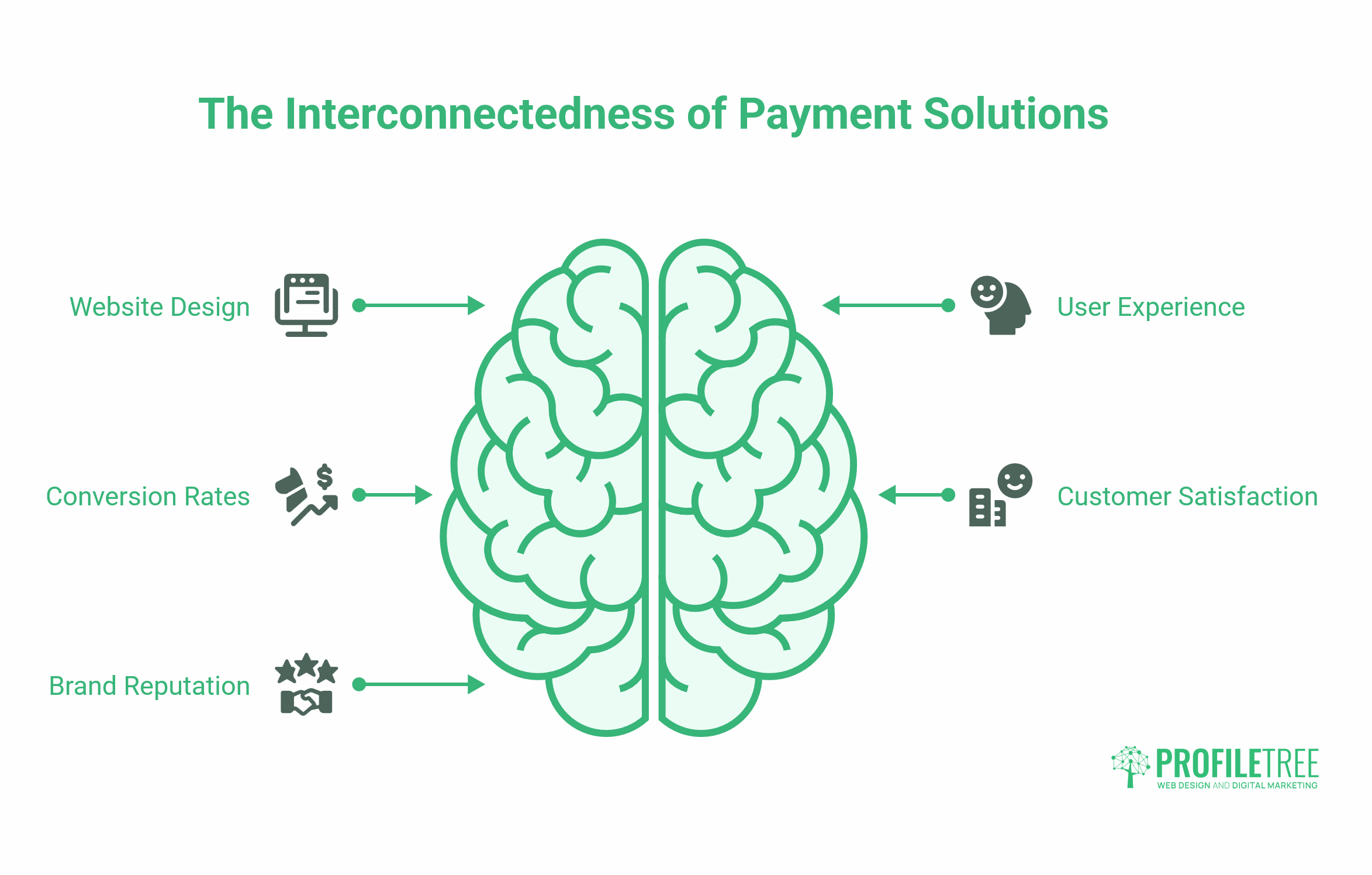
A payment solution does not exist in isolation. For any SME taking online payments, the quality of the integration depends on the quality of the website it is built into.
WooCommerce and WordPress
WooCommerce is the most widely used e-commerce platform in the UK and Ireland for SMEs, largely because it sits within the WordPress environment that most small business websites are already built on. Most major payment gateways (Stripe, Worldpay, PayPal, Opayo) have WooCommerce extensions. The quality of those extensions varies. A well-maintained extension on a well-maintained WordPress installation, running on a reliable host with HTTPS correctly configured, provides a stable and secure checkout. An outdated extension on an old WordPress version with unpatched plugins does not.
The checkout experience within WooCommerce is also customisable to a degree that some hosted e-commerce platforms do not allow. This matters for conversion: the default WooCommerce checkout can be streamlined, the form fields simplified, and the trust signals (security badges, clear returns information) placed exactly where they help. These are design and development decisions that affect payment performance even though they sit outside the payment gateway itself.
Site Speed and Checkout Conversion
Page load speed affects checkout completion rates. A product page that loads quickly but a checkout that takes four seconds to render loses sales at a measurable rate. The technical causes are typically script loading, third-party payment widgets, or poor hosting performance at checkout. These are fixable problems, but they require development attention, not just gateway configuration.
ProfileTree’s digital marketing strategy regularly works for SME clients, identifying checkout abandonment as a conversion problem with a clear technical root cause. The fix is rarely in the payment settings; it is usually in how the site is built and hosted.
The Role of AI in Payment Operations
AI-powered tools are increasingly used in payment operations for fraud detection, chargeback management, and predictive reconciliation. Some payment providers have built these capabilities into their platforms; others offer them as add-on services. For SMEs, the practical relevance lies in fraud scoring for individual transactions (flagging unusual orders before fulfilment) and automated dispute management.
Separately, AI implementation within a broader business context: connecting payment data to inventory forecasting, customer segmentation, or variable pricing: this is an area where the benefits are real, but the setup requires more than a payment gateway integration. It requires a digital infrastructure that connects systems and surfaces the data in a usable way.
Implementation: Moving from Standalone to Integrated
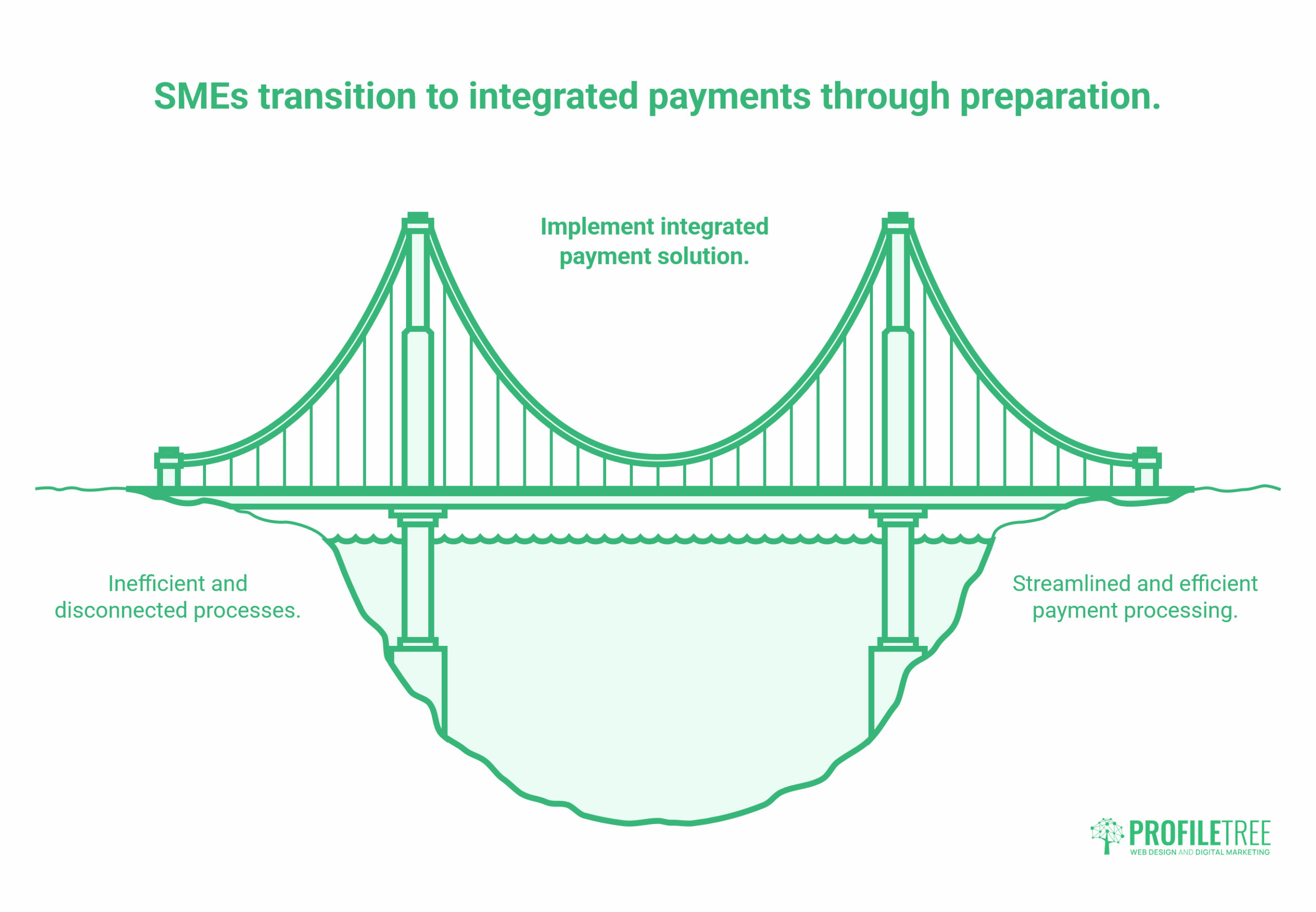
The practical steps involved in switching to an integrated payment solution are manageable for most SMEs, but they require a clear sequence and some preparation.
Step 1: Audit your current tech stack. List every piece of software that will need to connect to the new payment system: accounting platform, e-commerce platform, POS system, inventory management, and any subscription or booking tools.
Step 2: Shortlist providers with verified compatibility. Do not rely on a provider’s general claims about integrations. Check the specific connector or extension for each piece of software you use. Read recent reviews from users on the same stack.
Step 3: Verify regulatory compliance. Confirm FCA authorisation for UK operations and CBI authorisation or passporting for the Republic of Ireland operations if relevant.
Step 4: Understand the full cost structure. Get a written breakdown of all fees: transaction rate, scheme fees, authorisation fees, chargeback fees, and minimum monthly charges.
Step 5: Plan the website changes. If you are adding or replacing an online checkout, plan the development work in parallel with the gateway setup. The checkout design, mobile experience, and page speed should be addressed as part of the same project, not added as an afterthought.
Step 6: Test before going live. Most gateways provide a sandbox environment. Test the full transaction flow, including refunds, failed payments, and subscription renewals if applicable, before switching over.
Step 7: Train your team. Integrated systems provide more data than standalone terminals. Make sure whoever manages your accounts understands how to read and reconcile the automated records.
Conclusion
Getting the integration right (technically, commercially, and from a user experience perspective) requires the same care as any other part of your digital infrastructure. The ProfileTree team works with SMEs across Northern Ireland, Ireland, and the UK on web development and digital strategy projects, including e-commerce setup, payment gateway integration, and site performance. If you are reviewing your payment setup as part of a broader website project, get in touch to discuss what is involved.
FAQs
What are integrated payment solutions?
Integrated payment solutions connect your payment processing directly to the other software your business runs, such as your accounting package, e-commerce platform, or point-of-sale system, so transaction data updates automatically across all connected systems when a payment is processed, rather than being entered manually.
How do integrated payments work technically?
An API connects your payment gateway to your business software. When a transaction completes, the gateway sends a data signal that triggers updates across all integrated systems simultaneously. The quality of that API and its integration with your specific software determine how reliably this works in practice.
What is the difference between integrated and embedded payments?
Integrated payments connect a third-party gateway to your existing software via an API. Embedded payments build payment capability directly into a platform as a native feature. Shopify Payments is embedded; connecting Stripe to WooCommerce is integration. Integration offers more provider flexibility; embedded solutions offer more simplicity.
Which businesses benefit most from integrated payment solutions?
Any business processing more than 20 to 30 transactions a day gains meaningfully from automated reconciliation alone. Businesses operating across multiple sales channels, those trading in both GBP and EUR, and subscription-based businesses all have a particularly strong case.