
Risk Assessment for Marketing Strategies: A Practical UK Guide
Table of Contents
Most marketing budgets are spent with confidence. The brief looks solid, the channels are familiar, and the team has done this before. Then something goes wrong, a campaign misses badly, a regulatory complaint lands, a social post catches the wrong kind of attention, and the post-mortem reveals that the warning signs were there all along.
A risk assessment for marketing is the process that surfaces those warning signs before they become problems. It is not a bureaucratic exercise or a reason to slow down ambitious campaigns. It is the thinking that allows you to move faster, because you have already worked out what you would do if something goes wrong.
This guide covers the four categories of marketing risk, the five-step assessment process used by UK marketing teams, and the compliance obligations that most published guides miss entirely, including ICO enforcement, ASA CAP Code requirements, and CMA digital marketing guidance. It also addresses the risks AI tools introduce to modern campaign strategies, as well as the monitoring infrastructure available to SMEs that cannot afford a dedicated risk function.
What Is Marketing Risk Assessment?
A marketing risk assessment is the process of identifying, analysing and prioritising threats that could prevent a marketing campaign or strategy from achieving its objectives. It sits within the broader discipline of business risk management but focuses specifically on the activities, channels, and decisions within the marketing function.
The distinction matters. Business risk covers the full operational picture: supply chain, finance, HR, and legal exposure across the organisation. Marketing risk is a specific subset. It deals with the hazards introduced when you spend the budget to change customer behaviour. The two overlap in areas like reputational damage and regulatory non-compliance, but the assessment process, the people responsible, and the mitigations are often quite different.
For UK SMEs, a formal marketing risk assessment is increasingly expected when presenting annual plans to investors, applying for growth funding, or working with enterprise clients who conduct their own supplier due diligence. You can find useful context on how business expansion risk management connects to marketing planning in a related article.
The Four Types of Marketing Risk
The most commonly used classification breaks marketing risk into four categories. Understanding each one is the starting point for any assessment.
Financial Risk
Financial risk in marketing refers to the possibility that spending does not generate expected returns. This includes budget overruns on paid media, declining conversion rates that increase cost per acquisition beyond viable levels, and campaigns that perform well on vanity metrics but fail to produce revenue. Channel concentration is a particularly common financial risk for SMEs: a business that relies heavily on a single paid channel is exposed if that platform changes its pricing model or targeting rules.
A proper ROI tracking framework is the first line of defence here. Teams that review cost-per-lead and cost-per-acquisition weekly can identify budget bleed early enough to redirect spend. Those who review monthly often discover the damage after the quarter is already lost.
Reputational Risk
Reputational risk is the most visible category, and often the hardest to recover from quickly. It includes social media crises, influencer partnerships that backfire, campaigns that land poorly with specific audiences, and messaging that misses the cultural moment. Some of the most instructive examples appear in ProfileTree’s breakdown of marketing campaigns that went wrong. The patterns are remarkably consistent: inadequate pre-launch review, no escalation process, and no prepared crisis response protocol.
Reputational risk is not just a large-brand problem. A single poorly judged social post from a Northern Ireland SME can reach a far wider audience than its organic following through sharing and press coverage. The mitigation is not risk avoidance: it is having a review process that asks who could take offence at this, and why, before content goes live, and a clear response plan if something does go wrong.
Operational Risk
Operational risk covers the internal and logistical failures that prevent a campaign from executing as planned. Missed launch dates, technology failures on campaign landing pages, underperforming agency partners, staff turnover during a campaign, and approval bottlenecks are all operational risks. For businesses running content-led campaigns, the gap between planned content volume and actual production capacity is one of the most common sources of operational risk.
Operational risk assessment is closely connected to campaign planning discipline. Teams that build risk checkpoints into their project timelines, rather than treating risk as a separate document produced once at the start, tend to catch operational problems early. A marketing audit conducted before a major campaign launches is an effective way to surface operational gaps before they become live failures.
Legal and Compliance Risk
Legal risk is the category where UK-specific context matters most, and where the majority of published guides fall short. UK marketing operates under a distinct regulatory framework, and the consequences of getting it wrong are documented and public.
The core UK-specific compliance risks are covered in the dedicated section below. The broader principles of ethics and legalities of digital marketing provide useful additional context on how these obligations interact with day-to-day marketing decisions.
The Five-Step Marketing Risk Assessment Process
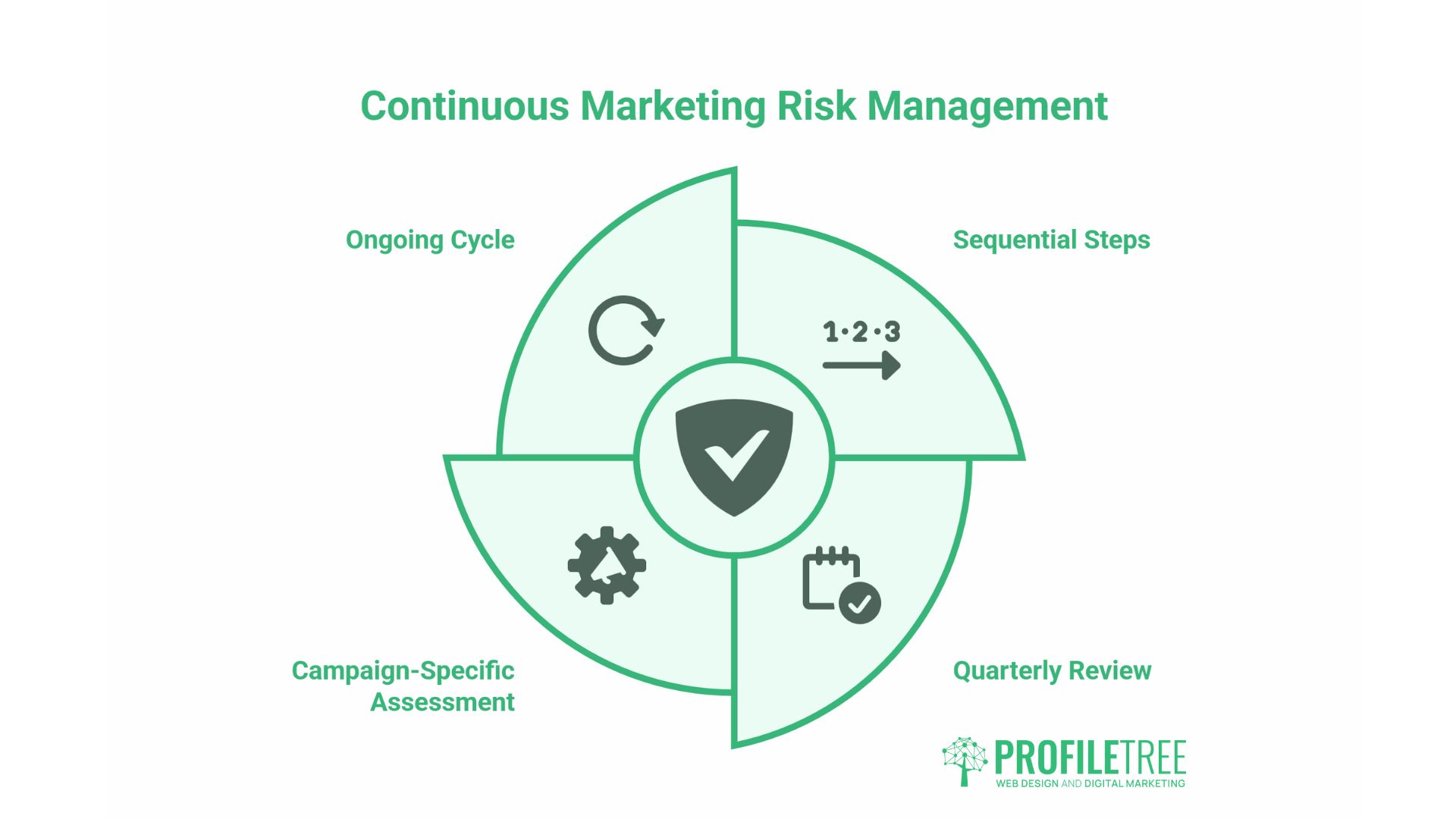
This process applies whether you are assessing a single campaign or a full annual marketing plan. The five steps are sequential but not one-off: a well-run marketing function returns to this cycle quarterly, and before any campaign with significant spend or reputational exposure.
Step 1: Identify Potential Risks
Start with a structured brainstorm across the team, drawing on four inputs: past campaign experience (what went wrong before), a SWOT analysis of the current plan, a PESTLE review covering the political, economic, social, technological, legal and environmental factors relevant to your market, and a channel-by-channel audit of dependencies and single points of failure.
Do not limit the identification process to senior staff. Channel managers, content producers and campaign coordinators often have the most direct visibility of operational risks. Build an environment where flagging a potential problem is expected, not treated as scepticism about the plan.
Step 2: Analyse Likelihood and Impact
Once risks are identified, score each on two axes: how likely is it to occur, and how severe would the impact be if it did? The output is a risk matrix, typically a 5×5 grid with probability on one axis and impact on the other. Risks that score high on both axes are your priorities. High-impact, low-probability risks, such as a major regulatory change affecting your sector, should be monitored even if they do not require immediate action.
The matrix does not need to be elaborate. A shared spreadsheet with consistent scoring criteria, reviewed by multiple people, is more useful than a complex document produced once and never opened again.
Step 3: Prioritise and Assign Ownership
Prioritise the top risks from your matrix and assign a named owner to each. A risk without an owner will not be monitored. The owner is responsible for the mitigation plan, for reporting on status, and for escalating if the risk materialises.
At this stage, categorise your response strategy for each risk. There are four options: treat (take action to reduce the likelihood or impact), tolerate (accept the risk as within acceptable limits), transfer (shift the exposure to a third party, such as through contractual protections or insurance), or terminate (remove the activity that creates the risk altogether).
Step 4: Develop Mitigation Strategies
For each priority risk, the mitigation plan should be specific and testable. “Monitor social media” is not a mitigation. “Check brand mentions daily using a monitoring tool, with a defined escalation path if negative sentiment spikes above a set threshold in a 24-hour window” is a mitigation.
Where financial risk is the concern, maximising ROI through disciplined spend tracking and weekly performance reviews is a practical mitigation. Where reputational risk is the concern, a pre-launch review checklist and a prepared crisis communication document are the relevant tools.
Step 5: Monitor, Review and Adapt
Risk assessment is not a document you produce once before a campaign and then file. It is a live process. Monitoring frequency should match the speed at which risks can materialise: paid media campaigns with daily spend may need daily performance monitoring; brand reputation should be tracked continuously; compliance exposure should be reviewed whenever regulatory guidance changes.
Build review checkpoints into your campaign calendar. A mid-campaign risk review at the halfway point of any significant activation allows you to catch emerging risks before they become crises, and to reallocate budget away from underperforming channels before the damage accumulates. This approach connects directly to the evidence base for risk management, showing that organisations that review regularly outperform those that treat risk as a one-off planning exercise.
UK Regulatory Risks: What Most Guides Miss
The majority of marketing risk content published online is written for a US audience. It covers the FTC and CCPA in passing and provides generic advice about “advertising regulations.” For UK-based businesses, particularly those operating across Northern Ireland and the Republic of Ireland, the relevant regulatory framework is quite different, and the consequences of non-compliance are well documented.
ICO Enforcement and UK GDPR
The Information Commissioner’s Office has enforcement powers that are actively used. Data protection failures in marketing contexts, including sending unsolicited email without valid consent, failing to honour opt-out requests, or misusing customer data for targeting, can result in fines of up to £17.5 million or 4% of global annual turnover under UK GDPR. The ICO publishes its ICO enforcement actions publicly, and a review of recent cases shows that marketing-related breaches account for a significant proportion of enforcement activity.
For Northern Ireland businesses, the cross-border picture adds complexity. Campaigns reaching Republic of Ireland audiences engage both UK GDPR (regulated by the ICO) and the GDPR as retained in Irish law (regulated by the Data Protection Commission). Understanding which regulator has jurisdiction and complying with both frameworks where audiences overlap are genuine legal risks that require specific attention.
Practical mitigation: audit your consent mechanisms, email opt-in processes and data retention policies as part of your annual marketing risk assessment. If you run campaigns across both jurisdictions, document which regulatory framework applies to each audience segment. A broader overview of UK digital compliance requirements provides useful context for businesses operating online.
ASA and CAP Code Compliance
The Advertising Standards Authority enforces the CAP Code across UK marketing and advertising. Common sources of ASA complaints and formal rulings include misleading claims about product performance, inadequately disclosed paid partnerships and influencer content, and targeting restrictions for specific product categories, such as gambling, alcohol, and foods high in fat, salt, or sugar.
Influencer marketing is currently one of the highest-risk areas for ASA compliance failures. The requirement to clearly label paid partnerships and gifted content applies to all brand collaborations, regardless of the influencer’s follower count. Businesses that brief influencers without providing explicit guidance on disclosure requirements carry the compliance risk themselves, not the influencer. The legal implications of misleading advertising are more significant than many SMEs realise, and the ASA’s published rulings make the pattern of failures easy to study.
CMA Digital Marketing Enforcement
The Competition and Markets Authority has taken an increasingly active interest in digital marketing practices, particularly around fake reviews, subscription traps, and drip pricing in online advertising. The CMA’s investigations into online review manipulation have resulted in formal undertakings from major platforms and brands. For businesses that use review-generation strategies as part of their digital marketing, understanding the CMA’s guidance on genuine reviews is a legal risk that should be included in the assessment.
Maintaining a genuinely ethical marketing strategy is not just a values position: it is increasingly a compliance requirement with enforcement consequences.
AI Risks in Modern Marketing Strategies
Generative AI tools have created a new category of marketing risk that did not exist in most risk frameworks before 2023. These risks are not hypothetical. They have already produced documented brand failures and legal disputes, and they require specific assessment as part of any modern marketing risk review.
Brand Dilution and Content Authenticity
AI-generated content at scale creates reputational risk when it is inaccurate, tone-deaf, or detectable as machine-written by audiences who did not expect it. The risk is not that AI is used: most audiences accept this. It is that AI-generated content is published without adequate human review, which reflects poorly on the brand. This risk is particularly acute for long-form content, customer communications and social copy that depends on brand voice consistency.
Mitigation requires a clear internal policy on where AI-generated content is acceptable, where human review is required before publication, and the quality threshold for each context. The broader challenges of AI implementation in a marketing context, including quality control and workflow design, are worth reviewing alongside any AI content policy.
Intellectual Property and Copyright Risk
The copyright status of AI-generated content remains an evolving legal area in the UK. Images generated by AI tools may incorporate training data from copyrighted work, and the ownership of AI-generated creative output is not settled in UK law. For businesses using AI image generation in advertising campaigns, this creates a legal risk that should be assessed and documented. Understanding the ethical AI and legal requirements relevant to your marketing activity is a practical starting point.
Zero-Click Search and Algorithm Risk
Google’s AI Overviews and Bing Copilot are changing how search results deliver information to users. For businesses that depend on organic search traffic as a marketing channel, the risk of significant traffic loss to AI-generated answer summaries is a real strategic threat that should be factored into any SEO-dependent marketing plan. This is not a reason to abandon content-led marketing: content cited in AI Overviews drives brand recognition even when users do not click through. It does, however, require a shift in how content performance is measured and what success looks like. Maintaining transparency in content marketing is increasingly relevant as AI systems evaluate content credibility.
Technology and AI Risk Monitoring Tools
The same technology that creates new marketing risks also provides the monitoring infrastructure to manage them. The shift from annual to continuous risk monitoring has been made practical by a generation of tools that did not exist a decade ago.
Social listening platforms track brand mentions, sentiment shifts and emerging conversations at scale. When negative sentiment around a brand spikes, these tools can alert the team within hours rather than days, giving the communications function time to respond before a story develops momentum. The same tools flag competitor activity, regulatory announcements and sector-specific news that may affect campaign positioning.
Analytics platforms, including Google Analytics 4, the Google Search Console, and Bing Webmaster Tools, provide early warning of performance shifts that may signal underlying risks. A sudden drop in organic traffic can indicate a Google algorithm update, a technical problem on the website, or a competitor campaign that has cannibalised search visibility. Identifying which of these is driving the decline requires a combination of data and human judgement, but the data makes the identification possible.
AI-powered anomaly detection, now built into many analytics and paid media platforms, flags unusual patterns in spend, conversion rates and audience behaviour without requiring manual daily review. For smaller marketing teams, this automation makes consistent risk monitoring achievable without additional headcount.
ProfileTree’s approach to digital marketing strategy integrates risk monitoring into campaign management from the outset, rather than treating it as a separate audit function.
Marketing Risk vs Business Risk: The Difference That Matters
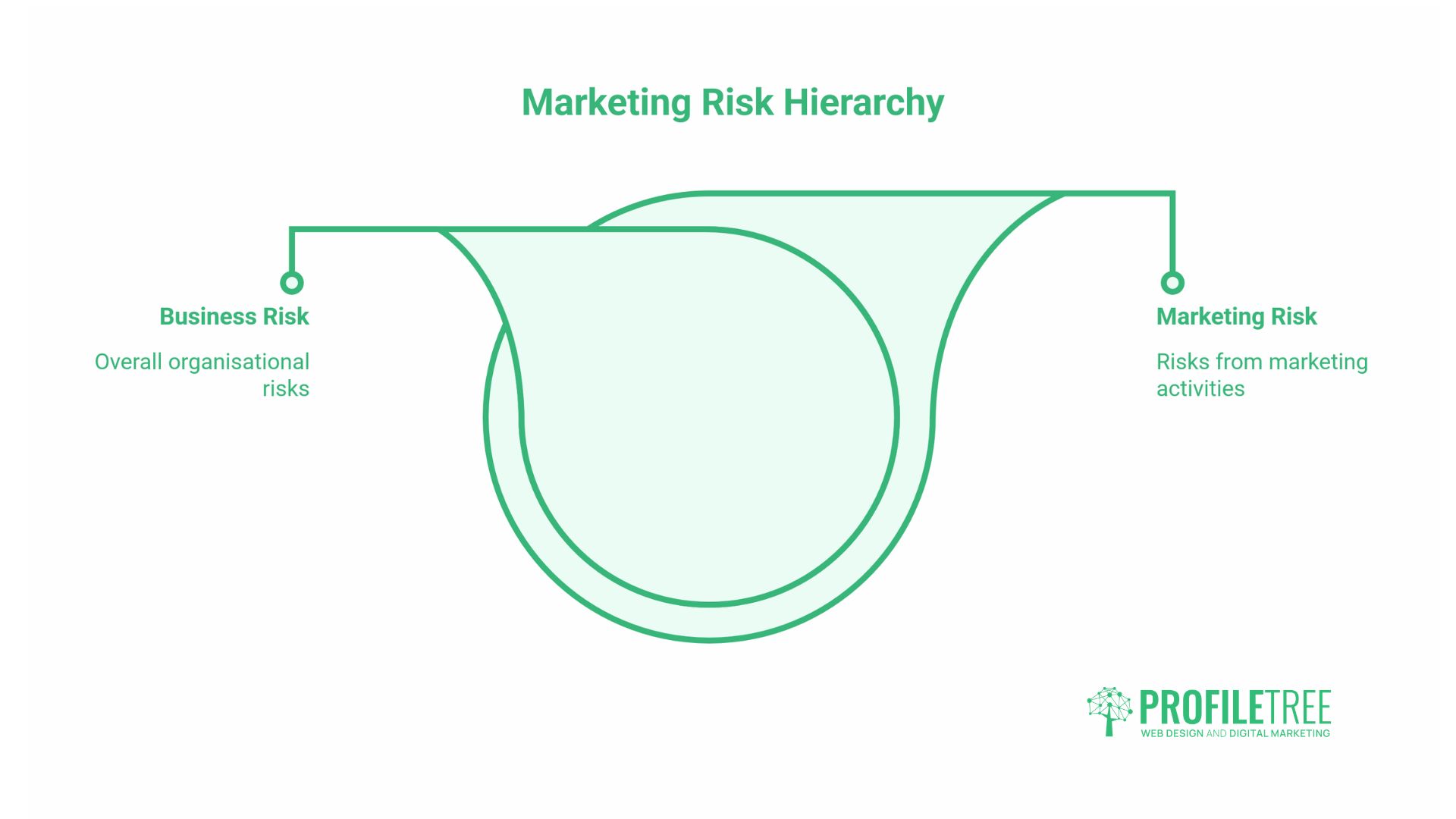
Marketing risk is a subset of business risk, not a synonym for it. Business risk encompasses the full range of operational, financial, strategic and compliance exposures an organisation faces. Marketing risk covers the specific hazards introduced by the decision to spend budget and brand capital to influence customer behaviour.
The practical difference lies in scope and ownership. A general business risk register might flag “reputational damage” as a risk. A marketing risk assessment goes further: it identifies which specific campaigns, channels or content types create that exposure, how likely a reputational event is given the current campaign plan, and who in the marketing team owns the monitoring and response.
For SMEs, the two are often conflated because the same person, a founder, a marketing manager, or a general director, is responsible for both. Keeping the frameworks distinct remains useful because the mitigations differ. Understanding how business risk management sits alongside dedicated marketing risk processes helps teams avoid duplicating effort while ensuring neither framework has significant gaps.
“The businesses we see managing risk well are not the ones with the longest risk registers,” says Ciaran Connolly, founder of ProfileTree. “They’re the ones who have a clear owner for each risk, a realistic plan for when it materialises, and a campaign review process that’s actually used. Most of the marketing failures we’ve helped clients recover from were predictable. They just didn’t have a process that would have caught them in time.”
Building Your Marketing Risk Register
A marketing risk register is the practical output of the assessment process. It is a living document, not a filing exercise. At minimum, it should record each identified risk, its likelihood and impact scores, the assigned owner, the agreed mitigation approach, and the review date.
For most UK SMEs, a well-structured spreadsheet serves this purpose adequately. It becomes genuinely useful when it is reviewed at regular intervals, quarterly for strategy-level risks and per campaign for high-spend activations, and when the review is treated as a team conversation rather than a document-filling task.
Before any significant campaign, consider running a pre-launch risk review using the register as a checklist. The process should take no more than an hour for a well-prepared team. The questions to ask at each review are: has anything changed in the regulatory environment since the last review? Has competitor activity introduced new reputational risks? Are the mitigation plans still appropriate for the current risk profile? The answers will often be “no change”. The occasions when something has shifted are the ones that matter most.
For a broader picture of what a structured pre-campaign process looks like, ProfileTree’s guide to marketing audits covers the diagnostic steps that inform both planning and risk assessment.
Conclusion: Risk Assessment for Marketing Strategies
Marketing risk does not disappear when you ignore it. It accumulates quietly until a campaign overspends, a compliance failure surfaces, or a reputational problem moves faster than your response plan.
The framework in this guide gives you a starting point: four risk categories to assess, five steps to follow, and a set of UK-specific compliance obligations that generic guides often miss. The register does not need to be elaborate. What it does need is a named owner, a realistic mitigation plan, and a review date that is actually kept.
That discipline, more than any single tactic, is what separates marketing plans that hold up under scrutiny from those that do not.
FAQs
What are the four types of marketing risks?
Financial (budget overruns, poor ROI), reputational (brand damage, social media crises), operational (logistical failures, technology problems), and legal and compliance (data protection breaches, misleading advertising). UK businesses should pay particular attention to the legal category, given their obligations under the UK GDPR, the ASA CAP Code, and CMA guidance.
How often should you perform a marketing risk assessment?
Annually at a minimum, and before any high-spend or sensitive campaign. Mid-campaign reviews at the halfway point help catch emerging risks early. Compliance-related risks should be reviewed whenever regulatory guidance changes.
What is a marketing risk matrix?
A 5×5 grid that plots each identified risk on two axes: likelihood of occurring and severity of impact. Risks scoring high on both are your immediate priorities. It makes comparing risks across categories straightforward and is useful for presenting to a board or senior stakeholder.
What are the biggest legal risks in UK digital marketing?
UK GDPR breaches, enforceable by the ICO with fines up to £17.5 million or 4% of global turnover; undisclosed advertising under the ASA CAP Code, particularly in influencer marketing; and CMA-flagged practices including fake reviews. Northern Ireland businesses targeting Irish audiences must also account for DPC obligations.