
Privacy-First Marketing for SMEs: A Practical UK & Ireland Guide
Table of Contents
If you run a small or medium-sized business in the UK or Ireland and you’ve been putting off the question of data privacy, this is the guide that explains what actually needs to change, why it matters for your marketing, and what to do first.
Privacy-first marketing is not about becoming a compliance officer. It’s about building a marketing approach that will still work in three years, when the tools that currently let you track anonymous visitors across the web are gone or restricted. For SMEs in Northern Ireland, Ireland, and the UK, the shift also carries a specific regulatory weight: UK GDPR, the ICO’s enforcement priorities, and PECR all apply, and they are not the same framework that American marketing guides are written around.
Beyond Compliance: Why Privacy-First Marketing Is Now a Commercial Advantage
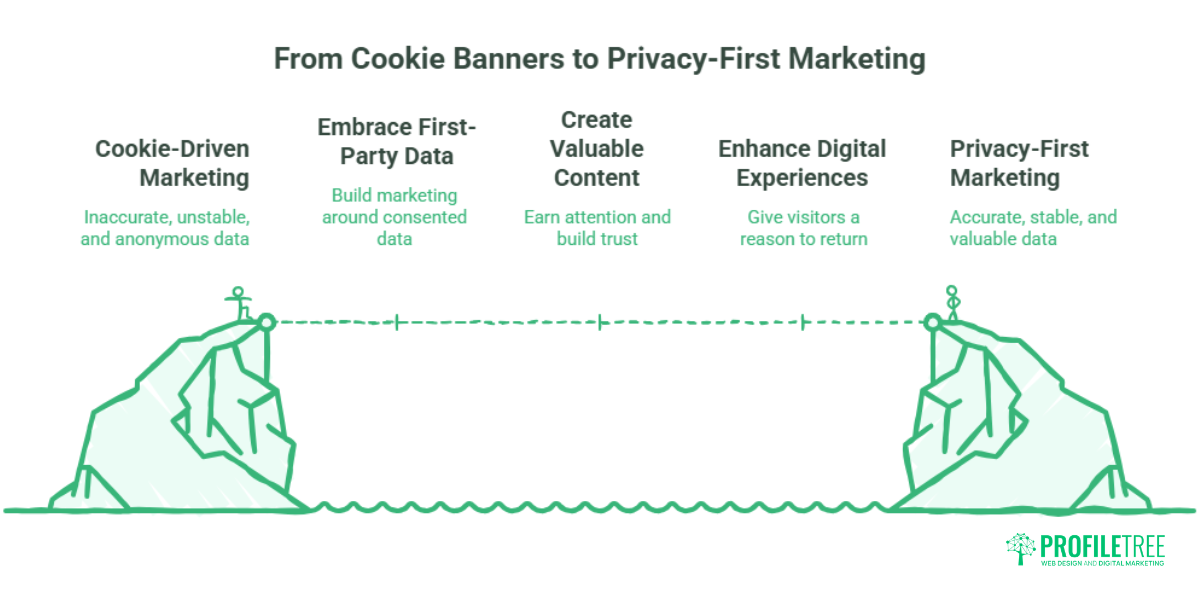
For most UK businesses, the conversation about privacy started with a cookie banner. It has since grown into something much more significant: a structural change in how digital marketing works.
Third-party cookies, which allowed advertisers to track users across websites, have been restricted in Safari and Firefox for years. Google’s own deprecation timeline has shifted repeatedly, but the direction is clear. Even where cookies technically still function, consumers are increasingly choosing to reject them. Cookie consent acceptance rates on UK websites typically run between 40% and 65%, meaning a significant portion of your site visitors are already invisible to traditional analytics from the moment they arrive.
The businesses that treat this as an opportunity rather than a problem are already pulling ahead. When you build your marketing around data that people have genuinely chosen to share with you, that data is more accurate, more stable, and more valuable. A first-party email list of 2,000 people who opted in because they found your content useful will outperform a retargeted audience of 20,000 anonymous browser sessions.
“Privacy-first marketing isn’t about doing less,” says Ciaran Connolly, founder of ProfileTree. “It’s about doing the right things: building content that earns attention, collecting data people actually consent to, and creating digital experiences that give visitors a reason to come back. The SMEs that get this right now will have a significant head start.”
The UK and Ireland Regulatory Context
This section matters specifically for UK and Irish businesses, because the regulatory environment here has diverged from the global picture in ways most American or global guides don’t address.
UK GDPR and What Changed After Brexit
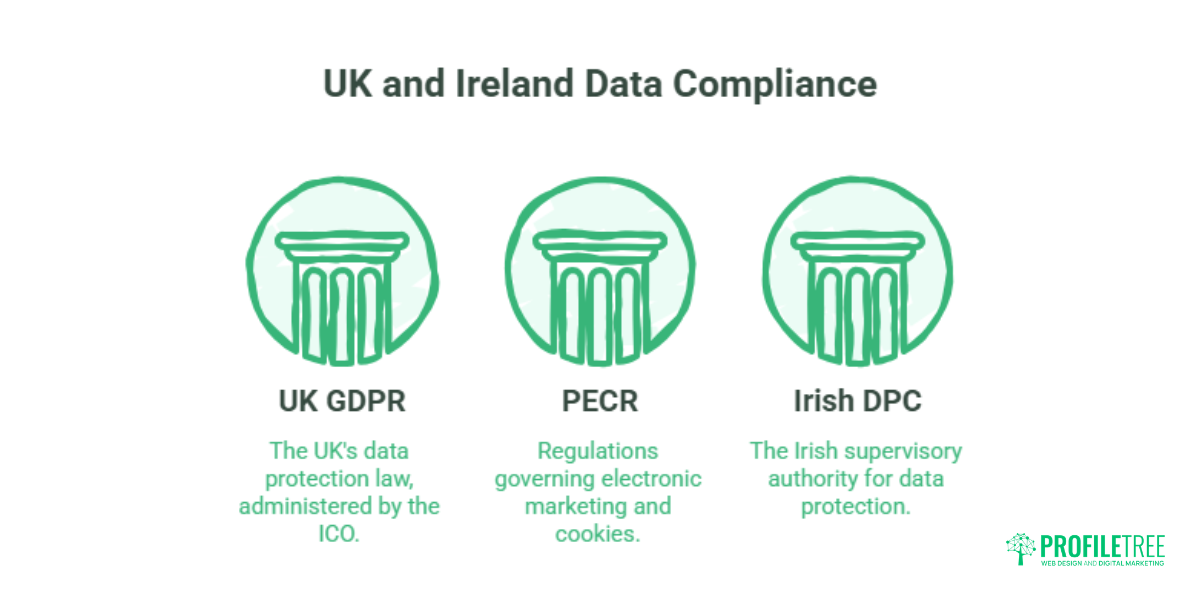
When the UK left the EU, it transposed the EU GDPR into domestic law as UK GDPR, administered by the Information Commissioner’s Office (ICO). The frameworks are broadly similar, but they are now separate instruments. If your business processes the personal data of EU residents (for example, if you sell to customers in the Republic of Ireland), you may need to comply with both UK GDPR and EU GDPR simultaneously.
The practical differences are modest for most SMEs, but the key point is that ICO guidance, not EU guidance, is the authoritative source for UK compliance. The ICO’s website publishes straightforward guidance specifically aimed at small businesses, including practical advice on consent, legitimate interest, and privacy notices.
PECR: The Often-Overlooked Regulation
The Privacy and Electronic Communications Regulations (PECR) sit alongside UK GDPR and govern electronic marketing specifically. PECR is the regulation that controls when you can send marketing emails, use cookies, and contact people by phone or text. Many businesses focus on GDPR and miss PECR entirely, but the ICO enforces both.
The key PECR rules for SMEs:
- You need prior consent to send marketing emails to individuals (the “soft opt-in” applies only to existing customers and only for similar products or services)
- Cookies that are not strictly necessary require informed consent before they are set, not after
- You must tell users what cookies you use and give them a genuine choice
The Irish Data Protection Commission (DPC)
For businesses operating in Ireland or Northern Ireland that also serve customers in the Republic, the Irish Data Protection Commission is the relevant supervisory authority on the EU side. The DPC has been one of the more active enforcement bodies in Europe, particularly around ad-tech and tracking. If your business runs Facebook or Google advertising to Irish customers, this is relevant to you.
The Strategic Pivot: From Third-Party to First-Party Data
The most practical shift any SME can make is to start treating first-party data as a deliberate asset, not a byproduct of other activity.
Auditing Your Current Data Reliance
Before building anything new, it helps to understand what you currently rely on. A basic cookie audit asks:
- Which analytics tools are you running, and what data do they collect?
- Are you running Facebook Pixel, Google Ads conversion tracking, or any other advertising tags?
- Do you have a consent management platform in place, and is it correctly categorising cookies before they fire?
- If a visitor rejects all non-essential cookies, what do you actually know about them?
For most SME websites, the answer to that last question is: almost nothing. The audit reveals the exposure, and from there you can make deliberate choices about which tracking is worth the consent overhead and which can be replaced with better approaches.
Zero-Party Data: Asking Instead of Inferring
Zero-party data is information a customer proactively shares because they get something valuable in return. It’s the most privacy-safe form of customer data because the exchange is explicit.
Practical zero-party data collection for SMEs includes:
- A short preference survey embedded in your welcome email sequence, asking new subscribers what topics they want to hear about
- A product recommendation quiz on an e-commerce site that trades personalised results for declared preferences
- A “what’s your biggest challenge with [topic]” form on a landing page that tailors the follow-up content to the answer
These approaches work for SMEs in Northern Ireland and Ireland across service businesses, retail, trades, and hospitality. The data you collect is yours, it’s consented to, and it doesn’t depend on third-party platforms maintaining tracking functionality.
Building First-Party Data Through Organic Search and Content
Organic search is inherently privacy-compliant. When a potential customer finds your website through Google or Bing because your content answered their question, no tracking cookie was involved in that acquisition. It works through relevance and authority, not surveillance.
This is one of the strongest commercial arguments for investing in content marketing and search engine optimisation. Every article, guide, or resource that attracts search traffic is building a privacy-compliant acquisition channel that doesn’t break when cookie rules tighten further. The reader who lands on your article, finds it useful, and subscribes to your email list has given you genuine first-party data through a genuine exchange of value.
Building a Low-Budget Privacy-First Tech Stack
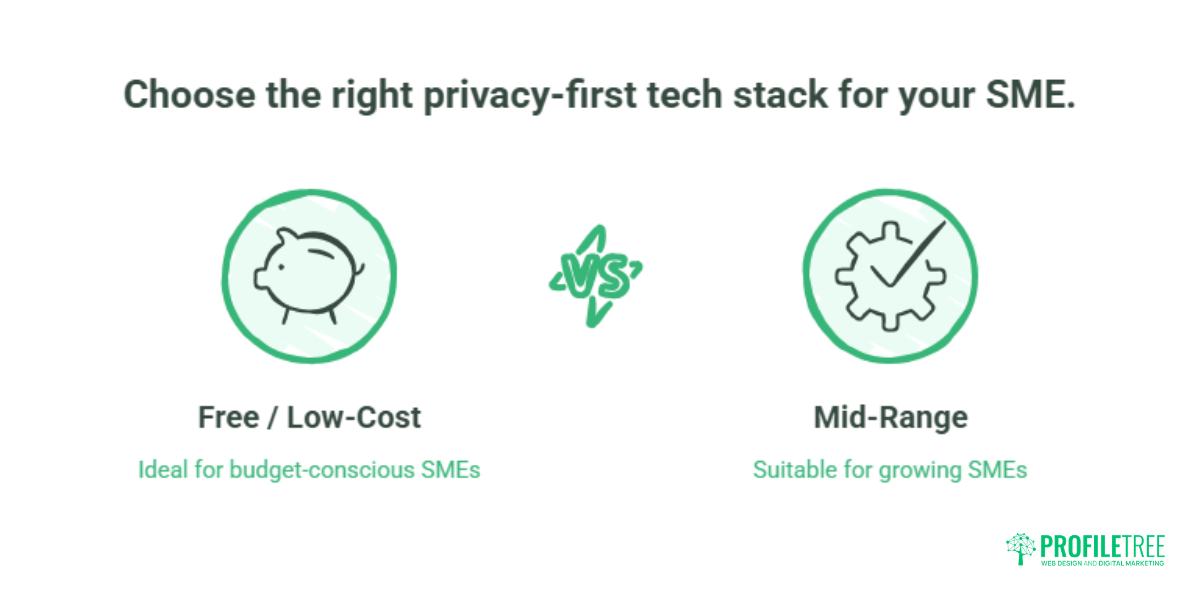
You don’t need enterprise software to run a compliant, effective privacy-first marketing operation. The following table covers the key tools SMEs need and the realistic cost options at each level.
| Tool Category | Free / Low-Cost Option | Mid-Range Option | What It Does |
|---|---|---|---|
| Consent Management Platform | CookieYes (free tier) | Cookiebot (from ~£9/month) | Controls when cookies fire; generates consent records |
| Privacy-Friendly Analytics | Plausible (from ~£9/month) | Fathom Analytics (from ~£14/month) | Page-level traffic data without individual tracking |
| Email Marketing | Mailchimp (free to 500 contacts) | Klaviyo, ActiveCampaign | First-party data activation; consent-based messaging |
| CRM | HubSpot CRM (free) | Pipedrive (from ~£15/month) | Stores consented customer data; tracks engagement |
| Server-Side Tag Management | Stape.io (from ~$10/month) | Custom GTM server setup | Routes tracking server-side, reducing cookie dependency |
Consent Management Platforms: What You Actually Need
A consent management platform (CMP) does one critical job: it prevents non-essential cookies from firing until the user has made a choice. Without one, cookies set by Google Analytics, Facebook Pixel, or any other third-party script fire the moment a visitor lands on your page, before any consent has been collected. That is a PECR violation.
For most SME websites, a CMP like CookieYes or Cookiebot, correctly configured, solves the compliance problem at low cost. The configuration part matters: many businesses install a CMP but leave it in a default state that still fires analytics before consent. Check with your web development provider that the implementation is blocking cookies correctly, not just displaying a banner.
Privacy-Friendly Analytics: The Practical Alternative to GA4
Google Analytics 4 collects significant amounts of personal data and has faced regulatory scrutiny in several EU countries. For SMEs serving EU customers from Ireland or Northern Ireland, this is worth taking seriously.
Privacy-focused alternatives like Plausible Analytics and Fathom Analytics provide the core data most businesses actually use: traffic volumes, page performance, referral sources, and conversion events. They do not track individuals across sessions, which means they don’t require a consent banner in most configurations. For many SMEs, this is a better outcome than GA4 with a consent banner, because you see data from 100% of visitors rather than only those who accepted cookies.
The Privacy-First Creative Approach: Marketing When Tracking Is Limited
This is the section most compliance guides skip, because it’s not about law, it’s about how you actually attract customers when hyper-targeted advertising is less available or less effective.
Contextual Advertising: Placing Ads Where Intent Already Exists
Contextual advertising places ads based on the content of the page, not the profile of the individual viewing it. A trade business advertising on a home improvement website, a hospitality venue advertising within local tourism content, or an accountancy firm advertising alongside business news articles; these placements work because the context signals intent.
Contextual advertising doesn’t require personal data. It doesn’t depend on cookies. And for many UK and Irish SMEs, it’s significantly cheaper than the competitive bidding environments of Google Search or Meta, where cost-per-click has risen substantially over the past three years.
Using Your Privacy Stance in Your Messaging
The “Privacy as Brand Value” angle is currently underused by UK SMEs, but it’s particularly relevant for businesses where trust is a buying criterion. Accountants, solicitors, healthcare providers, financial advisers, and any business handling sensitive customer data can use their privacy commitments as a visible differentiator.
This doesn’t mean leading every ad with a GDPR declaration. It means being explicit: “We don’t sell your data,” “Your details stay with us,” “Unsubscribe any time, no questions asked.” These are trust signals that increase conversion rates precisely because most businesses don’t say them clearly.
Building Authority Through Content
When you can’t track individuals through their browsing behaviour, the most reliable way to stay visible is to be the best answer to the questions your customers are asking. That means publishing genuinely useful content, consistently, on topics your customers search for.
This is the core case for content marketing as a privacy-first strategy. A guide, article, or video that answers a real question builds organic search visibility, earns links, and gets cited in AI search results without any reliance on personal data collection. ProfileTree’s digital strategy services are built around this principle: creating content that earns attention rather than buying access to people’s browsing histories.
How Your Website Becomes a First-Party Data Engine
Your website is the foundation of a privacy-first marketing approach, but only if it’s built to support it. A site that loads slowly, doesn’t convert visitors to subscribers, or lacks structured content will generate very little first-party data regardless of how good your SEO is.
The key website elements for first-party data collection:
- A content upgrade or email opt-in that offers something genuinely useful in exchange for an address
- A clear, easy-to-find privacy notice written in plain English (not legal boilerplate)
- A consent management platform correctly configured to block non-essential cookies
- Contact forms that explain how submitted data will be used
- A preference centre that lets email subscribers control what they receive
For SMEs building or redesigning their websites, these elements should be planned from the start rather than added retrospectively. ProfileTree’s website design process includes privacy architecture as part of the build specification, because retrofitting consent management onto an existing site often creates gaps.
AI Tools and Privacy: What SMEs Need to Know Now
The conversation about AI in marketing and privacy is developing quickly. Many of the AI tools now being used for content creation, customer service, and marketing automation collect and process data in ways that have not been fully tested against GDPR frameworks.
The practical guidance for SMEs is straightforward: before adopting any AI tool that processes customer data, check the provider’s data processing agreement, confirm where data is stored, and assess whether processing it requires a specific legal basis under UK GDPR. For tools like AI chatbots on your website, customers should be informed that they are interacting with an automated system.
ProfileTree’s AI implementation services and AI training programmes include data governance as part of the implementation process, because using AI tools responsibly means understanding what happens to the data they process. The AI chatbot implementations ProfileTree builds for clients include appropriate disclosure and consent architecture.
A Five-Step Action Plan for the Next Quarter
If you want to move from awareness to action, these are the five steps worth prioritising:
Step 1: Audit your current cookie and tracking setup. Use a tool like CookieYes’s scanner to identify every cookie your site sets, when it fires, and whether it’s currently gated behind consent. Fix any that fire before consent.
Step 2: Switch to a privacy-friendly analytics tool. If you’re using GA4 and your consent acceptance rate is below 70%, you’re making decisions based on partial data. Plausible or Fathom will give you cleaner, complete numbers.
Step 3: Build one first-party data capture mechanism. A single well-designed opt-in, with a genuinely useful incentive, will start building an asset that belongs to you.
Step 4: Publish one piece of genuinely useful content per month. Not a product announcement. A guide, a how-to, or an answer to a question your customers actually search for. This is the compounding investment that builds organic visibility without any tracking dependency.
Step 5: Review your email consent records. If you can’t confirm that everyone on your marketing list gave consent under PECR-compliant conditions, clean the list before your next campaign. A smaller, consented list outperforms a larger, questionable one in deliverability, engagement, and regulatory safety.
ProfileTree’s digital training programmes cover a privacy-first marketing strategy for in-house teams, and ProfileTree’s digital strategy service can run the full audit and transition process for businesses that want external support.
Frequently Asked Questions
What is a privacy-first marketing strategy?
A privacy-first marketing strategy builds customer acquisition and retention around data that people have actively chosen to share, rather than data collected through background tracking. In practice, this means prioritising organic search, email marketing to consented lists, contextual advertising, and zero-party data collection over cookie-based retargeting and third-party audience targeting.
Is privacy-first marketing more expensive for SMEs?
There is a short-term setup cost: a consent management platform, potentially a new analytics tool, and time spent on content. But the running costs are often lower than cookie-based advertising, where competition has driven up cost-per-click significantly. First-party data, once built, has no ongoing acquisition cost. A consented email list of 3,000 people costs the same to email whether you’ve had it for one year or five.
Can I still use Facebook or Meta Pixel?
Yes, but it requires proper implementation. Meta’s Conversions API (CAPI) moves tracking server-side, reducing reliance on browser cookies. To use Meta Pixel legally in the UK and Ireland, it must be gated behind consent: it should not fire until the user has actively accepted marketing cookies. Many businesses currently have this misconfigured. Check with your web development team or a specialist.
How do I track conversions without cookies?
Server-side tracking routes conversion events through your own server rather than the visitor’s browser, which means browser-based cookie restrictions don’t apply in the same way. Tools like Stape.io make server-side Google Tag Manager accessible to SMEs without a large development budget. First-party cookies (set by your own domain rather than third parties) are also significantly less affected by browser restrictions.
What is UK GDPR, and how does it differ from EU GDPR?
UK GDPR is the version of the EU General Data Protection Regulation incorporated into UK domestic law when the UK left the European Union. It is administered by the Information Commissioner’s Office (ICO) rather than EU supervisory authorities. For most practical purposes, the frameworks are similar, but they are separate instruments. Businesses that process data from both UK and EU/Irish customers may need to comply with both.
Do I need a Data Protection Officer?
Most SMEs do not. Under UK GDPR, a DPO is required if your core activities involve large-scale systematic monitoring of individuals, large-scale processing of special category data, or if you are a public authority. For a typical SME running a website and an email list, a DPO is not required, but you must still comply with UK GDPR and appoint a responsible person internally for data protection matters.
What role does customer trust play in zero-party data collection?
Trust is the prerequisite for zero-party data. Customers will only proactively share preferences and personal information with businesses they believe will use it responsibly and not pass it on. Transparency about how you use data, a clear and accessible privacy notice, and a track record of only contacting people about things they’ve indicated interest in are the conditions that make zero-party data collection work.