
What Is a Keyword? Understanding Search Terms for SEO Success
Table of Contents
Understanding what keywords are forms the foundation of successful digital marketing. For business owners and marketing managers seeking to grow their online presence, grasping how search terms connect potential customers to your services can transform your digital strategy.
What Is a Keyword?
A keyword is a word or phrase people enter into search engines like Google for information, products, or services. These search queries reveal what your potential customers want to find, making them critical for any business operating online.
For businesses offering services like web design, video production, or SEO, keywords represent the bridge between what you provide and how customers search for those solutions. When someone searches “web design Belfast” or “SEO agency Northern Ireland,” they use keywords to find businesses like yours.
Keywords should appear naturally throughout your website content, embedded in page titles, headings, body text, and metadata. This strategic placement helps search engines understand what your pages offer and match them to relevant searches.
How Keywords Drive Business Growth
Keywords are the primary mechanism for connecting your business with potential clients through search engines. Nearly all online business interactions begin with a search query. Research shows that 93% of online experiences start with a search engine, meaning your visibility for relevant keywords directly impacts your business opportunities.
When you optimise your content for the right keywords, you’re positioning your business to be found by people actively seeking your services. A company offering AI training or a digital marketing strategy must appear when prospects search for those solutions.
Search engines rank pages based on relevance and authority. By targeting keywords that match your services—whether WordPress development, video marketing, or content creation—you signal to search engines that your site deserves to rank for those terms.
The language your customers use matters tremendously. A construction firm searching for “construction website design” has different needs than a retail shop looking for “e-commerce web development.” Your keyword strategy must reflect these distinctions.
Understanding Search Engine Results Pages
Search Engine Results Pages (SERPs) display when someone enters a keyword. Your goal is to appear on the first page, as 75% of users never scroll past it. This visibility is significant for local businesses competing for regional clients.
Keywords determine where your website appears in these results. If you’re targeting “video production Northern Ireland” or “Belfast digital agency,” your content must demonstrate clear relevance to these searches through strategic keyword usage.
First-page rankings aren’t just about prestige—they’re about business survival. When competitors rank above you for your core services, they capture the leads that should be yours.
The Role of Metadata in Keyword Strategy
Metadata provides search engines with structured information about your pages. This behind-the-scenes content includes meta titles, descriptions, and tags that help search engines understand and categorise your content.
Your meta title appears as the clickable headline in search results. It should include your target keyword while accurately describing the page content. For a page about digital training, a meta title like “Digital Marketing Training | Belfast Agency” signals immediate relevance.
Meta descriptions appear below the title in search results. Though they don’t directly influence rankings, they significantly impact click-through rates. A compelling description incorporating your keyword can be the difference between a visitor choosing your site or a competitor’s.
Research Methods
Effective keyword research separates successful digital strategies from wasted effort. Understanding how to identify and prioritise the right terms determines whether your content reaches the right audience.
What Is Keyword Research?
Keyword research is the systematic process of discovering, analysing, and selecting the search terms most relevant to your business and likely to drive qualified traffic. This isn’t guesswork—it’s data-driven decision-making about where to focus your content creation and optimisation efforts.
The process begins with understanding your core offerings. Suppose you provide web design, SEO services, and video production. Your keyword research must span all these areas while identifying which terms offer the best opportunities for your market position.
Effective research considers several factors: search volume (how many people search for a term), competition level (how difficult it is to rank), and commercial intent (how likely searchers are to become customers). A term like “free website templates” may have high volume but poor commercial intent for an agency, whereas “hire web designer Belfast” has clear purchase intent.
Short Tail vs Long Tail Keywords
Understanding the distinction between short and long tail keywords fundamentally shapes your SEO and content creation approach.
Short tail keywords are broad, usually one or two words, with high search volumes but intense competition. Examples include “marketing,” “web design,” or “SEO.” These terms attract massive traffic but rarely convert well because they’re too generic.
Long tail keywords are specific phrases, typically three to five words, with lower search volumes but much higher conversion potential. Terms like “affordable web design for solicitors Belfast” or “AI automation for retail businesses” attract fewer searches but capture people with precise, specific needs.
“Long tail keywords are where most agencies actually make their money,” explains Ciaran Connolly, Director of ProfileTree. “While everyone fights over ‘web design,’ we’re ranking for specific terms that bring us clients who already know what they want and are ready to buy.”
For service businesses, long tail keywords offer several advantages. They’re easier to rank for, attract more qualified leads, and better match your specific services. The distribution of keywords follows a natural pattern: a few broad terms attract significant traffic, whilst numerous long tail variations collectively drive substantial, highly-targeted visitors.
Search Intent and User Behaviour
Search intent—the underlying goal behind a search query—determines whether your content satisfies what visitors actually want. Four primary types exist:
Informational intent: Users want to learn something. Queries like “what is SEO” or “how to improve website speed” indicate research mode. Content addressing these queries builds authority and captures early-stage prospects.
Navigational intent: Users seek a specific website or brand. Searches for “ProfileTree contact” or “YouTube login” show people know where they want to go.
Commercial investigation: Users research before purchasing. Terms like “best web design agency Belfast” or “Wix vs WordPress comparison” indicate active consideration. Content targeting these queries must demonstrate clear value and expertise.
Transactional intent: Users are ready to buy or engage a service. Phrases like “hire SEO consultant” or “book video production” signal high purchase intent.
Mapping your content to these intents for a digital agency creates a complete customer journey. Blog posts satisfy informational intent, service pages target commercial and transactional searches, and optimised navigation captures brand searches.
Keyword Mapping and Content Structure
Keyword mapping assigns specific keywords to pages based on relevance, search intent, and strategic priorities. This organisational approach prevents keyword cannibalisation—where multiple pages compete for the same term—and creates clear pathways for users and search engines.
Start by categorising your keywords into thematic groups. Keywords related to web design, website development, SEO services, and video production should each map to distinct sections of your site. A logical structure might look like:
Web Design (main service page)
- Website design for SMEs (sub-service page)
- E-commerce website design (sub-service page)
- Accessible web design (sub-service page)
Each page targets a primary keyword whilst naturally incorporating related variations. Blog content extends this structure, targeting informational keywords that feed into your service pages.
Finding Seed Keywords
Seed keywords form the foundation of your research, representing the core terms around which you’ll build your keyword strategy. These are the basic descriptors of your business, services, and industry.
Begin with the obvious: what do you actually do? Those phrases are your seeds if you’re a digital agency offering web design, video production, and AI training.
Next, consider how customers describe your services. They may use different terminology than you do. Where you say “website development,” they might search “build business website.”
Competitor analysis provides additional seeds. Review competitor websites, particularly their service pages and blog content. What terms do they target? Tools like SEMrush or Ahrefs show which keywords drive traffic to competitor sites.
Your existing analytics reveal seeds you’re already capturing—Google Search Console shows which queries currently bring visitors to your site.
Strategy & Implementation
Translating keyword research into practical improvements requires systematic implementation across your website. This stage determines whether your research generates actual business results.
Strategic Keyword Distribution
Proper keyword distribution balances optimisation with natural readability. Your target keyword should appear in specific, high-value locations:
Page title (H1): Include your primary keyword naturally within the title, keeping it under 70 characters.
URL structure: Clean URLs incorporating keywords perform better. “profiletree.com/web-design-belfast” beats “profiletree.com/services/page-42.”
First paragraph: Search engines weigh early content more heavily. Introduce your keyword naturally within the opening sentences.
Subheadings (H2, H3): Distribute your primary keyword and variations across several subheadings, not forcing it where it doesn’t fit naturally.
Body content: Aim for 1-2% keyword density—roughly once or twice per 100 words. More important than frequency is context. Surround your keywords with semantically related terms that reinforce topical relevance.
Image alt text: Describe images accurately whilst incorporating relevant keywords where appropriate.
Meta description: Whilst not a ranking factor, including your keyword here improves click-through rates from search results.
Avoid keyword stuffing—the practice of cramming keywords unnaturally into content. Modern search algorithms penalise this practice, creating a terrible user experience.
Optimising for Multiple Keyword Variations
Single pages can and should rank for multiple related keywords. Search engines understand semantic relationships—the connections between related terms. A page optimised for “web design” naturally ranks for variations like “website design,” “web designer,” “website designer,” and “web development” if your content comprehensively covers the topic.
Rather than creating separate pages for minor variations, build comprehensive pages that incorporate multiple related terms naturally. Your web design service page should mention web design, website design, web development, website creation, custom websites, responsive design, and mobile-friendly websites.
Track which variations actually drive traffic through Google Search Console. You’ll often discover you’re ranking well for terms you didn’t explicitly target, revealing opportunities to strengthen that content further.
Content Type Matching
Different keywords require different content types to satisfy search intent:
Service keywords (“web design Belfast,” “hire video production”) demand clear service pages with pricing indicators, portfolio examples, and conversion-focused calls to action.
Informational keywords (“what is SEO,” “how to choose a web designer”) require detailed, educational content like blog posts or guides.
Comparison keywords (“WordPress vs Wix,” “best video hosting platforms”) work well as detailed comparison articles with pros/cons tables and clear recommendations.
Local keywords (“Belfast digital agency,” “Northern Ireland web designer”) benefit from location-specific pages with local references, Google Maps integration, and regional case studies.
For an agency offering multiple services—web design, video production, SEO, AI training—each service needs its own optimised landing page targeting the specific keywords for that offering.
Managing Keyword Cannibalisation
Keyword cannibalisation occurs when multiple pages on your site compete for the same keyword, confusing search engines about which page to rank. This internal competition dilutes your ranking potential.
Audit your site regularly to identify cannibalisation. If three blog posts all target “web design tips,” search engines struggle to determine which deserves to rank. The solution is consolidation or differentiation.
Consolidation: Merge similar content into one comprehensive resource. Three thin blog posts about web design become one authoritative guide, with redirects pointing old URLs to the new consolidated page.
Differentiation: Refocus each page on distinct aspects. One article covers “web design tips for small businesses,” another “web design accessibility guidelines,” and a third “web design trends 2025.
Your service pages should never cannibalise each other. Internal linking helps signal priority to search engines. When multiple pages mention “web design,” link them all to your primary web design service page using that exact phrase as anchor text.
Tools & Analytics
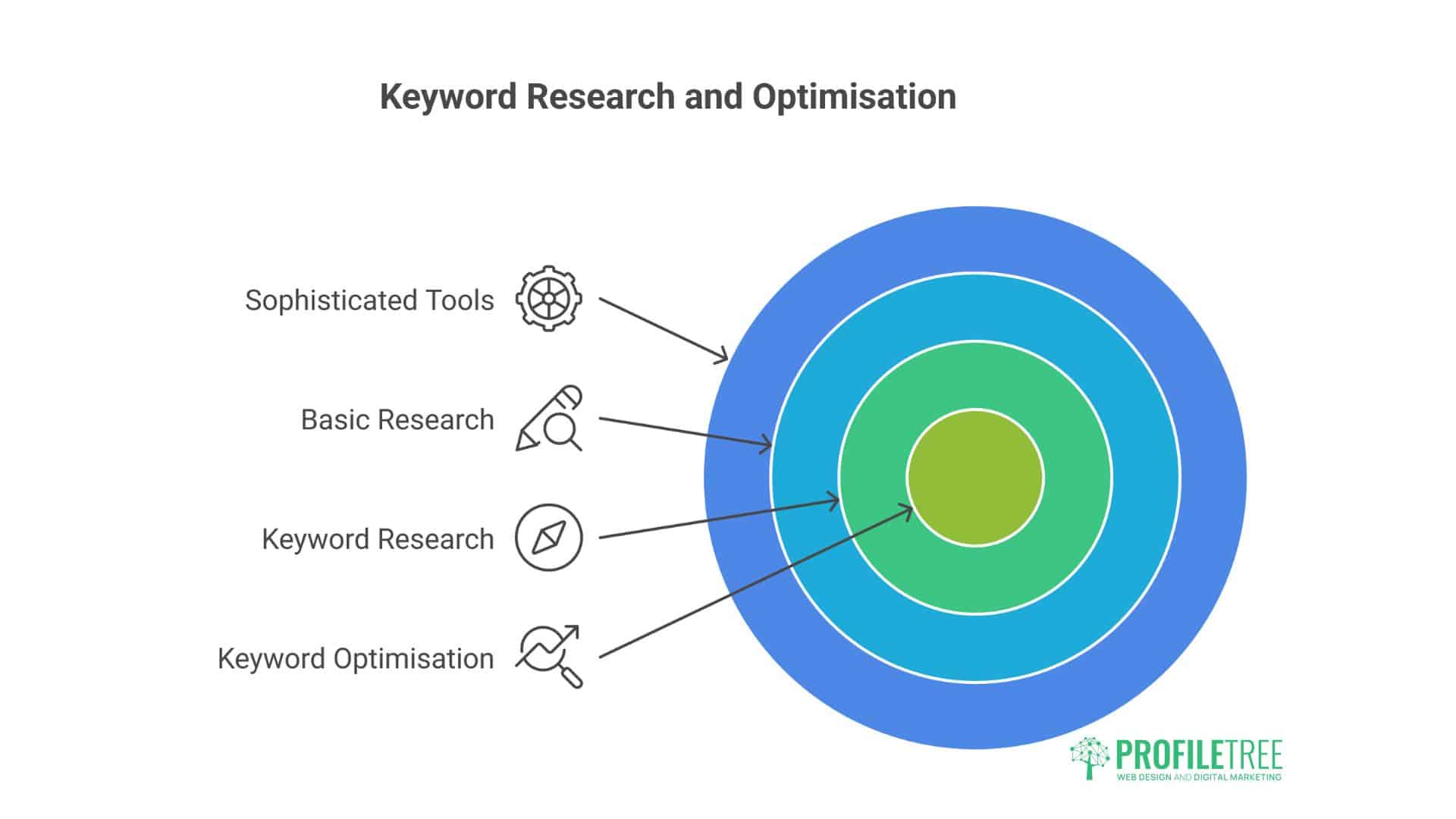
Professional keyword research and optimisation require the right tools. Whilst basic research can be done manually, sophisticated tools dramatically accelerate the process and reveal opportunities you’d otherwise miss.
Essential Keyword Research Tools
Several tools dominate the keyword research landscape, each offering unique strengths:
Google Keyword Planner: This tool, available free through Google Ads, provides search volume estimates directly from Google. It’s beneficial for identifying search volumes for specific terms and discovering related keywords.
Ahrefs: A comprehensive SEO platform offering detailed keyword data, including accurate search volumes, keyword difficulty scores, and competitor analysis. Ahrefs excels at showing which keywords drive traffic to competitor sites.
SEMrush: Similar in scope to Ahrefs, SEMrush provides extensive keyword research capabilities alongside position tracking, site audits, and competitive intelligence. It’s powerful for analysing keyword gaps—terms competitors rank for that you don’t.
Moz Keyword Explorer offers keyword suggestions, search volume data, and a unique “priority” score that combines volume, difficulty, and opportunity.
Ubersuggest: A more affordable option providing basic keyword suggestions, search volumes, and difficulty scores. Whilst less comprehensive than premium tools, it’s sufficient for smaller businesses.
Google Search Console: This tool is entirely free and essential. It shows exactly which keywords already drive traffic to your site, their positions, click-through rates, and impressions.
Interpreting Search Volume and Difficulty
Raw keyword data means nothing without context. Understanding search volume, keyword difficulty, and other metrics determines which keywords deserve attention.
Search volume indicates how many times per month people search for a term. However, high volume doesn’t always mean high value. “Web design” might show 50,000 monthly searches, but “web design for dental practices Belfast” with 40 searches could be more valuable if you specialise in dental websites.
Keyword difficulty (KD) scores estimate how hard it is to rank for a term, typically on a 0-100 scale. Scores above 60 generally require substantial authority and backlinks. Below 30, even newer sites can compete.
Match your targets to your site’s authority. If your domain is new or has few backlinks, prioritise keywords with KD scores below 30. As you build authority, gradually tackle more difficult terms.
Cost-per-click (CPC) data from Google Ads reveals commercial value. High CPC indicates businesses pay significant amounts to advertise for that keyword, suggesting strong purchase intent and business value.
Trend data shows whether search interest is growing, stable, or declining. Targeting declining keywords wastes effort that could be better spent on emerging opportunities.
Using Google Search Console for Keyword Insights
Google Search Console (GSC) is the most underutilised SEO tool available. It provides insight into how Google views your site and which keywords drive traffic.
The Performance report shows four critical metrics for every keyword:
Impressions: How often did your page appear in search results for this keyword? High impressions with low clicks suggest your meta descriptions need improvement.
Clicks: Actual visits from this keyword. This is your business-critical metric—the keywords generating real traffic.
Average position: Where you typically rank for this keyword. Positions 1-3 capture most clicks; positions 4-10 offer improvement opportunities.
Click-through rate (CTR): Percentage of impressions that result in clicks. Low CTR at high positions suggests apoor title/description.
GSC reveals low-hanging fruit—keywords where you rank positions 11-20 that could reach page one with modest optimisation. The tool also exposes keyword cannibalisation. You’re competing with yourself if multiple pages show impressions for identical keywords.
Tracking Keyword Performance
Set specific, measurable goals for each target keyword. Rather than vague aims like “rank higher,” establish concrete targets: “Reach position 5 for ‘web design Belfast’ within three months.”
Position tracking tools (available in SEMrush, Ahrefs, Moz) monitor your rankings for target keywords daily or weekly. Watch for ranking volatility. Sudden drops might indicate algorithm updates, technical issues, or competitor improvements requiring immediate response.
Traffic analysis in Google Analytics shows which keywords drive the most valuable traffic. Filter by engagement metrics (time on site, pages per session) and conversions to identify your highest-quality keyword sources.
Conversion tracking reveals which keywords generate actual business. If “web design Belfast” drives traffic but “affordable website design” generates enquiries, adjust your priorities accordingly.
Create regular keyword performance reports (monthly or quarterly) that document progress against goals, identify opportunities, and inform strategic adjustments.
Advanced Techniques
Moving beyond basics, advanced keyword strategies separate competent SEO from exceptional results. These techniques require more sophistication but deliver disproportionate returns.
Keyword Clustering and Topic Modelling
Keyword clustering groups related keywords into thematic clusters, allowing you to create comprehensive content that ranks for multiple terms simultaneously. This approach reflects how modern search engines understand topics rather than individual keywords.
Instead of creating separate pages for “web design,” “website design,” “web development,” and “website creation,” clustering recognises these as semantically related. One authoritative page comprehensively covering website creation naturally ranks for all variations.
The clustering process:
- Export your keyword list with search volumes and difficulty scores
- Group keywords sharing identical or near-identical intent
- Identify a primary keyword for each cluster (typically the highest volume)
- Map each cluster to a specific page or content piece
- Incorporate secondary cluster keywords naturally throughout that content
For a digital agency, topic clusters might include: “Web Design Services,” “SEO Services,” “Video Production,” “AI Implementation,” and “Digital Training.” Each cluster contains dozens of related keywords, all addressed by one comprehensive service page or pillar content piece.
Semantic Search and Natural Language Optimisation
Search engines have evolved beyond simple keyword matching to understanding context, intent, and meaning. Semantic search considers relationships between concepts, enabling more nuanced ranking decisions.
This shift means obsessing over exact-match keywords is outdated. Google understands “web designer Belfast” and “website design Northern Ireland” as related queries, ranking content based on topical relevance rather than keyword repetition.
Optimise for semantic search by:
Using natural language: Write for humans first. If your keyword is “web design,” naturally use related terms like “website creation,” “online presence,” “digital design,” and “user interface” throughout your content.
Answering related questions: Google’s “People Also Ask” boxes reveal semantically related queries. Address these within your content to demonstrate comprehensive expertise.
Incorporating entities: Entities are distinct concepts Google recognises—people, places, things, ideas. Mentioning relevant entities (WordPress, Northern Ireland, SMEs, accessibility standards) in a natural context strengthens topical signals.
Adding schema markup: Structured data explicitly tells search engines what your content is about, improving their understanding and potentially earning rich results.
Voice Search Optimisation
Voice searches fundamentally differ from typed queries, requiring adjusted keyword strategies. They are conversational and question-based. Where someone might type “web design Belfast,” they’d ask their voice assistant, “Who are the best web designers in Belfast?”
Optimise for voice by:
Targeting question keywords: Focus on how, what, where, when, why, and who questions related to your services.
Using conversational language: Write content that answers questions directly and conversationally, mirroring how people speak.
Creating FAQ sections: These naturally match voice query patterns and often appear in featured snippets.
Optimising for local queries: Voice searches are three times more likely to be local. Include location-specific information in your content.
For a digital agency, this means creating content addressing common client questions: “How long does website design take?” “What does SEO cost?” “How do I improve my website’s ranking?
Competitor Keyword Gap Analysis
Competitor gap analysis identifies keywords your competitors rank for that you don’t—revealing immediate opportunities to capture market share.
Tools like Ahrefs and SEMrush offer dedicated gap analysis features. Input your domain alongside several competitor domains, and the tool reveals keywords driving traffic to competitors but not to you.
Prioritise gaps by relevance, difficulty, volume, and intent. Create targeted content to fill strategic gaps. If competitors rank well for “video marketing strategy” and you offer video services but lack content on strategy, that’s a clear opportunity.
AI-Powered Keyword Research
Artificial intelligence transforms keyword research from a manual, time-intensive process into an automated, insight-driven discipline.
AI tools can generate keyword ideas, predict search trends, analyse intent, optimise content, and identify content gaps. Tools like MarketMuse, Frase, and Clearscope use AI to provide sophisticated content optimisation recommendations. They analyse top-ranking content for target keywords, identifying semantic terms and topics your content should include.
For agencies offering AI implementation services, demonstrating AI-powered keyword research showcases practical applications while improving your own visibility.
Practical Implementation for Service Businesses
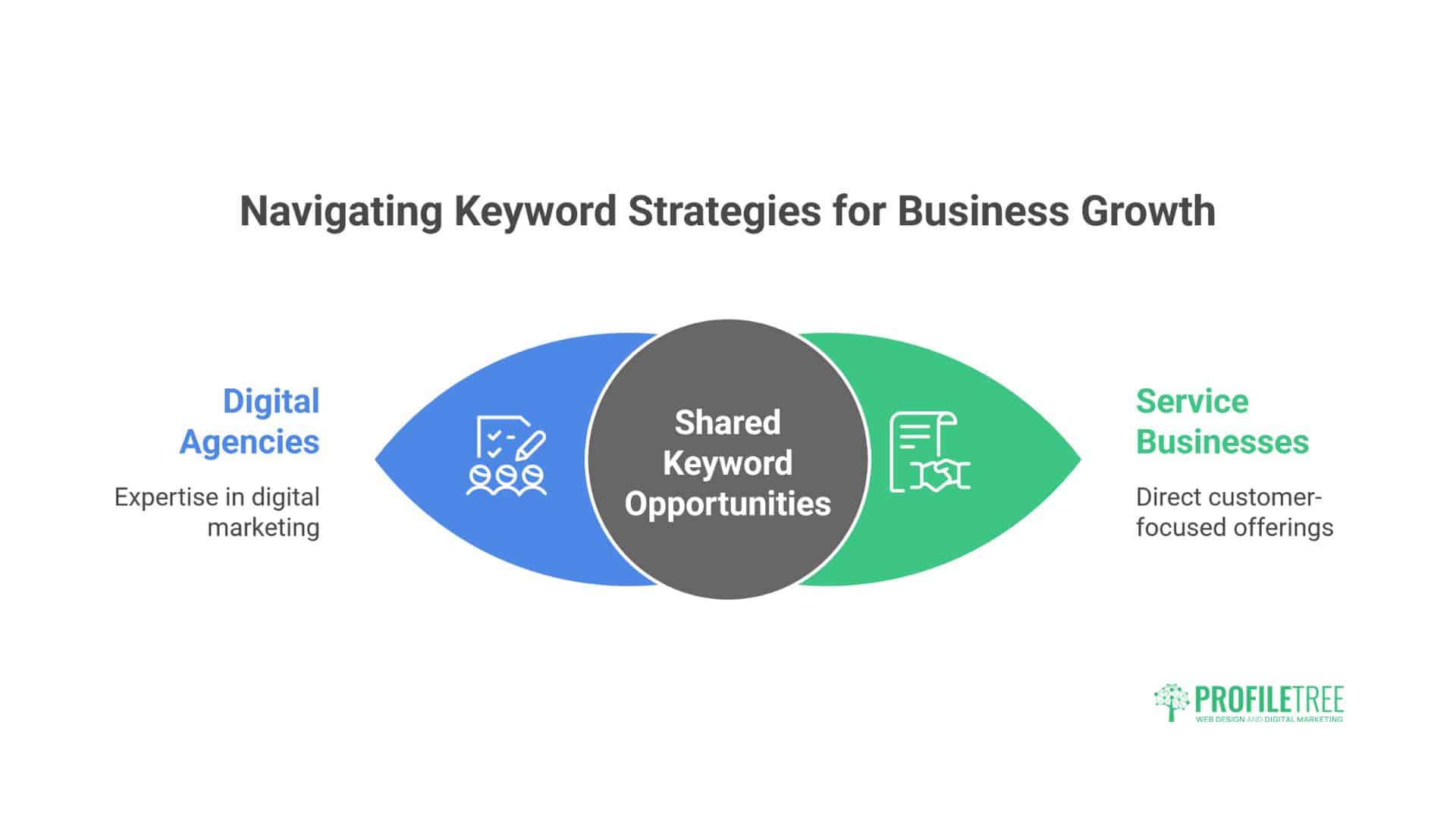
Digital agencies and service businesses face unique keyword challenges and opportunities. Translating generic advice into specific actions requires understanding these distinctions.
Service-Specific Keyword Strategies
Service businesses sell expertise and outcomes rather than products, requiring adjusted keyword approaches.
Problem-solution keywords: Prospects search for problems they face. “Website not showing in Google,” “video marketing not working,” “need AI automation” are how people describe their pain points. Create content addressing these problems, positioning your services as solutions.
Process keywords: such as “how to choose a web designer,” “questions to ask SEO agency,” and “video production process,” attract prospects researching how to engage services like yours.
Service modifiers: Add specificity to base service keywords: “affordable web design,” “enterprise SEO services,” “animated explainer videos,” “AI training for retail.
Industry-specific services: If you specialise in particular sectors, target industry-specific variations: “dental practice websites,” “solicitor SEO,” “retail AI automation.”
Location-based services: For local service businesses, location is your competitive advantage: “web design Belfast,” “Northern Ireland digital agency,” “Dublin video production.
Local SEO and Geographic Keywords
For agencies serving specific geographic regions, local keyword targeting offers significant advantages over broader national competition.
City and region keywords: Target your primary service cities and regions: “Belfast web design,” “Northern Ireland SEO,” “Dublin digital agency.” These terms have lower competition than national keywords whilst attracting genuinely local prospects.
Service area pages: If you serve multiple locations, create dedicated pages for each: “Web Design in Belfast,” “Web Design in Derry,” etc. Avoid thin content—each needs substantial, location-specific information.
Google Business Profile optimisation: Optimising your GBP with consistent keywords, services, and descriptions reinforces your local relevance.
Local keywords typically have lower search volumes but substantially higher conversion rates. A prospect searching “web designer near me” is actively looking to hire, whereas someone searching just “web design” might be researching careers or learning resources.
Measuring Success and ROI
Keywords only matter if they drive business results. Measuring the commercial impact of your keyword strategy separates marketing activity from genuine growth.
Defining Keyword Success Metrics
Move beyond vanity metrics like total traffic to measure what actually matters:
Qualified traffic growth: Are you attracting more visitors who match your ideal customer profile? Segment analytics by keyword to identify which terms bring quality traffic.
Lead generation: How many enquiry forms, phone calls, or demo requests result from organic search? Track conversions by landing page and keyword.
Rankings for target keywords: Are you moving up positions for strategically chosen keywords? Track month-over-month progress.
Click-through rates: Are you capturing a good share of available clicks for keywords you rank for? Improving CTR from position 3 to 5 can dramatically increase traffic.
Customer acquisition cost: How much do you spend on SEO and content creation compared to the value of customers acquired through organic search?
Set benchmarks based on your starting point, then measure progress quarterly. SEO is a long game—meaningful improvement often requires 6-12 months.
Attributing Revenue to Keywords
Understanding which keywords drive actual revenue allows you to prioritise investment toward your highest-value opportunities.
Set up goal tracking in Google Analytics for actions indicating business value: form submissions, phone clicks, chat initiations, or e-commerce transactions.
Use assisted conversions reports to see the full customer journey. A prospect might first find you through informational content (“what is SEO”), return later through a service search (“SEO agency Belfast”), then convert. Both keywords deserve credit.
Calculate keyword value by multiplying conversion rate by average transaction value. A keyword driving 100 monthly visits with a 5% conversion rate and £2,000 average value generates £10,000 monthly.
This revenue-focused approach transforms keyword research from guesswork into a strategic investment in measurable business growth.
Taking Action
Understanding keywords is valuable. Acting on that knowledge transforms your business.
Start with a comprehensive keyword audit using Google Search Console to identify which keywords already drive traffic. Create a prioritised keyword list based on relevance, search volume, difficulty, and business value. Initially, focus on 10-20 primary keywords.
Map each priority keyword to existing pages or identify needs for new content. Set specific, measurable goals: “Reach first page for ‘web design Belfast’ by Q3,” “Double organic traffic from AI-related keywords by year-end.”
Implement a consistent content schedule. SEO rewards sustained effort more than sporadic activity. Even one well-optimised piece outperforms occasional bursts monthly.
Most importantly, measure everything. Keywords that drive traffic but have no conversions need reassessment. Low-volume keywords generating qualified leads deserve more attention. Let data guide your evolving strategy.