
How AI Enhances Website Crawling and Indexing
Table of Contents
How AI enhances website crawling and indexing now decides whether search engines and AI answer engines find, understand, and cite a website at all. Search engines don’t crawl the web with simple rule-based bots any more: AI crawl optimisation and semantic indexing now shape which pages get discovered, how quickly they appear in results, and whether they get surfaced in AI-generated answers. ProfileTree works with SMEs across Northern Ireland, Ireland, and the UK to close the crawl and indexing gaps that keep technically sound websites invisible.
This guide covers what’s actually changed in how AI enhances website crawling and indexing, what ProfileTree SEO services does as a service to fix it, and what to prioritise first if budget and technical resources are limited.
Three things to know before you start:
- AI systems now predict which pages are worth crawling, rather than working through a site mechanically.
- Semantic indexing means search engines match meaning and intent, not just keywords.
- AI crawl optimisation and site crawlability are fixable technical and content problems, not something only enterprise sites can afford to solve.
How AI Enhances Website Crawling and Indexing: Predictive Discovery and Crawl Budget
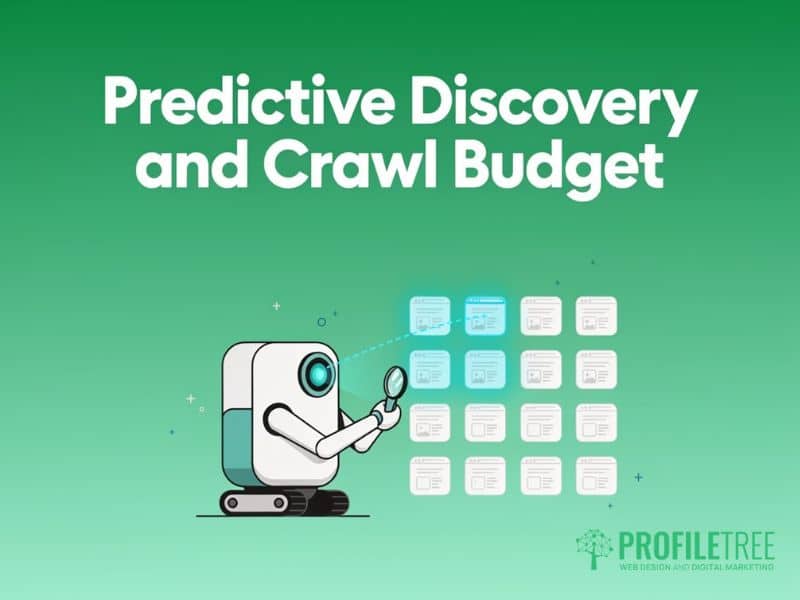
How AI enhances website crawling starts with prediction. Rather than following every link in a fixed sequence, modern crawlers use machine learning to estimate which pages are likely to be valuable before they even visit them, then allocate crawling resources accordingly. This predictive layer is the core of AI crawl optimisation.
Predictive Crawling and Priority Scoring
Traditional crawlers worked through a website in a fairly mechanical way: follow the links, log the pages, move on. This approach missed content that changed frequently and often wasted time on thin or duplicate pages, particularly on sites with faceted navigation or session-based URLs.
Search engines now build priority scores from signals such as historical traffic, update frequency, internal linking patterns, and content uniqueness. Pages that score well get crawled more often; pages that look thin, duplicated, or rarely updated get deprioritised. According to Google’s own documentation on crawl budget, a site’s crawl budget is essentially the set of URLs a search engine can and wants to crawl, and Google allocates more of it to sites it judges to have genuine value and sufficient serving capacity.
For SMEs, this means the old advice to just publish more content is incomplete. A site with fifty well-linked, clearly structured pages will often outperform a site with two hundred pages that are difficult for a crawler to prioritise. Quality signals now carry more weight than sheer page count, and that shift favours smaller, disciplined sites over larger, sprawling ones.
Crawl Budget Optimisation for SME Websites
Crawl budget matters most for larger sites, but even a modest business website can waste it. Duplicate URLs created by tracking parameters, thin filter pages, and orphaned content with no internal links all compete for the same limited crawling attention.
Three practical fixes address most of the waste: consolidate duplicate URLs with canonical tags, block low-value pages such as staging environments or internal search results in robots.txt, and fix broken internal links that send crawlers to dead ends. Sites that avoid unnecessary duplicate pages and dead-end URLs also typically see lighter server load from crawler traffic, which matters for smaller hosting plans as well as for search performance.
This efficiency angle is worth flagging to anyone managing a hosting budget alongside a marketing one. A well-structured, well-linked site doesn’t just get crawled more usefully; it also asks less of the server doing the crawling. For SMEs weighing up a modest hosting upgrade against a content overhaul, the content and structure work is very often the better first move, because it reduces wasted crawl activity rather than just adding capacity to absorb it. ProfileTree’s website hosting and management services take this combined view, looking at hosting performance and crawl efficiency together rather than treating them as separate problems.
How AI Enhances Website Crawling and Indexing: Semantic Understanding and Voice Search
How AI enhances website indexing is the step after crawling. AI crawl optimisation gets a page discovered; once a page is crawled, AI systems now interpret what it means, not just which words appear on it, and that semantic indexing layer is where indexing decisions actually happen.
Semantic and Entity-Based Indexing
Semantic indexing uses natural language processing to identify entities, such as people, places, organisations, and services, and to understand how they relate to each other. Rather than cataloguing individual keywords, search engines build a representation of what a page is actually about and how it connects to everything else they know.
This matters for local businesses in particular. A page about a “Belfast web design agency” and a page about a “Dublin digital marketing consultancy” are understood as related but distinct entities, tied to different locations and, often, different market contexts. Businesses that state their location, service area, and specialism clearly and consistently, in the page title, headings, and body copy, give AI systems a much easier job connecting the right entities together through semantic indexing.
Consistency across pages matters as much as clarity on any single page. If a business describes itself as a “web design agency” on the homepage, a “website development company” on the services page, and a “digital consultancy” in its footer, AI systems have a harder time confirming these all refer to the same entity. Picking one clear description and using it everywhere is a small change with a disproportionate effect on how well a site’s entities are understood.
This is also where AI Overviews and AI answer engines tend to draw from. When a system needs to summarise “who offers web design in Belfast,” it’s pulling together entity signals from across a site, not just quoting one paragraph. A site that repeats its core entities clearly, without needing to rely on marketing flourish to do it, gives these systems a cleaner set of facts to work with.
Voice Search and Conversational Queries
Voice assistants and conversational AI tools rely on this same semantic layer to match spoken, often longer and more specific, queries with the right content. A typed search for “web design Belfast” and a spoken question like “who can redesign my small business website in Belfast” are different query shapes but should ideally lead a well-optimised site to the same relevant page.
Content that answers a specific question directly in the first sentence or two of a section, before adding supporting detail, tends to perform better here. FAQ sections, clear H2 questions, and direct opening answers all help AI systems extract a usable response quickly, which is part of why featured snippets and AI-generated overviews so often pull from well-structured how-to and FAQ content.
How AI Enhances Website Crawling and Indexing as a ProfileTree Service
Understanding AI crawl optimisation in theory is one thing; fixing it on a live client site is another. This is where ProfileTree’s technical SEO and AI transformation work meets day-to-day website management.
“AI crawl optimisation isn’t an abstract concept for the businesses we work with, it’s the difference between being found and being invisible,” says Ciaran Connolly, founder of ProfileTree. “For NI and UK SMEs especially, getting the technical foundations right often matters more than anything else we do, because it decides whether the rest of the content work even gets seen.”
What Our AI Crawl Optimisation Audits Cover
A ProfileTree AI crawl optimisation audit starts with the same signals search engines themselves prioritise: crawl budget waste, duplicate URLs, broken internal links, thin or orphaned pages, and server response consistency. From there, the audit maps entity clarity across the site, checking that service, location, and specialism descriptions are consistent from the homepage through to individual service pages. ProfileTree’s search engine optimisation services build this audit process into every technical SEO engagement, rather than treating it as a one-off health check.
Technical foundations get checked alongside the content and entity work, because AI-driven crawlers still need to render a page successfully before they can evaluate it. Fast loading speeds, clean code, and mobile-first design remain the baseline for good crawlability; sites built on outdated themes, heavy unoptimised images, or excessive third-party scripts routinely see slower indexing, regardless of how good the content is. ProfileTree’s WordPress development services address this at the build level, so content has a fair chance of being crawled and understood properly in the first place, and server response time gets checked directly rather than assumed to be fine.
AI Crawlability Solutions with Consulting Support
Fixing what an audit finds is where consulting support matters most. Robots.txt and canonical tag changes need to be implemented correctly to avoid accidentally blocking important pages; internal linking restructures need to be planned so link equity flows to the right service pages; and entity consistency work needs someone checking every page against a single agreed description, not just the homepage. ProfileTree’s AI transformation support pairs this technical implementation work with training, so an internal marketing team can maintain crawlability standards after the initial fix rather than needing an agency involved for every future page.
Content structure work sits alongside the technical fixes. Clear heading hierarchies, one H1 per page, descriptive H2S that map to real user questions, and consistent naming of core services and locations all help AI systems build an accurate picture of a page. Video content feeds this same layer: pages with well-labelled video, including titles, descriptions, and transcriptions, give AI systems additional context signals beyond the text alone. ProfileTree’s video on content, PR, and SEO strategy covers how these pieces fit together in practice.
NI and UK Examples: Where AI Crawl Optimisation Makes a Difference
The pattern shows up consistently across the type of SME clients ProfileTree works with. A Belfast-based professional services firm with a strong reputation but a dated, template-built website typically has good content buried behind crawl friction: duplicate URLs from an old CMS migration, orphaned service pages with no internal links pointing to them, and inconsistent business naming across the site and its Google Business Profile. A regional retailer with several location pages often has the opposite problem: near-identical content swapped only by city name, which does little to help AI systems distinguish one location’s entity from another’s.
In both cases, the fix is the same technical and content discipline covered earlier in this guide: consolidate and canonicalise, connect orphaned pages back into the site’s internal linking structure, and make entity descriptions consistent everywhere they appear. Neither case requires an enterprise budget, which is precisely why this work matters so much for SMEs competing against larger sites with more historical authority but less structural discipline.
Table 1: Traditional Crawling vs AI-Enhanced Crawling
| Feature | Traditional Method | AI-Enhanced Method | Benefit to Website Owner |
|---|---|---|---|
| Page discovery | Fixed link-following sequence | Predictive scoring of likely valuable pages | Faster discovery of new content |
| Content matching | Keyword matching | Semantic and entity understanding | Better matches for natural language queries |
| Crawl frequency | Uniform schedule | Adjusted to update patterns and value signals | Crawl budget spent on pages that matter |
| Quality assessment | Basic spam filters | Machine learning content quality scoring | Genuine content rewarded over thin pages |
How AI Enhances Website Crawling and Indexing: Troubleshooting Common Issues
Most indexing problems come down to a small set of recurring issues, and most are fixable without developer time.
If pages are not being indexed at all, check the Page Indexing report in Google Search Console for noindex tags, robots.txt blocks, or canonical tags pointing elsewhere. If indexing is slow rather than absent, review internal linking; orphaned pages with no links pointing to them are far less likely to be prioritised. If a page ranks for the wrong queries, the entity and heading structure usually needs clarifying, rather than the content needing to be longer.
Sitemaps remain useful throughout this process. AI-driven crawling still uses a sitemap as a starting map to validate what it finds, not as a replacement for good site structure. A sitemap that lists thousands of thin or duplicate URLs can work against a site rather than for it, so it is worth reviewing what a sitemap actually contains, not just confirming that one exists.
Finally, patience matters more than it feels like it should. Search Console’s URL Inspection tool can request a recrawl, but for most sites, waiting a few days after fixing a structural issue is normal, and repeatedly resubmitting the same URL doesn’t speed up the process.
One more pattern worth checking: pages that rank well but attract very few clicks often have a mismatch between the title and meta description shown in search results and what the searcher was actually expecting. This isn’t strictly a crawling or indexing problem, but it sits right next to both, and it’s usually a quicker fix than either.
Conclusion: How AI Enhances Website Crawling and Indexing for Your Business
How AI enhances website crawling and indexing comes down to a simple shift: search engines and AI answer engines increasingly reward clarity, structure, and genuine value over volume. For SMEs, this is good news. Fixing crawl budget waste, clarifying entity signals, and building a clean technical foundation are all achievable without an enterprise budget, and they matter more now than adding another dozen pages of content ever will.
The next step for most businesses is a straightforward AI crawl optimisation audit: find out what is actually being crawled, what is being indexed, and where the structure is getting in the way. ProfileTree’s SEO services and AI transformation support are built around that starting point.
FAQs
1. What does AI crawl optimisation actually involve?
It covers the technical and content work that improves crawlability, making a site easier for AI-driven crawlers to discover, understand, and index correctly: fixing crawl budget waste, consolidating duplicate URLs, clarifying entity signals, and structuring content around clear headings and questions.
2. Does AI mean I no longer need an XML sitemap?
No. AI-driven crawling systems still use sitemaps as a reference point to check they have found everything on a site. A sitemap doesn’t guarantee indexing, but it remains a useful signal, particularly for larger or frequently updated sites.
3. Can AI crawl optimisation help get a new page indexed faster?
Indirectly, yes. Strong internal linking, clear entity signals, and genuine content quality all feed the priority scoring that determines how quickly a search engine wants to recrawl and index a page. There’s no way to request faster indexing directly, beyond submitting the URL through Search Console.
4. What is the real difference between crawling and indexing?
Crawling is the discovery process: a search engine finds and downloads a page. Indexing is the decision to store that page and make it eligible to appear in results. AI now influences both stages, but they remain separate steps, and a page can be crawled without being indexed.
5. Do I need an agency to fix AI crawl optimisation issues, or can I do it myself?
Many of the fixes, such as canonical tags, robots.txt changes, and consistent business naming, can be done in-house once identified. Where consulting support tends to add the most value is in diagnosing what’s actually wrong on a specific site and prioritising fixes correctly, rather than guessing which issue matters most.