
Video Marketing for Irish SMEs: A Results-Focused Guide
Table of Contents
Video marketing gives Irish businesses a way to turn attention into enquiries, but most can produce a video long before they can connect it to sales. The gap between making content and earning a return is where marketing budgets quietly disappear.
This guide sets out how small and medium businesses across Northern Ireland, Ireland, and the UK can plan video that supports the sales funnel rather than sitting beside it. It covers the formats that suit different stages of buying, how to optimise video for search, what realistic production costs look like, and how to measure whether any of it worked.
Why video earns its place in an SME marketing plan
Video works because buyers prefer it. Wyzowl’s 2026 survey of marketers and consumers found that around four in five marketers report a good return on their video investment, and that the large majority of businesses now use video as a marketing tool. Demand sits on the consumer side too: most online buyers say they would rather watch a short video about a product than read about it.
For smaller firms, that preference matters more than budget. A clear, well-planned video from a Belfast startup can hold attention as well as anything produced by a larger competitor, because viewers respond to relevance and clarity rather than spend. If you want help turning that into a plan, our video marketing services set out how strategy, production, and distribution fit together.
One figure worth keeping in perspective: Wordstream has reported that companies using video grow revenue faster than those that do not. Treat that as a directional signal rather than a guarantee, because results depend on what you film, where you publish it, and whether anyone with buying intent ever sees it.
Which video formats match which business goals
Different formats do different jobs. Choosing the wrong one wastes production money, so match the format to where the customer sits in their decision. Before you commission anything, it helps to understand the full video production process, from brief through to edit and delivery.
Product demonstrations
These answer the “how does it actually work” question that text struggles with. They suit buyers who already understand their problem and are weighing up whether your product solves it. A demonstration removes uncertainty before a sales conversation begins.
Customer testimonials
A real customer describing their experience carries weight that a written quote does not. Insivia’s research on video has long pointed to higher retention of messages delivered on screen than the same messages read as text. For Northern Ireland businesses, featuring recognisable local voices and locations can add regional credibility.
Educational and how-to content
Tutorials that solve a genuine problem position your business as a useful authority. This format builds trust before any selling happens, which tends to produce better-qualified enquiries. It also performs well on platforms that reward watch time.
Company and culture videos
Behind-the-scenes content shows the people and standards behind the work. It helps with customer trust and doubles as a recruitment asset, since candidates increasingly research a company’s culture before applying.
Live video
Live streams create immediacy that edited content cannot. Product launches, demonstrations, and question-and-answer sessions let you handle objections in real time and build a sense of community around the brand.
How to make video that search engines can rank
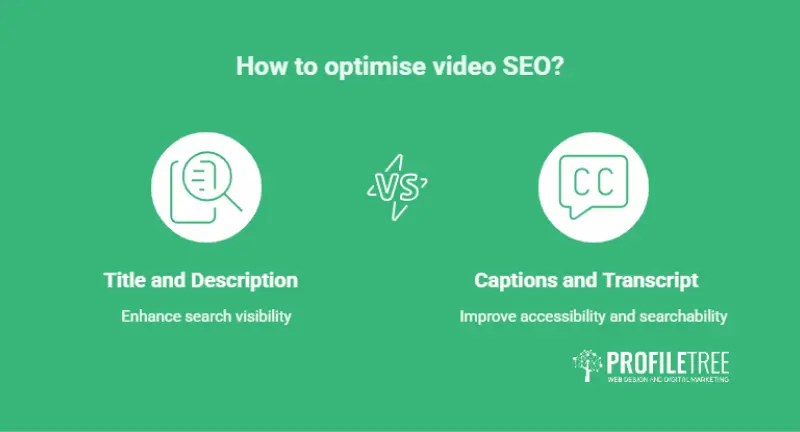
Search engines cannot watch a video, so ranking depends on the text around it. Get the supporting signals right and the same piece can earn traffic for months.
Titles and descriptions
Front-load the main keyword in the title while keeping the language natural enough to earn a click. Write a description of real substance rather than a single line, include timestamps for longer pieces, and link to the relevant page on your site.
Captions and transcripts
Captions serve two purposes: accessibility and search. Search engines index caption files, so every spoken word becomes findable, and a transcript adds indexable text to the page. Captions also help the large share of people who watch with the sound off.
Schema and thumbnails
VideoObject schema tells search engines what a video contains and can produce a thumbnail in results. A custom thumbnail, rather than an auto-generated frame, tends to earn more clicks and signals a more considered piece of content.
Choosing the right platform for each video
Each platform rewards different characteristics, so the same core footage often needs reformatting rather than reposting.
| Platform | Best suited to | Practical note |
|---|---|---|
| YouTube | Longer tutorials and detailed explainers | Rewards watch time and topical depth; good for evergreen search traffic |
| Industry insight and thought leadership | Favours native uploads over external links; keep professional pieces short | |
| Community engagement and discussion | Native uploads reach further than shared links; design for mobile and silent viewing | |
| Short, visually polished clips | Reels suit quick value; Stories suit behind-the-scenes content | |
| TikTok | Authentic, native-feeling content | How-to content often outperforms overtly promotional clips |
Measuring whether your video actually worked
View counts flatter without informing. The metrics that indicate business impact are the ones tied to behaviour, not vanity.
Watch time and average percentage viewed show whether the content held attention and where viewers dropped off, which tells you what to change next time. Engagement rate, measured as interactions divided by views, shows what resonated enough to amplify. Click-through rate from a video to your site shows commercial intent, and conversion rate from that traffic, tracked with UTM parameters and goals in your analytics, is the figure that connects video to revenue. Finally, dividing production cost by customers acquired gives a workable cost-per-customer you can compare against other channels.
What video production realistically costs in Ireland and the UK
Costs vary widely with quality and ambition, so the figures below are working ranges for the Irish and UK market rather than fixed prices. Treat them as planning estimates and confirm against quotes.
| Approach | Typical range | Best suited to |
|---|---|---|
| DIY (in-house) | Initial kit and software outlay, plus team time | Regular social content and internal communications |
| Freelance videographer | Day rates for shooting and editing | Talking-head pieces, simple demonstrations, event coverage |
| Agency project | Project or monthly retainer | Strategy, production, and distribution handled together |
| Animation | Priced per finished minute | Explaining concepts that live action cannot easily show |
Whatever the production budget, set aside a share of it for distribution. A video nobody is directed to rarely repays its cost, so plan the channels and promotion before filming begins.
Common mistakes that waste video budgets
Most wasted spend comes from a handful of avoidable errors. Filming without a distribution plan leaves good content unseen. Prioritising clever concepts over a clear message confuses buyers and dampens conversion. Ignoring mobile viewing, when so much consumption happens on a phone held vertically, cuts off a large part of the audience. Producing one-off videos instead of a series misses the compounding benefit of an audience that returns. Skipping basic search optimisation and analytics setup leaves you unable to be found or to learn from what you published.
Fitting video into your wider digital marketing
Video performs best when it supports other channels rather than standing alone. In email, a thumbnail with a play button pointing to a landing page can lift engagement. In content marketing, a blog post can be repurposed into a script, and an embedded video can increase the time visitors spend on the page. In paid social, video creative often outperforms static images. On your own site, a considered video on a key page can support conversion and trust. The principle is the same throughout: the video should earn its place by doing a job the surrounding content cannot.
As Ciaran Connolly, ProfileTree founder, puts it: “The businesses that get a return from video are the ones that decide what each video is for before they switch a camera on. A clear objective, a metric attached to it, and a plan for who will see it. Get those three things right and video stops being a cost and starts being a channel.”
In-house, agency, or a mix
There is no single right answer here; it depends on how much video you need and how consistent it has to be. An in-house team gives you deep brand knowledge and daily output, at the cost of equipment and salaries. An agency gives you experienced crews and proven processes without fixed overhead, which suits periodic, higher-quality work. Many SMEs settle on a hybrid: staff handle quick social content while an agency produces the pieces that carry the brand. A freelancer network offers flexibility for businesses that can manage projects internally but want to outsource the production itself.
Frequently asked questions
What makes ProfileTree different from other Irish video marketing companies?
ProfileTree combines video production with wider digital marketing, so video connects to SEO, web design, and the rest of the plan rather than sitting on its own. The Belfast team works with clients across Northern Ireland, Ireland, and the UK, with a focus on measurable outcomes rather than view counts.
How long does it take to see results from video marketing?
Early engagement signals usually appear within a few weeks of publishing. Search benefits take longer, often a couple of months, as engines index and rank the content. Conversion improvements depend on having enough traffic to measure, which typically means giving a campaign two to three months before judging it.
What video length works best for business marketing?
Wyzowl’s data suggests most people find videos between roughly 30 seconds and two minutes most effective. Social clips tend to work short, educational content can run longer where it earns the time, and product demonstrations sit in between. Match length to platform and purpose rather than a fixed rule.
Should we focus on quantity or quality?
Quality builds credibility and consistency builds an audience, so you need both, in that order. Start with a sustainable rhythm of strong videos rather than a high volume of weak ones, then increase frequency as your process improves.
How do we measure video marketing ROI?
Track viewers through to your site using UTM parameters and conversion goals, then compare the cost of acquiring a customer through video against your other channels. Looking at the lifetime value of those customers gives a fuller picture than views alone.
Which video types deliver results fastest for SMEs?
Testimonials tend to build trust and conversions quickly. Product demonstrations shorten the sales cycle by handling objections early. Short FAQ-style videos can reduce support queries while improving satisfaction. These practical formats usually show measurable results sooner than brand-building pieces.
Where to start
Video rewards planning more than budget. Decide what each video is for, match the format to that goal, optimise it so people can find it, and measure what it returns. If you would like help building a video plan that connects to real business outcomes, talk to ProfileTree’s Belfast team about your objectives and where video could fit.