
Product Launch Content Strategy for UK and Irish SMEs
Table of Contents
Content for product launches is the single most underplanned element of most go-to-market plans. Teams spend months refining a product, then rush the content in the final weeks before release, and wonder why the launch lands quietly.
A structured product launch content strategy changes that. From pre-launch through to post-launch retention, the right mix of SEO content, video, social assets and a conversion-focused landing page gives a product its best chance of being found, understood and bought. For SMEs in Northern Ireland, Ireland, and the UK, this guide sets out what to build, in what order, and where a digital agency’s services (web design, SEO, video production, and content marketing, among them) genuinely earn their place in the plan.
Why Most Product Launch Content Fails to Convert
The failure usually happens before launch day. Teams produce an announcement without building the search infrastructure to support it. There’s no dedicated landing page designed to convert, no supporting blog content to capture early search intent, and no video to clearly demonstrate the product.
For SMEs, the gap is often between knowing what to say and knowing where to publish it, in what format, and in what sequence. That sequencing is where a proper content strategy earns its keep.
The other common failure is treating launch content as a single event rather than a sustained programme. A social post and a press release don’t make a launch campaign. What works is a coordinated set of assets, published in a deliberate order, across the channels your audience actually uses.
| Common Launch Content Mistake | What to Do Instead |
|---|---|
| Announce without building search presence | Publish supporting SEO content six to eight weeks before launch |
| No dedicated landing page | Build a conversion-focused launch page with a clear call to action |
| Generic social posts | Tailor content format and message per platform |
| No video | Produce a short product demo or explainer for the launch |
| Nothing planned for launch claims | Check every claim against ASA guidance before it goes live |
| Nothing post-launch | Plan review collection, user-generated content and retention content in advance |
The Three Phases at a Glance
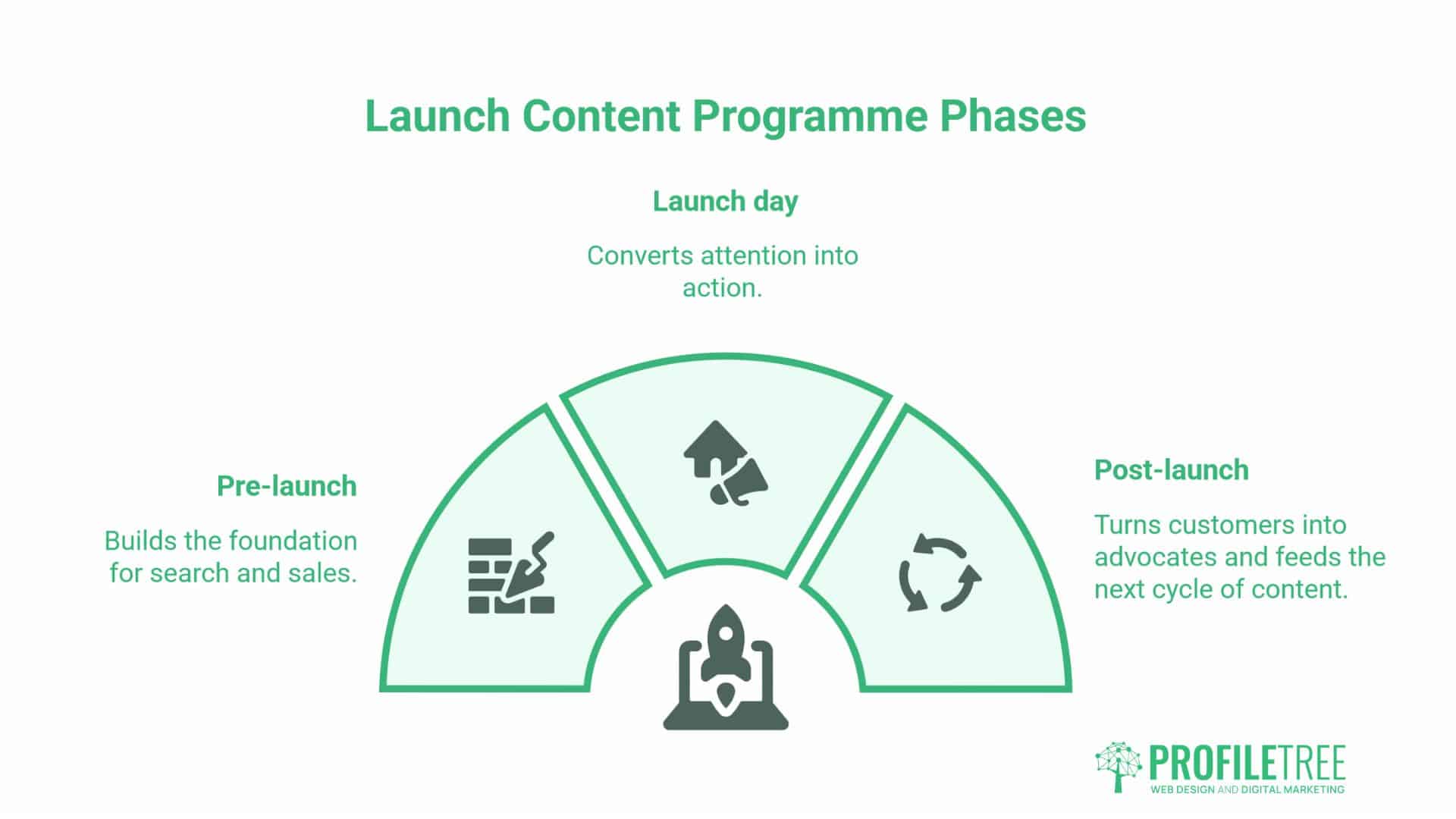
A launch content programme runs across three phases: pre-launch, launch day and post-launch. Each phase has a different job. Pre-launch builds the foundation for search and sales. Launch day converts attention into action. Post-launch turns customers into advocates and feeds the next cycle of content. Skipping any one of the three is usually where a launch underperforms, not the quality of any single asset.
Phase 1: Pre-Launch. Building the Search and Sales Foundation
The pre-launch phase is where organic search visibility gets built. It’s also where most SMEs do nothing, then scramble.
SEO Content as the Foundation
Search intent around a new product rarely arrives on launch day. Potential customers start researching problems, comparing approaches and looking for solutions weeks or months before they’re ready to buy. Pre-launch SEO content targets that early-stage intent. Blog posts that answer the questions your product solves, comparison guides that help buyers understand their options, and FAQ pages that address common objections all work long before the product goes live.
This is exactly the kind of structured, phased publishing our content marketing service is built around. For an SME bringing a new product or service to market, the goal is to have supporting content indexed and build authority before the announcement goes out, which usually means starting the keyword research and content brief stage through our SEO service at least six to eight weeks ahead of the planned date.
If the launch sits within a wider push, rather than a one-off, it’s worth mapping the whole sequence against our four-stage digital marketing strategy process: audit what’s currently ranking, plan the content and asset calendar, deliver the pre-launch and launch content, then monitor performance and refine the post-launch programme. A launch treated as a single stage within that cycle tends to sustain its search gains longer than a launch treated as an isolated project.
Internal Enablement: The Hidden Content Layer
One of the most consistently overlooked elements of a product launch is internal content. Sales teams need to know how to talk about the product before it goes live. Customer service teams need answers to the questions they’ll receive on day one. If these teams aren’t equipped with clear, accurate content, the external campaign gets undermined by inconsistent messaging at the point of enquiry.
Internal assets worth producing before launch include a product one-pager, a set of key objection responses, an FAQ document for the customer service team, and a short briefing document for anyone in the business who’ll be talking to customers or prospects about the new product. Building this internal layer alongside the external content, rather than as an afterthought, is one of the more practical outcomes of our digital training service; a short internal workshop ahead of launch day usually pays for itself in fewer inconsistent answers during the first week.
Checking Claims Before They Go Live
Before any launch copy, ad creative or press release goes out, it’s worth a claims check. The Advertising Standards Authority (ASA) sets out guidance on what businesses can and can’t say about a new product, particularly regarding health, environmental, and performance claims, and the rules apply just as much to a small business’s first product launch as to a national campaign. It’s a quick check against ASA’s published guidance, not a legal review, but it catches the kind of overstatement that gets flagged after launch rather than before it.
The Pre-Launch Checklist
Before announcing anything publicly, confirm these assets are in place:
- Supporting blog content published and indexed
- Dedicated launch landing page built and ready
- An email campaign was drafted for the announcement
- Social content planned and scheduled
- Internal team briefed on product documentation
- Product demo video produced or in final edit
- Launch claims checked against ASA guidance
Phase 2: Launch Day. Choosing and Sequencing Your Assets
Launch day content has one job: make it easy for the right people to understand, find and act on the product.
Soft Launch or Hard Launch?
Not every product needs a big-bang announcement. A soft launch, releasing quietly to a limited audience before the full public push, suits products that benefit from early feedback or a smaller SME team that can’t support a high volume of enquiries on day one. A hard launch, a coordinated public announcement across every channel at once, suits products where momentum and press timing matter more than iteration.
| Soft Launch | Hard Launch |
|---|---|
| Lower risk, easier to adjust before wider release | Higher visibility, stronger initial momentum |
| Suits limited support capacity | Needs support and sales capacity ready from day one |
| Useful for gathering early feedback and reviews | Useful when press timing or a seasonal window matters |
| Common for SaaS, apps and services | Common for physical products and retail launches |
Most SMEs in Northern Ireland, Ireland and the UK are better served by a soft launch into an existing customer base or email list before a wider hard launch, simply because the support and sales capacity to handle a sudden spike rarely exists in a small team. Ciaran Connolly, founder of ProfileTree, puts it plainly: “The businesses that get the most out of a launch are usually the ones who tested the message on a smaller group first, not the ones who shouted loudest on day one.”
The Hero Asset: Video, Blog or Landing Page?
The answer depends on the product and audience, but for most B2B SMEs in the UK and Ireland, the hierarchy is: landing page first, product video second, long-form content third.
A well-designed launch landing page is the conversion engine. It captures all the traffic your other content drives, clearly presents the product, and gives visitors a single next step. Without one, launch day traffic disperses across a site with no obvious focal point. This is where our web design and web development teams are usually brought in several weeks before launch, rather than the week of it, since a rushed landing page tends to show in the conversion rate.
Our video production team works with SMEs across Northern Ireland and the UK on exactly this kind of product explainer and launch content, usually scripted around the same objection-handling material produced for the internal enablement stage above, so the video and the sales team are saying the same thing.
Social Media Sequencing
Not every platform serves the same purpose on launch day. LinkedIn is the strongest channel for B2B announcements in the UK and Ireland: decision-makers, longer-format posts and genuine professional reach. Instagram and TikTok are more useful for B2C launches where visual demonstration and reach matter more than professional context.
Our social media marketing service covers the organic strategy, content creation and community engagement side of this sequencing across LinkedIn, Instagram, Facebook, TikTok and X. Worth noting for planning purposes: this is organic delivery, so if a launch depends on paid social spend to reach a cold audience quickly, that sits under paid activity and should be scoped separately from the organic content plan.
YouTube sits in a separate category. A product demo or launch video uploaded to YouTube isn’t just a social post; it’s a searchable asset that continues to attract views for months after launch. For a business that’s invested in video production, YouTube distribution is a natural extension through our YouTube marketing service, and it’s often the single asset from a launch that keeps generating organic traffic long after the announcement has been forgotten on social feeds.
Press and UK Media Outreach
For UK and Irish launches, trade publications relevant to the industry usually carry more weight than broad consumer press for an SME audience. A product announcement submitted to a relevant trade title, accompanied by a well-structured press release, builds credibility and earns backlinks that support long-term search performance. Every claim in that release should have already passed the ASA check during the pre-launch phase; a correction issued after launch does more damage to credibility than a modest claim would have in the first place.
Phase 3: Post-Launch. Retention, Advocacy and Cross-Border Considerations
The post-launch phase is where most launch content programmes stop. It’s also where the highest-return content opportunities sit.
Help Content as a Retention Tool
Support documentation, onboarding guides, FAQs and knowledge base articles are launch content. They directly affect whether a customer who’s bought the product succeeds with it, and whether they recommend it to others. For a B2B product in particular, well-documented onboarding reduces support burden, improves adoption and builds the kind of trust that leads to renewals and referrals.
This is a gap that most launch guides don’t address. The focus is almost entirely on acquisition content; the content that helps customers succeed with the product after purchase is treated as an operational task rather than a marketing one. In practice, it’s both, and it usually sits within the same content marketing workstream as the pre-launch material, but aimed at existing customers rather than prospects.
User-Generated Content and Review Collection
Post-launch content planning should include a deliberate strategy for collecting and publishing customer reviews, testimonials and user-generated content. These assets serve two purposes: they provide social proof for new prospects and generate fresh indexed content that supports long-term search visibility. Our guide to leveraging user-generated content for brand building goes into this in more depth [slug to confirm].
For an SME, a simple email sequence sent two to four weeks after purchase, asking customers to share their experience, is often enough to generate a steady flow of reviews. Platforms relevant to the UK and Irish market include Google Business Profile, Trustpilot and industry-specific review sites.
AI-Assisted Post-Launch Analysis
AI tools are now genuinely accessible to SMEs and genuinely useful in the post-launch period. Analysing customer feedback at scale, spotting recurring objections and tracking sentiment across channels are all tasks AI tools handle faster than manual review. Our AI implementation service helps an SME work out which of these tools actually suit its context, and the AI-specific training delivered through our sister brand, Future Business Academy, is often the practical next step once a team has decided a tool is worth adopting rather than just trialling.
Northern Ireland and the Republic of Ireland: Cross-Border Considerations
A meaningful share of ProfileTree’s client base sells across the Northern Ireland-Republic of Ireland border, and a launch aimed at both markets requires only a small amount of extra planning rather than a separate strategy. Pricing needs to be clear in the relevant currency for each audience, messaging that references UK-only or Ireland-only regulation needs a second read before it goes out, and press outreach usually means building two separate lists of trade titles rather than treating “local media” as one list. None of this needs a separate campaign, but it does need someone to check the details before launch day, rather than after a customer flags it.
A Note on Sustainability
Increasingly, UK and Irish buyers ask about the environmental impact of a new product before committing, particularly in sectors such as retail, food and drink, and manufacturing. It’s worth having a genuine, verifiable answer ready (packaging choices, sourcing, delivery footprint) rather than a vague sustainability claim bolted onto the launch copy. A claim that can’t be backed up is also the kind of claim the ASA guidance referenced earlier takes a dim view of.
The UK and Ireland Product Launch Checklist
Use this as a working reference before any product launch.
Pre-launch: problem-focused blog content published, dedicated landing page live with a conversion goal, email list segmented and campaign drafted, product demo video produced, internal team briefed, launch claims checked against ASA guidance.
Launch day: landing page call-to-action tested, social posts published across relevant platforms, YouTube video live, press release issued to relevant UK and Irish trade publications, analytics tracking confirmed.
Post-launch: customer onboarding content published, review collection sequence active, cross-border messaging checked if selling into both NI and ROI, performance data reviewed at 7 days, 30 days and 90 days, content updated based on early customer questions.
Measuring Success: KPIs for Launch Content
The metrics that matter depend on what the content is trying to do. Pre-launch SEO articles should be measured on organic traffic and keyword rankings. A landing page should be measured on conversion rate and cost per lead. A YouTube video should be measured on views, watch time and click-through to the site.
| Content Asset | Primary KPI | Secondary KPI |
|---|---|---|
| Launch landing page | Conversion rate | Bounce rate |
| Pre-launch blog content | Organic sessions | Keyword ranking |
| Product demo video | Views and watch time | Call-to-action click-through |
| Email campaign | Open rate | Click-to-conversion |
| Social content | Engagement rate | Profile visits |
| Help documentation | Support ticket volume | Time on page |
Moving beyond surface metrics matters here. A social post with high likes but no traffic to the landing page isn’t contributing to launch success. Attribution, working out which content asset actually preceded a conversion, is where the analysis becomes genuinely useful, and for an SME without a dedicated analytics resource, this is a practical area where our digital training service pays back quickly.
What This Typically Costs
Budgets vary by scope, but as a rough guide for an SME running a launch content programme alongside ongoing SEO and content work, £800 to £2,000 a month covers core SEO and content activity, rising to £1,500 to £4,000 a month once paid activity is layered on top. A standalone strategy document or audit ahead of a launch, mapping the pre-launch, launch and post-launch content against the digital marketing strategy process above, typically runs to £1,500 – £3,500 as a one-off. These are general benchmarks rather than a quote; the actual scope depends on the product, the channels involved, and the amount of existing content.
Turning This Into a Launch That Lands
A product launch content strategy isn’t a single asset or a single day. It’s a sequence: search visibility built in advance, a landing page and video ready to convert attention on the day, and a retention plan that turns first buyers into reviews and referrals that support the next launch. Most of the failure points above come down to sequencing and ownership rather than budget, which is usually good news for an SME working with a smaller team and a tighter timeline than a national brand.
If you’re planning a launch and want a second opinion on the sequencing, get in touch to talk through your next product launch, or explore our content marketing services for a fuller look at how the pre-launch and post-launch stages fit together.
FAQs
What content is essential for a B2B product launch?
A conversion-focused landing page, a product explainer video and supporting SEO content are the three non-negotiable assets for a B2B launch. Sales enablement materials for internal teams matter just as much, even though they rarely get budgeted for as launch content.
How far in advance should I start creating launch content?
For a planned launch, start content production at least eight to twelve weeks out. Pre-launch SEO content needs time to be indexed and build authority before the announcement goes live, and a landing page needs time to be built and tested properly through our website design process, rather than being rushed in the final week.
What’s the most effective social media platform for UK and Irish product launches?
LinkedIn is the strongest channel for B2B launches. For B2C, Instagram and TikTok deliver better reach, while YouTube provides lasting search value for any product with a visual demonstration.
What’s the difference between a soft launch and a hard launch?
A soft launch releases quietly to a limited audience first, so a business can gather feedback and fix issues before a wider push. A hard launch is a coordinated public announcement across every channel at once. Most SMEs get more out of a soft launch first.