
Psychological Principles in Marketing: How to Apply Them in Practice
Table of Contents
Psychological principles in marketing are not a niche academic concern. They are the reason one service page converts and an almost identical one does not, why a subject line gets opened or ignored, and why some brands earn repeat business without ever running a discount. Every purchasing decision a person makes is shaped by how they process information, assess risk, and respond to others’ behaviour.
For SMEs across Northern Ireland, Ireland and the UK, understanding these principles is practical rather than theoretical. This guide covers the core psychological principles used in marketing, what the research behind them actually says, and how to apply them across digital marketing strategy, content, and web design without crossing into manipulation.
What is Marketing Psychology?
Marketing psychology is the study of how people think, feel, and make decisions, and how businesses can use that understanding to communicate more effectively.
It draws on decades of research in behavioural economics, cognitive psychology, and consumer neuroscience. The goal is not to trick people into buying things they do not want. The goal is to remove friction, communicate value clearly, and reach people in ways that match how they actually process information.
For SMEs, this matters at every stage of the customer journey: how your website is structured, how your service pages are written, how your social content is framed, and how your calls to action are worded.
12 Psychological Principles Every Marketer Should Know
The following principles are drawn from established research, including Robert Cialdini’s foundational work on influence and subsequent studies in consumer behaviour. Each one has direct applications for digital marketing strategy, web design, and content.
1. Social Proof
People look to others when they are uncertain. If a service page shows Google reviews, case study outcomes, or the number of clients served, visitors are more likely to trust it than a page that makes claims without supporting evidence.
For a Belfast-based accountancy firm, displaying 47 five-star Google reviews on a landing page is social proof. For an e-commerce business, showing “312 people bought this in the last week” is social proof. The form varies; the mechanism is the same.
On your website, social proof belongs near decision points: above the fold on service pages, adjacent to contact forms, and in the opening section of case studies.
2. Reciprocity
When someone gives you something useful without asking for anything in return, you feel an inclination to give something back. In marketing, this principle underpins content strategy: a business that publishes genuinely helpful guides, free audits, or useful tools builds goodwill before any commercial conversation begins.
A content marketing approach built on reciprocity treats blog posts, videos, and downloadable resources as investments in trust rather than sales pitches. The return comes later, when the reader is ready to buy.
3. Scarcity and Urgency
People value things more when they perceive them as limited. A product “available for a limited time” or a service with “only three slots remaining this month” prompts action more effectively than an open-ended offer.
A note on UK compliance: The Competition and Markets Authority (CMA) has issued clear guidance on urgency tactics. Countdown timers that reset, fake “low stock” warnings, and fabricated deadline claims are considered misleading advertising under the Consumer Protection from Unfair Trading Regulations 2008. Scarcity works as a marketing principle only when it reflects reality. Using it dishonestly damages trust and exposes you to regulatory risk.
4. Loss Aversion
Research in behavioural economics, most notably by Kahneman and Tversky, established that people feel the pain of a loss approximately twice as strongly as the pleasure of an equivalent gain. In marketing terms, “Don’t miss out on your free website audit” tends to outperform “Claim your free website audit.”
Framing your offer around what the prospect risks losing: missed leads, poor search visibility, a website that undermines their credibility leads, poor search visibility, a website that undermines their credibility, is often more motivating than listing features and benefits.
5. Anchoring
The first number a person sees sets the reference point for everything that follows. If a service proposal opens with a premium package at £2,400, a standard package at £1,200 feels reasonable by comparison. Without the anchor, £1,200 might feel expensive.
Anchoring is particularly relevant on pricing pages and in proposal documents. Present your full-service option first, then your entry point. The order matters.
6. The Decoy Effect
When three options are presented and one is clearly inferior to the others, people are more likely to choose the option the business prefers. This is why three-tier pricing (Basic, Standard, Premium) is so common in SaaS and agency services. The middle option is designed to make Premium look better value relative to Standard.
Used honestly, this is a structuring tool that helps people make decisions. Used deceptively, it erodes trust.
7. Commitment and Consistency
Once someone takes a small action: signing up for a newsletter, downloading a guide, attending a webinar, they are more likely to take a larger action later. This is because people prefer their behaviour to remain consistent with previous choices.
In digital marketing, this principle informs the customer journey: a low-commitment entry point (a free resource or a brief consultation) creates the conditions for a higher-commitment next step. Email sequences, onboarding flows, and drip campaigns all apply this principle.
8. Authority
People follow the lead of credible experts. In marketing, authority is built through demonstrated expertise: published research, speaking engagements, accreditations, media appearances, and the quality of the content a business produces.
For an agency or professional services firm, a well-structured blog, an author bio with genuine credentials, and citations from reputable sources all contribute to authority signals. Google’s E-E-A-T framework (Experience, Expertise, Authoritativeness, Trustworthiness) is in part a formal attempt to measure these authority signals algorithmically.
9. The Liking Principle
People do business with companies they like. Likability in marketing comes from shared values, relatability, humour, and the sense that the business genuinely understands the customer’s situation.
This is why brand voice matters in brand storytelling and content marketing. A company that sounds like a real team of people, opinionated, specific, occasionally willing to say something unexpected, is more likeable than one that produces safe, generic copy.
10. Priming
Priming occurs when exposure to one stimulus influences a response to a subsequent stimulus. In web design, images, colour choices, and copy above the fold prime visitors before they read your core message. A law firm that uses dark navy tones, formal serif fonts, and images of professional settings primes the visitor to perceive the firm as authoritative before a word is read.
The concept applies to colour psychology in digital design as well. Blue signals trust and stability; green is associated with health, sustainability, or money, depending on context; red creates urgency. These associations are not absolute, but they are consistent enough to inform design decisions.
11. Cognitive Ease
People prefer information that is easy to process. A well-structured, plain-language website that is visually clear creates cognitive ease. Visitors stay longer, engage more, and are more likely to convert.
Cognitive ease is the psychological argument behind good UX: clear navigation, short paragraphs, descriptive headings, logical page flow, and fast load times all reduce mental effort. A cluttered, slow, or confusing website increases cognitive load, and visitors leave.
This is one of the strongest cases for investing in professional web design. The visual and structural decisions that create cognitive ease are not cosmetic. They are conversion decisions.
12. The Von Restorff Effect (Isolation Effect)
When something stands out from its surroundings, it is more likely to be remembered. In design, a CTA button in a contrasting colour stands out on a neutral page. In content, a well-placed statistic or a surprising analogy stands out in otherwise predictable copy.
The principle applies across channels: a subject line that breaks the pattern in a crowded inbox, a video thumbnail that uses an unexpected visual, or a social post that takes a genuine stance rather than repeating the obvious.
How Psychology Applies to B2B Marketing
Most examples of marketing psychology focus on retail and direct-to-consumer contexts. B2B buying decisions differ; they typically involve multiple decision-makers, longer consideration cycles, and higher perceived risk.
In B2B contexts, authority and social proof tend to outweigh scarcity and urgency. A procurement manager or marketing director buying services for their company needs to feel confident they can justify the decision to colleagues. Case studies with measurable outcomes, client logos from recognised organisations, and evidence of the agency’s expertise carry more weight than a countdown timer.
Risk mitigation psychology is also more prominent in B2B. Buyers are not just worried about whether the service will deliver value; they are worried about what happens if it does not. This is why process transparency (showing how a project works, what’s included, what happens if something goes wrong) reduces anxiety and increases conversion more reliably in B2B than in B2C.
Psychological Principles in Web Design and Digital Marketing
Understanding these principles is useful. Applying them systematically across your digital presence is where the commercial impact emerges.
In web design: social proof near conversion points, anchoring in pricing layouts, cognitive ease in navigation and typography, priming through colour and imagery, and the Von Restorff effect in CTA design.
In content marketing: reciprocity is achieved through genuinely useful content, authority through depth, and liking through a consistent brand voice.
In SEO strategy: search psychology and user intent inform how people phrase queries. Loss aversion and urgency shape which headlines earn higher click-through rates. Understanding what the reader fears losing is as important as understanding what they want to find.
In video production and YouTube marketing: social proof (view counts, comments), authority (expert-to-camera content, production quality), and liking (presenter warmth, clear point of view) all influence whether a viewer watches to the end and takes action.
Ethical Marketing: Where Persuasion Becomes Manipulation
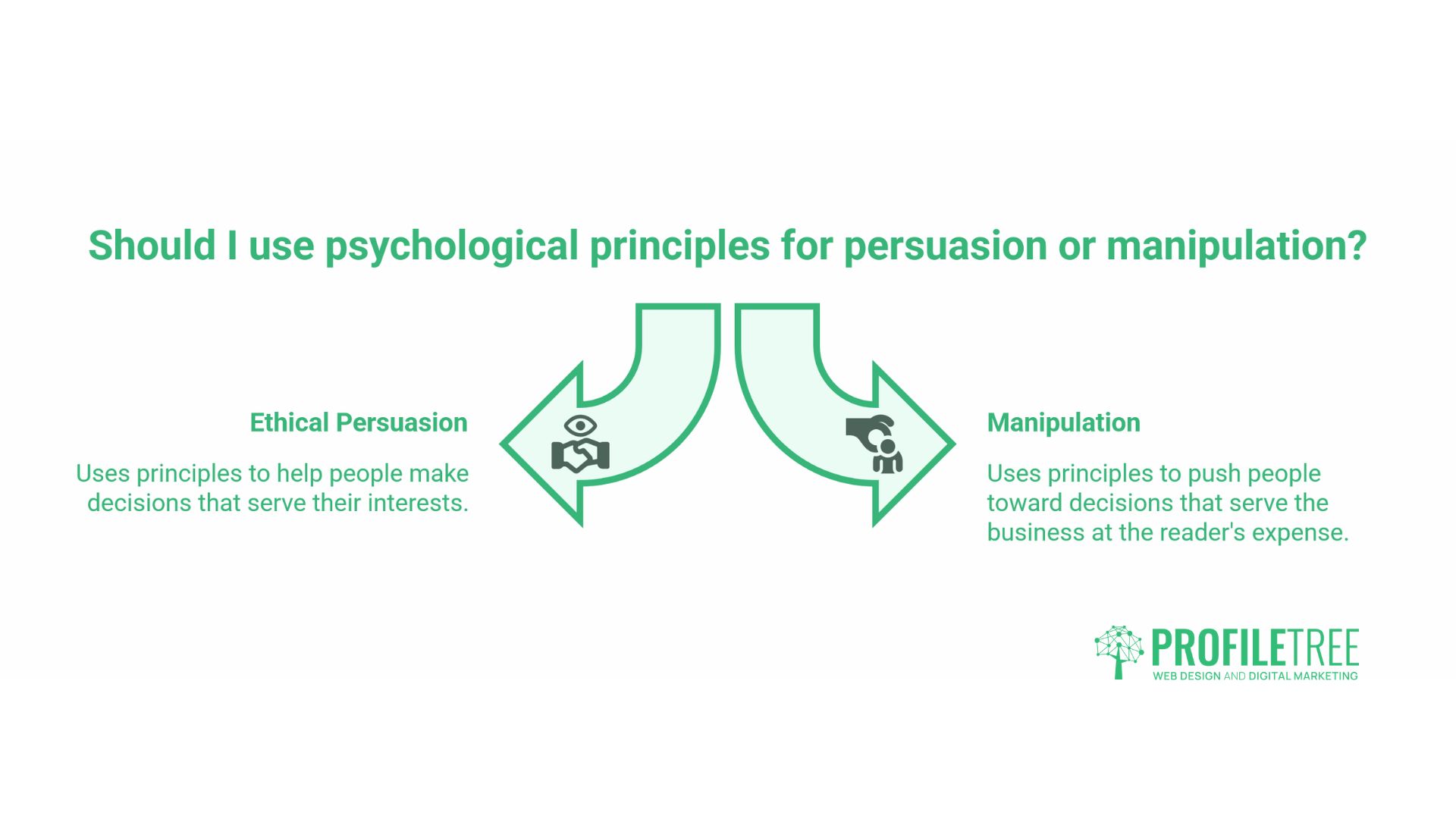
The difference between ethical persuasion and manipulation is not always obvious, but it is important. Ethical marketing uses psychological principles to help people make decisions that genuinely serve their interests. Manipulation uses those same principles to push people toward decisions that serve the business at the reader’s expense.
The UK Advertising Standards Authority (ASA) and the CMA have both moved in recent years to address “dark patterns”, design or messaging choices that exploit psychological principles to mislead consumers. Examples include:
- Fake scarcity or urgency messaging (countdown timers that reset, false “only 2 left” stock warnings)
- Hidden costs revealed only at checkout
- Pre-ticked opt-in boxes
- Deliberately confusing cancellation flows
Avoiding these is not just a compliance matter. Businesses that rely on manipulation to convert tend to have higher churn rates, lower lifetime customer value, and more reputation risk. Sustainable persuasion, building trust through honest communication and genuine value, produces better long-term commercial outcomes.
The ethics and legalities of digital marketing are a topic worth understanding in depth if you are running campaigns in the UK or Ireland, where consumer protection frameworks are well established.
Applying These Principles to a Small Business Budget
Not every psychological principle requires significant investment. Several of the most effective can be applied with minimal cost:
Reciprocity is delivered through content: a useful blog post, a practical guide, a short video answering a common question. Social proof requires collecting and displaying what your customers already say: Google reviews, testimonials, and before-and-after project photos. Cognitive ease comes from clear writing and logical page structure, not expensive tools.
Where investment makes sense is in the decisions that are harder to reverse: website architecture, brand voice, and content strategy. Getting these right from the start, or fixing them once they are wrong, tends to cost more than doing them properly in the first place. Digital training for SMEs is one route for in-house teams that want to apply these principles without outsourcing everything.
Psychology in the Age of AI-Generated Content
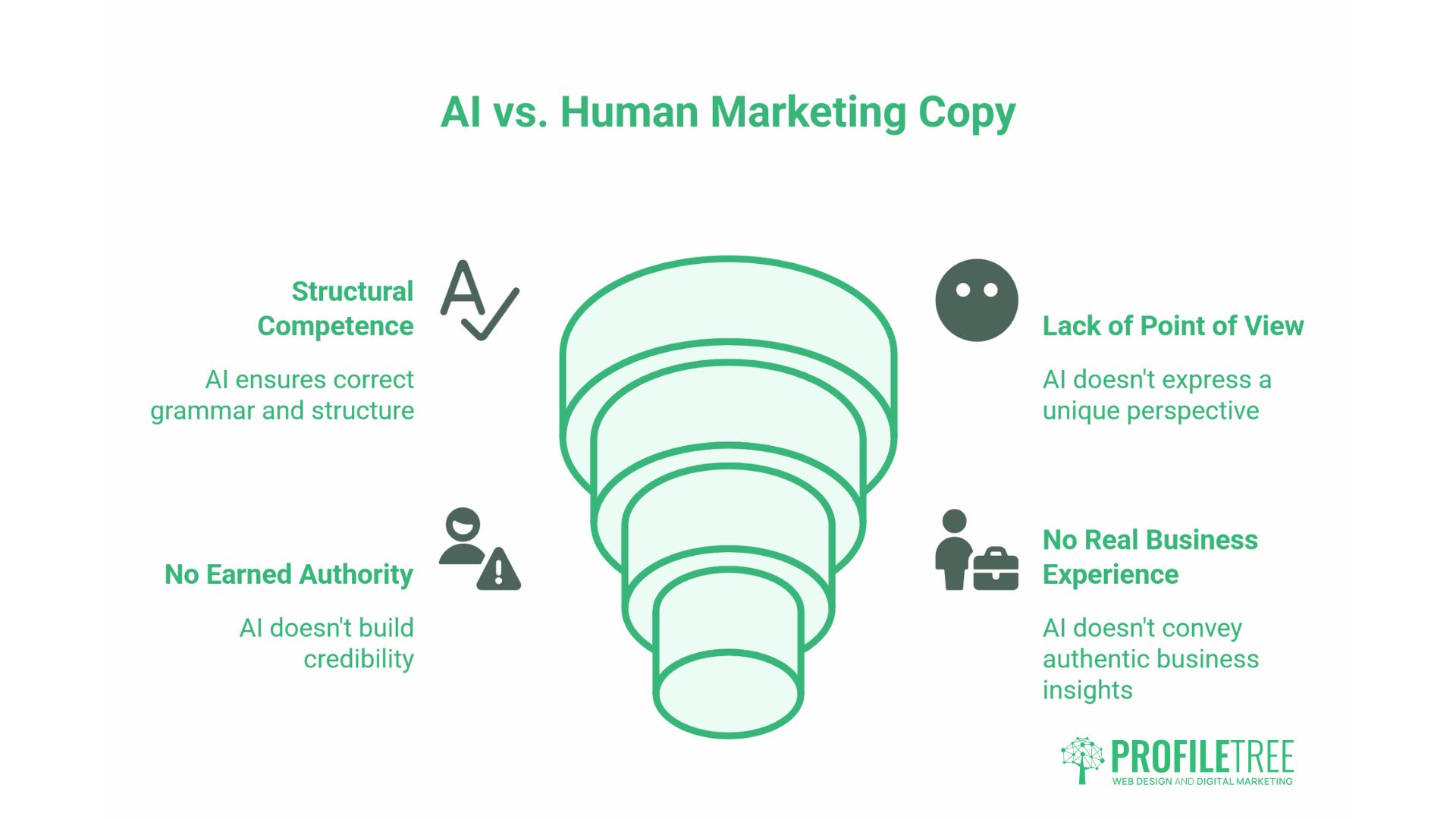
AI tools can produce marketing copy faster than any human writer. What they cannot do reliably is apply psychological principles with judgement. The output tends to be structurally competent and psychologically flat: correct sentences, no point of view, no earned authority, no sense that a real business with real experience is speaking.
This creates both a problem and an opportunity. The problem: AI-generated content that skips cognitive ease, social proof, and authority signals will not convert, regardless of how quickly it was produced. The opportunity: Businesses that understand psychological principles can use AI as a drafting tool while applying those principles themselves during editing.
In practice, this means treating AI output as a first draft that needs a psychological audit before publication. Does the introduction apply loss aversion or reciprocity to draw the reader in, or does it open with a generic definition? Does the service page carry social proof near the call to action, or does it list features in a vacuum? Is the brand voice consistent enough to build the liking principle over time, or does it shift register between pages because different prompts produce different tones?
AI implementation and transformation are most effective when the human layer, the strategic and psychological layer, remains in place. The technology handles volume; the marketer handles meaning.
Conclusion: Psychological Principles in Marketing
Marketing psychology helps you understand why some campaigns connect and others do not. The principles in this guide are not tricks. They describe how people actually think and make decisions. Apply them with the reader’s genuine interests in mind, stay within the bounds of UK advertising standards, and test your assumptions rather than treating any principle as guaranteed. The businesses that do this consistently tend to build stronger customer relationships and better long-term commercial results than those chasing short-term conversion lifts through manipulation.
ProfileTree works with SMEs across Northern Ireland, Ireland, and the UK to apply these principles across digital marketing strategy, web design, content, and video. Talk to the team to find out how this applies to your business.
FAQs
What is the psychology behind marketing?
Marketing psychology applies research from behavioural economics and cognitive science to understand how people make purchasing decisions, covering factors such as perception, trust, and cognitive biases.
What are the 7 psychological triggers in marketing?
Reciprocity, commitment and consistency, social proof, authority, liking, scarcity, and loss aversion. These are based on Robert Cialdini’s research in Influence (1984) and remain the most widely applied framework in marketing.
How do psychological principles influence consumer behaviour?
Each principle acts at a different point in the decision process: social proof reduces uncertainty, loss aversion creates urgency, and cognitive ease keeps visitors on a page. Effective application depends on knowing where in the buyer journey the principle is most relevant.
What is an example of a psychological principle in a small business context?
Displaying Google reviews on a contact page is social proof. Publishing a free monthly guide is reciprocity. Listing your highest-priced service package first is an anchoring bias. None requires a significant budget.
Are countdown timers and scarcity claims legal in the UK?
Only when genuine. The CMA considers fake urgency, including timers that reset and false stock warnings, to be misleading advertising under UK consumer protection law.