
Managing a Remote Content Team: Strategies That Work
Table of Contents
Running a remote content team is no longer an unusual arrangement for Northern Irish and UK businesses. Since 2020, distributed teams have become standard practice across agencies, in-house marketing departments, and SMEs that need content output without the overhead of a full-time office. The challenge is not whether remote content work is viable. It clearly is. The real challenge is doing it without losing editorial standards, missing deadlines, or burning out your writers with a schedule built around too many video calls and too little deep work.
This guide covers the practical systems, tools, and management approaches that enable long-term management of a remote content team. It draws on ProfileTree’s experience with distributed teams across Northern Ireland, Ireland, and the UK. ProfileTree is a Belfast-based digital agency founded in 2011, with over 1,000 projects completed and a 5-star Google rating from more than 450 reviews. The focus is on operational realities that generic guides skip: asynchronous workflows, AI governance, UK employment law, and content performance measurement.
Three Things That Make or Break a Remote Content Team

Before getting into the specifics of tools and processes, it is worth naming the three variables that most consistently determine whether managing a remote content team succeeds or struggles. These apply regardless of team size, industry, or whether writers are employed or freelance.
- Clear output expectations with realistic deadlines, not process compliance measured by hours online
- Asynchronous-first communication that protects creative focus time, with synchronous sessions reserved for decisions that genuinely need real-time input
- A single source of truth for briefs, editorial standards, and content status, so no writer in your remote content team is ever waiting on information they need to do their job
Building Your Remote Content Tech Stack
The tools a remote content team uses shape how work flows and how much time gets lost to coordination overhead. When managing a remote content team, the priority is choosing tools that integrate with each other and that your team will actually use consistently. A sophisticated tech stack nobody follows is worse than a simple one that works.
| Category | Recommended Tool | Key Function | Approx. Cost (GBP/month) |
|---|---|---|---|
| Project Management | Asana or Trello | Task tracking and workflow visibility for remote content teams | Free to £10/user |
| Communication | Slack | Asynchronous messaging, file sharing | Free to £6.75/user |
| Document Collaboration | Google Workspace | Brief creation, content drafts, editorial review | £4.60/user |
| CMS / Publishing | WordPress | Content production and scheduling | Hosting-dependent |
| SEO Research | Ahrefs or Semrush | Keyword data and content audits | From £89/month |
The tools above are a starting point. The more important decision is establishing clear protocols for how each tool is used. Slack becomes a distraction engine if there are no norms around response time and channel purpose. Asana works well when tasks have owners and due dates; it creates confusion when used as an ideas dump.
ProfileTree’s content marketing services use a combination of project management and editorial tools to manage content across multiple client accounts simultaneously. The key insight from that experience is that tool selection matters far less than agreement on how those tools are used within the remote content workflow.
Integrating AI into a Remote Content Workflow

AI writing tools are now part of most professional content workflows. When managing a remote content team, the question is not whether to use them but how to use them without producing content that is undifferentiated, factually vague, or tonally flat. Remote content teams face a specific risk here: without clear governance, individual writers will adopt different AI practices, and editorial consistency will break down across the team.
Defining the Human-in-the-Loop Process
A human-in-the-loop (HITL) process defines exactly where AI assists within the remote content workflow and where humans take over. The most workable structure for a remote content team looks like this:
- AI handles initial research aggregation and outline drafts
- A human writer takes the outline and produces the first substantive draft, applying editorial standards throughout
- An editor reviews for factual accuracy, brand voice, and editorial standards before any AI-assisted section is treated as finished copy
- Final sign-off confirms the piece adds genuine information gain, not just well-formatted summaries of existing content
This structure gives remote content writers the speed benefit of AI research tools while keeping human judgment at the stages where it matters most. The alternative (using AI to produce complete drafts that writers lightly edit) tends to produce content that reads smoothly but says nothing distinctive.
Setting Editorial Guardrails for Generative AI
Remote content teams need a written AI policy that is specific enough to be followed consistently. Vague guidance like “use AI responsibly” does not translate into consistent practice across a distributed team. A workable policy for any remote content workflow covers three things:
- Which AI tools are approved and which are not (primarily a data security consideration for client work)
- What AI output can be used directly (research summaries, structural outlines) versus what must be human-written (introductions, opinion sections, client quotes, any specific claim that requires verification against editorial standards)
- How AI use is disclosed internally when remote content writers submit work for editorial review
UK and Ireland Specifics for Remote Content Teams
Most published guidance on remote team management is written for a US or global audience. UK and Irish businesses face specific considerations that affect how remote content teams are structured, particularly around employment law, tax status, and asynchronous scheduling across different time zones.
IR35 and Freelance Content Writers in the UK
IR35 is the UK tax legislation that determines whether a freelance content writer should be treated as an employee for tax purposes. Off-payroll working rules, introduced in 2021 for medium and large private sector organisations, place responsibility on the client to assess whether a contractor engagement falls inside or outside IR35.
For remote content teams that rely on regular freelancers, the practical IR35 risk is straightforward: if a writer works exclusively or predominantly for your business, follows your direction on how and when to work, and cannot substitute another person for themselves, HMRC may assess them as an employee. Getting this wrong carries significant penalties.
The UK Government’s Check Employment Status for Tax tool (CEST) is the starting point for any IR35 assessment. The key structural protections for a remote content team are: writers working for multiple clients, clear project-based contracts with defined deliverables, and no requirement for writers to follow a daily schedule set by your business.
Managing GMT and BST Time Zones Across a Remote Content Team
UK and Irish businesses managing a remote content team that includes writers across multiple time zones need to build their remote content workflow around overlap hours rather than trying to synchronise everyone. Asynchronous communication covers the gaps; synchronous meetings fill only the slots where overlap exists.
| Time Zone | Working Hours | GMT Overlap Hours |
|---|---|---|
| GMT / BST (UK & Ireland) | 09:00 to 17:30 | Full day |
| EST (US East Coast) | 14:00 to 22:30 GMT | 14:00 to 17:30 GMT |
| IST (India Standard Time) | 03:30 to 12:00 GMT | 09:00 to 12:00 GMT |
UK bank holidays and Irish public holidays, which differ, create recurring disruption points that are worth explicitly building into your remote content workflow. A content calendar that marks all UK and Irish public holidays at the start of the year removes the last-minute scramble when a deadline falls on a day half the remote content team is not working.
Hiring and Onboarding Remote Content Writers

Hiring remote content writers removes geographic constraints but introduces a different assessment challenge: you cannot rely on in-person interactions to evaluate whether someone will work well in a distributed team. When managing a remote content team, the skills that matter most are not writing ability alone. Self-direction, clear written communication, and the capacity to ask the right questions early matter equally, particularly in an asynchronous environment where a writer who disappears with a brief and surfaces a week later with something wrong can cost the whole content workflow a significant amount of time.
Assessing Fit for Remote Content Roles During Hiring
The interview process for remote content writers should include at least one asynchronous task. Asking candidates to respond to a written brief, produce an outline, or conduct a short research task tells you more about how they work independently within a remote content workflow than any live video interview will. Specifically, look for:
- Whether they ask clarifying questions before starting, or make assumptions and plough ahead
- How clearly they communicate their reasoning alongside the work itself, which reflects how they will operate within the remote content team
- Whether their output follows editorial standards or interprets the brief in ways that suit them
A 30-60-90 Day Onboarding Approach for Remote Content Teams
Remote content team onboarding fails when it is treated as a single-day event. A structured 30-60-90-day approach gives new remote content writers time to understand the brand voice, editorial standards, internal tools, and client context before they are expected to operate fully independently within the content workflow.
- Days 1 to 30: Access setup, introductions, guided first briefs with close editorial review and detailed feedback on every piece submitted
- Days 31 to 60: Increased independence on standard article formats, first participation in content planning, check-ins reducing from daily to weekly as the remote content workflow becomes familiar
- Days 61 to 90: Full independent operation on agreed content types, editorial review shifting to exception-based rather than routine for established remote content writers
ProfileTree’s digital training programmes include practical modules on managing content teams and building editorial workflows, particularly useful for marketing managers stepping into a remote team management role for the first time.
Measuring Remote Content Team Performance
Measuring performance in a remote content team requires a clear separation between output metrics, which tell you what was produced, and impact metrics, which tell you whether the remote content workflow is delivering results. Most teams over-index on output (articles published, tasks completed) and under-invest in impact (organic traffic, keyword rankings, conversion support). Neither tells the full story in isolation.
Output Metrics vs Impact Metrics for Remote Content Teams
Output metrics give you a view of how the remote content team is operating day to day. Impact metrics tell you whether the content is serving its commercial purpose. A useful performance framework for any remote content team tracks both:
- Output: articles published per week, brief-to-draft turnaround time within the content workflow, editorial revisions required per piece, deadline adherence rate across the remote content team
- Impact:organic traffic to content pages via Google Search Console, keyword position changes, on-page engagement, including time on page and scroll depth, and internal link click-through rates
ProfileTree’s SEO services for Northern Ireland businesses include content performance auditing that connects organic search data directly to remote content output. Reviewing this data regularly is one of the most effective ways to identify which writers, brief types, and content formats within your remote content workflow are generating the most commercial value.
To find out how a content performance audit could improve your remote content team’s results, get in touch with the ProfileTree SEO team.
Reducing Creative Burnout in a Remote Content Team Without Micromanaging
Burnout in a remote content team tends to come from two sources: volume pressure (too many pieces, too fast) and ambiguity stress (unclear briefs, contradictory feedback, no sense of whether work is landing). Effective remote team management addresses both without resorting to constant check-ins or micromanagement.
Volume pressure is addressed through honest capacity planning. Most remote content teams are running at higher throughput than is sustainable for maintaining editorial standards. Cutting output by 20% and improving quality by the same margin is almost always the better commercial decision for organic search performance.
Ambiguity stress is addressed through better briefing. A brief that specifies the target reader, the primary keyword, the angle, the internal links to include, and the word count target removes the need for remote content writers to make guesses that are then corrected in the editing stage. Proper briefs pay back in fewer revision cycles and higher writer satisfaction.
Asynchronous Brainstorming: A Better Approach for Remote Content Teams
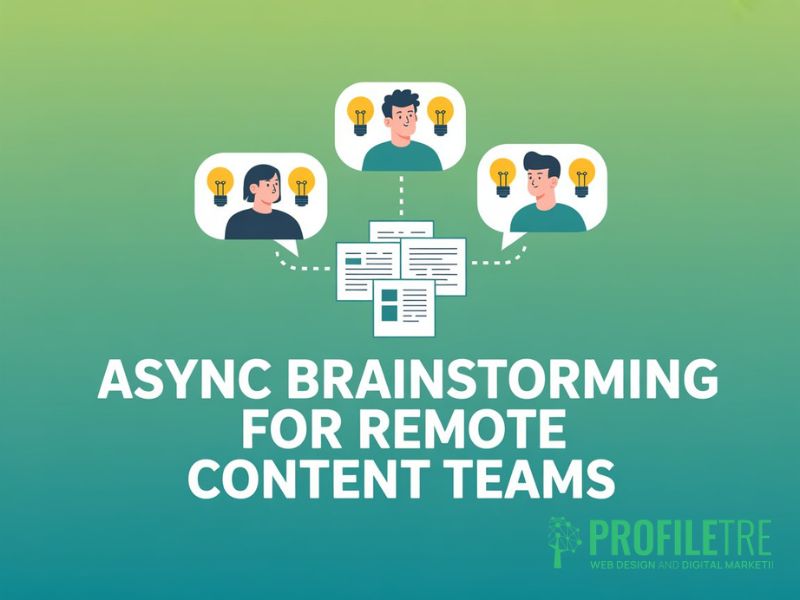
The reflexive answer to most distributed team management problems is “let’s have a call.” For content teams, this is usually the wrong answer. Creative thinking requires uninterrupted focus time, and most writers produce their best work when not context-switching between writing and a video meeting. Structured asynchronous brainstorming is one of the most underused tools available to anyone managing a remote content team.
The framework works as follows:
- The content lead posts a brief in the team’s shared workspace: the topic, the intended audience, the search intent, any editorial standards constraints, and the target keyword
- Each writer in the remote content team has 48 hours to contribute three to five angle ideas in a shared document, with a one-paragraph rationale for each
- The content lead reviews submissions and responds asynchronously with a selected direction and any follow-up questions
- A 20-minute synchronous call is held only if a decision cannot be reached from written input alone; in a well-run remote content workflow, this is the exception rather than the rule
This structure produces better ideas than a live brainstorm in most cases, because remote content writers have time to think independently before they are anchored by someone else’s suggestion. It also creates a documented record of rejected angles, which is useful when the same topic comes up for review months later.
ProfileTree’s digital marketing training programmes cover remote content team workflows, editorial systems, and AI integration for SMEs across Northern Ireland and the UK. If your team is scaling up, explore the training options available.
What Makes Remote Content Team Management Actually Work
The difference between a remote content team that delivers consistently and one that produces uneven output is rarely the tools. It is almost always the systems: how briefs are written, how editorial standards are communicated and upheld, how feedback is given, and how performance is measured beyond a simple article count.
The principles here apply whether you are managing two freelancers or a distributed department of fifteen. Start with the briefing process, because that is where most content quality problems begin. Add a written AI policy before your team adopts inconsistent practices independently. Measure impact, not just output.
Managing a remote content team is not harder than managing a co-located one. Good remote management simply requires making explicit the things that in-person teams often leave vague: clear briefs, documented standards, and structured asynchronous communication.
FAQs
1. What is the best way to manage freelance content writers in the UK?
Set clear project-based contracts with defined deliverables and deadlines rather than retainer arrangements that could imply employment under IR35. Use IR35-compliant contract language, establish a written brief process within your remote content workflow to document expectations before work begins, and provide feedback through the same project management tools used for in-house staff to maintain editorial standards consistently. Where remote content writers work across multiple clients, the IR35 risk is lower; exclusive arrangements with individual freelancers carry the most exposure.
2. How do you maintain editorial standards across a remote content team?
The single most effective tool for maintaining editorial standards in a remote content team is a centralised style guide covering brand voice, UK English conventions, banned words and phrases, heading hierarchy, and internal linking standards. This should live in a shared document updated whenever standards change. Pair it with a consistent editorial review process where the same person or a small, consistent group reviews all published content. Without this, editorial standards drift as each remote content writer develops their own interpretation of the brand’s sound.
3. How do you prevent Zoom fatigue in a remote content team?
Audit your current meeting schedule and apply a simple test to each session: could this decision have been made asynchronously? Most status updates, brief reviews, and content planning sessions in a remote content team can be handled through written communication within the content workflow. Reserve synchronous meetings for decisions requiring real-time back-and-forth: complex editorial disputes, strategy changes, or onboarding conversations. Cutting meeting frequency in half is a realistic target for most remote content teams, and the productivity gain is usually immediate.
4. How do I handle time zone differences for content approvals in a remote content team?
Build a standard operating procedure within your remote content workflow that defines turnaround expectations for each approval stage, accounting for the time zones involved. A piece submitted by a remote content writer in Dublin at 16:00 GMT should have a stated response time (for example, by 11:00 GMT the next working day) that the editor commits to. Uncertainty about approval timelines is one of the most common causes of missed deadlines in asynchronous remote content team management.
5. What are the must-have tools for a remote content team of three to five people?
At this scale, the essential stack is: Asana or Trello for task tracking, Google Workspace for document collaboration, Slack or Microsoft Teams for asynchronous communication, Google Search Console for performance data, and a shared content calendar. WordPress is the standard CMS for most UK and Irish businesses.