
Content Writing: The Definitive Guide for UK Businesses
Table of Contents
Content writing sits at the heart of every effective digital marketing strategy. Whether your goal is better search rankings, stronger brand authority, or more enquiries from the right audience, the quality and consistency of your written content shape how Google, Bing, and prospective customers perceive your business.
Yet most businesses either publish sporadically with no clear strategy or rely on volume over value. Both approaches produce diminishing returns. This guide covers what content writing actually involves, how it has changed in the post-AI era, and what UK and Irish businesses need to do differently to compete in 2026.
You will find sections on the core principles of effective content, the distinction between content writing and copywriting, how to approach a human-led strategy alongside AI tools, professional rates and career paths in the UK market, and how to measure what your content is actually delivering.
What Is Content Writing and Why Does It Matter
Before diving into strategy and execution, it is worth establishing what content writing actually means in a commercial context. The definition has broadened considerably as digital channels have multiplied, and conflating it with other disciplines leads to strategic confusion.
Definition and Core Purpose
Content writing is the process of planning, drafting, editing, and publishing written material created to inform, educate, or guide a specific audience. Unlike advertising copy, which is designed primarily to prompt immediate action, content writing builds trust and awareness over time by providing genuine value to the reader.
In practice, this covers a wide range of formats: blog posts, service page descriptions, case studies, email newsletters, social media captions, video scripts, white papers, and press releases. What unites them is purpose. Each piece should exist to serve a defined audience and support a measurable business outcome.
For businesses across Northern Ireland, Ireland, and the wider UK, this means producing content that reflects local market conditions, uses British English consistently, and speaks to the specific challenges facing your sector, rather than recycling generic advice written for a global audience.
Content Writing vs. Copywriting: The Key Distinction
The two terms are frequently used interchangeably, but they describe different disciplines with different objectives. Understanding the distinction helps you brief writers more effectively and set realistic expectations for each piece you commission.
| Factor | Content Writing | Copywriting |
|---|---|---|
| Primary Goal | Educate, inform, build trust | Persuade, convert, prompt action |
| Typical Length | 800 to 4,000+ words | 50 to 500 words |
| Typical Channels | Blog, email, guides, white papers | Ads, landing pages, product descriptions |
| Success Metric | Traffic, time on page, return visits | Click-through rate, conversions, sales |
| Time to Result | Weeks to months (organic) | Immediate (paid or on-page) |
A blog post explaining how to choose an accountant for a small business is content writing. The headline and sub-headline on that accountant’s paid search landing page is copywriting. Both require skill, but the mindset, structure, and measurement approach differ substantially.
Businesses that only invest in copywriting often find they generate clicks but no sustained organic presence. Those who only invest in content writing may have strong traffic but weak conversion rates on commercial pages. The strongest digital strategies use both, each serving a distinct purpose within the content marketing mix.
Types of Content Writing for Business
The format you choose should match the stage of the buyer journey you are targeting, not simply what is easiest to produce. The most common types for B2B and B2C businesses in the UK and Ireland include:
- Blog posts and thought leadership articles (awareness and organic search)
- Website service and product pages (consideration and conversion)
- Case studies and project write-ups (trust and proof)
- Email newsletters and nurture sequences (retention and loyalty)
- Video scripts and podcast outlines (engagement and reach)
- Technical guides and white papers (authority in specialist sectors)
A business selling B2B software will weigh its investment towards technical guides and case studies. A hospitality brand will lean towards short-form social content and local guides. There is no universal formula; the right mix depends on your audience, your sector, and how your customers actually make purchase decisions.
The UK and Ireland Content Market
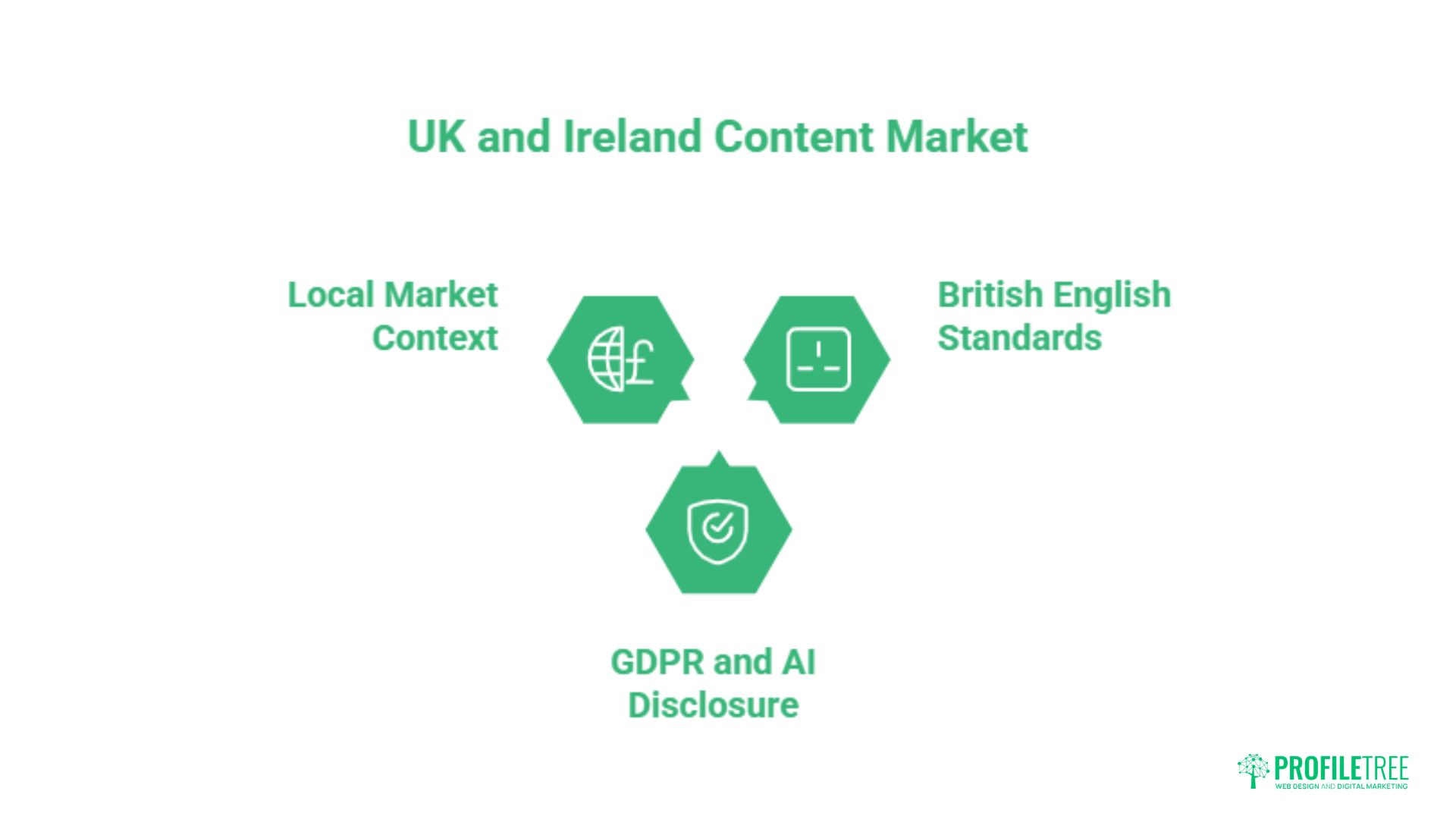
Most of the prominent guides to content writing are written for a North American audience. When UK and Irish businesses follow that advice without adaptation, they produce content that feels slightly off-key to local readers and misses region-specific search intent entirely. The differences run deeper than spelling conventions.
British English Standards and Why They Matter
British English is not merely a preference; it is a trust signal. When a business based in Belfast publishes content full of American spellings such as “optimise,” “colour,” and “program,” it creates a subtle credibility gap. Readers may not consciously notice, but the inconsistency suggests the content was not written with them in mind.
The most common errors to correct include: organise not organise, recognise not recognise, colour not colour, favour not favour, programme not program, centre not centre, and practise (verb) not practice. Search engines also index these spelling variants separately, so consistent British English improves relevance for UK-based queries.
For businesses in Northern Ireland and the Republic of Ireland, there is an additional layer. Certain phrases, references, and cultural touchpoints differ from those used in England or Scotland. Acknowledging that your audience spans both jurisdictions and occasionally addressing region-specific considerations, such as cross-border trading or local funding schemes, adds a dimension that no generic US-authored guide can replicate. Readers from across Northern Ireland’s major cities will recognise content written with genuine local knowledge.
GDPR and AI Disclosure Considerations
UK and Irish content writers and marketing teams operate under legal and ethical frameworks that differ from those in the US. GDPR remains in effect across both jurisdictions and directly shapes what you can collect, store, and share in your content. Any article collecting personal data through embedded forms or lead magnets must reference your privacy policy and comply with consent requirements.
On AI disclosure: the UK’s ICO has published guidance on transparency when AI-generated content is used commercially. While there is no blanket legal requirement to label AI-assisted content in the same way as, say, a sponsored post, the principle of transparency is increasingly factored into editorial credibility assessments by both readers and search engines. A practical approach is to make certain every published article carries a named author with verifiable credentials and reflects genuine human editorial judgement, rather than treating AI output as a finished product.
Local Market Context: How UK Business Tone Differs
British professional communication tends towards understatement, precision, and a certain scepticism about hyperbole. The kind of energetic, superlative-laden copy that performs well in some US markets can actively undermine trust with a UK audience. Phrases like “revolutionary solution,” “all-encompassing approach,” or “the ultimate guide” read as promotional noise rather than credible advice.
The most effective content for UK and Irish SMEs is direct, specific, and backed by evidence. It names the problem clearly, offers a grounded solution, and allows the quality of the advice to do the persuasive work. This is not modesty for its own sake; it is a strategic alignment with how your audience actually evaluates information.
The Seven Pillars of High-Performing Content
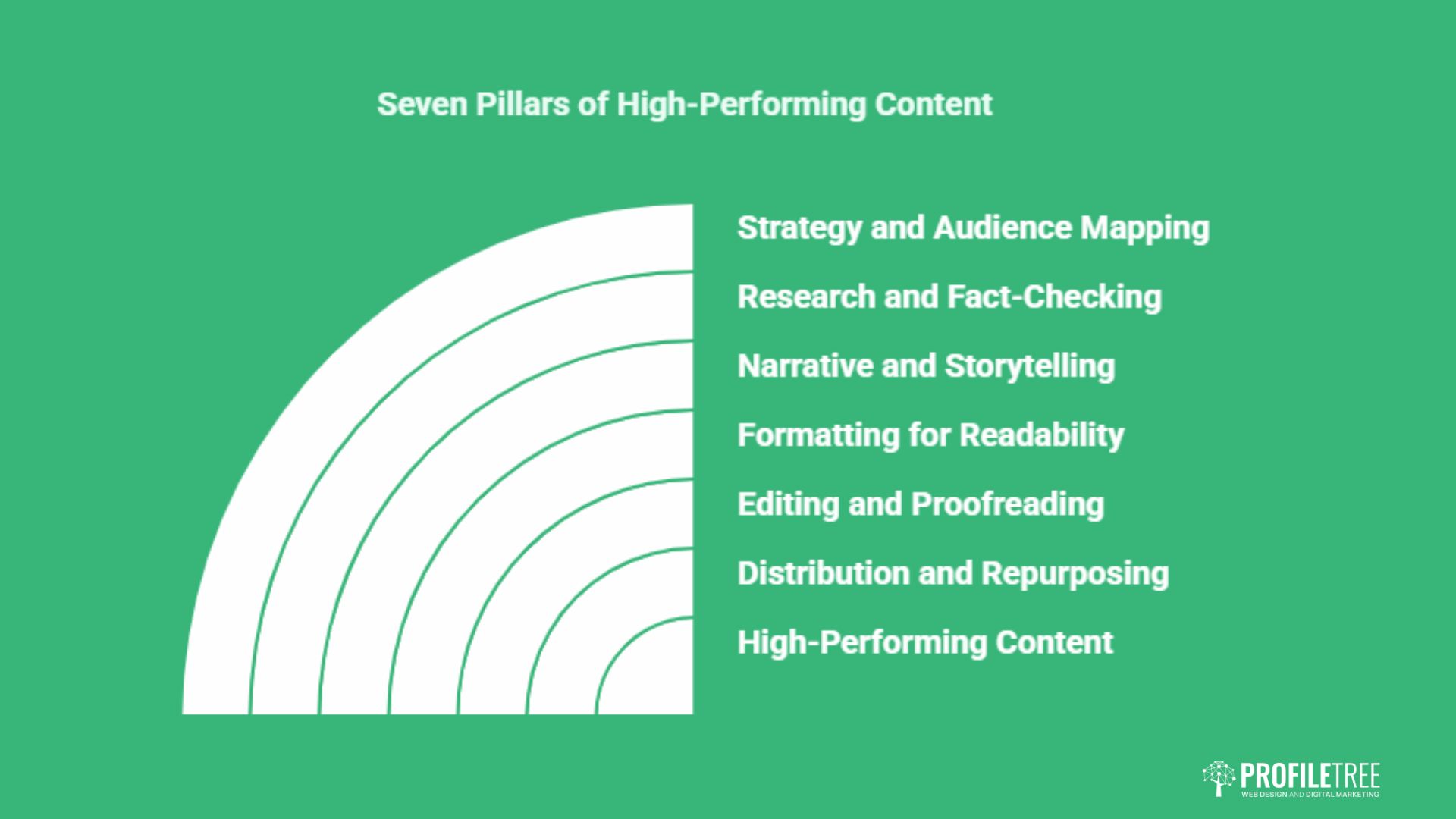
Producing content that ranks, earns AI citations, and converts readers into enquiries requires more than good writing. It requires a repeatable process that addresses seven distinct dimensions of quality. Each pillar builds on the others; weakness in one area typically limits what the others can achieve.
1. Strategy and Audience Mapping
Every piece of content should begin with a clear brief: who is this for, what do they already know, and what question are they trying to solve. Without this foundation, even well-written articles underperform because they are optimised for the wrong intent.
Audience mapping means understanding the specific language your customers use when they search, the objections they raise before purchasing, and the follow-on questions they are likely to have. Google Search Console query data is invaluable here; the phrasing real users type reveals intent in a way that internal brainstorming cannot replicate.
2. SEO and Keyword Integration
Keyword optimisation in 2026 is not about density targets or exact-match repetition. Modern search algorithms evaluate semantic relevance, assessing whether your content genuinely covers the topic rather than simply containing the target phrase a set number of times.
Effective integration means your primary term appears in the title, H1, and naturally within the opening section. Tables, FAQs, and structured data elements help search engines surface your content in AI overviews and featured snippets. For businesses looking to improve organic visibility, SEO services that connect keyword strategy with content planning consistently outperform those that treat the two as separate workstreams.
3. Research and Fact-Checking
One of the clearest quality gaps between human-led and AI-generated content is the depth of the underlying research. AI tools can summarise existing published material, but they cannot conduct original interviews, access unpublished data, or apply professional judgement to conflicting sources.
Every non-obvious factual claim should have a traceable source. This directly affects how Google assesses trustworthiness under its EEAT framework. A single fabricated statistic, once fact-checked by a reader or competitor, can damage credibility in ways that take months to recover from.
4. Narrative and Storytelling
Facts and data alone do not hold attention. Readers engage with content that frames information within a recognisable problem, builds context progressively, and reflects genuine practitioner experience. A case study, an anonymised client scenario, or a specific project example does more for credibility than three paragraphs of abstracted advice.
For UK and Irish businesses, local narrative detail adds a layer that no global competitor can match. Referencing the conditions, regulations, or cultural context specific to your market signals to readers that the content was written for them, not repurposed from a broader template.
5. Formatting for Readability
Structure and prose quality are not separate concerns. An article can be factually accurate and well-researched yet still fail to hold attention if the formatting is poor. For web content, short paragraphs, subheadings every 200 to 300 words, and at least one table or structured list per major section improve both readability and search performance.
Formatting choices also affect how AI systems extract and cite your content. Self-contained sections with a clear answer in the opening sentence are significantly more likely to appear in AI overviews than sections that bury the key point in the third paragraph.
6. Editing and Proofreading
The editing stage is where most of the quality gains happen. A first draft that has been properly reviewed for clarity, consistency, and tone will consistently outperform an unedited draft, regardless of how strong the initial writing was.
In a production environment where AI tools generate first drafts quickly, editorial oversight is the primary differentiator. Checking for banned phrases, tightening loose sentences, removing unsourced claims, and verifying British English consistency are all steps that require human attention and cannot be safely delegated to automation.
7. Distribution and Multi-Channel Repurposing
A long-form article is rarely a single-use asset. The research and structure behind a 3,000-word guide can generate a LinkedIn post series, a short video script, an email newsletter section, and a set of social media captions without duplicating effort unnecessarily.
Planning for repurposing at the brief stage, rather than as an afterthought, makes the original content more modular and easier to adapt. It also extends the reach of each content investment across channels where your audience may be more active than they are on search. ProfileTree’s social media marketing service works alongside content production to build that distribution layer systematically.
Human-Led Strategy in an AI-Assisted World
AI writing tools have changed the economics of content production significantly. They can produce a first draft in minutes, summarise research efficiently, and generate headline and meta description variants at scale. What they cannot do is replace the strategic judgement, original perspective, and genuine expertise that make content worth reading.
Where AI Falls Short
The core limitation of AI-generated content is that it is, by definition, a recombination of existing published material. It can reflect the consensus view on a topic, but it cannot provide a genuinely original perspective, conduct primary research, or make the kind of nuanced professional judgements that build authority in a specialist field.
Google’s Helpful Content system specifically evaluates whether content demonstrates first-hand experience and expertise. Pages that cover a topic from a purely aggregated perspective, without original insight, project examples, or practitioner knowledge, are assessed as lower quality regardless of how fluently they are written. This is not a temporary algorithm quirk; it reflects a structural shift in how search quality is evaluated.
“Most businesses understand they need content, but very few start with a strategy,” says Ciaran Connolly, founder of ProfileTree, the Belfast-based digital agency. “Without a clear audience map and a defined purpose for each piece, you end up with a blog full of articles that serve no commercial goal. The businesses we work with that see the strongest results are the ones that treat content as a system, not a task list.”
How to Use AI as a Research Assistant
The most effective use of AI in a content workflow is not generation but acceleration. AI tools are genuinely useful for: identifying the sub-questions people ask about a topic, generating a first-pass outline that a human editor then restructures, summarising long research documents to identify the key points worth including, and producing multiple headline or description variants for human selection.
What this approach retains is human judgement at every decision point: which angle is most useful for our specific audience, which claims need a source, which sections require original case study material, and whether the overall piece reflects genuine expertise. The output is faster to produce than fully manual writing, but the quality ceiling is set by the human oversight applied, not the AI tool used.
Protecting Your Content from AI Dilution
As AI-generated content has increased in volume, the average quality of published web content has declined. This creates a genuine opportunity for businesses willing to invest in original, expert-led material. Original data, genuine project examples, named expert quotes, and region-specific case studies are all elements that AI tools cannot replicate and that search algorithms are increasingly designed to reward.
For UK and Irish businesses, this means commissioning content that draws on your team’s actual experience, includes specific examples from real client or project work, and provides practical detail that could only come from someone who has done the thing they are writing about.
This is not a higher bar for its own sake; it is the only sustainable content strategy in an environment where the supply of generic, AI-generated material is effectively unlimited. Businesses looking to develop this capability internally can benefit from structured digital training that covers both content strategy and the practical mechanics of planning and briefing content at scale.
Professional Paths, UK Rates, and Measuring ROI
For business owners deciding whether to hire in-house, work with a freelancer, or engage an agency, and for professionals considering content writing as a career, understanding the UK market benchmarks helps set realistic expectations on both sides of the arrangement.
Skills Required for Modern Content Writers
The skillset required of a professional content writer has expanded considerably. Beyond strong literacy and grammar, effective content writers in 2026 need: working knowledge of SEO principles, including keyword research and on-page optimisation; familiarity with Google Search Console and basic analytics; the ability to conduct and integrate primary research; editorial judgement to assess source credibility; and an understanding of how content fits into a wider digital marketing strategy.
Subject matter expertise is increasingly valued over generalist writing skills. A writer with deep knowledge of a specific sector, whether fintech, healthcare, legal services, or manufacturing, can produce content that generalist writers cannot. This specialisation commands higher rates and tends to produce better-performing content because the expertise itself is part of the value.
UK and Ireland Salary and Freelance Rate Benchmarks
The following figures are indicative of the UK and Irish markets at the time of writing. All prices and figures in this guide are indicative UK examples and correct at the time of writing; use them as a benchmark rather than fixed quotations.
| Experience Level | Per Word Rate (GBP) | Day Rate (GBP) | Typical Deliverables |
|---|---|---|---|
| Junior (0 to 2 years) | £0.05 to £0.10 | £150 to £250 | Blog posts, social copy, product descriptions |
| Mid-level (2 to 5 years) | £0.10 to £0.20 | £250 to £400 | Long-form guides, email sequences, case studies |
| Senior / Specialist | £0.20 to £0.40+ | £400 to £700+ | Technical B2B, white papers, thought leadership |
| Agency (project basis) | Variable | £600 to £1,500+ | Full content programmes, strategy + production |
For freelancers operating in the UK, IR35 is a relevant consideration when working through limited companies for clients who would otherwise be classed as employers. The rules require careful assessment of each contract; a number of professional bodies, including the Professional Copywriters’ Network, offer guidance specific to the content and marketing sector.
Measuring Content Performance Beyond Page Views
Page views are a vanity metric. The signals that actually indicate content quality and commercial impact are: organic click-through rate (whether your title and description compel people to choose your result), average time on page (whether readers are engaging with the content or bouncing immediately), conversion rate from organic traffic (whether content readers are progressing to enquiry or purchase), and return visitor rate (whether your content is building a loyal audience rather than serving one-off searches).
For businesses running a content programme, it is worth tracking these metrics at the cluster level, not just for individual articles. A single pillar page may receive moderate traffic directly, but if it drives internal traffic to three or four commercial service pages that convert well, its contribution to revenue is substantial. Google Search Console, combined with your site’s analytics platform, provides enough data to make these connections without expensive third-party tools.
ProfileTree’s digital strategy service helps businesses connect their content output to commercial outcomes, identifying which topic clusters are driving enquiries and where investment should be focused or redirected.
Conclusion
Content writing remains one of the highest-return investments available to UK and Irish businesses that take it seriously. The bar has risen: generic, lightly edited material no longer ranks, earns AI citations, or builds the kind of authority that converts readers into customers. What works now is expert-led, strategically structured content that serves a specific audience with genuine depth. For businesses ready to approach content as a commercial system rather than a publishing task, the competitive gap is wider than it has ever been.
Ready to build a content strategy that delivers measurable results? Explore ProfileTree’s content marketing services or AI transformation support to find out how a structured, human-led approach can improve your organic performance.
FAQs
Is content writing still a viable career in the age of AI?
Yes, but the role is shifting. The demand for writers who can simply produce volume at low cost has declined as AI tools automate that tier of work. The demand for writers who can provide genuine expertise, conduct primary research, manage editorial quality, and develop strategy has increased. Professionals who reposition themselves as content strategists and editors, rather than pure producers, are finding stronger career prospects in 2026 than they did five years ago.
How do I start content writing with no experience?
The most practical starting point is building a portfolio through guest posts on industry blogs, writing for local business websites on a pro bono basis, and publishing regular long-form articles on LinkedIn. A portfolio of six to ten strong, well-researched pieces on a defined topic area demonstrates more to potential clients than a broad claim of general writing ability. Formal qualifications help in some sectors but are rarely a prerequisite.
What is the difference between a content writer and a copywriter?
The core distinction is intent versus action. A content writer’s primary goal is to inform, educate, or build trust over time. A copywriter’s primary goal is to persuade the reader to take a specific action, whether that is clicking an ad, completing a form, or making a purchase. In practice, many professionals do both, and the strongest commercial content combines elements of each.
How does Google assess AI-generated content?
Google does not penalise content for being AI-generated per se. What it penalises is content that lacks genuine helpfulness, first-hand experience, or demonstrable expertise, which happens to describe a significant proportion of unedited AI output. The Helpful Content system, now permanently integrated into core ranking, evaluates whether content was produced to serve readers or primarily to game search rankings.
Do I need a degree to work as a content writer?
No degree is required, though relevant qualifications in journalism, English, marketing, or a specialist subject can be an advantage. The content writing industry assesses candidates primarily on the quality of their portfolio and their demonstrable understanding of audience, SEO, and editorial standards. A CIM qualification or a recognised digital marketing course can provide useful structured knowledge for those entering the field without a relevant degree background.