
Digital Presence for Business: What European Football Teaches SMEs
Table of Contents
Digital presence is one of those terms that gets used constantly and is rarely explained. Most businesses know they need one. Far fewer know whether theirs is actually working.
To make it concrete, it helps to look at organisations that compete publicly on this ground where the data is visible, and the stakes are high. The 24 nations that competed in UEFA Euro 2024 make an unusually useful case study. Their official football accounts give a clear picture of what a strong and weak digital presence looks like across Facebook, Instagram, X, TikTok and YouTube. The patterns in that data translate directly to decisions any UK SME can make this week.
What Is Digital Presence?
Digital presence is the sum of every point of contact your business has online: your website, your social media profiles, your Google Business Profile, your reviews, and anywhere else your name appears in search results. It is not the same as digital marketing. Marketing is the action; presence is the asset that those actions build.
The distinction matters because a business can run paid campaigns and still have a weak presence. If your website is slow, your Google profile is incomplete, and your reviews are thin, paid traffic lands somewhere unconvincing. Building presence means creating a stable, credible, findable version of your business online before you spend money driving people toward it.
For small and medium-sized businesses in Northern Ireland, Ireland and the UK, digital presence is now the first thing a prospective customer checks. A referral still picks up the phone, but only after they have looked you up.
What the Euro 2024 Data Reveals About Digital Strategy
The 24 nations that competed in UEFA Euro 2024 ran their official social media accounts publicly and consistently throughout the tournament. That makes the data unusually readable, and six metrics across five platforms reveal behaviour that applies well beyond football. All figures below were captured during and shortly after the tournament in summer 2024, so treat them as a snapshot rather than live numbers. What carries over is the pattern, not the count.
Follower Count Is Not the Same as Influence
The most repeated mistake in social media strategy is measuring success in followers. The Euro 2024 data makes this visible at scale.
Portugal led Instagram with 17.1 million followers but ranked last for engagement rate at 0.22%. Germany had 2.5 times fewer followers (6.4 million) but averaged over 52,000 likes per post compared to Portugal’s 37,000. On Instagram, Germany’s smaller but more engaged audience was producing measurably better results.
For an SME, the same principle applies. A local business with 800 genuinely interested followers will outperform one with 8,000 who never interact. Before investing in growing an audience, it’s worth asking whether the current one is actually engaged. Reach means nothing if nobody responds.
Platform Choice Has to Follow Audience Behaviour
Several nations in the Euro 2024 data had disabled Facebook’s likes feature, including France, Turkey, the Netherlands and Slovenia. This is a configuration error that costs nothing to fix but strips the page of useful audience data. The equivalent mistake for an SME is maintaining accounts on platforms where your audience is not active, or neglecting the settings that give you insight into who is engaging.
Italy had 251,000 Facebook followers and 5.9 million Instagram followers. That 23x difference signals where their audience actually spends time. Any SME still putting equal effort into every platform, regardless of results, is making the same error as a digital team that hasn’t looked at its own data.
The right starting point is always analytics, not assumptions. ProfileTree’s social media marketing services begin with an audit that identifies where your audience is, then recommends where you should be.
Video Content Earns Disproportionate Reach
France’s most-viewed YouTube video, backstage footage from the 2018 World Cup final, has 28 million views. England’s most popular at the time this data was collected was 11 million. The key difference was not production quality. France published authentic behind-the-scenes content. England’s most-shared video captured a memorable live moment.
Neither required an expensive shoot. Both succeeded because they showed something real that their audience wanted to see.
This holds for businesses, too. A 90-second video showing how a process works, what a project looks like mid-build, or how a team approaches a problem will almost always outperform a polished promotional clip. The TikTok UK statistics show the same pattern: smaller accounts with specific, relatable content routinely outperform larger accounts with generic posts.
For businesses that have never used video, the barrier is usually uncertainty about format rather than budget. ProfileTree’s video production team works with businesses at exactly this stage.
Engagement Rate Reveals Content Quality
Slovenia ranked first for Instagram engagement rate at 2.60%, ahead of Serbia (2.51%), Hungary (2.41%), Switzerland (2.19%) and Austria (2.04%). None of these nations is among the largest or best-resourced. Their results came from content that worked for their specific audience, not from having the biggest operation.
Engagement rate is one of the most honest metrics available to a business. It measures the proportion of your audience that actually responds to your content. A 1% engagement rate on Instagram is a widely used benchmark. Anything consistently above that suggests the content is resonating. Anything consistently below it suggests it is not, regardless of follower count.
For SMEs, monitoring this number monthly is more useful than tracking total followers. If it is dropping, the content strategy needs to be reviewed. If it is growing, something is working, and the question is how to repeat it.
TikTok Rewards Specificity Over Scale
Belgium, a smaller nation with a smaller football fanbase than France, England or Germany, ranked fourth for TikTok followers (1.9 million) and fifth for total likes (16.5 million). They outperformed several much larger nations.
TikTok’s algorithm distributes content based on interest signals, not on account size. A video that connects with a specific interest group gets shown to more people who share that interest, regardless of whether the account has 100 or 100,000 followers. This is the same mechanism that has allowed small UK businesses to build significant audiences on the platform without advertising spend.
For SMEs cautious about TikTok, the more relevant question is whether their audience uses it. If the answer is yes, the platform rewards exactly the kind of specific, low-production content that a small team can produce without a dedicated creator.
The Five Components of a Strong Digital Presence
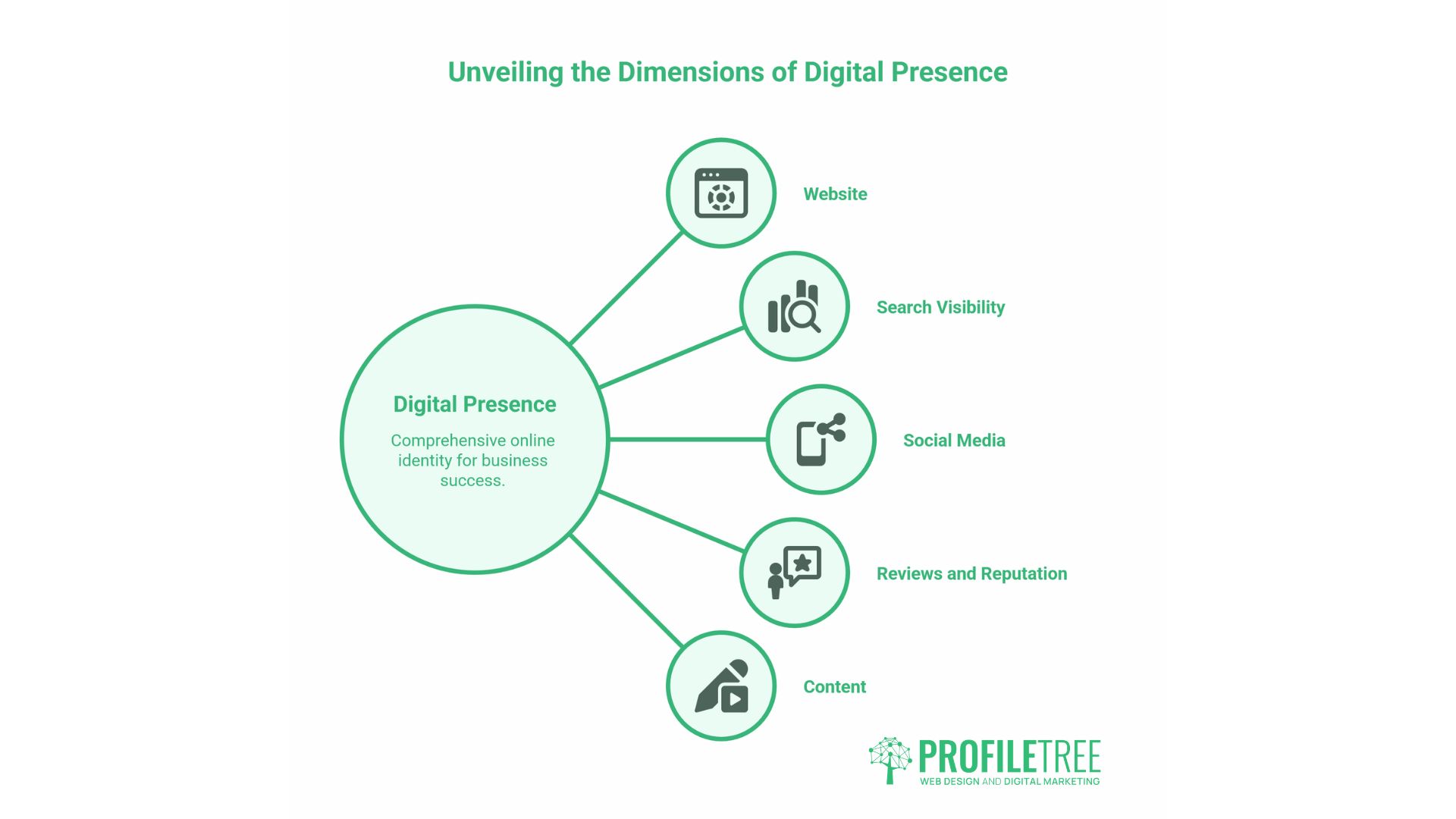
The Euro 2024 data specifically covers social media. But for a business, digital presence is wider than that. Five components determine whether a business is findable, credible and compelling online.
1. The Website
The website is the only digital asset a business fully controls. Social platforms change algorithms, reduce organic reach, and occasionally disappear. The website does not. It needs to load quickly on mobile, clearly communicate what the business does and who it serves, and give visitors a reason to get in touch and a way to do so.
For most UK SMEs, this is also the component with the most room for improvement. Slow load times, outdated content and unclear navigation are common problems that professional web design addresses directly.
2. Search Visibility
Being found on Google matters more than any other single factor for most UK businesses. Search visibility comes from a combination of on-page SEO, Google Business Profile optimisation, and content that answers the questions your customers are actually asking. Understanding SEO fundamentals is the starting point for any business that wants consistent organic traffic.
Local SEO appearing in map results for your service area is often the highest-priority action for businesses that serve a specific geography.
3. Social Media
The Euro 2024 data illustrates the principles. Choose platforms based on where your audience is, not on where every competitor happens to be. Measure engagement rate, not just follower count. Publish content that is specific and useful, not generic or frequent.
Consistent, relevant posting on one or two platforms outperforms sporadic activity spread across five.
4. Reviews and Reputation
In the UK, Trustpilot, Google Reviews and industry-specific directories (Checkatrade, Bark, and professional body listings) carry considerable weight with prospective customers. A business with 4.8 stars across 200 reviews will convert at a substantially higher rate than one with no reviews or a handful of dated ones.
Actively requesting reviews from satisfied customers is one of the highest-return activities available to an SME. It costs nothing beyond a follow-up message and a direct link.
5. Content
Content is what gives the other four components something to work with. Blog posts, guides, and videos earn search visibility, provide social channels with content to share, and demonstrate expertise to prospective customers. The businesses that rank consistently for competitive search terms are almost always the ones that have built a content library over time.
ProfileTree’s content marketing approach is built around this: creating content that serves both readers and search engines.
How to Audit Your Digital Presence
A basic audit takes less than an hour and identifies where effort is most needed.
Step 1: Search yourself. Type your business name into Google. Check what appears on the first page: your website, your Google Business Profile, your social profiles, any review sites, and any press mentions. Anything inaccurate, incomplete or outdated is a priority fix.
Step 2: Check your website on a mobile device. Use your phone rather than a desktop. Does it load within three seconds? Is it easy to navigate with a thumb? Is your phone number tappable? Most UK search traffic is mobile-first; if the mobile experience is poor, rankings and conversions both suffer.
Step 3: Review your Google Business Profile. Is it claimed? Is every field complete? Are the photos recent? Is your address and opening hours correct? Google Business Profile is often the most valuable five minutes of improvement available to a local business.
Step 4: Pull your social analytics. For each active platform, look at your last 30 days. What is your engagement rate? Which posts performed best? Are you posting consistently? If analytics aren’t accessible because the account settings haven’t been configured, fix that first. Several Euro 2024 nations lost audience data this way.
Step 5: Count your reviews. How many reviews do you have on Google, Trustpilot, or your industry-specific platform? When was the last one posted? A recent stream of reviews signals an active, trustworthy business. A gap of several months raises questions.
Step 6: Check what competitors rank for. Search your main service terms and see which local businesses appear. Note the gap between where they appear and where you do. That gap represents work to be done on search visibility, content or local SEO.
Measuring What Matters
The metrics that matter depend on the component.
| Component | Key Metric | What It Tells You |
|---|---|---|
| Website | Organic sessions, bounce rate | Whether search is sending quality traffic |
| Search | Google Business Profile views, search position | How visible you are locally |
| Social | Engagement rate, reach | Whether content is resonating |
| Reviews | Average rating, review recency | How you appear to undecided buyers |
| Content | Impressions, clicks, time on page | Whether content is being found and read |
ProfileTree’s digital training programmes cover how to read and act on these metrics using free tools, such as Google Search Console and Google Analytics 4.
What the Euro 2024 Data Ultimately Shows
The nations with the strongest digital presence in that dataset were not necessarily the biggest or the best-funded. France dominated TikTok and YouTube not because of budget but because of content quality and consistency. Slovenia topped Instagram engagement because its content connected with its specific audience.
The lesson for a business is the same. A strong digital presence is built on clarity (about who you serve and what you offer), consistency (across platforms and over time), and content that is genuinely useful to the people you serve.
Ciaran Connolly, founder of ProfileTree, has seen this pattern repeatedly across client projects: “The businesses that show the most improvement in digital visibility are rarely the ones that increase spend first. They are the ones that fix what they already have: the website, the Google profile, the review strategy before they do anything else.”
Getting an external view of where you stand is often the most efficient starting point. A structured digital presence audit surfaces gaps, prioritises fixes, and shows where effort will yield the most visible results.
UK Trust Signals That Strengthen Digital Presence
Social media reach is visible, but trust is what converts. For UK businesses, several specific signals carry weight with prospective customers that US-centric guides consistently overlook.
Google Business Profile is the single most important trust signal for any business with a physical location or a defined service area. It determines whether you appear in map results, what customers see before they click your website, and how your reviews are displayed in search. An incomplete or unverified profile is one of the most common gaps in an SME’s digital presence, and one of the quickest to fix.
Trustpilot dominates UK consumer behaviour in a way Yelp never has. For e-commerce and professional services businesses, particularly, a verified Trustpilot profile with a consistent stream of recent reviews carries genuine purchasing weight. The recency of reviews matters as much as the volume; a business with 400 reviews from three years ago looks less active than one with 40 from the last six months.
Industry-specific directories vary by sector but matter in trades, healthcare, legal, and financial services. Checkatrade, Rated People, and professional body listings (Law Society, RICS, CIPD) function as trust signals for audiences who already know to look for them. Being listed accurately and completely in the right directories is part of a credible digital presence in those sectors.
GDPR compliance is a trust signal that most digital presence guides ignore entirely. For UK B2B buyers, a website with a clear privacy policy, a functional cookie consent mechanism, and transparent data handling communicates that the business operates professionally. Businesses that handle this carelessly signal, however unintentionally, that their internal processes may be equally careless. ProfileTree’s work on digital marketing compliance covers this as part of building a presence that holds up to scrutiny.
Common Digital Presence Mistakes UK SMEs Make
The Euro 2024 data made several strategic errors visible at scale. Each one has a direct equivalent for businesses.
Prioritising the wrong platform. Italy’s Facebook following (251,000) versus its Instagram following (5.9 million) showed clearly where its audience was spending time. Businesses that put equal effort into every platform, or that stay on platforms out of habit rather than on the basis of evidence, make the same mistake. Check your analytics before you decide where to invest.
Treating follower count as a success metric. Portugal’s 17.1 million Instagram followers and 0.22% engagement rate illustrate the problem. A large, disengaged audience is not an asset. For SMEs, the equivalent is posting consistently for months, seeing follower numbers creep upward, and assuming the strategy is working without checking whether any of those followers are actually clicking, enquiring, or buying.
Leaving platform settings unconfigured. France, Turkey, the Netherlands and Slovenia all had Facebook likes disabled. This is a small configuration error with real costs: lost audience data, reduced social proof, and a page that appears incomplete to visitors. Many SME social profiles share similar gaps: incomplete bios, missing contact details, disconnected booking links, or unverified business status that quietly undermine an otherwise reasonable presence.
Publishing without a content plan. The nations with strong TikTok engagement, France and England in particular, had clearly defined content approaches. France built around player personality content; England around key match moments. Businesses that post reactively, without a content plan, tend to see inconsistent results regardless of how frequently they post. Consistency of theme matters as much as consistency of frequency.
Ignoring video entirely. YouTube subscriber counts in the Euro data were smaller than on other platforms, but the engagement depth was higher. A subscriber who watches 20 minutes of content represents far more commercial value than a follower who scrolls past a static post in two seconds. Businesses that have not yet experimented with video, even short-form content, on TikTok or Instagram Reels, are leaving a large share of audience attention on the table.
Where to Start
Start with what you already have. Fix the website, claim and complete the Google Business Profile, and build the review stream. Only then choose platforms based on evidence, measure engagement rather than follower count, and publish content that serves the reader.
That order matters more than it sounds. Most businesses reverse it, adding channels before the foundation can carry the traffic those channels send.
ProfileTree works with SMEs across Northern Ireland, Ireland and the UK to assess and improve their digital presence across all five components, from web design and SEO to content, video and digital training. Get in touch to discuss where your business currently stands.
Frequently Asked Questions
What is digital presence?
Digital presence is everywhere your business exists online: your website, social profiles, Google Business Profile, reviews, and search results. It is the underlying asset your marketing activity relies on, not the marketing itself.
Is social media the same as digital presence?
No. Social media is one component of a wider picture. A business can have active social profiles and still have a weak digital presence if its website is slow, its Google profile is incomplete, or it has no reviews.
What are the main components of digital presence for UK businesses?
The five that matter most are: a fast, mobile-friendly website; Google Business Profile and local SEO; active social media on the right platforms; consistent customer reviews; and content that demonstrates expertise and earns search visibility.
How do I know if my digital presence is working?
Look at organic search traffic (Google Search Console), Google Business Profile views, social engagement rate, review recency, and enquiry volume from online sources. Flat or declining numbers across these indicate the presence needs attention.