
Market Analysis: How to Research Your Market and Act on It
Table of Contents
Performing a market analysis means assessing the size, direction, and competitive shape of the market you operate in or plan to enter. For SMEs in Northern Ireland, Ireland, and across the UK, the process relies on free digital tools, official data sources such as ONS and NISRA, and competitor intelligence available online. This guide covers five practical steps.
Every business decision that involves entering a new market, launching a product, or adjusting your competitive position needs one thing first: evidence. Knowing how to perform a market analysis properly is what separates strategic decisions from expensive guesses.
Most guides on this topic are written for large organisations with research budgets. This one is written for SMEs in Northern Ireland, Ireland, and across the UK who need a practical, grounded process that works without a dedicated research team. Digital tools now make faster, more accurate market analysis possible, drawing on live search data, publicly available sector statistics, and competitor intelligence that is openly visible online.
“The biggest shift in how SMEs now perform a market analysis is the move away from expensive one-off research projects toward continuous digital monitoring,” says Ciaran Connolly, founder of ProfileTree. “Search data shows you what your market wants right now. A commissioned report that takes months to produce is already out of date by the time you act on it.”
What is a Market Analysis?
A market analysis is a structured assessment of the market you operate in or plan to enter. It examines the size and trajectory of the market, the customers within it, the competitive environment, and the external factors that determine how businesses succeed or struggle in that sector.
For an SME, performing a market analysis answers the practical questions that determine whether a strategy is viable: Is there real demand for what you are offering? Who specifically wants it? Who else is already serving that demand, and how well? Where are the gaps a business like yours could fill?
Primary Data Sources for UK and Irish SMEs
The analysis draws on qualitative and quantitative inputs. Search data reveals what potential customers are actively looking for and how frequently. Official sector reports from bodies such as the Office for National Statistics (ONS), the Northern Ireland Statistics and Research Agency (NISRA), and the Central Statistics Office (CSO) in Ireland provide verified economic and demographic context. Direct competitor research, customer interviews, and social listening fill in the behavioural detail that statistics alone cannot provide.
Market Analysis vs. Market Research vs. Marketing Analytics
These three terms are used interchangeably, but each covers different ground.
Market research gathers information directly from customers or potential customers through surveys, interviews, focus groups, or behavioural observation. It answers questions about attitudes, preferences, and unmet needs.
A market analysis synthesises multiple data sources, including market research findings, economic statistics, and competitor intelligence, into a broader strategic picture. It is wider in scope and more decision-focused than research alone.
Marketing analytics tracks the performance of your marketing activities after they are running: website traffic, conversion rates, campaign ROI, and audience behaviour. It evaluates what is working once you are already in the market.
All three inform your digital marketing strategy, and all three benefit from the same underlying habit: treating data collection as an ongoing process rather than a one-off project.
Key Benefits of Performing a Market Analysis
The practical case for performing a market analysis comes down to risk reduction and resource efficiency. Decisions made without market evidence are assumptions. A structured analysis replaces assumptions with grounded intelligence.
Validate Demand Before You Invest
Google Trends shows the relative search interest in topics related to your planned product or service over time, broken down by region. Free tools such as AnswerThePublic surface the specific questions people type before making a purchasing decision. Testing demand this way costs nothing and takes hours rather than months.
Identify Your Actual Competition
Most SMEs know their obvious direct competitors. A proper market analysis often surfaces indirect competitors and digital challengers that they had not been tracking. Understanding who holds search visibility in your market is as important as knowing who holds market share offline. Your SEO services strategy depends on knowing exactly where competitors are and are not visible.
Understand Customer Behaviour in Detail
Search intent data reveals not just what people want, but where they are in the decision-making process. Someone searching “what is content marketing” is at a very different stage from someone searching “content marketing agency Belfast.” A market analysis maps these distinctions and shapes how you position and communicate.
Spot Gaps Before Competitors Do
The most actionable opportunities sit at the intersection of what customers are searching for and what competitors are failing to serve adequately. This is particularly relevant for SMEs in Northern Ireland and Ireland, where large national and international competitors frequently underserve local intent and sector-specific audiences.
Set Realistic Benchmarks and KPIs
You cannot set credible growth targets without understanding what market conditions actually support. A market analysis provides the external reference points your internal targets need.
How to Perform a Market Analysis: Five Steps
The following five-step process is designed for SMEs working without a dedicated research team. Each step builds on the previous one, moving from defining what you need to know through to translating findings into action.
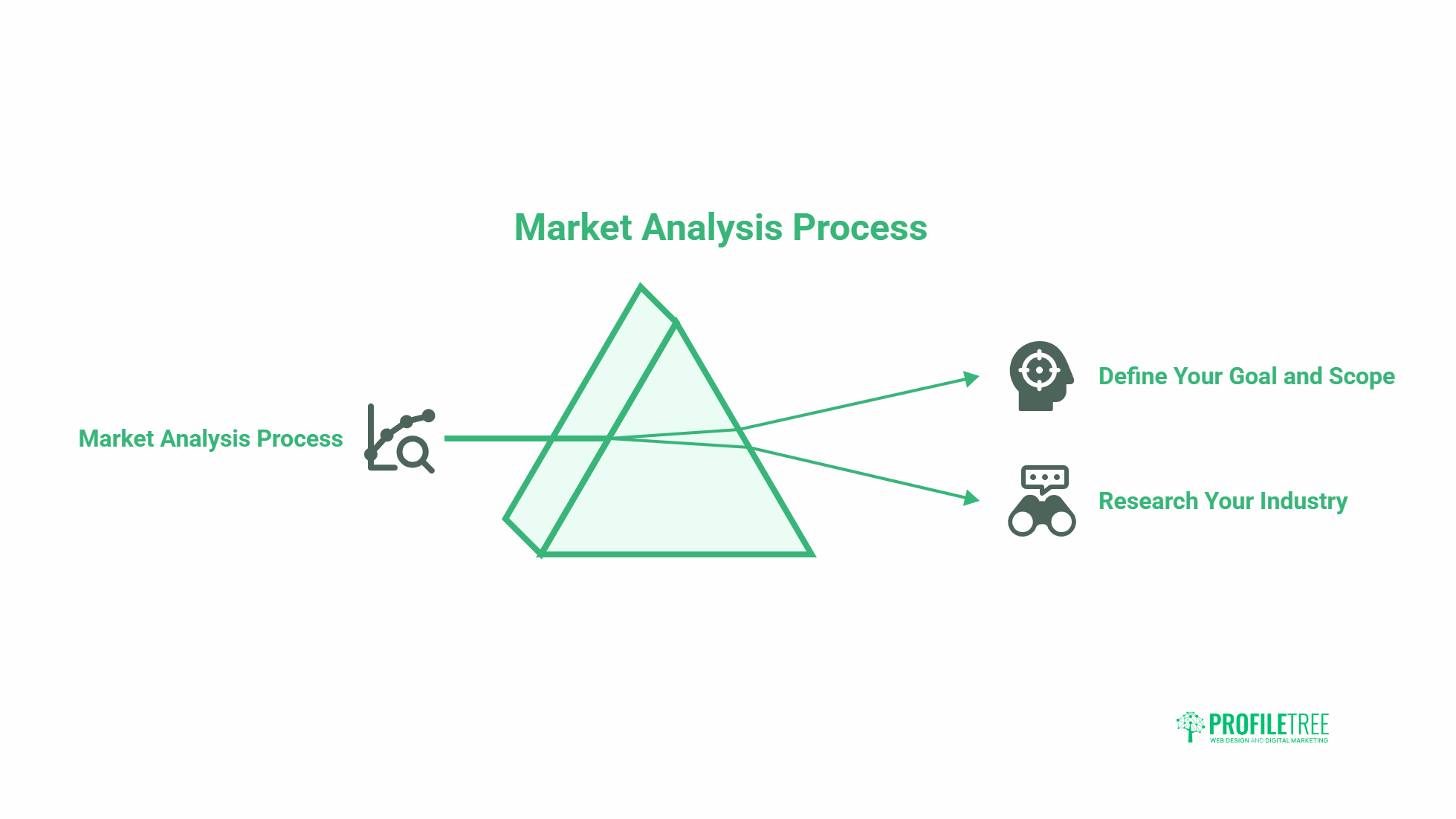
Step 1: Define Your Goal and Scope
The first step in performing a market analysis is clarifying what decision it needs to inform. The scope of the analysis should be shaped entirely by its purpose, and the purpose determines which data you need and which you can set aside.
Common drivers include: exploring a new service line, assessing whether a planned product has sufficient demand, preparing the market analysis section of a business plan for funding, or benchmarking your current position against key competitors before repositioning.
Write your objective in a single sentence before gathering any data. For example: “We want to understand the size and competitive shape of the digital training market for manufacturing businesses in Northern Ireland.” That sentence determines the geographic scope, the sector focus, and the competitive context you need to research.
If the goal is external, such as applying for a grant through Invest Northern Ireland or Enterprise Ireland, or preparing a pitch for investment, the analysis needs to demonstrate a credible grasp of market size, growth projections, and your competitive positioning within it.
Step 2: Research Your Industry
This step builds the macro picture: how large is the market, where is it heading, and what external forces are shaping it? Verified data sources are essential here rather than assumptions or secondary commentary.
| Source | What It Provides | Region |
|---|---|---|
| Office for National Statistics (ONS) | Economic output, consumer spending, sector data | UK |
| NISRA | Population, business counts, employment, economic activity | Northern Ireland |
| Central Statistics Office (CSO) | Business, consumer, and trade data | Republic of Ireland |
| Companies House | Filed accounts, company registration and financial data | UK |
| Enterprise Ireland | Sector growth reports, export statistics, market intelligence | Ireland |
| Google Trends | Relative search interest by region and time period | UK/Ireland/Global |
Trade associations and industry bodies are also worth consulting for sector-specific depth. For Northern Ireland businesses, the Northern Ireland Chamber of Commerce publishes regular reports on local business conditions. Sector-specific bodies within construction, agri-food, and professional services often publish annual data relevant to specific markets.
Step 3: Understand Your Target Audience
Performing a market analysis without a clearly defined audience profile means gathering data without knowing what you are looking for. This step moves beyond broad demographic categories to understand the specific behaviours, intents, and decision-making processes of the customers you want to reach.
Start with the questions your potential customers are actually asking. Google Search Console (free for any verified website) shows the exact queries bringing people to your existing content. AnswerThePublic and Google’s “People Also Ask” feature surface the questions people type at the early stages of a search journey, before they have identified a specific provider.
This kind of search intent mapping forms part of the digital strategy work that ProfileTree carries out for clients during onboarding. The data reveals the audience’s mindset: what problem they are trying to solve, the language they use to describe it, and how urgently they need a resolution. That information directly shapes website messaging, content topics, and ad copy.
Build an audience profile that answers: who are these people, what are they trying to achieve, what is stopping them, what would make them choose you, and where do they spend time online? This profile serves as the foundation for your content marketing plan and the brief for any website copy development.
Step 4: Analyse the Competitive Picture
This is the step where performing a market analysis has changed most significantly over the past decade. A competitor’s digital presence now makes the most important intelligence visible to anyone willing to look methodically.
For each key competitor, examine four areas.
Search visibility: Which keywords are they ranking for? Where do they appear in Google results for your target queries? Free tools such as incognito Google searches and Ubersuggest provide a starting point. Paid tools such as Semrush or Ahrefs give a full view of keyword rankings, backlink profiles, and content gaps, and are worth the investment when performing a market analysis that will inform significant spending decisions.
Content strategy: What topics are they publishing on? How frequently? A competitor who has published consistently on a topic for two or three years has a head start that needs to be factored realistically into your timeline.
Website experience: Is their site fast, well-structured, and clear about what they offer? A competitor with strong content but a poor website experience has a vulnerability that better web design and clearer user journeys can exploit.
Customer sentiment: What are customers saying in Google reviews and industry forums? Recurring complaints in competitor reviews are direct evidence of unmet market needs. If multiple reviews flag slow response times or lack of local knowledge, those are gaps you can position against specifically.
Running a SWOT analysis for each main competitor produces a clear comparison matrix. It forces you to assess not just what they do well, but where their weaknesses create opportunity for a different positioning.
Step 5: Identify Market Gaps and Translate Findings into Strategy
The output of a market analysis is only valuable if it directly informs action. This final step is about translating data into a clear strategic direction.
Market gaps exist at the intersection of three things: what customers are actively looking for, what competitors are not serving adequately, and what you are genuinely positioned to deliver. The most useful gaps are specific. “Better service” is not a gap you can build a strategy around. “Bilingual digital training for hospitality businesses in Northern Ireland” is.
For UK and Irish SMEs, two consistent gap types appear repeatedly through digital research.
Local and regional specificity. National and global competitors rarely invest in content built around genuine local knowledge. A service page or article built with real regional context, local terminology, and locally relevant examples will often outperform generic national content in locally focused searches.
Industry-specific depth. Broad guides serve everyone generically. Content built specifically for a sector, whether solicitors, trades businesses, food producers, or manufacturers, addresses a more qualified audience against far less competition.
Once you have identified the gaps, the natural next step is to build a digital presence to capture them. That typically means a website that clearly reflects your positioning, an SEO strategy targeting the gaps your competitors have left, and a content marketing plan that builds authority in the specific areas your analysis has identified as underserved. ProfileTree’s digital strategy service takes market analysis findings and translates them into a prioritised action plan covering website, content, and search visibility in sequence.
Market Analysis Methods: Choosing the Right Approach
No single method gives a complete picture. Most SMEs performing a market analysis without a dedicated research team get the best balance of depth and speed by combining secondary research for macro context with digital proxy research for live demand and competitive signals.
| Method | Best For | Cost | Speed |
|---|---|---|---|
| Primary research (surveys, interviews) | Validating specific assumptions directly with customers | Low to medium | Slow |
| Secondary research (ONS, CSO, trade reports) | Macro context, sector size, economic trends | Free to low | Medium |
| Digital proxy research (search data, SEO tools) | Real-time demand signals, competitor intelligence | Free to medium | Fast |
| AI-assisted analysis | Processing large datasets, categorising reviews, summarising reports | Low (tool subscription) | Fast |
Using AI Tools in Your Market Analysis
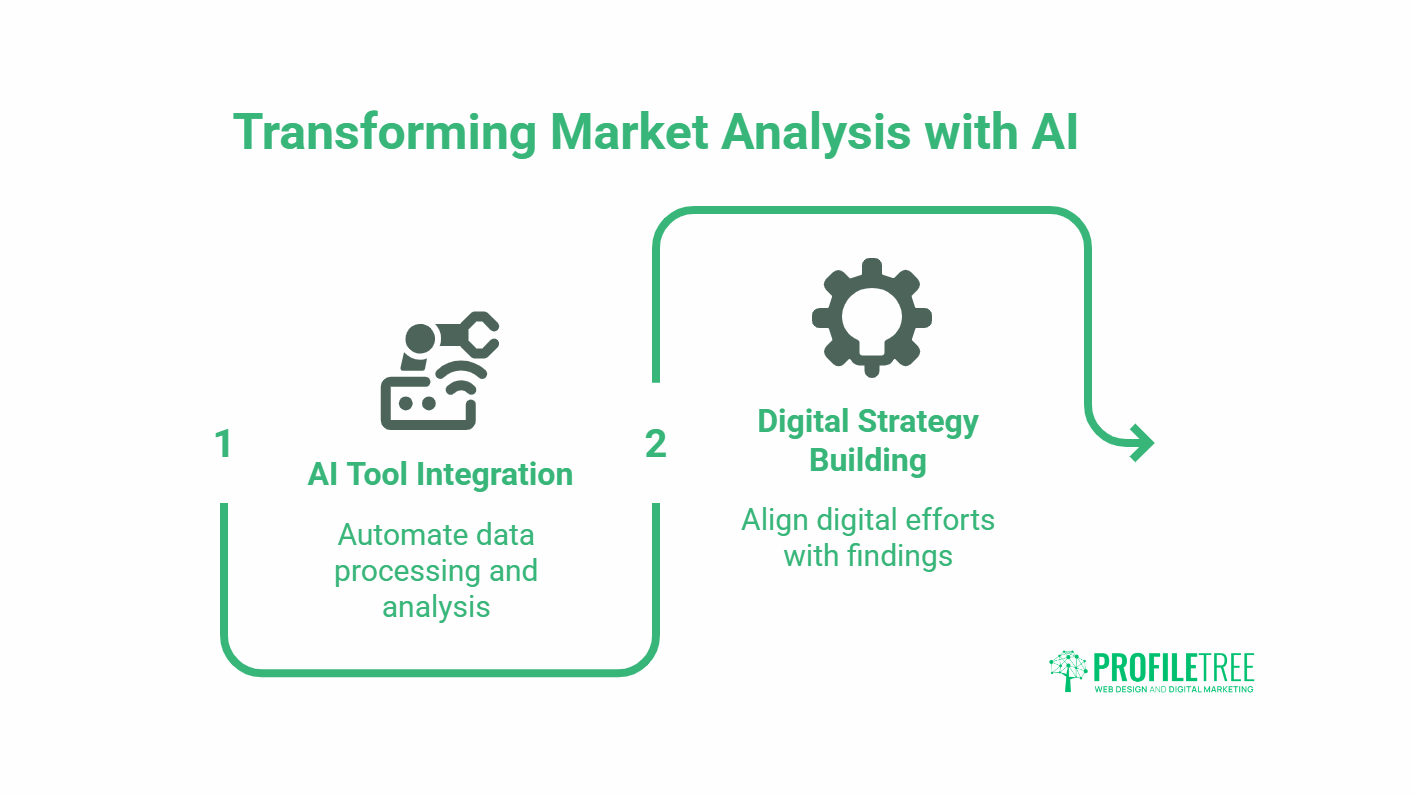
AI tools can speed up specific parts of the process. Categorising recurring themes across dozens of competitor reviews, or pulling the most relevant data points from a lengthy ONS or CSO sector report, are tasks that AI handles well and that previously required significant manual time. ProfileTree’s AI training service helps businesses identify where these tools fit into their existing workflow, without requiring technical expertise to configure them.
Integrating Market Analysis into Your Digital Presence
The findings from your analysis do not sit in isolation from the rest of your digital activity. They directly shape where you invest in your website, which topics you prioritise in your social media marketing, what your video marketing covers, and where your SEO efforts are concentrated. The most common mistake SMEs make is completing a thorough research process and then failing to act on it systematically. Building a digital strategy from the findings is how the work pays for itself.
Conclusion
Performing a market analysis does not require a large budget or a dedicated research team. For UK and Irish SMEs, free tools such as Google Trends, Google Search Console, and publicly available data from ONS, NISRA, and the CSO provide the foundation. The five steps above, from defining your goal through to translating findings into strategy, give you a repeatable process that works whether you are entering a new market or reassessing your position in an existing one.
Frequently Asked Questions
What are the key steps in a market analysis?
The five core steps are: define your goal and scope, research your industry using verified data sources, understand your target audience’s behaviour and search intent, analyse the competitive picture, and identify market gaps. For SMEs, the most important shift is treating this as a digital process that draws on live search and competitor data, rather than a one-off research project based solely on printed reports.
What is the difference between market research and a market analysis?
Market research gathers information directly from customers or potential customers through surveys, interviews, or observation. A market analysis uses that data alongside economic statistics, competitor intelligence, and sector trend data to build a broader strategic picture. Research is an input; analysis is the synthesis that turns multiple inputs into decisions.
How do I find my target market for free?
Google Trends shows how search interest in topics related to your product or service changes over time and by region. AnswerThePublic surfaces the questions people type into search engines before they make a purchase decision. Google Search Console, free for any verified website, shows the exact queries bringing people to your existing content. These three tools together give a solid starting point for audience research at no cost.
How often should an SME perform a market analysis?
A full market analysis makes most sense when entering a new market, launching a product, or preparing a business plan for funding. Between those points, a quarterly digital review that checks search trend shifts, competitor content activity, and your own search visibility keeps your understanding current without requiring a full research cycle each time.
What is a SWOT analysis in the context of market research?
A SWOT analysis (Strengths, Weaknesses, Opportunities, Threats) is a framework for organising the findings of your market analysis. It maps your internal capabilities against external market conditions. Running a SWOT analysis both for your own business and for each key competitor produces a clear matrix that shows where your best positioning opportunities sit.
Where can I find market data for Northern Ireland?
The Northern Ireland Statistics and Research Agency (NISRA) is the principal source of official statistics for Northern Ireland, covering population, business counts, employment, and economic activity. The Northern Ireland Chamber of Commerce and local enterprise offices also publish sector-specific reports. For the cross-border context, the CSO covers the Republic of Ireland and the ONS covers Great Britain.
What should be included in a market analysis for a business plan?
A business plan market analysis typically requires: an overview of the total market size and growth trend, a description of your target customer segment and their behaviour, a summary of the main competitors and their positioning, an analysis of market gaps or opportunities, and an assessment of external factors such as regulatory, economic, and technological conditions that could affect your market. Citing specific data sources and including regional statistics from ONS, NISRA, or CSO strengthens credibility with funders, particularly for applications to Invest Northern Ireland or Enterprise Ireland.
How does a market analysis connect to digital marketing strategy?
Good research tells you where the demand is and where competitors are failing to serve it. Your digital marketing strategy is the plan for capturing that demand. The findings determine which services to prioritise on your website, which keywords to target in your SEO work, and which audience segments to address in your content and social media activity. Without this kind of grounded research first, a digital strategy is built on assumptions rather than evidence.