
Programmatic Marketing Strategies: The UK SME Guide
Table of Contents
Digital advertising has changed fundamentally. The days of manually negotiating ad placements and guessing at audience segments are gone. Well-built programmatic marketing strategies replace all of that with automation, real-time bidding, and decisions that happen in milliseconds. For UK SMEs, the question is no longer whether to use programmatic advertising, but how to build strategies that work without wasting budget or falling foul of data regulations.
This guide covers the foundations, the practical strategies, and the compliance realities that any business operating in the UK market needs to understand before committing significant spend. If you would rather talk it through with a specialist, contact ProfileTree for a free initial consultation.
What is Programmatic Marketing?

Programmatic marketing strategies centre on the automated buying and selling of digital ad space, using algorithms and audience data to serve the right ad to the right person at the right moment. A well-defined programmatic strategy replaces manual media buying with real-time auctions governed by predefined targeting rules.
For UK SMEs, programmatic advertising strategies remove manual overhead from media buying, make budgets more efficient, and provide granular performance data that simpler formats cannot match.
How Real-Time Bidding Works
At the centre of most programmatic activity is real-time bidding (RTB). When a user loads a webpage, an auction runs in milliseconds. Advertisers submit bids through DSPs for the available impression; the highest bid wins, and the ad appears. The process completes in roughly 100 milliseconds.
RTB is not the only programmatic buying strategy available. Programmatic direct deals secure guaranteed inventory at a fixed price, bypassing open auctions. Each programmatic buying strategy carries different implications for transparency, pricing, and brand safety, so matching the approach to the campaign objective matters.
The Core Components
Three technology layers make up a real-time data-driven programmatic advertising function: the DSP on the buy side, the SSP on the sell side, and the data layer connecting both. Understanding each one is essential for building sound programmatic marketing strategies.
| Platform | Role | Who Uses It |
|---|---|---|
| DSP (Demand-Side) | Advertisers buy ad inventory across multiple sources | Brands, agencies, SMEs |
| SSP (Supply-Side) | Publishers sell ad inventory to multiple buyers | Website owners, publishers |
| DMP / CDP | Aggregates and segments audience data to inform bidding | Both sides |
| Ad Exchange | The marketplace where DSPs and SSPs connect | Technology intermediary |
Demand-Side Platforms (DSPs) connect to multiple ad exchanges, apply audience targeting rules, and handle automated bidding. Supply-Side Platforms (SSPs) sell inventory to the highest-value buyer while controlling which advertisers appear. Data Management Platforms (DMPs) and Customer Data Platforms (CDPs) manage the programmatic data that flows between them, aggregating audience signals that improve targeting accuracy.
Seven High-Performance Programmatic Strategies
No single set of programmatic marketing strategies works for every business. The most effective programmatic advertising strategies depend on your campaign objective, your audience data quality, and your compliance position. The following seven approaches cover the range from awareness-building to direct conversion, with a focus on what works in the UK and Irish markets.
1. Contextual Targeting
Contextual targeting places ads based on the content of the page rather than the identity of the visitor. An ad for accounting software appears on a business finance article; a running shoe ad appears on a fitness blog. No personal data is required.
With third-party cookie deprecation progressing across major browsers, contextual targeting has moved from a fallback to a primary strategy for many UK advertisers. It avoids the consent complexities of behavioural targeting and is fully compatible with UK GDPR requirements. Modern contextual technology goes beyond keyword matching, using semantic analysis to understand page sentiment and topic clusters.
For SMEs without large first-party data sets, contextual targeting is often the most practical entry point into real-time data-driven programmatic advertising before more data-intensive approaches become viable.
2. First-Party Data Activation
First-party data, collected directly from your own customers and website visitors with proper consent, is the most valuable programmatic data asset in a post-cookie environment. Activating this programmatic data through a DSP allows you to target known customers, build lookalike audiences, and suppress existing buyers from acquisition campaigns.
Typical first-party data sources include CRM records, email subscriber lists, and consented website visitor data. To use this programmatically, data is hashed, anonymised, and uploaded to the DSP or matched against publisher audiences through a clean room environment.
Building a first-party data strategy takes time, but it determines which programmatic buying strategy is realistic for your business. Without owned audience data, even the best programmatic buying strategy defaults to contextual or third-party targeting.
3. Lookalike Modelling
Lookalike modelling uses machine learning to find users who share characteristics with your existing customers. Once a DSP has a seed audience, its algorithms identify similar users across the network and target them.
The quality of lookalike modelling depends on the size and quality of the seed audience. For SMEs, building that seed list through consented first-party data collection before investing heavily in lookalike campaigns is the right sequencing.
4. Behavioural and Retargeting Campaigns
Behavioural targeting uses data about past actions, browsing history, and purchase behaviour to infer intent and serve relevant ads. Retargeting is a specific application for re-engaging users who have visited your website or interacted with your content.
Both approaches require careful handling under UK GDPR. Consent for targeting must be explicit and managed through a Consent Management Platform (CMP). That said, retargeting remains one of the highest-ROI programmatic marketing strategies for businesses with sufficient website traffic. A user who has viewed a product page is demonstrably closer to a purchase decision than a cold audience.
5. Geo-Fencing and Hyper-Local Targeting
Geo-fencing lets advertisers define a geographic boundary and serve ads only to users within that area, making it one of the most efficient uses of programmatic budget for UK businesses targeting local customers.
A Belfast retailer might geo-fence the city centre and serve ads to mobile users on a Saturday morning. A professional services firm in Derry might target postcodes in their catchment area. Geo-fencing works particularly well combined with time-of-day scheduling, matching delivery to when the target audience is most likely to convert.
ProfileTree works with SMEs across Northern Ireland and Ireland on real-time data-driven programmatic advertising that includes location-based targeting, where understanding the local media environment makes geo-fencing considerably more effective than a generic approach.
6. Programmatic Connected TV and Video
Connected TV and video are among the fastest-growing programmatic marketing strategies available to UK advertisers. CTV advertising reaches audiences on smart TVs, streaming sticks, and set-top boxes. In the UK, ITVX, Channel 4’s streaming platform, and Sky’s ad-supported tiers all offer programmatic access to their inventory.
CTV combines the reach of television with the targeting precision of digital. Advertisers can serve ads to specific audience segments, track view-through rates, and measure attribution in ways traditional broadcast cannot. For brands that have historically found TV advertising too expensive, programmatic CTV opens a viable path.
Programmatic Digital Out-of-Home (pDOOH) applies similar principles to digital screens in physical environments. Screens in retail environments, transport hubs, and high streets across the UK can now be bought programmatically, with targeting based on footfall data, time of day, and weather conditions.
7. Dynamic Creative Optimisation
Dynamic Creative Optimisation (DCO) automatically adjusts ad creative elements, including headlines, images, and calls to action, based on audience and performance signals. Rather than one fixed ad, DCO generates multiple variations and serves the version most likely to convert. For SMEs, it is most valuable in retargeting and catalogue scenarios where product-level personalisation drives measurable uplift.
Programmatic Strategy Comparison
The table below outlines the key differences between the seven strategies.
| Strategy | Primary Goal | Data Needed | GDPR Risk | Difficulty |
|---|---|---|---|---|
| Contextual Targeting | Awareness | None (page content) | Low | Low |
| First-Party Data | Retention / Conversion | CRM / consent data | Low | Medium |
| Lookalike Modelling | Acquisition | Seed audience | Medium | Medium |
| Behavioural / Retargeting | Conversion | Consented tracking | High | Medium |
| Geo-Fencing | Local awareness | Location | Low | Low |
| CTV / pDOOH | Brand awareness | Audience segments | Low-Medium | High |
| Dynamic Creative (DCO) | Conversion | Product feed / behaviour | Medium | High |
Navigating UK Privacy and GDPR Compliance

Any programmatic advertising strategies deployed in the UK must operate within UK GDPR and the ICO’s guidance on online advertising. The ICO has been clear that real-time bidding as currently practised has significant compliance issues, particularly around the breadth of personal data shared in bid requests and the quality of consent being collected.
This is not a reason to avoid programmatic advertising. It is a reason to build your strategy on a sound compliance foundation from the outset.
Consent Management Platforms
A Consent Management Platform (CMP) collects and communicates user consent for advertising and tracking. For any programmatic strategy using personal data, a properly implemented CMP is non-negotiable.
The CMP must present consent options clearly, without pre-ticked boxes or dark patterns. It must communicate consent signals to the DSP and downstream processors, and store a record that can be produced if the ICO requests it.
Declining opt-in rates are a practical reality for UK advertisers. Average consent rates for full tracking cookies sit well below 50% in many sectors, which is why contextual and first-party data strategies have become more prominent.
Legitimate Interest and Its Limits
Some advertisers rely on legitimate interest rather than explicit consent for programmatic advertising. The ICO’s position is that legitimate interest is unlikely to be appropriate for real-time bidding, given the volume of data shared in bid requests and the reasonable expectations of individuals.
For UK businesses, the safest approach is to obtain explicit consent for any programmatic targeting that uses personal data, and to rely on contextual or first-party strategies where consent rates are low. You can find detailed guidance in ProfileTree’s resource on the importance of customer data privacy in digital marketing and the practical steps covered in our guide to designing GDPR-compliant web forms.
The Post-Cookie Transition
Third-party cookie deprecation is a structural shift that is changing how real-time data-driven programmatic advertising operates. The UK industry is adapting through Universal IDs based on consented email matching, clean rooms enabling first-party data analysis, and a return to contextual relevance.
For UK SMEs building a programmatic strategy now, designing it around first-party data and contextual approaches rather than third-party cookie dependence is simply the more sustainable choice.
Measuring Programmatic Advertising Success
Measuring the effectiveness of programmatic advertising strategies requires going beyond surface-level metrics. Click-through rates alone tell you little about whether a campaign is driving real business outcomes. The measurement framework should match the campaign objective.
Key Performance Metrics
Good programmatic data underpins effective measurement. The table below covers the most useful metrics for UK SME campaigns.
| Metric | What It Measures | When to Use It |
|---|---|---|
| CTR (Click-Through Rate) | Percentage of impressions that result in a click | Direct response campaigns |
| VTR (View-Through Rate) | Percentage of video ads watched to completion | CTV and video campaigns |
| CPA (Cost Per Acquisition) | Cost to generate one conversion or lead | Performance campaigns |
| ROAS (Return on Ad Spend) | Revenue generated per pound of ad spend | E-commerce campaigns |
| Brand Lift | Change in awareness, recall, or consideration | Awareness campaigns |
| Viewability Rate | Percentage of ads that were actually seen | All campaigns |
Attribution is a persistent challenge in programmatic advertising. Last-click attribution, which assigns all credit to the final ad clicked, undervalues upper-funnel activity, including CTV and display. Multi-touch models that distribute credit across all touchpoints give a more accurate picture of how your programmatic strategy contributes to revenue.
For SMEs without sophisticated attribution infrastructure, a pragmatic approach is to track direct response conversions with last-click attribution, monitor brand search volume as a proxy for awareness impact, and use incrementality testing to establish baseline uplift from programmatic spend. Our guide to maximising ROI from digital marketing campaigns covers attribution frameworks in more depth. Speak to our team if you need help with measurement.
Budget Optimisation Principles
Most DSPs offer automated bid strategies that optimise towards a target CPA or ROAS, adjusting bids in real time based on performance signals. This is real-time data-driven programmatic advertising at its most practical: the algorithm learns from conversion data, typically 30 to 50 events, before automated bidding becomes reliable.
Before that threshold is reached, manual bidding prevents the algorithm from overspending in pursuit of data it does not yet have. Eliminating underperforming placements and creatives early frees budget for what is working.
B2B vs B2C Programmatic: Key Differences
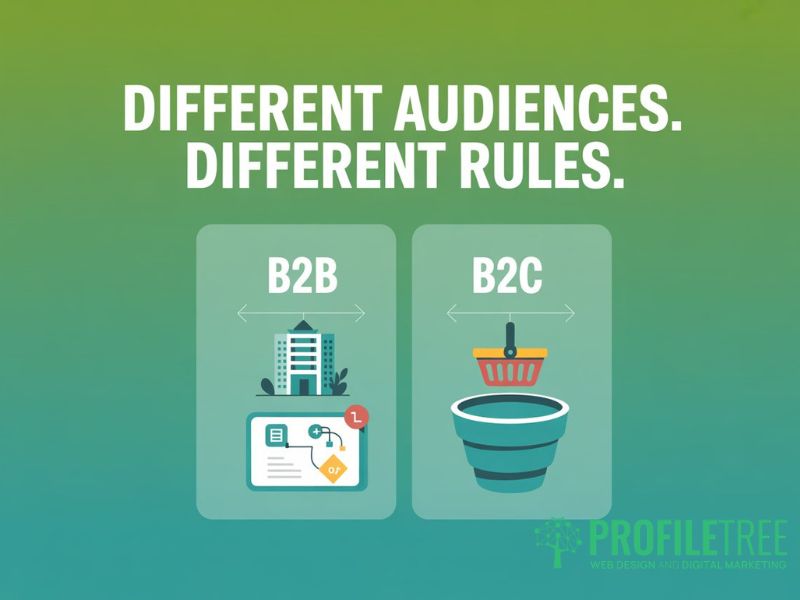
The mechanics of programmatic advertising are the same for B2B and B2C, but the programmatic buying strategy differs considerably. B2C campaigns reach mass audiences cost-effectively, with short purchase cycles and clear direct response feedback. B2B is more constrained: decision-making units are smaller, cycles longer, and account-based marketing approaches, where ads target users at specific prospect companies, tend to outperform broad targeting. LinkedIn’s programmatic offering is the most widely used B2B platform in the UK, though its CPMs are substantially higher than display.
For B2B SMEs in Northern Ireland and Ireland, practical programmatic marketing strategies often combine geo-fenced display advertising in key business districts with LinkedIn retargeting for website visitors who fit the target company profile. Our broader guide to digital marketing channels for UK businesses covers how programmatic fits within the wider media mix.
Building Programmatic Marketing Strategies That Last
Programmatic marketing strategies have matured from a mechanism for buying cheap remnant inventory into a full-stack approach covering real-time bidding, programmatic guaranteed deals, connected TV, and digital out-of-home. The businesses that benefit most are not those with the largest budgets but those with the clearest objectives and the best programmatic data to inform their decisions.
For UK SMEs, the practical priorities are consistent. Start with a sound consent framework and clean first-party data. Choose a programmatic buying strategy that matches your data assets: contextual and geo-fencing first if you are starting from scratch, first-party activation and lookalike modelling once you have sufficient audience data. Measure against objectives that match your campaign type, not vanity metrics.
Compliance is not a constraint on good programmatic advertising strategies. UK GDPR and the ICO’s guidance on real-time bidding are forcing the industry towards approaches that are more durable and more trusted by users. A programmatic strategy built on explicit consent and first-party data will outlast one built on third-party tracking, and it will perform better as consent rates on third-party cookies continue to decline.
ProfileTree has been helping SMEs across Northern Ireland, Ireland, and the UK since 2011. If you are ready to build programmatic marketing strategies that are compliant and built for long-term performance, get in touch.
FAQs
1. What is a programmatic marketing strategy?
Programmatic marketing strategies are plans for using automated technology to buy and place digital advertising. They define which audience targeting approaches to use, which platforms to operate through, how budgets will be allocated across campaign types, and how performance will be measured. A sound strategy also addresses data compliance, particularly the requirements of UK GDPR and the ICO’s guidance on online advertising.
2. Is programmatic advertising GDPR compliant?
Programmatic advertising can be GDPR compliant, but requires proper implementation. Behavioural targeting and retargeting require explicit consent managed through a Consent Management Platform. The ICO has stated that many current real-time bidding practices fall short of the required standard. Contextual targeting and first-party data strategies carry lower compliance risk because they do not depend on third-party tracking.
3. What budget do you need to start with programmatic advertising?
There is no fixed minimum, but campaigns need enough daily budget to generate meaningful data. A display campaign can start with a few hundred pounds per month, though this slows the algorithm’s learning. For performance-focused campaigns targeting a specific CPA, a working budget of at least two to three times the target CPA per week is a practical starting point.
4. What is the difference between a DSP and an ad network?
A DSP gives advertisers direct access to ad inventory across multiple exchanges, with real-time bidding and granular audience controls. An ad network aggregates inventory and sells it at a markup, with less transparency and fewer targeting options. DSPs provide more control but require more expertise. Ad networks are simpler but offer less flexibility.
5. Can small businesses use programmatic advertising effectively?
Yes, though the programmatic buying strategy must match the business’s data assets and budget. Small businesses without large CRM databases or high website traffic will find contextual targeting and geo-fencing more practical than sophisticated behavioural strategies requiring significant audience data. Self-serve DSP platforms have lowered the barrier to entry substantially, and working with an agency experienced in SME campaigns can compress the learning curve.