
Content Marketing Strategy: A Practical Guide for UK and Irish SMEs
Table of Contents
Most SMEs start producing content before deciding what it is for. Blog posts go live, social updates get scheduled, a video gets filmed, and six months later, there is some traffic but no line connecting any of it to a single enquiry.
A content marketing strategy fixes that ordering problem. It settles the audience, the topics, the channels and the measurement before anyone writes a word, so each piece produced has a job to do and a way of being judged.
This guide covers what a content marketing strategy is and how it differs from a content plan, a seven-step framework for building one, how to run the calendar and production side without burning out a small team, the UK and Ireland specifics that American guides skip entirely, and how to measure return when fewer people click. Five short FAQs close it out.
What a Content Marketing Strategy Actually Is
The words “content strategy”, “content marketing”, and “content plan” get used interchangeably in most briefings, and the confusion costs money. Sorting out which layer you are working on tells you who owns the decision, how long it stays valid, and what happens when business priorities shift.
Strategy, Plan and Tactics Are Three Different Layers
A content marketing strategy answers why and for whom. It defines commercial objectives, the audience being served, the positioning that separates you from everyone else publishing on the same subject, and the topics you intend to own. It lives for months or years and belongs to a senior marketer or the business owner.
A content plan answers what and when. Formats, titles, publication dates, and owners. It changes every quarter. Tactics sit below that: the individual keyword choice, the video length, and the posting time.
| Content marketing strategy | Content plan | |
|---|---|---|
| Question it answers | Why and for whom | What and when |
| Typical lifespan | 12 to 24 months | 4 to 12 weeks |
| Who owns it | Owner or senior marketer | Content manager |
| Trigger for change | Business goals shift | Campaign cycle ends |
Get these the wrong way round, and you end up with a busy calendar attached to nothing. This layering sits behind how ProfileTree structures its content marketing services for SME clients: the strategy document is signed off first, and only then does anything get scheduled.
Why Most SME Content Programmes Stall
Three failures account for most of it. Objectives were never written down, so nobody can tell whether the work succeeded. The audience was borrowed from a template rather than built from real customer conversations. Or production speed was prioritised over substance, which produces pages that read fine and rank nowhere.
That third failure has become more expensive. Search systems now reward material that shows real experience and named expertise, and thin, generic copy struggles regardless of volume. The practical test is whether a page contains anything a reader could not get from the first result they clicked. ProfileTree’s guide to spotting the phrasing that marks out generic AI output is a useful checklist for editors reviewing drafts.
How Content Marketing Differs From Paid Advertising
Paid channels rent attention. Content earns it. A Belfast engineering firm running search ads pays per click, every click, forever. The same firm publishing a detailed guide to procurement compliance for Northern Ireland public contracts builds something that keeps pulling qualified traffic without further spend.
The economics differ, and so do the timelines. Paid delivers this week; organic content usually needs six to nine months before the numbers move. For most SMEs, the sensible answer is both, with paid covering immediate lead flow while search engine optimisation and organic content build a base that lowers the cost of acquisition over time.
The Seven-Step Framework for Building the Strategy
Building a documented content marketing strategy from nothing takes a few weeks of focused work, not a quarter. The sequence matters more than the effort: each step produces a decision the next one depends on.
- Set commercial objectives with a metric attached to each
- Define the audience from real data, not personas borrowed from a template
- Audit what already exists before commissioning anything new
- Choose two to four narrative pillars
- Build topic clusters underneath each pillar
- Plan the distribution channel by channel
- Set up measurement and attribution before publishing
Steps One and Two: Objectives and Audience
“Build brand awareness” is not an objective because nothing follows from it. “Increase organic sessions to the three main service pages by 30% within six months” is good because it tells you what to write and how you will know.
Pick metrics you can already see. Organic sessions to specific pages, enquiry volume from a named form, and positions for a defined set of queries. Anything that requires a new tracking setup before it can be reported tends not to get reported at all.
Audience definition should come from sources you already own: search queries in Google Search Console, questions from sales calls, customer service tickets, and the language buyers actually use to describe their problem. Patterns worth looking for are the objections raised before purchase and the terms people reach for when they cannot name the thing they need. A Dungannon food manufacturer and a Dublin software firm share almost nothing in reading habits or buying process, so a persona lifted from an American template will produce content aimed at nobody. ProfileTree’s breakdown of how to define your audience for content marketing walks through the quantitative and qualitative sides of that research.
Step Three: Audit Before You Commission
An audit tells you which pages earn traffic and enquiries, which pick up impressions but almost no clicks, which rank for nothing at all, and where the coverage gaps sit. Those four categories map to four actions: strengthen, retitle, rewrite or consolidate, and commission.
Skipping this step is how sites end up with 400 pages and shrinking authority. A structured content audit framework turns a page inventory into a prioritised list of decisions, which is the only version of an audit worth running.
Steps Four and Five: Pillars and Topic Architecture
Narrative pillars are the two to four themes your content returns to. A digital agency serving manufacturers might settle on operational efficiency, winning public sector contracts online, and workforce skills. Everything published sits under one of them.
Underneath each pillar sit topic clusters: a substantial guide surrounded by supporting pieces that link back to it. That structure signals topical depth and makes planning easier, because the boundaries are already drawn. Studying who currently occupies those topics is part of the work, and running a competitive analysis for content strategy shows where rivals are thin enough to be displaced.
Steps Six and Seven: Distribution and Measurement
Content without distribution is a leaflet left in a drawer. Organic search carries the long-term value for most SMEs. Email compounds trust with an audience you already have and is immune to algorithm changes. Social works best as amplification for material created elsewhere.
Video sits slightly apart because it is a search channel in its own right. A short clip cut from a longer guide reaches people who will never read 3,000 words, and short-form video has changed how audiences discover businesses across every platform that matters. Measurement gets built at this stage rather than bolted on later, which is covered in more detail further down.
Turning Strategy Into a Working Content System
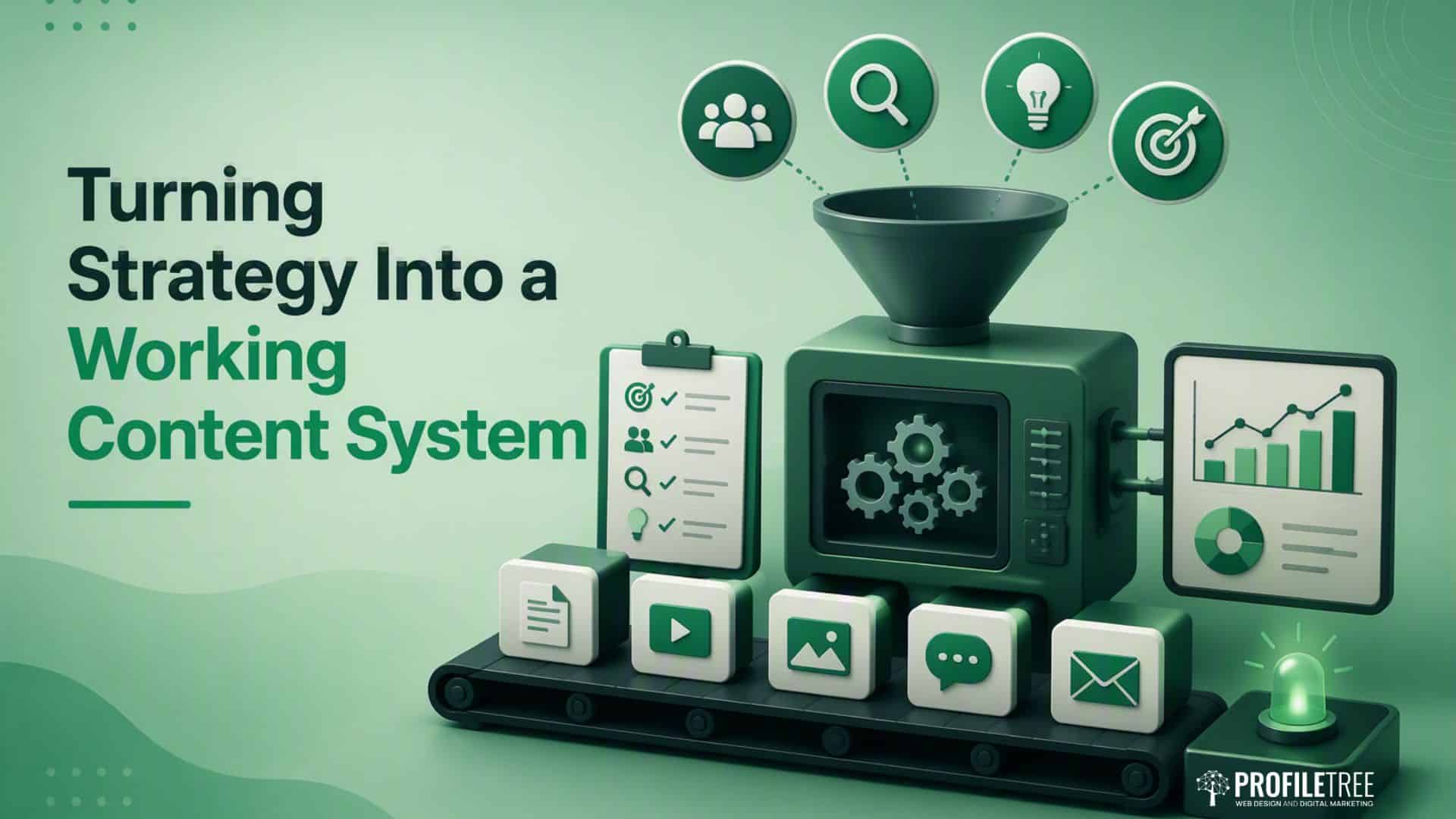
A strategy that never becomes a schedule is just a document. The production side is where most small teams lose momentum, usually because the cadence was set by ambition rather than capacity.
What Every Calendar Entry Should Capture
A shared spreadsheet is enough. What matters is that every row records the same six things: working title and target query, format, pillar theme, publication date, owner, and status.
The status column carries more weight than it looks. Without it, drafts sit unreviewed, and the calendar quietly becomes a wish list. Length is worth agreeing up front too, since the right word count depends entirely on what the query demands, a point covered in ProfileTree’s guide to content length and search rankings.
Choosing a Cadence You Can Actually Sustain
Two well-researched, properly distributed pieces a month will outperform eight rushed ones. Search rewards depth; it does not reward volume produced at the expense of quality.
A workable rhythm for a small team: quarterly review of which clusters are performing, monthly planning to lock the next four to six pieces and assign owners, weekly check-in to clear bottlenecks. Build around anchor pieces first, then derive the social cuts, email segments and short-form video clips from each one. A single strong guide can supply a month of secondary material.
Deciding Where AI Helps and Where It Hurts
By 2026 the question is not whether to use AI in content production but where it earns its place. It handles initial research, outline scaffolding and metadata drafting well. It handles fact-checking, tone, local context and final editorial judgement badly.
| Task | AI suitability | What still needs a person |
|---|---|---|
| Research and source gathering | Good | Verification of every claim |
| Outline drafting | Good | Editorial structure and angle |
| First draft of factual sections | Partial | Opinion, nuance, specifics |
| Fact-checking | Poor | Always human |
| Local and sector context | Poor | Always human |
| Title tags and meta descriptions | Good | Human approval |
Teams that get value from AI have usually been taught where the line sits. ProfileTree’s digital training programmes cover exactly that split for in-house marketing teams, which tends to be cheaper than outsourcing the whole function.
The UK and Ireland Context: Most Guides Skip

Almost every high-ranking guide on this subject is written for a US audience. The frameworks travel. The legal position, the tone and the regional search behaviour do not.
Data Collection, Consent and the Rules That Apply
Any content activity that collects data falls under UK GDPR and, for electronic marketing, the Privacy and Electronic Communications Regulations. Newsletter sign-ups, gated downloads and retargeting pixels all qualify. Consent has to be freely given, specific, informed and unambiguous, which rules out pre-ticked boxes and bundled agreements. The Information Commissioner’s Office guidance on marketing and data protection sets out how the two regimes interact and what records you need to keep.
The Advertising Standards Authority applies to editorial content as well as adverts: sponsored material must be labelled, and product claims must be substantiated. Getting the form mechanics right at the build stage avoids retrofitting later, which is why compliant capture forms are handled during website development rather than after launch.
Writing for British and Irish Readers
US marketing copy tends towards enthusiasm and direct self-promotion. UK and Irish readers are more sceptical, respond better to understatement, and disengage quickly from anything that reads as a pitch. Lead with the problem rather than the opportunity. Use specifics instead of superlatives. Say honestly that something takes six to nine months.
Local knowledge shows in the detail, and readers notice when it is real. ConnollyCove’s Belfast travel blog guide, written by someone who has lived in the city their whole life, is a clear example of the difference between content built on lived familiarity and content assembled from research. The same principle applies to content trends specific to Northern Ireland, where dialect, local references and regional search phrasing all shift what performs.
Regional Search Visibility and Local Authority
For businesses targeting Belfast, Derry, Dublin or a specific English region, strategic content marketing has to run alongside local search work. That means writing about the actual conditions of that market rather than swapping a city name into a template, earning mentions and links from regional publications, and matching topics to how people search locally.
An accountancy firm in Armagh writing about R&D tax credits should cover HMRC eligibility rules, the practical claim process, and the role of Invest Northern Ireland in supporting innovation. A generic version of that article that could have been written anywhere earns nothing. ProfileTree’s overview of digital marketing in Northern Ireland sets out how local search and content work together for SMEs here.
Measuring Content Performance and Commercial Return
Sessions tell you that content is being found. They say nothing about whether it earns money. A measurement framework worth having tracks three layers and connects the bottom one to the CRM.
Metrics That Map to the Buying Journey
Top of funnel: organic sessions, impressions, and new users. Middle: time on page, pages per session, email sign-ups, resource downloads. Bottom: enquiries attributed to organic content, conversion rate from organic traffic, and closed deals where the buyer read something first.
Setting this up properly takes an afternoon and saves months of guesswork. ProfileTree’s walkthrough of Google Analytics for content marketing covers the reports and events that make each layer visible.
Attribution Across Long Buying Cycles
B2B buyers rarely convert on the first contact. A business owner in Derry might read a guide in January, join the newsletter in February, and enquire in April. Last-click attribution credits whatever they touched immediately before the form. A multi-touch model shows the guide started the relationship.
Connecting content performance to CRM records is where content marketing management proves its case to a board. ProfileTree’s analysis of maximising ROI from digital marketing campaigns goes further into how assisted conversions get valued.
Tracking Visibility When Nobody Clicks
A growing share of queries is answered inside the results page or inside an AI assistant. Brand visibility now includes being quoted in those answers, which is measurable separately from clicks. Bing Webmaster Tools reports AI citation counts per page, and the grounding queries behind them show which questions your content is being pulled into.
Pages that get cited tend to share structural traits: direct answers near the top of each section, descriptive headings, tables, and current facts. ProfileTree’s explainer on how Bing AI and Copilot surface content covers how to read that data alongside Search Console.
Ciaran Connolly, founder of ProfileTree, puts the shift plainly: “The businesses winning at content in 2026 are not the ones publishing most. They are the ones whose content could only have come from them, because that is the only kind an AI system has a reason to quote.”
From Strategy to Execution
The gap between knowing what a content marketing strategy should contain and running one that works is an execution problem, not a knowledge problem. The discipline to publish consistently, measure honestly and adjust based on evidence is the hard part. ProfileTree works with SMEs across Northern Ireland, Ireland and the UK on strategy-first content programmes. To talk through where your current content activity stands and what it would take to improve it, get in touch with the team.
What are the seven steps of a content marketing strategy?
Set measurable objectives, define your audience from real data, audit existing content, choose two to four narrative pillars, build topic clusters underneath them, plan distribution channel by channel, and set up measurement before you publish.
What is the difference between content strategy and content marketing?
Content strategy is the framework: goals, audience, positioning and topics. Content marketing is the execution of that framework through blogs, video, email and social. Strategy is decided first and changes rarely.
How much does a content marketing strategy cost in the UK?
Outsourced content marketing typically runs from £1,000 to £5,000 a month, depending on volume, and whether SEO, video or paid distribution are included. Smaller businesses often start with a single topic cluster.
How long before content marketing produces results?
Expect six to nine months for meaningful organic traffic growth, and around twelve months before the commercial return is clear. Programmes abandoned at month three almost never recoup the investment.
Does content marketing still work now that AI answers so many queries?
Yes, though the measure of success has widened. Content that gets quoted inside AI answers builds brand presence even without a click, and pages with original data, named authors and clear structure are the ones being cited.