
Digital Publishing Rights for UK Small Businesses: The Complete Guide
Table of Contents
Digital publishing rights determine who can legally distribute, reproduce, license, and profit from content published online. For small businesses across Northern Ireland, Ireland, and the UK, getting this wrong carries real consequences: takedown notices, copyright claims, employment disputes over who owns content your team created, and legal exposure when using third-party assets in marketing materials.
This guide covers the legal framework UK and Irish businesses need to understand, from automatic copyright protection to drafting freelance contracts, licensing third-party assets, managing compliance for video and podcast content, and navigating the post-Brexit landscape for cross-border digital sales.
What Are Digital Publishing Rights?
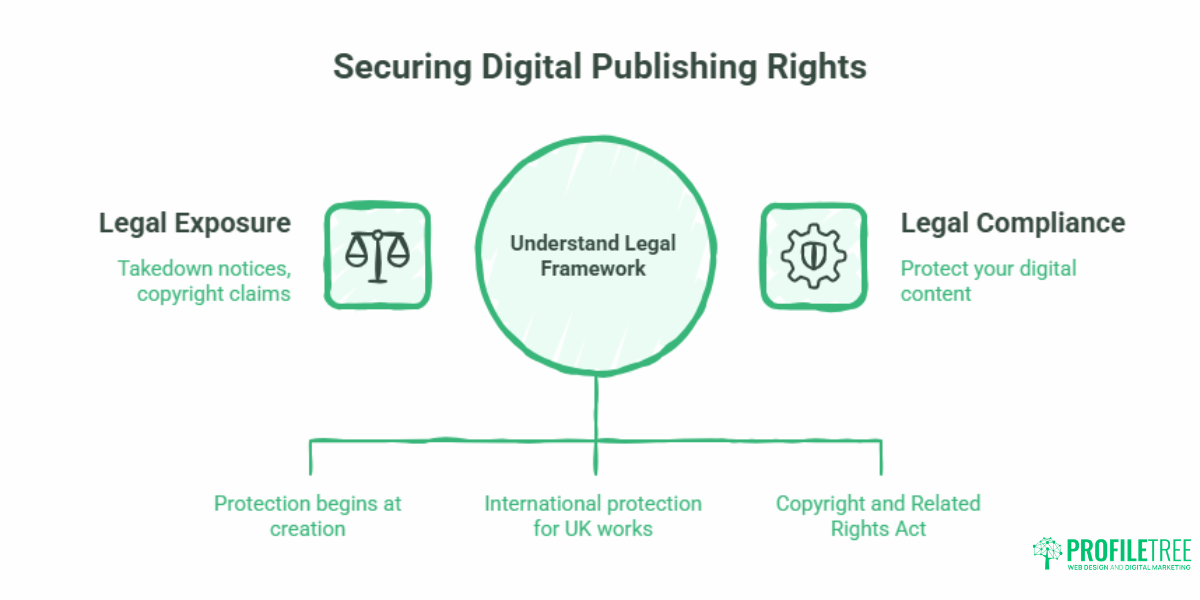
Digital publishing rights are the legal permissions that govern how original works can be distributed or reproduced in electronic formats. These include ebooks, blog posts, digital newsletters, video content, podcasts, online courses, and social media assets.
The Legal Foundation: Copyright, Designs and Patents Act 1988
In the UK, copyright protection for original works is automatic. The moment a piece of writing, a video, a piece of music, or a graphic is created and fixed in a tangible form, it is protected under the Copyright, Designs and Patents Act 1988 (CDPA). There is no registration process and no fee. Protection begins at the point of creation.
This matters for small businesses in two directions. Your own original content website copy, blog articles, video scripts, and product descriptions are automatically yours. At the same time, content created by others and published online is protected by the same rules, whether or not it carries a copyright notice.
The Berne Convention extends this protection internationally. UK copyright works receive automatic, equivalent protection in more than 180 countries, including all EU member states, the United States, and Commonwealth nations.
In Ireland, the equivalent legislation is the Copyright and Related Rights Act 2000. The principles are broadly similar to the UK framework, though there are distinctions in duration, moral rights, and specific exemptions that apply to Irish-registered businesses.
Types of Digital Assets and How Rights Apply
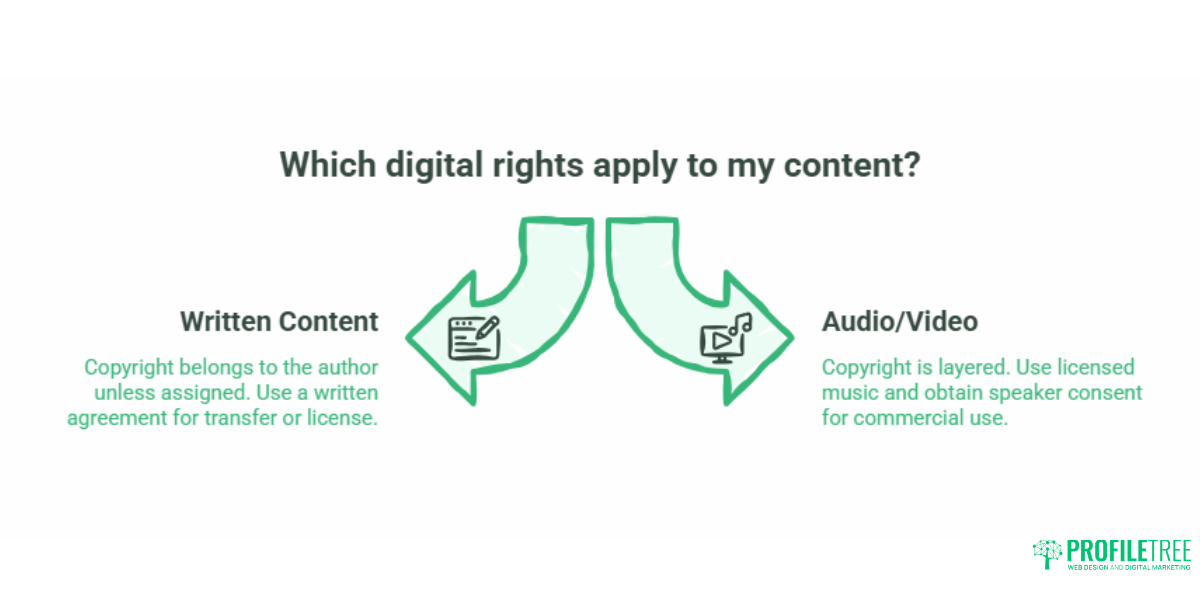
Understanding which rights apply to which content type is where most small businesses have gaps. The rights covering a blog post differ from those covering a podcast episode, a commissioned video, or a social media graphic.
Written Content: Blogs, eBooks, and Newsletters
Copyright in written content belongs to the author at the point of creation. For businesses that commission blog posts or newsletters from freelance writers, ownership of that content does not automatically transfer to the commissioning business. Unless a contract explicitly assigns copyright to the business, the writer retains it.
This is a common issue for SMEs scaling their content marketing. A business paying a freelancer to write blog posts may assume ownership simply because they paid for the work. That assumption is incorrect under UK law. Without a written copyright assignment, the freelancer retains copyright and can, in theory, publish the same content elsewhere or withdraw permission for the business to use it.
The solution is a clear written agreement at the point of commissioning: either a copyright assignment (full transfer of ownership) or an exclusive licence (which grants the business the right to use the content while the writer retains underlying ownership). Both have legitimate uses depending on the nature of the project.
Audio and Video: Podcasts, Webinars, and Social Media Clips
Copyright in audio and video content is layered. A podcast episode may involve copyright in the script, in the recorded performance, in any music used, and in any third-party content quoted or played. A YouTube video may involve separate rights in the footage, the soundtrack, any graphics, and the editing itself.
For businesses producing video content for marketing purposes, the most frequent legal exposure comes from music. Uploading a video to YouTube with a commercially licensed track that does not cover online distribution can trigger a Content ID claim, which, at minimum, results in monetisation being redirected and, at worst, results in the video being removed or the channel receiving a strike.
The correct approach is to use music explicitly licensed for online commercial use (YouTube Content ID-safe licences, or music sourced through platforms such as Epidemic Sound, Artlist, or similar). Licences from these platforms are typically non-exclusive and platform-specific, so it is worth confirming that the licence covers the specific platform where the content will appear.
Webinars introduce an additional layer: speaker consent. If a guest speaker appears in a recorded webinar that the business intends to publish, sell, or distribute as a product, the business needs written consent from that speaker covering the specific uses planned. Verbal agreement on the day of recording is not sufficient for commercial distribution.
Emerging Media: AI-Generated Content and Ownership Under UK Law
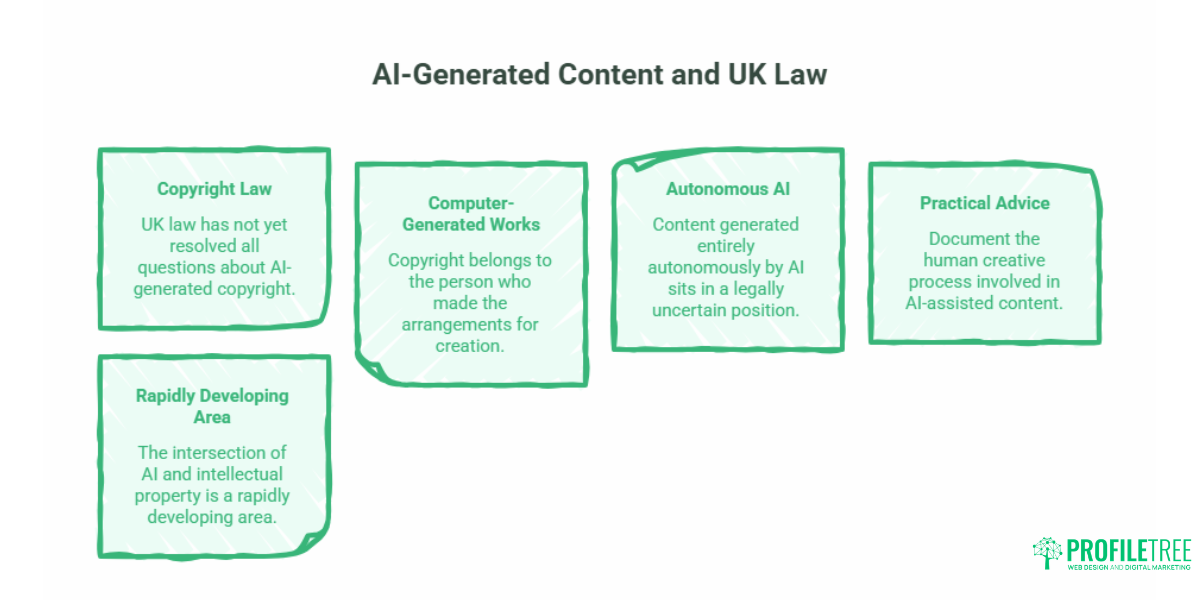
Generative AI tools are now part of many businesses’ content workflows, but UK law has not yet resolved all questions about AI-generated copyright.
Section 9(3) of the Copyright, Designs and Patents Act 1988 covers computer-generated works with no human author, and assigns copyright to “the person by whom the arrangements necessary for the creation of the work are undertaken.” Such works get 50 years of protection under section 12(7) and carry no moral rights.
Do not lean on that provision. The government’s Report on Copyright and Artificial Intelligence, published on 18 March 2026 by DSIT, the IPO and DCMS, proposes removing section 9(3) altogether. Most consultation respondents took the view that work created solely by AI should not attract copyright, while work created with AI assistance should. The government agreed in principle, though it has stopped short of legislating.
There is a further problem even while section 9(3) stands. The originality test requires a work to be the author’s own intellectual creation, and no UK court has ruled on whether writing a prompt clears that bar. The position is genuinely unsettled.
The practical position is therefore to treat AI output as assisted rather than generated, and to document the human creative process behind it: the prompts used, the editorial decisions made, and the revisions applied. This creates a paper trail demonstrating human authorship if copyright ownership is ever challenged.
The intersection of AI and intellectual property is a rapidly developing area. ProfileTree’s AI implementation services work with businesses on responsible AI adoption, which includes understanding the ownership and compliance implications of AI-generated content.
Protecting Your Business’s Digital Assets
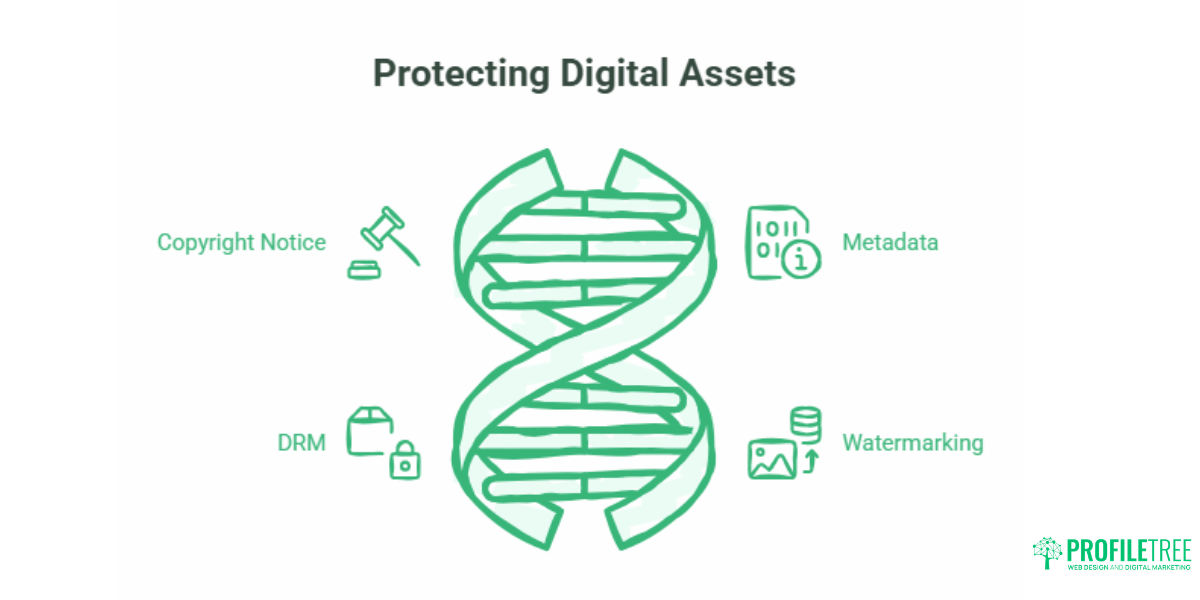
Copyright arrives automatically, but enforcement does not. If someone copies your work, the question a court or a hosting provider will ask is what you can prove and when you can prove it from. The steps below cost almost nothing and make that question much easier to answer.
Automatic Copyright vs Proactive Protection in the UK
Because copyright is automatic in the UK, many small businesses assume no further action is needed. In practice, proactive steps make enforcement significantly easier if your content is ever used without permission.
Marking your content with a copyright notice (© [Year] [Business Name]) does not create protection that already exists, but it does put third parties on notice that the content is owned and removes any argument that copying was accidental. Adding metadata to digital files (author name, creation date, rights statement) creates a timestamp that can support a copyright claim if the content is later reproduced without permission.
Unlike the United States, the UK does not require copyright registration. There is no official register. However, businesses can use timestamped records (emails, version history in document management systems, file metadata) as evidence of prior creation if a dispute arises.
Can a small business register a copyright in the UK? There is no formal registration system. The most practical protective measure is maintaining clear, dated records of when content was created and by whom.
Mitigating Piracy: DRM, Metadata, and Watermarking
For businesses selling digital products, such as ebooks, online courses, or downloadable templates, Digital Rights Management (DRM) tools add a technical layer of protection by restricting how files can be copied or shared after purchase.
DRM is not a legal protection in itself, but it does reduce casual piracy and creates a clear signal that the content is commercially licensed. For lower-value digital products, the overhead of implementing DRM may outweigh the benefit. For higher-value products (training programmes, proprietary research, premium templates), DRM is worth considering alongside clear licence terms displayed at the point of purchase.
Watermarking visual content, either visibly or as an invisible embedded identifier, allows you to trace unlicensed use back to the original distribution point if your images are used without permission.
Acquiring and Licensing Third-Party Assets Legally
Most copyright trouble for SMEs comes from using someone else’s work rather than from someone using yours. An image pulled from a search result, a track behind a promotional video, a paragraph quoted from a competitor’s blog. Each carries terms, and those terms are narrower under UK law than most business owners expect.
UK Fair Dealing vs US Fair Use
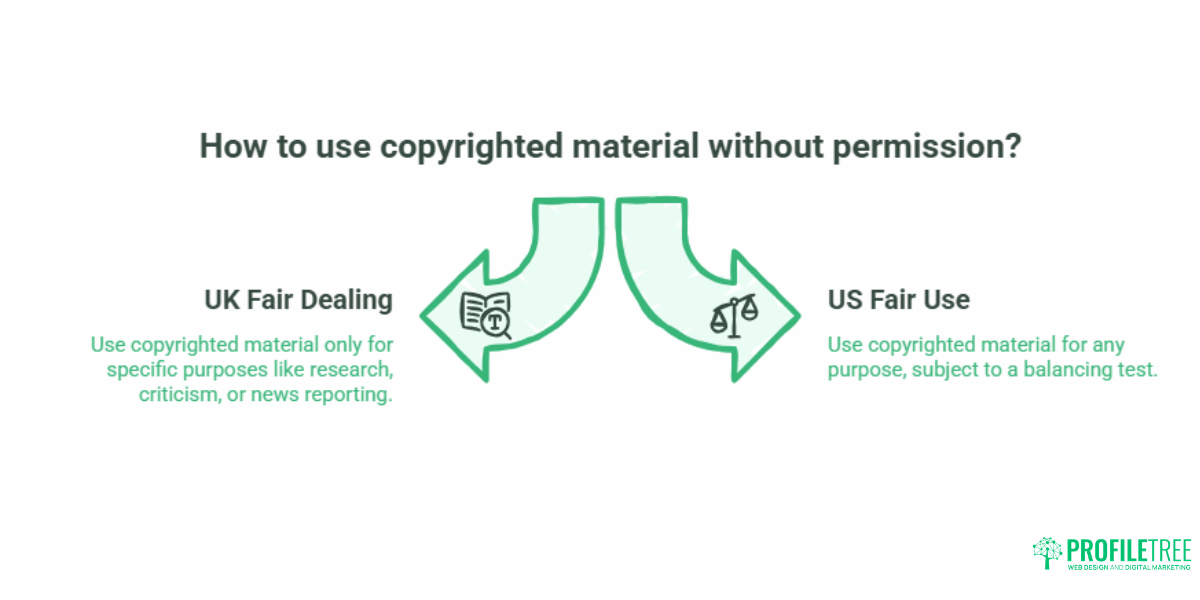
This distinction matters because a significant proportion of online content about copyright is written from a US perspective and references “Fair Use,” which is an American legal doctrine. It does not apply in the UK or Ireland.
In the UK, the relevant concept is Fair Dealing, which is considerably narrower. Fair Dealing permits the use of copyrighted material without permission only for specific, defined purposes: research and private study; criticism, review, or quotation; news reporting; and parody, caricature, or pastiche. It does not provide a general balancing test the way US Fair Use does.
| Feature | UK Fair Dealing | US Fair Use |
|---|---|---|
| Legal basis | Copyright, Designs and Patents Act 1988 | US Copyright Act 1976 |
| Approach | Specific permitted categories only | Four-factor balancing test |
| Categories | Research, criticism, news reporting, parody | Any purpose, subject to proportionality |
| Commercial use | Generally excluded | Permissible if other factors favour it |
| UK business applicability | Yes | No |
For Irish businesses, the Copyright and Related Rights Act 2000 uses similar “fair dealing” concepts, with broadly comparable categories to the UK.
The practical consequence is that UK businesses cannot rely on a general “it’s not a lot of content” or “it’s for educational purposes” argument to justify reproducing someone else’s work. The use must fit a defined category.
Digital Licensing Agreements Decoded
A licence grants permission to use content under specified conditions. Licences vary considerably in what they permit:
Exclusive licences grant one party the sole right to use the content in a defined way. The original creator cannot licence the same rights to anyone else during the licence period.
Non-exclusive licences allow the creator to license the same content to multiple parties simultaneously. Most stock image and music platform licences are non-exclusive.
Royalty-free licences do not mean free of cost or free of restrictions. They mean you pay once and do not owe further royalties based on usage. The licence terms still specify what uses are permitted and what are not.
Rights-managed licences grant use for a specific purpose, platform, time period, or territory. Using rights-managed content outside these parameters is infringement.
When commissioning content from freelancers or agencies, the licence (or assignment) must be clearly specified in the contract before work begins. Assuming ownership after payment is the most common and avoidable source of digital rights disputes for small businesses.
Drafting Freelance Contracts: Transfer of Ownership vs Licensing
A copyright assignment transfers full ownership of the work to the commissioning party. After a valid assignment, the original creator has no further rights in the work unless expressly reserved.
A copyright licence leaves ownership with the creator but grants specific permissions to the commissioning party. The scope of those permissions (exclusivity, territory, duration, permitted uses) must be stated clearly.
For businesses commissioning regular content, website copy, marketing videos, or branded graphics, a copyright assignment is usually preferable. It prevents later disputes about whether the business can modify, repurpose, or sub-license the content.
At minimum, a freelance contract for content creation should specify: who owns the resulting copyright; whether ownership is assigned or licensed; the territory and duration of any licence; whether the creator retains any moral rights (including the right to be credited); and what happens to the rights if the contract is terminated early.
Cross-Border Digital Commerce: UK, NI, and Ireland
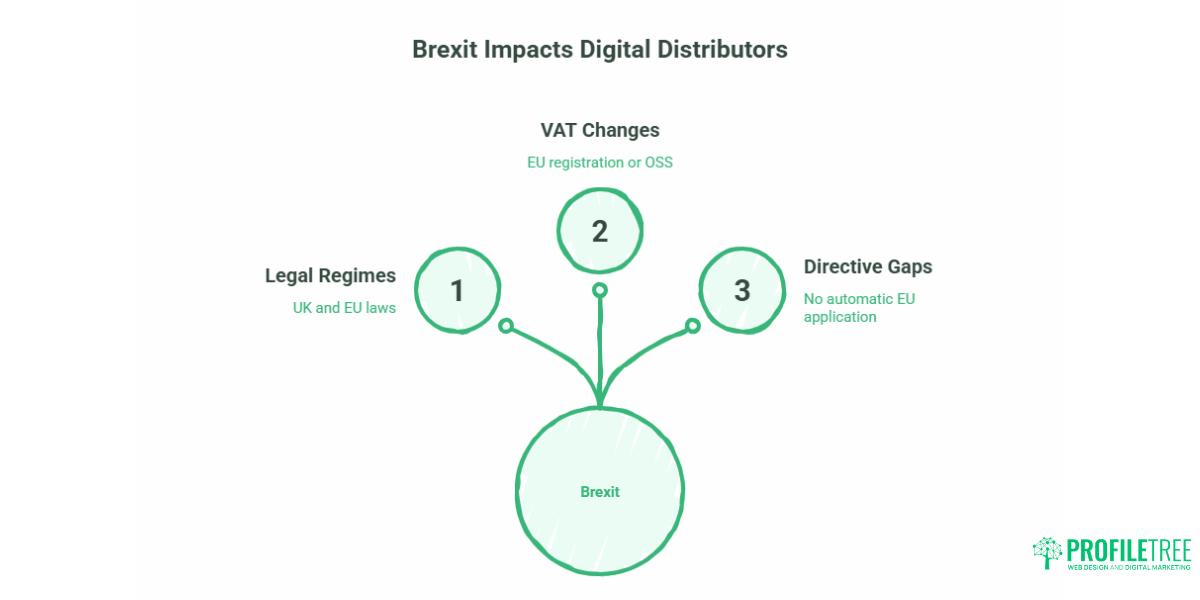
Selling digital content across borders means your work sits under more than one legal regime at once. For a business in Belfast selling into Dublin, or a UK company selling ebooks to customers in the EU, the copyright position is mostly settled by international treaty. The complications turn up in licensing terms and tax treatment instead.
Post-Brexit Compliance for Digital Distributors
Before the UK left the European Union, copyright and related rights across the UK and EU operated within a broadly harmonised framework under EU directives. That harmonisation no longer applies to UK-registered businesses selling digital content into EU markets.
For businesses in mainland UK, selling digital products directly to EU customers now involves operating across two separate legal regimes: UK copyright law and the applicable EU member state’s copyright law. In most practical cases, the Berne Convention provides reciprocal protection, so UK copyright works retain protection in EU countries. However, specific EU directives on digital single market rights, platform liability, and content filtering no longer automatically apply to UK businesses.
VAT treatment of digital sales to EU customers changed at the point of Brexit and has continued to evolve. Businesses selling digital content (ebooks, downloads, online courses) to EU consumers are required to register for VAT in the EU or use the EU’s One Stop Shop (OSS) mechanism. This is a tax compliance matter rather than a copyright one, but it affects how digital publishing businesses structure their sales operations.
Operating Across the Northern Ireland-Republic of Ireland Border
Northern Ireland occupies a distinct position. Under the Windsor Framework, Northern Ireland maintains alignment with certain EU single market rules for goods, but the position on digital services and intellectual property is less clearly defined.
For businesses operating on both sides of the border, UK copyright law applies to Northern Ireland, while Irish copyright law (the Copyright and Related Rights Act 2000) applies in the Republic. The two frameworks are broadly compatible, and the Berne Convention provides reciprocal protection. In practice, a business based in Belfast publishing and selling digital content in both jurisdictions is unlikely to face conflict between the two legal regimes for straightforward copyright ownership questions.
Where complexity arises is in licensing and distribution agreements. A licence drafted under UK law specifying “UK territory” may exclude the Republic of Ireland, which requires a separate licence or an explicit extension of territory. Businesses distributing digital content across the island of Ireland should check that their licence terms cover both jurisdictions.
The impact of Brexit on digital marketing operations more broadly is covered in detail in ProfileTree’s guide to Brexit’s impact on digital marketing in the UK.
How Businesses Manage Legal Compliance in Digital Publishing
Legal compliance in digital publishing involves more than understanding copyright ownership. Publishers, content marketing teams, and businesses producing digital content at scale need processes to manage compliance across every asset type.
The core areas are:
Content ownership documentation. For every piece of content commissioned, there should be a written record confirming who created it, who owns the copyright, and on what terms. This includes website copy, blog posts, images, video scripts, infographics, and social media assets.
Third-party asset audits. Images, icons, fonts, music, and video clips all carry licence conditions. Using an asset beyond the scope of its licence is infringement, even if the original licence was paid for. A regular audit of assets in use, compared against current licence terms, catches drift before it becomes a legal problem.
Privacy law compliance. Businesses publishing content that collects, processes, or references personal data must comply with the UK GDPR (in the UK) and GDPR (in the Republic of Ireland). This includes email newsletters, comment sections, gated content, and any form collecting user data. ProfileTree’s guide to designing GDPR-compliant web forms covers the web-specific requirements in detail.
Platform-specific terms. Social media platforms, content distribution networks, and marketplaces each impose their own terms of service on content published through them. These terms often include broad licences granting the platform certain rights over user-uploaded content. Businesses should understand what rights they are granting when publishing to each platform.
Employee vs contractor content. Under UK law, content created by an employee in the course of their employment is automatically owned by the employer. Content created by a freelance contractor remains the contractor’s property unless explicitly assigned. Businesses that have grown their content output using a mix of employed and freelance staff should check that their contracts reflect these distinctions.
“Understanding who owns what is the starting point for every digital content strategy we work on,” says Ciaran Connolly, founder of ProfileTree. “For many SMEs, the answer is less clear than they assume, and sorting it out before you scale is considerably easier than sorting it out after a dispute.”
ProfileTree’s digital training services include content compliance workshops for marketing teams, covering copyright basics, licensing, and platform-specific rules in practical terms.
Enforcement: Resolving Digital Rights Violations
Copyright gives you the right to stop someone using your work. Enforcing it is a separate question, and for most SMEs the practical route runs through hosting providers and platform reporting tools long before it reaches a courtroom.
Sending UK Copyright Takedown Notices
If you discover your content has been reproduced without permission, the first step is to document the infringement: screenshot the page, record the URL, and note the date. This establishes the evidence needed if the matter escalates.
The standard route for removing infringing content from websites is a takedown notice sent to the hosting provider. In the UK, there is no equivalent to the US DMCA’s formal notice-and-takedown procedure, but most reputable hosting companies have acceptable use policies that treat copyright infringement as grounds for removing content or suspending the infringing account.
For infringement on platforms (YouTube, Instagram, Facebook, LinkedIn), each platform operates its own copyright reporting mechanism. YouTube uses the Content ID system for automated detection and a manual copyright claim process for specific infringements. Instagram and Facebook have their own intellectual property reporting tools.
If a takedown notice does not resolve the matter, or if the infringement has caused measurable financial loss, legal action through the Intellectual Property Enterprise Court (IPEC) in the UK is available. IPEC was specifically designed for lower-value IP disputes and has a capped costs regime, making it more accessible for small businesses than traditional IP litigation.
Digital Publishing Rights: Rights Acquisition at a Glance
| Content Source | Rights Model | Permitted Uses | Recommended Action |
|---|---|---|---|
| Employed staff | Employer owns by default | Full business use | Confirm in employment contract |
| Freelance contractor | Creator owns by default | None until assigned or licensed | Include a written copyright assignment in the commissioning contract |
| Stock image (royalty-free) | Non-exclusive licence | Per platform terms | Check commercial and online use are permitted |
| Music (sync licence) | Licence for specific use | Specified platform and territory only | Confirm platform and duration covered |
| AI-generated content | Uncertain; section 9(3) under review | Treat as assisted, not generated | Keep records of prompts, edits and editorial decisions |
| Third-party quotes/excerpts | Fair Dealing (limited) | Criticism, review, research, news, parody only | Check the use fits a defined category before publishing |
What to Do Next
Digital publishing rights are not a niche legal concern. They affect every business that commissions content, publishes online, uses third-party images or music, produces video, or sells digital products. Getting the foundations right, clear contracts with freelancers, correct licences for assets in use, and documented ownership of AI-assisted content protects the content investment you are making and removes the legal exposure that accumulates when these things are left undefined.
ProfileTree works with businesses across Northern Ireland, Ireland, and the UK on content strategy, digital training, and AI implementation. If your business is scaling its digital content output and needs a clearer framework for rights, ownership, and compliance, get in touch with the team.
Frequently Asked Questions
Do I need to pay to register my copyright in the UK?
No. Copyright protection in the UK is automatic from the moment a work is created and fixed in a tangible form. There is no official registry and no registration fee. The most practical protective step is maintaining dated records of when content was created and by whom.
Can I legally use royalty-free assets in commercial content I intend to sell?
Royalty-free means you pay once without ongoing royalties, not that the asset has no restrictions. Each royalty-free licence specifies what uses are permitted. Some licences exclude commercial resale, restrict the number of copies, or exclude specific platforms. Check the specific licence terms before using any royalty-free asset in a commercial product.
Does UK copyright protect my content if it is accessed abroad?
Yes, in most cases. The Berne Convention means UK copyright works receive automatic, equivalent protection in more than 180 countries. Practical enforcement in foreign jurisdictions varies, but the legal basis for protection exists.
How do I legally buy the digital publishing rights for an article?
You need a written agreement: either a copyright assignment (full transfer of ownership) or an exclusive licence (permission to use the content in defined ways). The agreement should specify territory, duration, and which uses are covered. A freelance writer retains copyright in their work until it is explicitly transferred in writing. Paying for the work does not constitute an assignment.
Who owns copyright in content created by an employee versus a freelance contractor?
Under UK law, content created by an employee during the course of their employment is automatically owned by the employer. Content created by a freelance contractor belongs to the contractor unless a written agreement explicitly assigns ownership to the commissioning business.
Are digital publishing rights different from print rights?
Yes. Print rights govern physical reproduction and distribution. Digital rights cover electronic replication, online transmission, download, and streaming. A publishing contract that grants print rights does not automatically include digital rights, and vice versa. This distinction matters for businesses repurposing content across formats.
What does UK Fair Dealing permit compared to US Fair Use?
UK Fair Dealing allows use of copyrighted material without permission only for specific categories: research and private study, criticism and review, news reporting, and parody. It does not provide a general proportionality test. US Fair Use is broader and includes a four-factor balancing approach. UK businesses cannot rely on US Fair Use principles.