
Omnichannel Marketing: A Strategy Guide for UK and Irish Businesses
Table of Contents
Most UK businesses are already operating across multiple channels, a website, social media, email, maybe a physical location or a marketplace listing. The problem is that these channels rarely talk to each other. A customer who browses a product on your website, clicks a retargeting ad two weeks later, and then calls your sales team will often have to explain who they are at every single step. That is not a customer experience; it is a process failure.
Omnichannel marketing fixes that by connecting every touchpoint around a shared understanding of the customer, so the experience someone gets is consistent and informed, regardless of where or how they engage. This guide explains how omnichannel marketing works, how it differs from multichannel marketing, and how businesses in the UK and Ireland can build it without an enterprise-level budget.
What is Omnichannel Marketing?
Omnichannel marketing is an approach where every channel a business uses, website, email, social media, physical shop, phone, app, is connected through a shared record of the customer. Rather than running separate campaigns on separate platforms, each channel draws from and contributes to a single customer profile. When someone switches from browsing on their phone to completing a purchase on a desktop, or from clicking an email to walking into a store, the experience continues rather than restarting.
The central mechanism is the unified customer profile: a single record that captures every interaction a customer has across every channel, updated in real time. When that record is accessible to your marketing, sales, and support teams, every contact feels informed and relevant rather than generic and repetitive.
For SMEs in Northern Ireland, Ireland, and the UK, the practical starting point is simpler than the enterprise definition suggests. You do not need a £100k technology stack. You need your core tools, your CRM, your e-commerce platform, your email system, and your analytics to share data with each other. That integration, even at a basic level, is the foundation of omnichannel marketing.
Omnichannel vs Multichannel Marketing: What is the Difference?
The two terms are often used interchangeably, but they describe fundamentally different approaches. Multichannel marketing means being present on many platforms. Omnichannel marketing means those platforms work together. A business can be active on six channels and still give customers a fragmented experience if those channels do not share data.
| Factor | Multichannel | Omnichannel |
|---|---|---|
| Goal | Reach customers on multiple platforms | Create a unified experience across all platforms |
| Data flow | Each channel holds its own data | All channels share a single customer record |
| Customer experience | Varies by channel; often inconsistent | Continuous and personalised regardless of channel |
| Tech requirement | Individual platform tools | Integrated CRM, CDP, or connected stack |
| Where it breaks down | Customers re-identify at each step | Integration complexity and legacy system limits |
A useful way to picture the distinction: multichannel is a wheel with spokes radiating from a hub. Each channel operates independently from the centre. Omnichannel is a network in which every node is connected to every other node, with data flowing freely between them. A customer touching any point of the web creates a ripple that updates the whole.
The practical implication for UK retailers is significant. Click-and-collect, which remains a major purchase behaviour in British retail, is genuinely useful only when the online order, in-store inventory, and customer loyalty data are aligned. When they are siloed, you get the common frustration of an “available” item that is not at the branch, or of a customer who placed an order online but cannot have their loyalty points recognised in store.
Understanding social media marketing as one channel within a broader connected system rather than a standalone broadcast tool is often where the multichannel-to-omnichannel shift begins to feel concrete for SMEs.
The Four Pillars of a Successful Omnichannel Strategy
Before building channels or choosing tools, it helps to understand what a functioning omnichannel strategy actually requires. These four pillars underpin every effective approach, whether you are a regional SME in Northern Ireland or a mid-sized retailer operating across the UK and Ireland.
1. Centralised Customer Data
Everything in omnichannel marketing depends on having a single, accurate record of each customer. This unified customer profile aggregates data from every touchpoint: website visits, email opens, purchase history, support enquiries, social interactions, and in-store transactions where applicable. Without this record, personalisation is guesswork and measurement is unreliable.
For most SMEs, a CRM system is the practical starting point. At a more advanced level, a Customer Data Platform (CDP) enables unifying data from systems that wouldn’t naturally talk to each other, your point-of-sale, your e-commerce platform, and your email tool, for instance.
Good customer segmentation also matters here. A unified customer profile becomes far more actionable when you can group customers meaningfully by purchase frequency, channel preference, and lifecycle stage, and tailor communications to each segment rather than treating all customers identically.
2. Channel Integration
Channel integration is the technical work of connecting your platforms so that data passes between them without manual effort. This might mean linking your e-commerce store to your email system, connecting your CRM to your live chat tool, or ensuring that your social media advertising audiences are built from first-party data rather than broad demographic targeting.
Most UK SMEs already have partial integration in place, Google Analytics connected to Google Ads, for example, but significant gaps between other systems. Identifying where customer data goes dark (where interactions are not captured or shared) is the first diagnostic step.
3. Content Consistency
Integrated data is only half the picture. The other half is consistent messaging. A customer who sees a promotion on Instagram, searches for it on Google, and lands on a web page that makes no mention of that offer has had their expectation broken. Consistency does not mean identical copy on every channel; the format and length of content should fit the platform, but the brand voice, the offer, and the key messages should align.
This is where consistency in brand voice becomes operationally important rather than just a stylistic preference. Businesses that plan their content across channels, thinking through how a campaign will be expressed as a social post, an email, a web page, and a video, avoid the fragmentation that makes multichannel efforts feel disjointed to the customer.
4. Measurement and Attribution
Measuring omnichannel marketing performance is harder than measuring a single channel because customers rarely follow a straight line from first contact to purchase. A customer might discover a brand through a YouTube video, click a retargeting ad two weeks later, receive an email, and then walk into a shop. Last-click attribution assigns all the credit to the email. That is misleading and leads to poor budget decisions.
The practical standard for most SMEs is data-driven attribution in Google Analytics 4, which distributes credit across touchpoints based on actual conversion paths. Combined with customer lifetime value as a primary metric rather than individual transaction value, this gives a more accurate picture of which channels are genuinely earning their investment.
How to Build an Omnichannel Strategy: A Five-Step Framework
Knowing what omnichannel marketing is and being able to build it are two different things. This framework gives SMEs a practical starting sequence that does not assume a clean-tech slate or an unlimited budget.
Step 1: Audit Your Channels and Data Silos
Before building anything new, map what you already have. List every channel through which customers can interact with your business. For each one, identify what customer data is captured, where it is stored, and whether it is accessible to any other system. Most businesses at this stage discover multiple sources of truth: a CRM with some contacts, an e-commerce platform with purchase history, and an email tool with engagement data, with no easy way to connect them.
This audit also reveals the channels that create friction rather than value. A social media account with no engagement strategy, or a contact form that routes to an unmonitored inbox, is not a channel asset. It is a dead end.
Step 2: Map the Customer Journey
Customer journey mapping documents the stages a customer moves through from first awareness to purchase and beyond. For omnichannel purposes, the map should capture which channels are active at each stage, what data those channels generate, and where handoffs between channels occur or do not.
UK businesses should consider specific journey patterns. The “webrooming” behaviour, common in British retail, involves researching extensively online before buying in a physical store, which means that a disconnected online and offline presence directly costs revenue. The customer who spent 40 minutes on your website and then calls your sales team should not have to explain what they were looking at. If your website analytics are not connected to your CRM, that context is lost.
A clear digital marketing strategy should inform the journey map, because the channels you prioritise and the content you create at each stage both flow from strategic decisions about who your customers are and what they need before they buy.
Step 3: Choose Your Data Foundation
Once you know where your data silos are, you can decide which tool will serve as the single source of truth. The options broadly fall into three tiers:
- CRM systems (HubSpot, Zoho, Salesforce) — appropriate for most SMEs; manage contact records, deal pipelines, and often include basic email automation.
- E-commerce platforms with CRM integrations (Shopify, WooCommerce) — good for businesses where most customer interaction centres on transactions.
- Customer Data Platforms (Segment, Klaviyo CDP) — appropriate for businesses with complex multi-system environments where unifying data across incompatible platforms is the primary challenge.
For most Northern Ireland and Irish SMEs, a well-configured CRM connected to their main e-commerce or booking platform is sufficient to start. The goal is not perfection; it is to establish a single place where customer interactions across multiple channels can be viewed together.
GDPR compliance is a non-negotiable constraint here. Any system that collects and stores customer data across channels must have a lawful basis for each data type, a clear retention policy, and the ability to respond to subject access requests. Understanding data privacy laws governing cross-channel tracking in the UK and Ireland, including UK GDPR, EU GDPR for businesses with Irish customers, and the ePrivacy Regulations, is essential before any integration work begins.
Step 4: Build for Personalisation
With a shared data foundation in place, personalisation becomes achievable at a practical level. The first step is simply using what you know: follow-up emails that reference a customer’s actual purchase, returning website visitors shown content relevant to their previous browsing, and sales teams who can see a customer’s interaction history before a call.
More advanced personalisation, dynamic website content, predictive recommendations, and automated re-engagement sequences triggered by behaviour become possible as data quality improves and your tools mature. Teams building these capabilities internally benefit from digital training that covers both the tools and the strategic decisions around when and how automated personalisation adds value rather than just noise.
The relationship between AI and CRM is also changing what is achievable at the SME level. Features that previously required enterprise budgets, predictive lead scoring, automated segmentation, and behavioural trigger campaigns are now accessible within mid-market CRM platforms, and understanding how to use them is increasingly a practical skill rather than a specialist one.
Step 5: Test, Measure, and Iterate
An omnichannel strategy is not a project with a completion date. It is an ongoing operational discipline. Once basic integration is in place, the work shifts to measuring what is working, identifying where the customer experience is still breaking down, and testing improvements.
The metrics that matter most are cross-channel ones: customer lifetime value, repeat purchase rate, channel attribution across the full journey, and customer satisfaction scores that capture experience quality rather than just transaction outcomes. A consistent SEO strategy ensures that the organic discovery layer, often the first stage of the customer journey, is feeding well-qualified traffic into the omnichannel system rather than sending people to pages that break the experience before it begins.
The SME Reality Check: What Does Omnichannel Marketing Actually Cost?
One of the main reasons UK and Irish SMEs avoid investing in omnichannel marketing is the assumption that it requires an enterprise budget. The reality is more accessible, though it is worth being honest about where costs accumulate.
At the entry level, connecting a CRM to an email platform and an e-commerce system via native integrations, many tools are either free or low-cost. HubSpot’s free CRM, Mailchimp or Klaviyo for email, and a Shopify or WooCommerce store can share basic customer data with relatively little technical work. The main investment is the time to configure it correctly and the discipline to maintain data quality over time.
Costs increase significantly when businesses have legacy systems: older point-of-sale platforms, bespoke inventory tools, or telephony systems not designed for integration. Bridging those gaps typically requires either custom development work or middleware tools such as Zapier or Make. Businesses at this stage should budget for a proper discovery process before committing to a technical build, because the wrong integration architecture is expensive to undo.
A full CDP with real-time personalisation across all channels can run to tens of thousands of pounds annually in software costs alone, before implementation. That level of investment makes sense for a large business with significant e-commerce revenue. For most Northern Ireland and Irish SMEs, a well-integrated CRM, a good email platform, connected analytics, and consistent content across channels deliver most of the customer experience benefit at a fraction of that cost.
Omnichannel in Practice: UK and Irish Examples
The most frequently cited omnichannel examples in marketing content, Starbucks, Disney, and Target, are useful illustrations but unhelpful benchmarks for UK and Irish businesses. The relevant examples are closer to home.
Boots is one of the clearest operators in UK retail. The Advantage Card loyalty programme functions as a unified customer profile across in-store purchases, the website, the app, and pharmacy services. When a customer buys a product in store, that transaction feeds back into their digital profile, influencing both the email promotions they receive and the recommendations they see when they log in online.
Argos built its omnichannel model around a distinctly UK shopping behaviour: checking stock online before visiting a store. The check-and-reserve function, combined with same-day click-and-collect, connects the online and physical experiences in a way that directly removes the most common friction point, travelling to a shop without knowing the item is there.
For independent and regional businesses in Northern Ireland and Ireland, the equivalent is usually simpler: a booking system that shares data with a CRM, a website that captures first-party data with consent, and an email programme that uses actual purchase or appointment history to personalise communications. The principle is the same; the technology is scaled differently.
How Omnichannel Connects to Your Wider Digital Presence
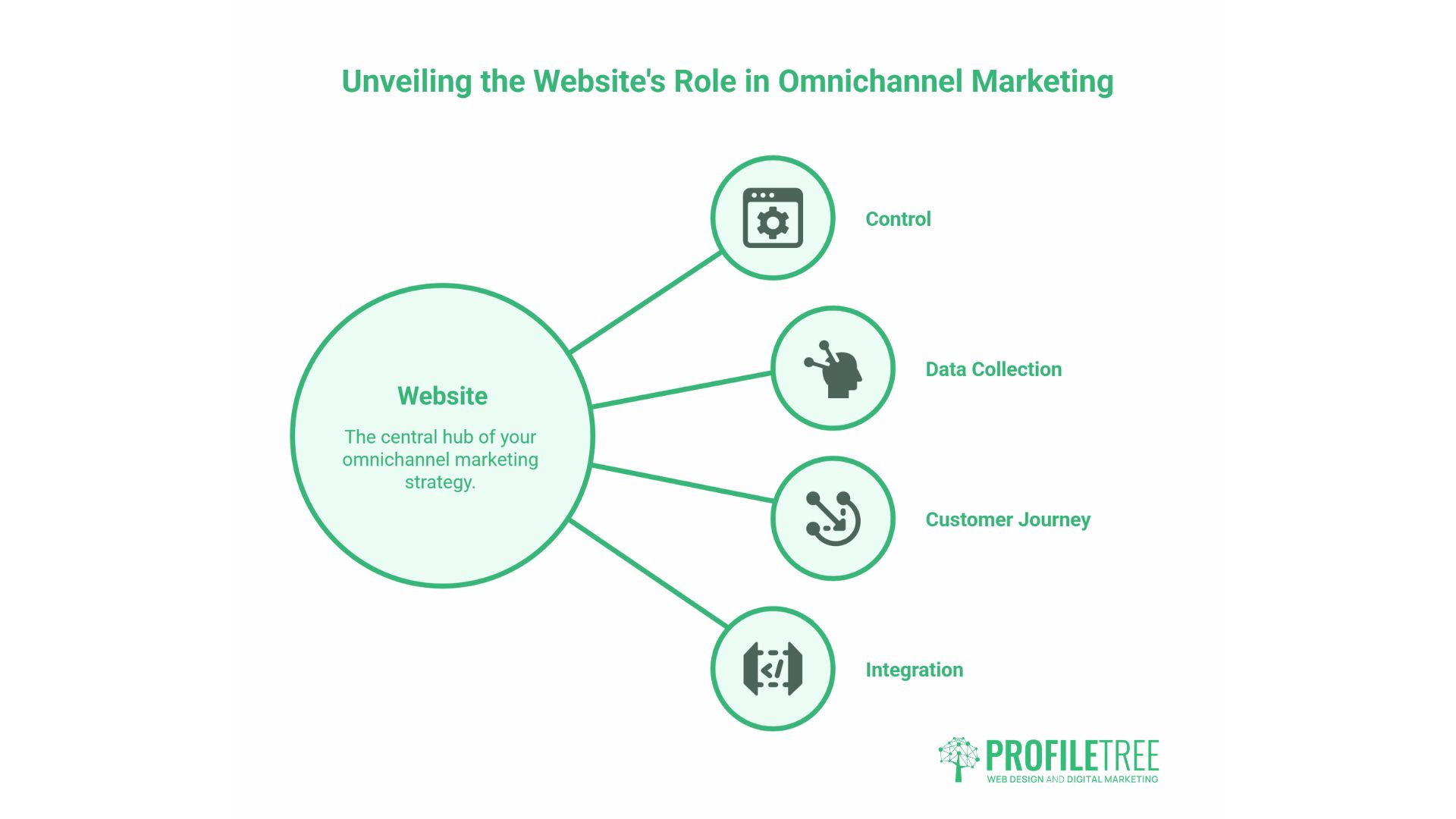
A well-designed website is the anchor of any omnichannel system. It is the platform you control entirely, where you can collect first-party data with full consent, and where the customer journey most often concludes with a purchase, a booking, or an enquiry. A website that is slow, hard to navigate, or disconnected from your CRM and analytics tools is a break in the omnichannel chain, regardless of how well the rest of your integrations are.
Video content is increasingly important in omnichannel execution. A product explanation video can live on your website, be shared on YouTube for organic discovery, be included in an onboarding email, and be cut for social media, all from the same asset, serving multiple channels with consistent messaging. For businesses building a video marketing strategy, this cross-channel utility is one of the strongest arguments for the investment.
Social media marketing works best when it is integrated with the rest of the customer journey rather than functioning as a broadcast channel. The data that social platforms generate, which posts drive traffic, which audiences convert, which messages prompt enquiries, becomes strategically useful only when it feeds back into the wider customer profile rather than staying locked inside the platform’s own analytics dashboard.
“Most SMEs in Northern Ireland and Ireland are further along the omnichannel journey than they realise. They have the channels, they have the customers, and they often have the data. What they typically lack is the architecture to connect it all. That is where the real work is,” says Ciaran Connolly, founder of ProfileTree.
GDPR and the Privacy-First Omnichannel Approach
UK and Irish businesses face a compliance layer that most US-produced omnichannel guides simply do not address: the need to collect, store, and use customer data across multiple channels in a way that meets the requirements of UK GDPR, EU GDPR (for businesses with customers in the Republic of Ireland), and the Privacy and Electronic Communications Regulations.
The phase-out of third-party cookies across major browsers is forcing a shift to first-party data strategies: collecting customer information directly through consent-based mechanisms such as email sign-ups, account creation, and loyalty programmes rather than passive tracking. For omnichannel purposes, this is an advantage. First-party data is more accurate, more durable, and more trusted by the customers who provided it.
Every business building an omnichannel data layer needs a consent management platform that records the legal basis for each data collection, provides customers with clear options to manage their preferences, and integrates with downstream tools that use that data. According to the UK Information Commissioner’s Office, organisations must demonstrate compliance with data protection principles, meaning that the technical infrastructure for consent management is not optional for any business collecting cross-channel customer data. The cost of getting this wrong, both in regulatory terms and in customer trust, significantly outweighs the cost of building it correctly from the start.
Conclusion
Omnichannel marketing is a strategic commitment to treating your customer as a single person across every channel, rather than as a different contact in each system. For UK and Irish SMEs, the starting point is realistic: audit your channels, identify where data is siloed, connect your core tools, and build from there. The businesses that do this well are not necessarily those with the biggest budgets; they are the ones that have taken the time to understand how their customers move between channels and removed the friction at every transition point.
FAQs
What is an example of omnichannel marketing in the UK?
Boots is a strong example of the Advantage Card, which connects in-store purchases, the website, and the app so that in-store transactions feed directly into the email promotions and recommendations a customer sees online. Argos’s check-and-reserve function is another, linking online stock visibility with in-store collection.
What is the difference between multichannel and omnichannel marketing?
Multichannel means being present on multiple platforms; omnichannel means those platforms share data. The difference is whether your channels know about each other or operate in isolation.
What are the four pillars of omnichannel marketing?
Centralised customer data, channel integration, content consistency, and measurement and attribution across the full customer journey.
Is omnichannel marketing expensive to implement?
Not at entry level, a CRM connected to your email platform and e-commerce store can be built with low-cost tools. Costs rise with legacy systems and custom integration work.