
AI SEO: What It Is and How It Works
Table of Contents
AI SEO is the practice of optimising a website so that AI systems, including Google’s AI Overviews, ChatGPT, Copilot and Perplexity, can find it, trust it and cite it as a source. It builds on the same foundations as classic SEO. ProfileTree is a Belfast-based SEO and web design agency working with businesses across Northern Ireland, Ireland and the UK.
Free AI visibility check
Find out whether ChatGPT, Google AI Overviews and other AI tools recommend your business, who they recommend instead, and what to fix first. There is no cost and no obligation.
Two things decide whether an AI system cites you: what the model learned during training, and what it retrieves live from the web when someone asks a question. The second route is the one you can influence within weeks. It depends on the same crawlability, structure and authority that always mattered, applied with a sharper focus on whether a clean answer can be lifted out of each page.
There is one caution worth stating before anything else. Several tactics currently sold as AI SEO wins, most notably adding an llms.txt file to a website, have no proven effect on whether a business gets cited. The evidence is further down this page, alongside a 12-point checklist you can run yourself or go through with us.
What AI SEO Is, And How It Differs From Classic SEO
AI SEO is not a replacement for search engine optimisation. It is the same foundations, aimed at a wider set of places an answer can now appear. Technical health, genuinely useful content, and real authority still decide whether a page gets found. What has changed is the destination: instead of one blue link, a business now competes to be the passage an AI system quotes, names, and links to inside a synthesised answer.
That shift matters commercially. A citation inside an AI Overview or a ChatGPT answer reaches someone who has already been told a source is trustworthy, before they ever click through. It is a different kind of visibility to a page-one ranking, and it needs a slightly different kind of content to earn it.
| What differs | Classic SEO | AI SEO |
|---|---|---|
| Where the answer appears | A ranked link on a results page | A passage quoted inside a synthesised answer, with a citation |
| The unit of work | A keyword and the page that targets it | A question and the cluster of sub-questions around it |
| What earns visibility | Rankings, links and technical health | The same, plus an extractable answer under each heading and a plain statement of who you are |
| How it is measured | Clicks, impressions and position in Search Console | Impressions in Search Console’s AI view, citations in Bing’s AI Performance report, and manual spot-checks |
| How quickly it moves | Weeks to months | Weeks for live retrieval; far slower for a model’s trained knowledge |
Which meaning of AI SEO do you need?
AI SEO is used to mean two different things, and it is worth knowing which one you are looking for. The first is using AI tools to do SEO work faster: keyword clustering, drafting, audits and reporting. The second is optimising your website so that AI systems cite it when they answer a customer’s question. This page covers the second, because that is where the commercial risk now sits: a business can be invisible in AI answers while its rankings look fine. If you want the first, our guide to using AI in SEO workflows covers the tools and their limits.
How common are AI answers already?
For a Northern Irish, Irish, or wider UK business, this is not a future problem. Prevalence estimates vary by methodology, from roughly a fifth of queries in conservative non-branded samples to around half in BrightEdge’s industry tracker. Similarweb’s analysis, reported by TechCrunch in July 2026, put AI Overviews on about 43% of US searches, up from 15% a year earlier. The exact figure is contested; the direction is not. Businesses across Northern Ireland and Ireland are already competing for these answers, whether or not they have noticed.
Businesses building this into their wider marketing already treat it as one strand of a joined-up plan rather than a separate project competing for the same budget as everything else. ProfileTree’s own AI-enhanced marketing work runs alongside conventional SEO for exactly this reason: the entity clarity and content structure that help a page get cited by an AI system is largely the same groundwork that strengthens its ordinary rankings.
How seriously should a business take this right now?
For a business trying to decide how much of this to take seriously right now, the honest answer is: enough to act on, not so much that it should abandon the fundamentals. Both Google and Microsoft have been open about treating AI-generated answers as a permanent feature of search. A business that waits for firmer proof before doing anything will simply be catching up once the shift is complete, which is the same trap that catches sites chasing short-term tactics instead of SEO that compounds.
The Two Routes Into AI Answers
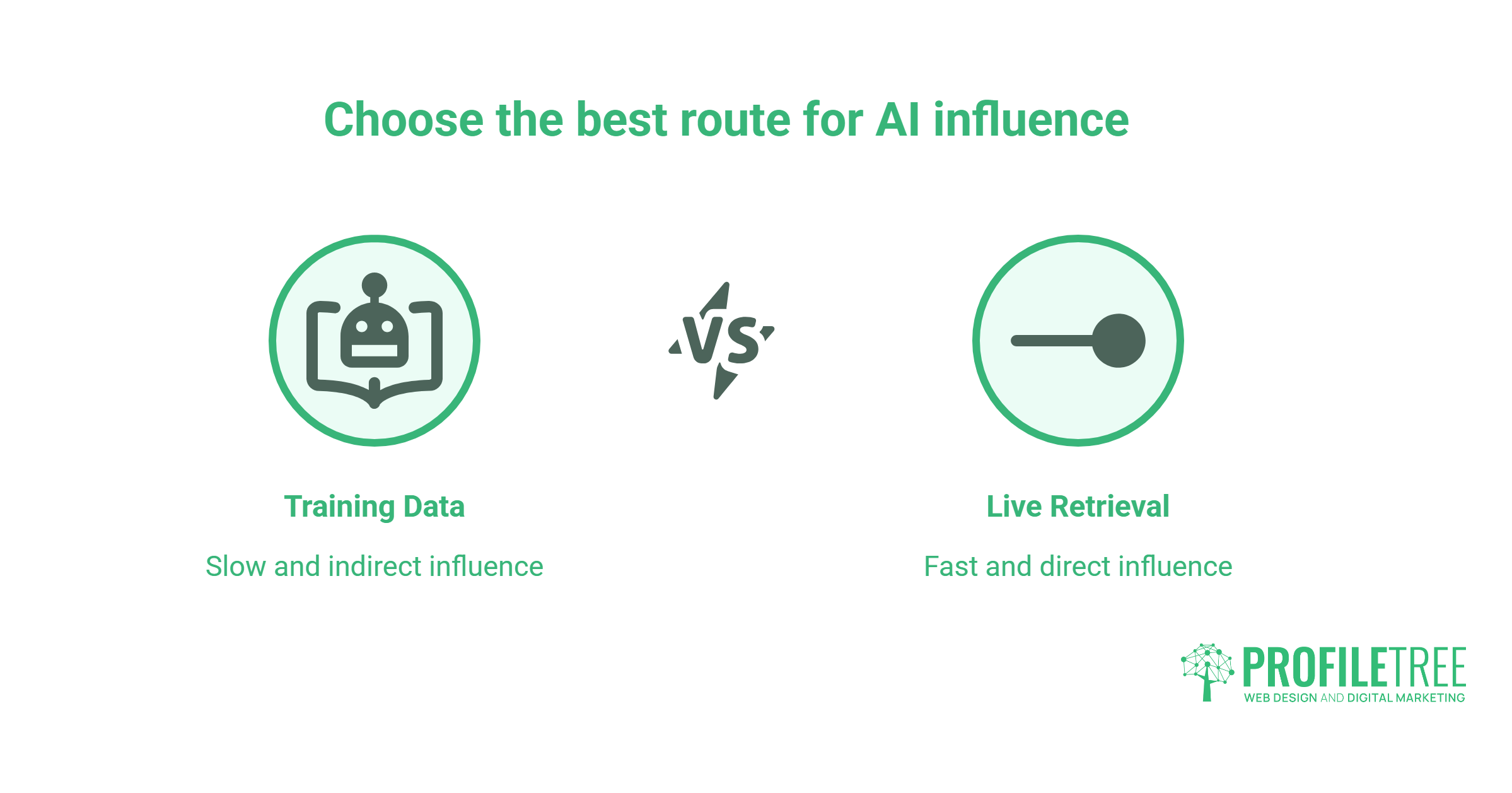
Every AI system that can answer a question about a business does so through one of two routes, and both need different things from a website.
Training data. Large language models learn general knowledge from a huge snapshot of text gathered up to a fixed point, then answer from that learned pattern without checking the live web. A model answering purely from training data cannot know about a business that launched last month, and will not reflect a change made to a website yesterday. Influencing this route is slow and indirect. It depends on a consistent, well-documented presence across the web (your own site, directories, press coverage, and reference sources) held long enough and consistently enough to be absorbed into a future training run.
Live retrieval. This is what happens when Google’s AI Overviews run a search behind the scenes before writing an answer, when ChatGPT Search or Perplexity fetch current pages, or when Copilot draws on a live Bing search. It works far more like classic SEO: the system searches, retrieves candidate pages, and picks passages from them, with a citation attached. This is the route you can influence in the near term because it depends on the crawlability, indexability, and content quality that always mattered, applied with a sharper focus on how cleanly a specific passage can be lifted out of a page.
Knowing which route is in play changes what to expect. A brand new company will not talk its way into a model’s trained knowledge quickly, no matter how good its website is. It can get picked up in live retrieval within weeks, the same way a new page can rank in classic search, provided the content is genuinely citeable. ProfileTree’s wider generative engine optimisation work is built around that distinction: strengthening live retrieval while trained-data presence builds slowly in the background.
What Actually Influences Whether You Get Cited
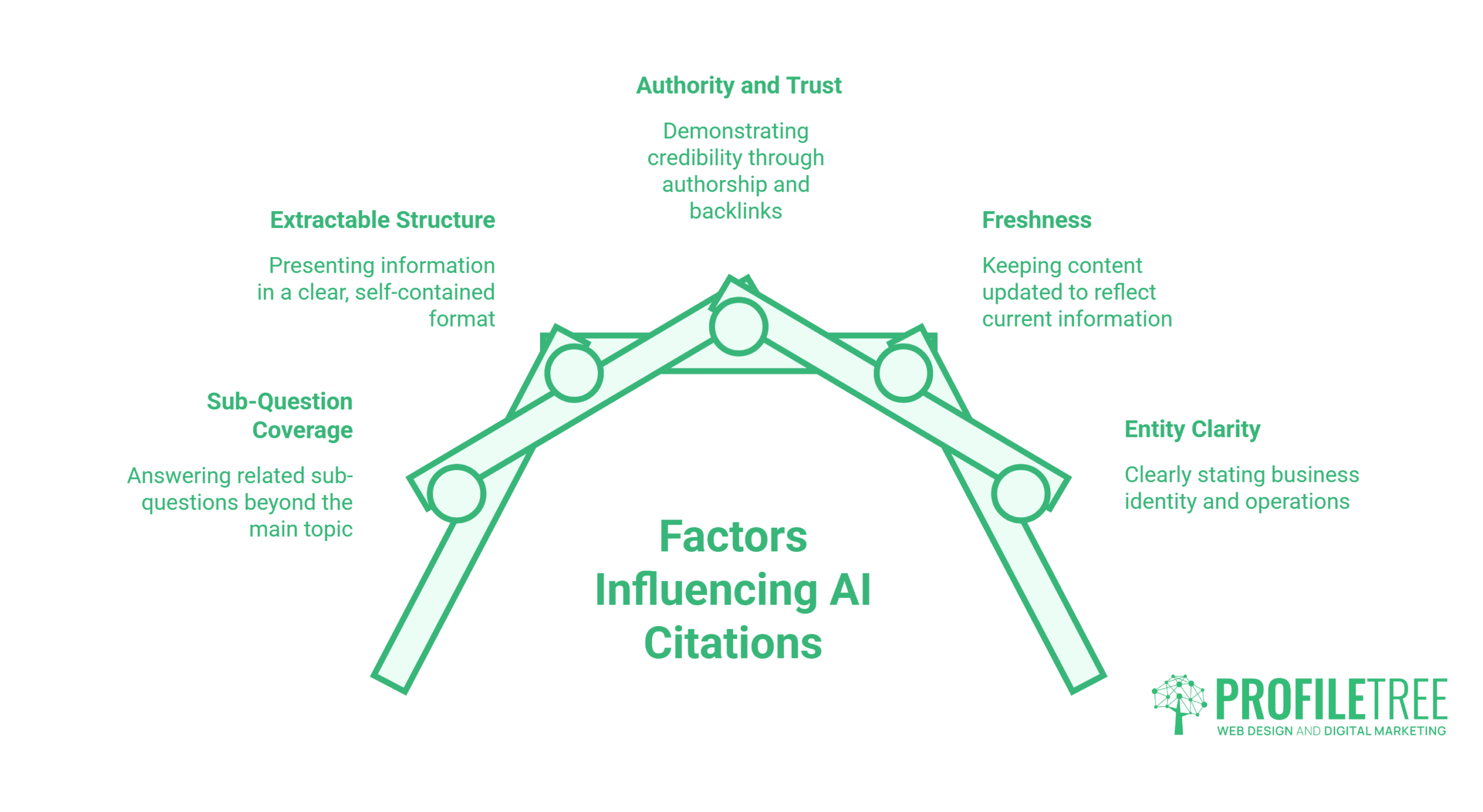
Five things show up consistently across independent analyses of AI Overviews, ChatGPT and Perplexity citations, and all five are things a business can act on.
Answering the Sub-question, not Just the Topic
When a model receives a query, it typically breaks it into several related sub-questions before searching, a process often called query fan-out. A page that only answers the headline question misses the citations available for the adjacent ones, which is why pages covering a topic and its natural offshoots in one place tend to earn more citations than several thin pages each chasing one narrow angle. This changes how keyword research feeds into content planning: the unit of work is a question cluster, not a phrase.
Extractable, Answer-first Structure
AI systems are not reading a page the way a person does. They are pulling short, self-contained passages that can stand alone as a quote. A section opening with a direct two- or three-sentence answer, then supporting detail, gives a system something clean to lift. A section opening with a preamble and burying the answer three paragraphs down gives it very little, even when the information is accurate.
Authority and Trust Signalling
At page and site level: a named author with a real, linked bio, a visible publication or update date, sources cited for any claim that needs one, and a domain with genuine backlinks and mentions from other relevant sites. Strong conventional SEO remains the most reliable foundation, since a page that ranks nowhere is rarely retrieved, though recent analyses suggest a growing share of AI Overview citations now come from pages outside the organic top ten. Treat a strong ranking as a significant advantage rather than a strict precondition.
Freshness
Content meaningfully updated recently, not just re-stamped with a new date, tends to be favoured for queries where the answer can plausibly move, which covers most commercial and how-to topics. A page untouched for two years is a weaker citation candidate than a recently reviewed equivalent covering the same ground.
Entity Clarity
A fifth factor worth naming separately, because it gets confused with the others. It means how plainly a page states who a business is, where it operates and what it does. Repeating a town name across a page adds nothing. What works is a single plain sentence, something equivalent to “this is a Belfast-based agency working across Northern Ireland, Ireland and the wider UK”, so a system has something concrete to attach a citation to rather than having to infer it. Schema markup supports this technically, but the plain-language version on the page matters just as much, because a system extracting a passage is reading the sentence, not the markup behind it.
What Doesn’t Influence It (The Honest Bit)
The most common claim made to businesses right now is that adding an llms.txt file, a short text file at the root of a site meant to summarise its content for AI systems, will improve how often that business gets cited. The evidence does not support that claim, at least not yet.
SE Ranking analysed nearly 300,000 domains and found no correlation between having an llms.txt file and being cited more often by large language models. Removing llms.txt from their predictive model actually improved its accuracy, meaning the file was contributing noise rather than signal. Only 10.13% of domains in that dataset had one at all.
Crawler data points the same way. Ahrefs examined server logs and traffic across 137,210 domains, around 38,000 of which had a valid llms.txt file. In May 2026, 97% of those files received zero requests, and among the small share that did see traffic, many requests did not come from AI search systems. Google’s search team has said directly that AI Overviews and AI Mode do not use llms.txt as a ranking or citation input, and OpenAI has never confirmed that ChatGPT uses it.
None of this makes the file harmful. It is low effort to add and may matter more as AI agents mature. Google’s own team has been cautious in public: in late 2025, an llms.txt file briefly appeared on Google’s Search Central documentation site, was noticed by SEO commentators within days, then quietly disappeared, which reads more like an internal experiment than a signal that the format is about to become a ranking factor.
A business paying an agency specifically for llms.txt implementation, on the promise it will move citation numbers, is paying for something the current evidence does not back up. Extractable structure, real authority signals, topic coverage, and freshness are what actually move the numbers.
Try it Yourself in 10 Minutes
Before you get in touch, three things will tell you roughly where you stand.
1. Ask the assistants what they say about you. Write down five questions a customer would actually type, in their words rather than yours, then run each one through ChatGPT, Google AI Overviews, and Perplexity. Note whether your business appears in the answer, appears in the cited sources, or is absent entirely. Absent from all three is the normal starting point.
2. Check whether the crawlers can get in. Open yourdomain.com/robots.txt in a browser and look for any rule blocking GPTBot, OAI-SearchBot, PerplexityBot, or ClaudeBot. Then load one of your key pages with JavaScript disabled. If the main body text disappears, most retrieval systems are seeing an empty page.
3. Read your best page as a machine would. Take the page you most want cited and read only the first two sentences under each heading. If those sentences answer the heading on their own, the page is extractable. If they set up an answer that arrives three paragraphs later, it is not, and that single fix is usually the fastest improvement available.
The 12-point AI Visibility Checklist
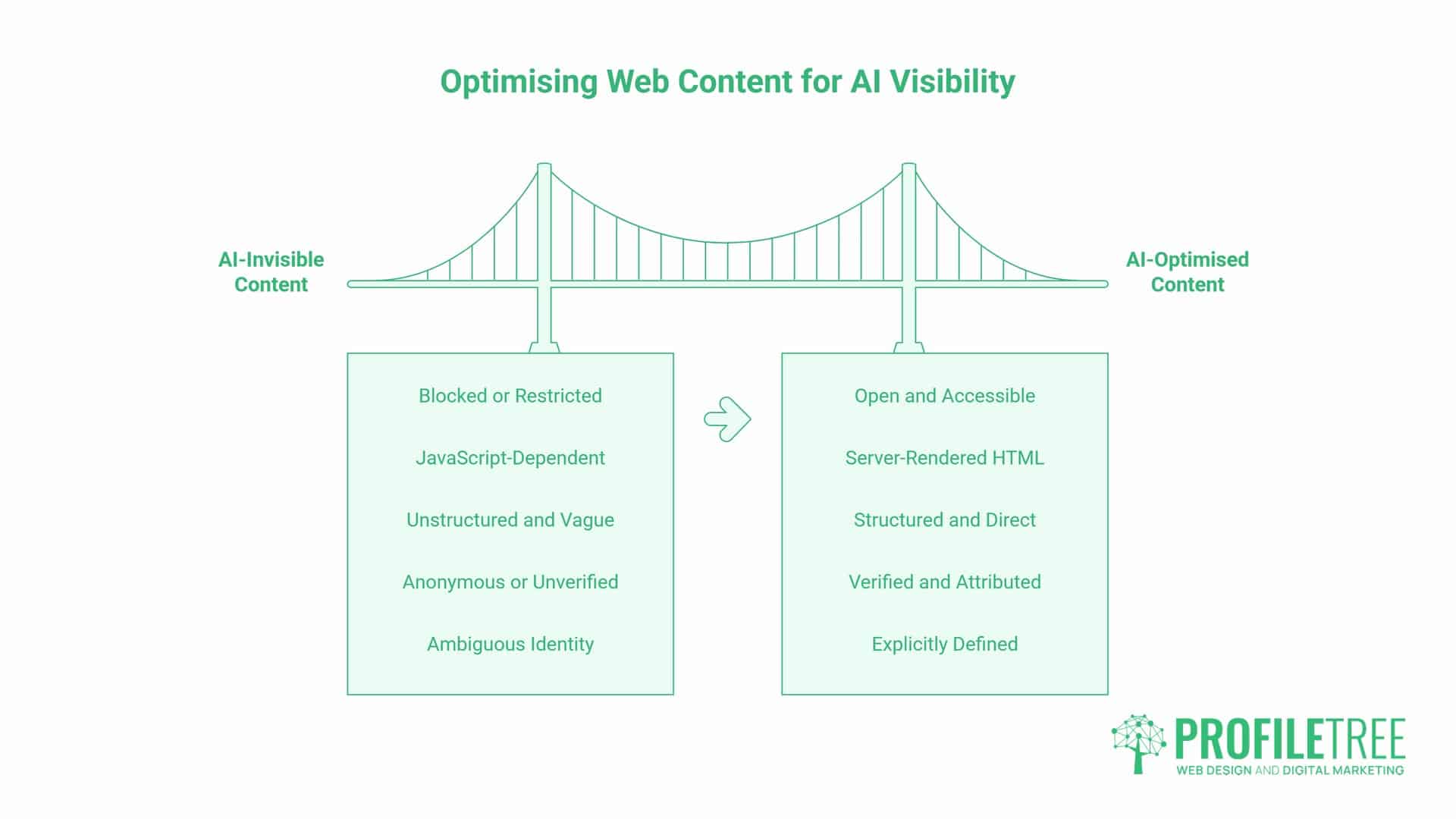
These are the twelve checks we go through with you in the free session: four questions, three checks each, with a way to test each one yourself.
Can an AI system reach the page?
1. AI crawlers are not blocked in robots.txt. Many sites block AI user agents by default, either through a security plugin or a decision taken before AI search mattered. A blanket block removes the page from live retrieval entirely, no matter how good it is. Decide deliberately which agents you allow rather than inheriting somebody else’s default.
How to check it yourself: open yourdomain.com/robots.txt and search for GPTBot, OAI-SearchBot, PerplexityBot and ClaudeBot.
2. Main content is in server-rendered HTML, not JavaScript only. Retrieval systems are far less patient than Googlebot about executing JavaScript. If your text is injected client-side, the crawler may receive a shell with navigation and nothing to quote. Page builders and single-page frameworks are the usual culprits on otherwise healthy sites.
How to check it yourself: right-click, View Page Source, and use Ctrl+F to find a sentence from the middle of your article.
3. The page is indexed and ranking somewhere for its topic. Retrieval starts from a search. A page that is not indexed cannot be retrieved, and a page ranking nowhere is rarely surfaced as a candidate. It does not need to be in the top three, but it needs to exist in the results for its own subject.
How to check it yourself: search site:yourdomain.com plus the page topic, then check its position in Search Console.
Can it extract a clean answer?
4. One primary question per page, stated in the title, the H1 and the opening two sentences. Systems match a page to a sub-question. When one page hedges across three questions, it matches none of them well, and when three of your pages chase one query, they compete with each other. One question, stated immediately and repeated in the same words, is what gets matched.
How to check it yourself: read your title, H1, and first two sentences. Do they name the same question?
5. Every section opens with a direct two- or three-sentence answer before the supporting detail. This is the single highest-value structural change on most pages. The opening sentences under a heading are what gets lifted and quoted. Detail, nuance and examples still belong on the page, just underneath the answer rather than in front of it.
How to check it yourself: read only the first two sentences under each heading and see whether they stand alone.
6. Headings appear every 200 to 300 words and are phrased as real questions. Long unbroken passages give a system no clean boundary to cut on, so it either takes too much or skips the page. Question-phrased headings also match the sub-questions generated during query fan-out more closely than noun-phrase headings do.
How to check it yourself: scroll the page and look for any stretch of text running past 300 words without a heading.
7. The page covers the adjacent sub-questions, not only the headline one. A single query typically fans out into several related questions before any search happens. Covering those follow-ups on the same page earns citations the headline answer alone would miss, and keeps you from splitting authority across several thin pages.
How to check it yourself: check the People Also Ask box and the assistants’ follow-up suggestions for your main query.
Can it trust the source?
8. A named author with a real, linked bio. Anonymous content and “admin” bylines give a system nothing to weigh. A named author with a bio page, a role, relevant experience and links to a professional profile elsewhere provides a checkable signal that a real person stands behind the claims on the page.
How to check it yourself: click your own byline and see where it goes, if anywhere.
9. A named reviewer for anything requiring subject expertise. Where a topic touches money, health, law, or technical risk, a separate named reviewer with relevant credentials strengthens the page considerably. The reviewer should be a real second person who actually read it, shown with their role and the date they reviewed it.
How to check it yourself: look for a reviewer line distinct from the author on your most sensitive pages.
10. A visible update date backed by a genuine content change. Freshness helps, but a silently re-stamped date is not freshness. The date should reflect a real revision, ideally with a short note saying what changed. Pages left untouched for two years should be genuinely reviewed, not redated.
How to check it yourself: compare the displayed date against your WordPress revision history.
11. Every factual claim attributed to a named, checkable source. Unsourced statistics are the fastest way to be passed over, and the fastest way to lose a reader who checks. Name the organisation and the timeframe in the sentence itself, so the attribution survives when a system lifts the passage out of the page.
How to check it yourself: highlight every number on the page and confirm each one names its source.
Can it tell the answer is about you?
12. One plain sentence stating who the business is, where it operates, and what it does, supported by Organisation, Article, and FAQPage schema. Without it, a system may use your content and credit nobody, or attach it to the wrong entity. Write the sentence in plain language on the page, then mirror it in structured data.
How to check it yourself: run the page through Google’s Rich Results Test and look for the sentence in your own copy.
What Happens After You Get in Touch
We run the twelve checks on this page against your key pages before we speak, so the session starts with findings rather than a questionnaire. Then we go through them with you, one-to-one.
That conversation covers three things: which of the twelve points your pages fail, which of your pages are closest to a citation already (usually the ones ranking between positions 8 and 25 that fail only on extractability), and the order to fix them in, because opening up crawler access on a page nobody can lift an answer from achieves nothing on its own.
“Nearly every site we check has the same problem, and it isn’t technical. The content is good, it just isn’t written in a way a machine can lift a clean answer out of. That’s a rewrite of the opening lines under each heading, not a rebuild.” Ciaran Connolly, Founder of ProfileTree
Most businesses do not need a rebuild. They need the top ten pages restructured, an author and reviewer model applied, and entity clarity written into the pages that already earn impressions. If that is the whole job, we will say so.
Where you want the fuller picture, the full AI visibility audit goes further than the twelve points. It samples how ChatGPT, Copilot, Gemini and Perplexity actually answer questions about your business, checks your brand details for consistency across the web, sets a Bing citation baseline and delivers a sequenced fix list. A short AI visibility check costs £300 to £600 and the full six-layer audit £800 to £1,200.
How to Measure Any of This
Measurement for AI SEO runs alongside classic reporting rather than replacing it because a growing share of searches now end in an answer the user never clicks through from.
What does Search Console show now?
Google Search Console remains the starting point, and it finally reports on AI surfaces directly. On 3 June 2026, Google launched a dedicated generative AI performance view covering AI Overviews, AI Mode and Discover’s AI features, isolating data that was previously folded into overall Web Search totals with no way to separate it. It shows impressions only, broken down by page, country, device and date. There are no clicks, no queries, and no average position yet, though Google has said more metrics will follow. The rollout began with a subset of UK sites at the CMA’s prompting and is expanding, so if the view has not appeared on your property yet, it is coming.
Classic Search Console data still matters alongside it. Impressions, position, and the queries a page appears for show whether it is climbing, even before it earns a click, and a page moving from position 60 to position 20 is genuine progress worth tracking.
What does Bing’s AI Performance report add?
Bing Webmaster Tools has gone further. Microsoft got there first and still reports more. Its AI Performance report, introduced as a public preview in February 2026 and expanded globally in June 2026 with Intents, Topics, Citation Share, and Compare, shows how often a site is cited across Copilot, AI summaries in Bing, and partner experiences, which pages are used and which queries trigger the citations. That query-level view is the part Google’s report does not yet offer, which is why running both is worth the setup time. It is free once a site is verified. Teams tracking this across several client sites will want a dedicated tool alongside both dashboards, since neither report covers every assistant.
What should you still check by hand?
Beyond the dashboards, manual spot-checks matter. Running a fixed set of ten to twenty real customer questions through ChatGPT, AI Overviews, and Perplexity each month, and noting whether you appear in the answer or its sources, gives a trend line automated tools will not show, and it covers the assistants neither dashboard reports on. The last signal worth tracking is branded search lift. A rise in people searching for the business by name in the weeks after it starts appearing in AI answers, visible in Search Console’s branded query data, which suggests the citation is reaching people rather than going unseen.
How a Business Gets Started
The starting point is an audit, not a rewrite. Before changing anything, it is worth establishing where you stand in both classic search and AI answers, which is what a full AI visibility audit covers: technical health, current citation presence, and the gap between the two.
From there, the right next step depends on where you are based. Businesses across Northern Ireland benefit from a strategy built around the region’s search patterns and its position between the UK and Irish markets, which is the focus of our AI SEO work in Northern Ireland. Businesses in the Republic weighing up a partner for the first time may find it useful to see how to choose an AI SEO partner in Ireland, covering what a genuine local partner should be able to show against a generic offshore provider. Dublin businesses face a dense local market where Map Pack visibility still sits alongside the AI picture, which is what our work with SEO agencies in Dublin addresses.
None of it needs to happen at once, and it rarely makes sense to rewrite a site in one go. Most businesses see the clearest early wins from fixing extractability and authority on existing best-performing pages before expanding into new content, since a page already ranking reasonably well is usually the fastest route to a first citation. A realistic order is: audit, then fix the pages closest to citation, then expand topic coverage. Doing all three at once tends to produce slower and harder-to-measure progress than working through them in sequence.
Ready to See Where Your Site Stands?
You have read what the twelve points check for. Leave your details below and we will run them against your pages, then go through what fails with you, one-to-one and in the order worth fixing.
FAQs About AI SEO
Short answers to the questions businesses ask us most about AI SEO.
What is AI SEO?
AI SEO is optimising a website so it can be found by both classic search engines and AI systems, including AI Overviews, ChatGPT, Copilot, and Perplexity. It builds on the same fundamentals as traditional SEO, with extra emphasis on structuring answers an AI system can extract and cite cleanly.
How do I appear in ChatGPT’s answers?
Mainly through live retrieval: ChatGPT Search fetches current pages and cites passages from them, so crawlability, clear structure, and genuine authority all apply. Write direct, self-contained answers near the top of each section and keep the content genuinely current.
Is AI SEO different from normal SEO, or is it just a buzzword?
The answer is a bit of both. The underlying work is the discipline SEO has always been, so anyone claiming a brand new field is overselling it. What is new is the destination, and writing content that works as a standalone citeable answer does call for real changes to how pages open, how sections are structured and how claims are sourced.
Is AI SEO the same as GEO, AEO and AI search optimisation?
Yes, in practice they describe the same work. AI SEO, generative engine optimisation (GEO), answer engine optimisation (AEO) and AI search optimisation all mean structuring content so AI systems can retrieve and cite it. The labels come from different corners of the industry and none of them describes a separate service. Pick one and use it consistently, and treat an agency that sells them as four different products with some caution.
How do I choose an AI SEO agency?
Judge on evidence rather than claims. Ask to see citation tracking from Bing’s AI Performance report for the agency’s own site or a client’s, named authors with real bios on the agency’s own content, and statistics that name their source. Ask what they would do first on your site and why, and expect an answer that starts with an audit rather than a rewrite. An agency selling llms.txt implementation as a citation strategy is a reliable warning sign, because the current evidence does not support it.
Do I need to add an llms.txt file to get cited?
No, not on current evidence. SE Ranking found no measurable link across nearly 300,000 domains, Ahrefs found 97% of published files received zero requests in May 2026, and Google has said it does not use the file. Low risk to add, not a strategy to buy.
Does AI SEO work differently for a local business?
The mechanics are the same, but entity clarity does more of the work. An assistant answering a location-specific question needs a plain statement on the page of where you operate and which areas you serve, backed by consistent business details across directories and your Google Business Profile. A local firm with that in place is easier to cite than a larger competitor whose pages never say where they are. Our guide to AI search visibility for local businesses covers the specifics.
How do I measure whether any of this is working?
Track three things together: Search Console impressions and positions, Bing Webmaster Tools’ AI Performance report, and monthly manual spot-checks of a fixed question set. A rise in branded search volume afterwards suggests the visibility is reaching people.
Can AI tools such as ChatGPT do your SEO for you?
Parts of it, and those parts are worth automating. AI tools handle keyword clustering, first drafts, technical audits and reporting well, and they take hours out of the routine work. What they do not do is decide which pages deserve to exist, verify a claim against a source, or judge whether a paragraph would persuade a real customer, and that is where rankings are won or lost. A tool left to run without oversight also produces the uniform, unsourced content that Google’s recent updates have marked down. If your team wants to use these tools well, our AI training for business covers where the line sits.
Is SEO still worth it now that AI answers so many questions?
Yes, for a practical reason: AI systems retrieve their sources from search indexes, so a page that ranks nowhere is rarely retrieved and rarely cited. The work that earns a ranking, sound technical health, useful content and real authority, is the same work that gets a page into an AI answer. What has changed is where the payoff shows up, since some of it now arrives as a citation rather than a click, which is why measurement needs both Search Console and Bing’s AI Performance report. Our search engine optimisation service is built on that basis.