
AI to Optimise Inventory Management: A UK & Irish SME Guide
Table of Contents
Most businesses that struggle with inventory don’t have a data problem. They have a decision-making problem: too much information arriving too slowly, acted on too late. AI changes that equation.
Using AI to optimise inventory management means applying machine learning and predictive analytics to the daily decisions that determine whether stock levels match demand. For SMEs across Northern Ireland, Ireland, and the UK, that translates directly into fewer stockouts, less capital tied up in excess goods, and supply chains that recover faster when things go wrong.
This guide explains how AI-driven inventory management works, what your business needs before investing, and how to build a practical roadmap toward implementation.
What Is AI-Driven Inventory Optimisation?
Traditional inventory management relies on fixed reorder points and manual adjustments. When sales spike or a supplier delays, the response is reactive; someone notices the problem, raises a purchase order, and waits. AI replaces that cycle with continuous, data-driven prediction.
At its core, AI inventory optimisation uses machine learning algorithms trained on historical sales data, supplier lead times, seasonal patterns, and external signals such as weather or market shifts. The system automatically generates demand forecasts and suggested order quantities, updating them as new data arrives.
Machine Learning vs. Rule-Based Systems
Rule-based systems apply fixed logic: if the stock drops below 200 units, order 500 more. That works when demand is stable. When it isn’t — when a promotion, a competitor going out of stock, or a supply disruption hits — fixed rules fail.
Machine learning models adapt. They recognise that your January figures are structurally different from your October figures, that one supplier’s lead time is deteriorating, and that certain product combinations sell together. That adaptability is the core advantage of AI to optimise inventory management over traditional methods.
The Shift From Reactive to Predictive
The practical difference is timing. A reactive system tells you that you’ve run out of stock. A predictive system tells you three weeks in advance that you’re likely to, and recommends a course of action before the gap opens. For UK and Irish SMEs operating with lean teams, that shift from firefighting to planning is often the most valuable thing AI delivers.
The Core Pillars of AI Inventory Success
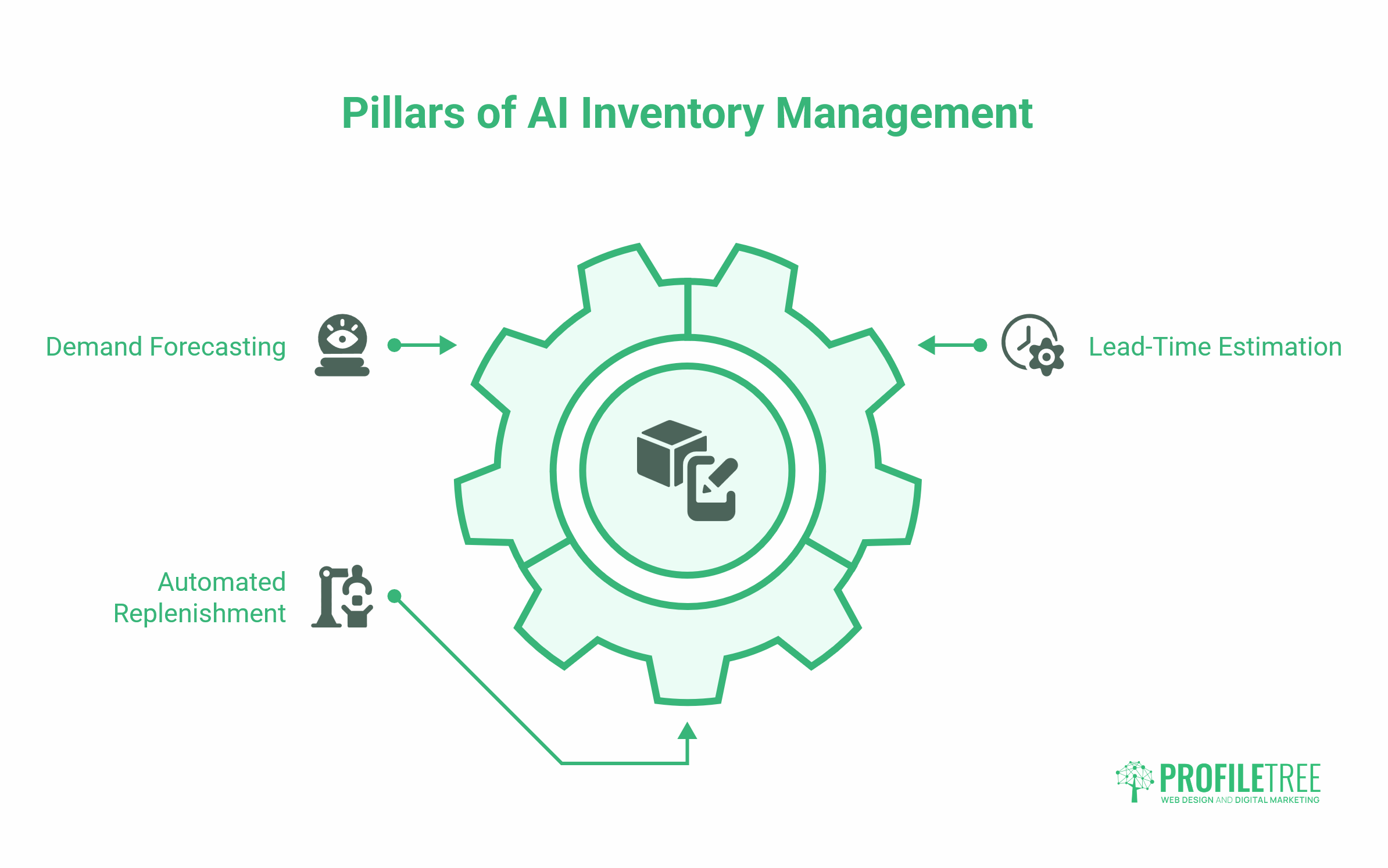
Effective AI inventory management relies on three technical capabilities working together: demand forecasting, lead-time estimation, and automated replenishment. Understanding each one helps businesses identify where the greatest gains lie.
Demand Forecasting and Predictive Analytics
Demand forecasting is where most AI inventory projects begin. Machine learning models analyse historical sales alongside contextual variables, promotional calendars, competitor activity, weather data, and economic indicators — to project future demand at the SKU level.
Accuracy matters here far more than speed. A forecast that’s directionally right but consistently 20% off creates the same cash flow problems as manual guesswork. Better AI systems achieve mean absolute percentage errors (MAPEs) in the 10–15% range for stable product categories, compared with 25–40% for standard spreadsheet forecasting.
For SMEs considering AI-driven forecasting, a minimum of 12–24 months of clean historical sales data per SKU is the practical starting point. Products with fewer than 12 months of data can still be modelled, but with wider confidence intervals.
Dynamic Lead Time Estimation
Most businesses calculate reorder points using average supplier lead times. Average lead times conceal the variation that causes stockouts. If a supplier delivers on average in 7 days but ranges from 4 to 14 days, ordering based on 7 days will result in regular shortfalls.
AI models track lead-time variability by supplier, product category, and time of year. That allows safety stock calculations to reflect genuine uncertainty rather than an optimistic average. For businesses sourcing across the Irish Sea under the Windsor Framework, where GB-to-NI movements require additional documentation and may involve delays, this capability is particularly relevant. AI can factor in the structural variability of cross-border supply into stock planning in a way that manual methods simply cannot.
Automated Replenishment and Safety Stock Logic
Automated replenishment uses AI-generated demand forecasts and lead-time estimates to trigger purchase orders for routine lines without manual intervention. Buyers review exceptions — items flagged as anomalous, high-value, or subject to strategic decisions — rather than processing every order from scratch.
Safety stock levels are recalculated dynamically rather than set once and forgotten. As demand patterns shift seasonally or in response to market conditions, the system adjusts the buffer accordingly. The result is capital deployed where risk actually sits, not uniformly spread across all SKUs regardless of their volatility.
The UK and Irish Context: Why Localisation Matters
Global AI inventory guides assume a frictionless supply chain operating in a single regulatory and currency environment. UK and Irish SMEs operate in a more complex reality, and that complexity shapes how AI should be configured.
Navigating the Windsor Framework and NI/GB Trade
Businesses moving goods between Great Britain and Northern Ireland operate under the Windsor Framework, which requires documentation and checks that add time and uncertainty to previously seamless supply chains. AI inventory systems can be configured to treat GB-to-NI and NI-to-GB movements as distinct supply routes with separate lead time distributions and risk profiles.
In practice, this means holding different safety stock levels for NI operations than for GB distribution, building in a buffer for documentation delays, and flagging at-risk SKUs where the cost of a stockout is disproportionate. Businesses that have configured their AI systems to reflect Windsor Framework realities report significantly fewer unplanned shortfalls in NI-facing operations than those applying a single UK-wide model.
Managing GBP/EUR Volatility in Purchasing Decisions
Businesses sourcing from the Republic of Ireland or the EU, or paying for goods in euros while selling in sterling, face currency risk that feeds directly into inventory costs. AI systems with currency integration can adjust suggested order quantities based on exchange rate forecasts, bringing forward purchases when sterling is strong and trimming order sizes when it weakens.
This isn’t speculation; it’s a systematic application of data that most SMEs already have access to but rarely feed into their purchasing decisions.
Energy and Warehousing Efficiency
UK warehousing costs have risen sharply since 2022. Energy represents a growing share of operational overhead, and AI can help reduce it. By optimising storage layouts based on pick-frequency data, AI reduces unnecessary travel for warehouse staff and robots. Demand-driven ordering that keeps stock levels lean reduces the volume requiring temperature or climate-controlled storage. For businesses with ESG reporting obligations, AI-driven stock efficiency is a legitimate sustainability lever — fewer returns, less obsolescence, lower transportation intensity per unit sold.
Data Readiness: Is Your Business Ready for AI?
The most common reason AI inventory projects underdeliver is dirty data, not bad software. Before selecting a platform, assess whether your data foundation is solid enough to support machine learning.
The Minimum Viable Data Checklist
To start producing reliable AI-driven forecasts, a business typically needs:
- At least 12 months of transactional sales data at the SKU level, including quantities, dates, and channels
- Supplier records showing historical lead times per product and per supplier
- Stockout and back-order records (to identify where historical data is suppressed by unavailability rather than absent demand)
- Promotional and pricing history, so the model can distinguish promotion-driven spikes from the underlying trend
- Returns data to avoid training models on gross sales figures that overstate demand
A business with 2 years of clean data across these categories is well-positioned to implement AI to optimise inventory management. A business with inconsistent product codes, unrecorded stockouts, and no promotional history will need a data cleaning phase before any AI investment makes sense.
Cleaning Legacy ERP Data for Machine Learning
Most SMEs running ERP systems have years of data that was entered inconsistently, product codes changed, categories reorganised, stockouts not recorded, and manual adjustments made without notes. Before feeding this data into a machine learning model, it needs to be normalised.
That process typically involves: standardising product identifiers across time periods, flagging and imputing periods of confirmed stockout, removing anomalous entries caused by data entry errors, and separating promotional periods from baseline. It’s not glamorous work, but it determines whether the AI model learns from reality or from artefacts. ProfileTree’s AI implementation services include data readiness assessments as part of project scoping — identifying exactly what preparation is needed before a business commits to platform costs.
The Buyer’s Trust Problem
One issue almost no vendor documentation addresses: buyers often override AI recommendations. When a system says “order 400 units” and the buyer has a gut feeling the market is softening, they order 200. Sometimes they’re right. More often, the pattern erodes the value of the AI investment.
The solution isn’t blind trust in the algorithm; it’s augmented intelligence. The best implementations treat AI as a co-pilot: the system makes a recommendation, the buyer reviews the reasoning (which data inputs drove the suggestion, how confident the model is, and the cost of being wrong in each direction), and overrides with a recorded reason. Over time, those override reasons inform model improvement. Businesses that build this feedback loop in from the start see markedly better outcomes than those that deploy AI as a black box.
Implementation Roadmap: A Five-Step Framework
Moving from spreadsheets or basic ERP to AI-driven inventory management doesn’t require a big-bang transformation. Most SMEs find a phased approach less disruptive and easier to build internal confidence around.
Step 1: Define Your North Star Metric
Before selecting software, decide what success looks like. Is the primary goal reducing excess stock and freeing cash? Eliminating stockouts on key lines? Reducing purchasing team workload? Different goals lead to different configuration choices. A business optimising for service level will carry more safety stock than one optimising for working capital — and an AI system needs to know which it’s serving.
Step 2: Audit and Clean Your Data
Run the minimum viable data checklist. Identify gaps and inconsistencies. Budget time for data remediation before the implementation timeline starts. Skipping this step is the single most common cause of failed AI inventory projects.
Step 3: Start With Your Highest-Impact SKUs
Don’t start by applying AI to your entire catalogue. Start with the 20% of SKUs that account for 80% of your revenue, or the SKUs that cause your most persistent stockouts and overstock problems. Build confidence and refine the model configuration on lines where the stakes are clear and the feedback loop is short.
Step 4: Integrate With Existing Systems
AI inventory tools need clean data feeds from your ERP, your e-commerce platform, and your supplier portals. Integration quality determines model quality. Before committing to a platform, verify that the integration with your existing stack is mature and well-documented, not a custom build that will create dependency on a single developer. ProfileTree’s web development team supports ERP and platform integrations for SMEs implementing AI tools across their operations.
Step 5: Upskill Your Buying Team
AI changes the buying role, not eliminates it. Buyers need to understand how to interpret model outputs, when to override with justification, and how to identify when the model is behaving unexpectedly (which often signals a data quality issue upstream). Investing in training at the point of implementation — rather than dropping a new system on a team without context — is the difference between adoption and resistance. ProfileTree’s digital training programmes cover AI literacy for operational teams, including practical sessions on working with AI-driven decision tools.
AI Inventory Tools for SMEs: Choosing the Right Fit
The platform market has matured enough that SMEs no longer need enterprise-scale budgets to access AI inventory tools. The practical question is how to match the capability to the business size and existing systems.
SaaS Platforms for Growing Businesses
Cloud-based tools such as Inventory Planner, Cin7, and Linnworks offer AI-assisted forecasting and automated replenishment at monthly subscription costs that scale with SKU volume. Most integrate with common e-commerce and accounting platforms. They work well for businesses with standard inventory patterns, where supply chains are genuinely complex — multiple sourcing countries, significant cross-border movement — entry-level SaaS forecasting may require more manual oversight than the marketing suggests.
Mid-Market and ERP-Integrated Options
Businesses with a turnover of roughly £ 5 m or 5,000 SKUs typically benefit from AI modules built into existing ERP systems such as NetSuite, SAP Business One, or Microsoft Dynamics 365. Integration with financial and warehouse data is tighter, but implementation costs and timelines are substantially higher than those of standalone SaaS tools.
What to Look for Before Committing
Three things determine whether a platform will deliver value in practice: clean data integration without manual preparation on each import; explainability, so buyers can see why a recommendation was made; and override tracking, so human interventions feed back into model refinement rather than being discarded as noise.
Measuring Success: ROI and Key Metrics
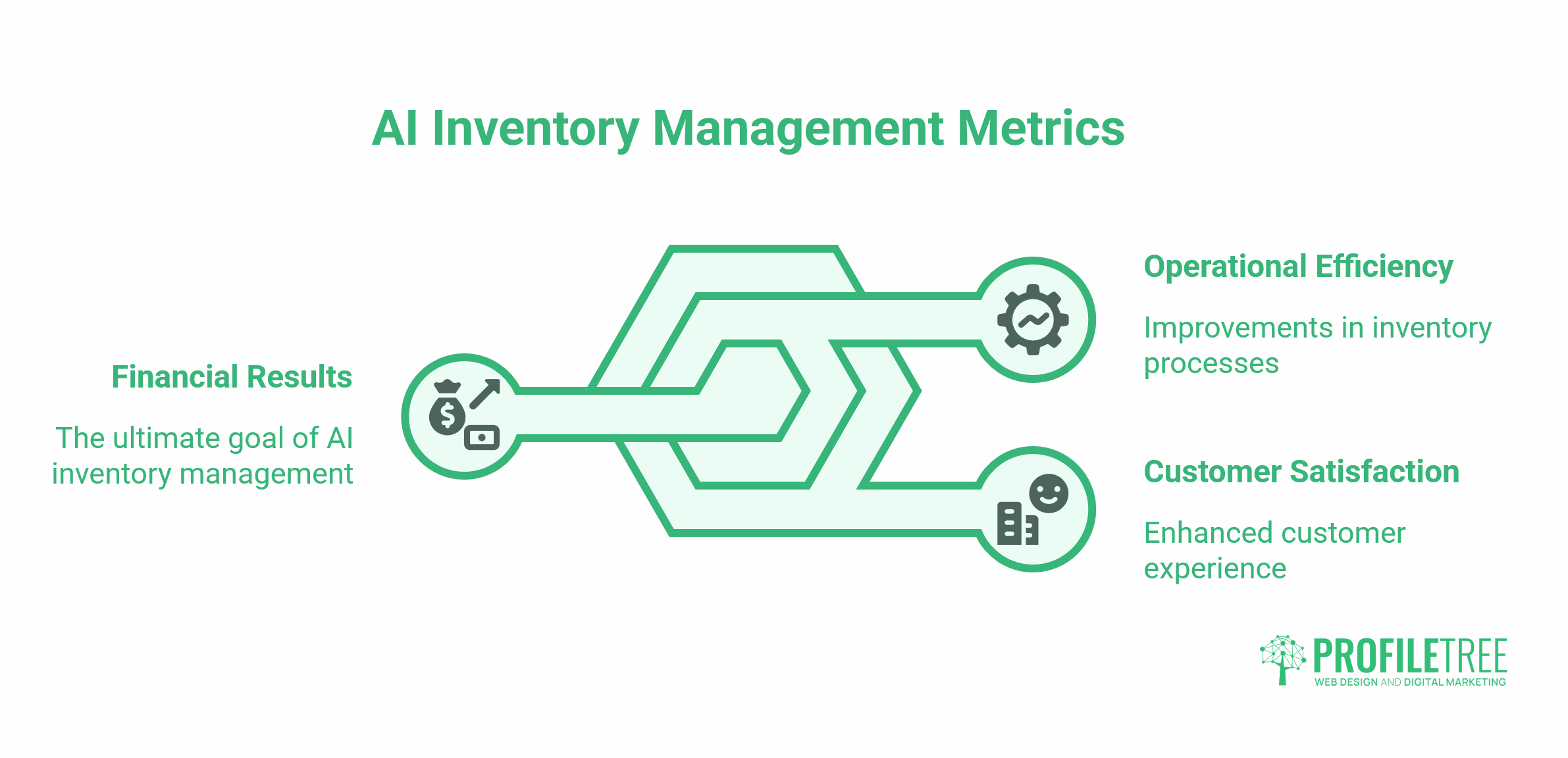
AI inventory management should produce measurable financial outcomes within 6–12 months of full implementation. The metrics worth tracking fall into three categories.
Working capital impact is the most direct: track inventory value as a percentage of revenue before and after implementation. Businesses typically see a 10–30% reduction in excess stock within the first year, with the greatest gains in seasonal and promotional categories where manual forecasting is least reliable.
Service-level metrics track the flip side: fill rate (the proportion of orders fulfilled from available stock), stockout frequency on key lines, and backorder rates. These should improve in parallel with working capital — if they don’t, the system has been calibrated too aggressively toward leanness at the cost of availability.
Operational efficiency gains are harder to quantify but real: reduced purchasing team time on routine order processing, fewer emergency orders at premium freight rates, and lower write-off costs from obsolete or expired stock.
For UK SMEs with ESG reporting requirements, AI-driven reductions in returns and obsolescence can be reported as material scope 3 emissions reductions — a growing requirement for businesses in retail, manufacturing, and distribution supply chains.
Conclusion
AI to optimise inventory management is no longer a capability reserved for large enterprises with dedicated data science teams. Cloud-based platforms have made it accessible at the SME scale, and the ROI case — reduced working capital, fewer stockouts, leaner operations — is well established. The businesses that see the best results start with clean data, define clear success metrics, and build human oversight into the process from day one. If you’re assessing whether your business is ready to make that move, get in touch with ProfileTree’s team for a practical conversation about where to start.
FAQs
How much data does a business need before AI inventory management will work?
A minimum of 12 months of transactional sales data at the SKU level is the practical starting point, though 24 months produces more reliable seasonal forecasting. Consistent product codes, recorded stockouts, and separable promotional history are equally important.
Does AI inventory management replace buyers and procurement staff?
No. Routine order processing on stable lines can be automated, but buyers remain essential for exception handling, supplier relationships, and situations where contextual judgement outweighs what the data captures.
Can AI help manage inventory across the GB/NI border under the Windsor Framework?
Yes. AI systems can be configured to treat GB-to-NI movements as a distinct supply route with its own lead time distribution, allowing businesses to hold appropriately calibrated safety stock for NI operations rather than applying a single UK-wide model.
What does it typically cost to implement AI-driven inventory management for an SME?
Cloud-based SaaS platforms typically range from £300 to £2,000 per month, depending on SKU volume and integration complexity. Most SMEs with turnover above £1m will find a viable option within that tier; enterprise custom builds sit at a different scale entirely.