
Camera Gear for Vloggers: Choosing the Right Equipment
Table of Contents
Getting camera gear for vloggers right is one of the most practical decisions a content creator or business owner will make. The wrong kit wastes money and adds friction to every shoot. The right kit disappears into the background, letting the content do the work.
This guide covers everything from choosing your first camera to building a setup that supports a YouTube channel, social media strategy, or business video workflow, with UK pricing context throughout. Whether you are a sole trader in Belfast producing your own social content, a marketing manager equipping a small in-house team, or an individual creator building an audience from scratch, the principles are the same: match the gear to the job, not the spec sheet.
Choosing the Right Camera
The camera market offers strong options at every price point. The goal is not finding the “best” camera in an absolute sense but identifying which type fits your shooting style, subject matter, and content distribution plan.
Camera types at a glance
| Camera type | Best for | Key trade-off | Approx. UK price (inc. VAT) |
|---|---|---|---|
| Compact / vlog-specific | Solo creators, travel, everyday social content | Smaller sensor than mirrorless | From £350 |
| Mirrorless | Quality-focused creators, hybrid photo/video | Higher cost, lens investment required | From £700 |
| DSLR | Controlled environments, longer shoots | Heavier, less portable | From £500 used |
| Action camera | Adventure, sport, hands-free mounting | Fixed lens, limited audio options | From £300 |
| Smartphone | Beginners, vertical-first platforms | Limited manual control | Existing device |
Prices are approximate UK street prices as of mid-2026 and will vary by retailer. Businesses purchasing equipment for commercial use should confirm the current HMRC guidance on capital allowances.
Five Features That Actually Matter
When comparing camera gear for vloggers, five specifications consistently separate functional kit from frustrating kit.
Flip screen. A fully articulating screen is close to non-negotiable for solo vloggers filming themselves. Without one, framing becomes guesswork.
Autofocus reliability. Fast, face-tracking autofocus keeps your subject sharp during movement. Sony’s Real-time Tracking and Canon’s Dual Pixel CMOS AF are two of the most respected systems currently available.
In-body image stabilisation (IBIS). If you shoot handheld while moving, IBIS is the most practical way to get smooth footage without investing in a gimbal. Not all cameras include it; check the specs before buying.
Microphone input. A 3.5mm mic jack opens up your audio options considerably. Cameras without one lock you into built-in mics or wireless systems that bypass the camera entirely.
4K recording. Most modern vlogging cameras offer 4K. The main case for it is not delivery resolution but post-production flexibility, particularly if you need to crop for vertical platforms after shooting horizontally.
Camera Recommendations by Use Case
Best overall compact. The Sony ZV-E10 II delivers solid image quality, a fully articulating screen, and reliable autofocus in a genuinely portable body. It is a strong starting point for creators who want something purpose-built for vlogging without crossing into mirrorless price territory.
Best for YouTube and business video. The Sony ZV-E1, a full-frame mirrorless body in a compact form factor, produces professional-quality footage well suited to brand video, interview content, and longer-form YouTube work. The price reflects that quality step up.
Best action camera. The GoPro Hero series remains the default for adventure content, weather-sealed shooting, and hands-free mounting. Its fixed lens and limited audio options make it best suited to a wider kit rather than a standalone solution.
Best for vertical-first platforms. Any camera that shoots 4K and can be mounted vertically using a cage or L-bracket works for TikTok and Reels. Modern smartphones are a genuinely competitive alternative here, producing exceptional vertical video straight from the pocket for run-and-gun social content. The TikTok statistics for UK creators make a compelling case for treating vertical video seriously rather than as an afterthought.
“Vlogging is more than just a camera; it’s about storytelling and engagement. A good camera contributes to the quality, but it’s the content that reigns supreme. Always tailor your gear to your narrative.” — Ciaran Connolly, ProfileTree Founder.
Audio Gear: The Part Most People Get Wrong
Audio quality has more impact on viewer retention than video quality in most vlogging formats. A slightly soft image is forgivable. Muffled, wind-damaged, or echoey audio causes people to stop watching within seconds. If you are building camera gear for vloggers as a business content tool, audio deserves at least as much budget as the camera itself.
Built-In Microphones
Built-in microphones have improved considerably in recent years, but they still struggle in real-world conditions: outdoor environments, busy offices, and rooms with hard reflective surfaces. They are adequate for controlled indoor shooting where you are close to the camera. For anything else, an external solution pays for itself quickly.
External Audio Options
Shotgun microphones attach to the camera’s hot shoe and capture directional audio, reducing background noise. The Rode VideoMicro II and Sony ECM-B10 are well-regarded compact options at different price points. They suit desk setups, interview-style content, and outdoor shooting in calm conditions. A deadcat windshield is essential for outdoor use.
Wireless lavalier systems clip to clothing and transmit audio wirelessly to a receiver on the camera. The DJI Mic 2 and Rode Wireless GO II are popular with business creators for their reliability and ease of use. They work particularly well for presenters who move around, walk-and-talk formats, or any setup where the camera is more than a metre away from the subject.
Studio microphones connected via USB or XLR are well-suited to static setups: home studios, desk-based YouTube recordings, or podcast-style business content. They deliver the cleanest audio of any option, but are not portable. For businesses also producing audio content, the same microphone can often serve both video and podcast recording.
Audio matched to the environment
| Environment | Recommended option | Notes |
|---|---|---|
| Compact shotgun with a deadcat | USB condenser or XLR studio mic | Highest quality; not portable |
| Outdoor, low wind | Busy/noisy | Deadcat windshield essential |
| Outdoor, variable | Wireless lavalier | Close-mic positioning beats directional |
| Busy / noisy | Wireless lavalier | Proximity matters more than directionality |
| Multi-person interview | Dual-channel wireless system | Rode Wireless GO II handles two channels |
Lighting, Stability, and Supporting Gear
The kit around your camera determines whether the footage looks considered or casual. For business video in particular, lighting and stabilisation are where production value is most visibly gained or lost.
Lighting
Ring lights are an affordable starting point for desk-based and interview-format content. They produce even, flattering light directly on the subject. The circular catchlights they create in the eyes are a minor aesthetic limitation that most viewers will not notice.
LED panel lights are more versatile. Adjustable colour temperature, typically between 3,200K and 5,600K, lets you match ambient light in different environments. A two-panel setup with stands covers most indoor scenarios for a UK business producing regular video content. Bi-colour panels in the Godox or Neewer range are practical mid-budget options.
Natural light remains the best free option when managed correctly. Position the camera so that a large window faces the subject rather than being behind them. North-facing windows in the UK give the most consistent, diffused light throughout the day.
Stabilisation
Tripods are the foundation of any vlogging setup. A lightweight but stable travel tripod covers most static and semi-static shooting. Avoid very cheap tripods with plastic ball heads; they flex under the weight of a mirrorless camera and produce unusable footage.
Gimbals are a meaningful upgrade for content that involves movement. A three-axis gimbal electronically counteracts camera shake, producing smooth footage even while walking quickly. The DJI RS series is well-regarded for mirrorless and DSLR bodies. Gimbals add setup time and are most worth the investment for planned shoots rather than spontaneous run-and-gun content, where IBIS alone may be sufficient.
Mini tripods and flexible grips are suitable for compact cameras and action cams. The Joby GorillaPod range attaches to surfaces that a standard tripod cannot reach, which is practical for solo travel content or location shooting with minimal crew.
360-Degree and Drone Cameras
360-degree cameras have become a practical content tool for specific formats. They capture an entire scene and let you choose the framing in post, which is useful for property tours, event coverage, and immersive travel content.
Drones add aerial perspectives that are impossible to achieve otherwise. Drones under 250g, such as the DJI Mini 4 Pro, carry fewer UK Civil Aviation Authority registration requirements than heavier models. Any business or creator using a drone commercially in the UK should check the current CAA regulations before flying, as the rules have been updated several times in recent years.
Camera Gear for Business Video: A Practical Framework
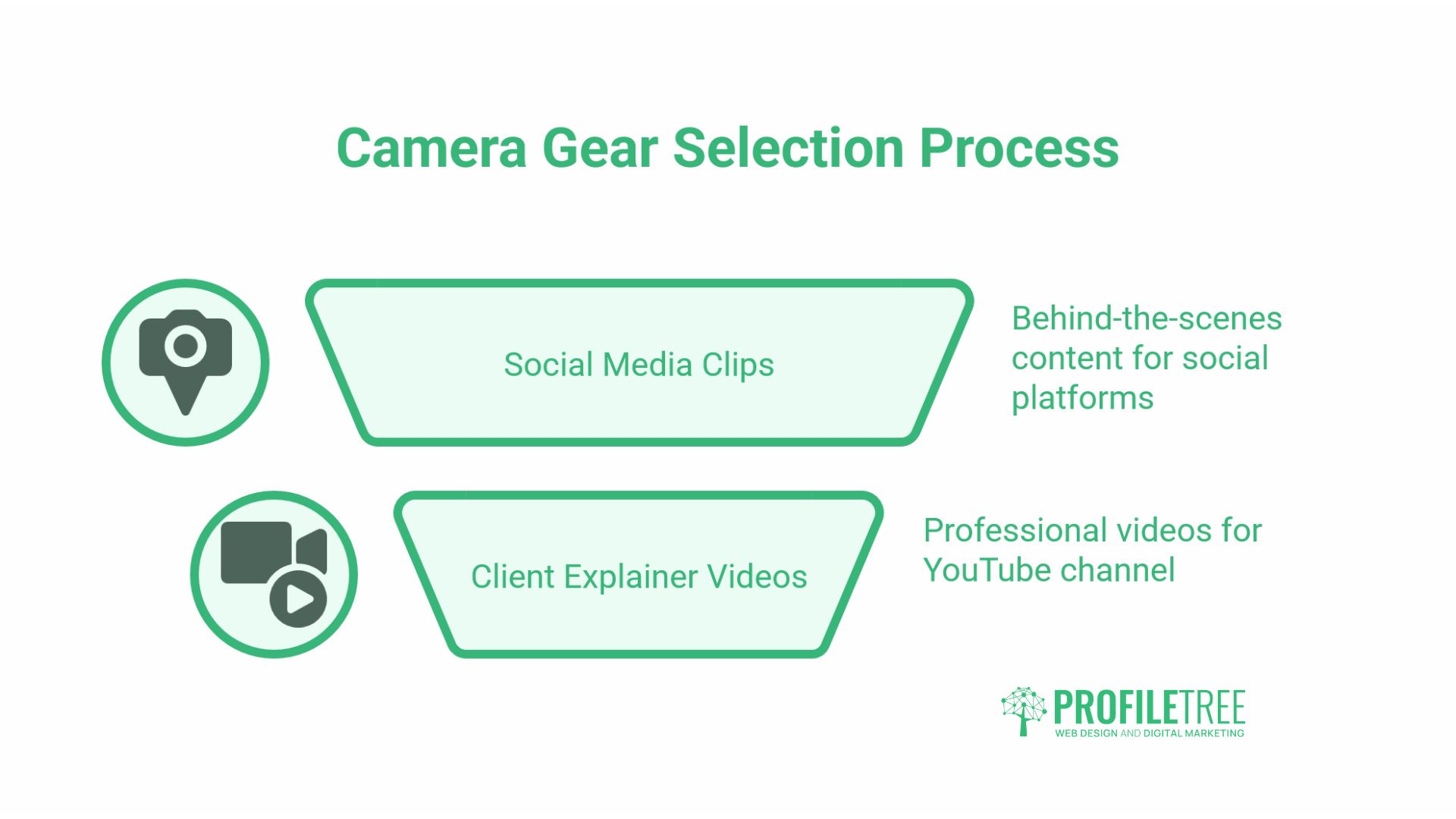
The camera gear decision looks different depending on what the content needs to achieve. A social media manager posting behind-the-scenes clips has different requirements from a professional services firm producing client explainer videos for a YouTube channel.
Tier 1: Social Content on a Tight Budget
For businesses starting out with video, a modern smartphone, a compact wireless microphone, and a basic LED panel cover most social media use cases. This is not a compromise position. Smartphone cameras produce broadcast-quality footage in good light, and the portability means content actually gets made rather than postponed.
A realistic starting kit for a UK SME: existing smartphone, DJI Mic Mini (around £80), small LED panel (around £50–£70), flexible mini tripod (around £25–£40). Total investment under £200 for a setup that covers Instagram Reels, TikTok, LinkedIn video, and basic YouTube content.
Tier 2: Dedicated Camera for YouTube and Longer-Form Content
Businesses investing in a YouTube channel or regular long-form video benefit from a dedicated camera. The Sony ZV-E10 II or Canon EOS M50 Mark II are practical choices at this level. Add a compact shotgun mic, a two-point lighting kit, and a stable tripod, and the total investment for a functional business video setup sits in the £700–£1,200 range before lenses.
Understanding how short-form video fits alongside longer YouTube content is worth doing before committing to a specific setup. The platforms have different production requirements, and equipment decisions should follow the content strategy rather than precede it.
Tier 3: Professional-Grade In-House Production
Organisations producing high volumes of video training programmes, product demonstrations, and thought leadership series may need a more significant kit investment. At this level, a full-frame mirrorless body, prime lenses, a professional audio interface, and a proper lighting rig become realistic components.
The gap between Tier 2 and Tier 3 is substantial. A professional in-house video setup can run to £5,000–£15,000 or more when lenses, audio, lighting, storage, and editing hardware are included. For many businesses, commissioning video marketing from a production partner is more cost-effective than maintaining that level of kit in-house, particularly for lower-frequency, higher-stakes content.
When Your Own Kit Is Enough, and When It Is Not
In-house production works well for: regular social content, behind-the-scenes footage, employee communications, quick product explainers, and YouTube content where consistency matters more than cinematic polish.
Professional production adds clear value for: brand films, client testimonials used in paid advertising, product launch videos, and any content where production quality is itself a signal of brand credibility. For businesses in sectors where trust is built through perceived professionalism, a visibly underproduced video can undermine the marketing objective it was meant to serve.
The blog vs vlog question is worth revisiting here, too. Some content objectives are better served by written content than video, and the format decision matters as much as the gear.
Equipping a Small Business Content Team
Setting up a small in-house team shifts the priorities slightly. Standardisation matters: consistent gear across team members means consistent output quality. A shared kit bag with a camera, two microphones, a lighting panel, and a portable backdrop gives a small team everything needed for talking-head content, customer interviews, and social video without requiring specialist knowledge for every shoot.
Investing in digital training alongside the gear purchase is often overlooked. A team that knows how to use the equipment correctly, light a subject, and edit efficiently will produce better content with modest kit than a team handed expensive gear with no guidance on how to use it.
Vertical Video and Multi-Platform Production
Producing content for TikTok, Instagram Reels, and YouTube Shorts requires a different approach to traditional horizontal video. If vertical-first platforms form part of your content strategy, the gear decisions change accordingly.
Shooting natively in 9:16 is the cleanest approach, and smartphones do this by default. For dedicated cameras, a cage with a vertical mounting plate allows a mirrorless body to shoot in portrait orientation. Alternatively, shooting in 4K horizontal and cropping to vertical in post is workable, though it reduces effective resolution. The content planning considerations behind these choices are covered in our guide to YouTube growth strategies.
Buying Gear in the UK: Practical Notes
UK specialist retailers, including Wex Photo Video, Park Cameras, and London Camera Exchange, stock a broad range of new and used camera gear. MPB is a well-regarded UK-based marketplace for used equipment and is a practical route to accessing better glass or a higher-specification body within a tighter budget.
Weather sealing is worth factoring in for UK creators shooting outdoors. The UK climate means overcast, damp, and intermittently wet conditions are the norm rather than the exception. Not all cameras are weather-sealed; the Sony α7 IV and Canon EOS R series offer meaningful protection at the higher end, while most compact vlogging cameras do not. If outdoor shooting is a regular part of your plan, either check the IP rating or budget for a rain sleeve.
For a broader look at vlogging accessories that complement your camera setup, including memory cards, ND filters, and carry solutions, this guide covers the supporting kit in depth.
The UK government’s guidance on capital allowances is worth reading before making any significant equipment purchase for commercial use, as qualifying business assets may be deductible against taxable profit.
Conclusion
Choosing the right camera gear for vloggers comes down to one question: what does the content need to achieve? A smartphone and a wireless mic can serve a small business producing weekly social content just as effectively as a mirrorless setup costing 10 times as much. The gear matters less than the consistency, the audio quality, and the thinking behind the content strategy.
Start with the minimum viable kit for your current output, get comfortable with it, then upgrade when a specific limitation is genuinely holding the content back. That approach saves money and produces better results than buying for ambition rather than actual use.
For businesses at a point where in-house production no longer keeps pace with content goals, professional video production is a natural next step rather than a last resort.
FAQs
What equipment is essential for a beginner vlogger?
A camera with a flip screen, a compact microphone, basic lighting, and a stable tripod. A smartphone with a wireless lavalier is a legitimate alternative to a dedicated camera. Budget around £400–£700 for a functional starter kit including all four components.
Do I need 4K for vlogging?
Not strictly. 1080p is fine for most platforms. The real case for 4K is post-production flexibility: shooting in 4K lets you crop or reframe for vertical platforms without losing output resolution.
Which cameras do professional vloggers prefer?
Sony’s ZV and Alpha series and Canon’s EOS R range are consistently popular. The Sony ZV-E1 and Canon EOS R50 are well-regarded across the quality-to-usability spectrum, particularly for business video.
Is a smartphone better than a dedicated vlogging camera?
For social content, closer than most people expect. Smartphones handle 4K, stabilisation, and native vertical video well. Dedicated cameras lead in sensor size, interchangeable lenses, audio inputs, and battery life for longer shoots.