
SEO Over-Optimisation: Signs, Risks and How to Recover
Table of Contents
SEO over-optimisation is what happens when the effort you put into ranking starts working against you. It’s the point where keyword placement, link patterns, or content structure become so deliberate that a search engine reads them as an attempt to game the system rather than help a reader, and it’s become far easier to trigger since Google permanently folded its Helpful Content system into core ranking.
SEO over-optimisation rarely arrives with a warning. Instead, it shows up as a slow drift: impressions that hold steady while clicks fall away, positions that plateau just outside page one, no matter how much new content you publish, or a page that ticks every on-page checklist item yet never earns the trust a genuinely useful resource attracts. This guide sets out what causes it, how to check your own site for it, and what a realistic recovery looks like for a small or mid-sized business.
What Is SEO Over-Optimisation?
SEO over-optimisation is a pattern, not a single mistake. Google’s own spam policies describe it in terms of content and links created primarily to manipulate ranking systems rather than to serve users, and that framing has stayed remarkably consistent even as the specific tactics have changed.
Ten years ago the culprits were obvious: a keyword repeated every second sentence, footers stuffed with anchor-rich links, backlink profiles that looked bought in bulk. Google’s Panda and Penguin updates targeted these directly, and most site owners adjusted. What’s shifted since is the level at which Google assesses the problem. Rather than scoring keyword density on a single page, ranking systems now look at the whole site: whether the pattern across dozens or hundreds of pages suggests content built to rank first and help second.
That’s a higher bar than it used to be. A page can pass every item on a traditional content optimisation checklist and still get suppressed if the wider site looks templated, thin in places, or reliant on the same three sentences reworded across twenty near-identical pages.
Why Google Suppresses Over-Optimised Content
Google suppresses over-optimised content because it correlates strongly with low information gain. If your page says the same thing as the top three results, in roughly the same order, with roughly the same phrasing, it isn’t adding anything a searcher couldn’t already find. The over-optimisation signals (keyword repetition, uniform anchor text, templated structure) are proxies Google uses to spot that pattern at scale, not the actual thing being penalised. The thing being penalised is a lack of genuine value, and that distinction matters because it changes what “fixing” the problem entails. It isn’t about removing keywords; it’s about adding something worth reading.
The Red Flags: Signs You’ve Gone Too Far
Six patterns account for most of the over-optimisation problems we see on client sites, and they rarely show up in isolation. If one of these is present, it is worth checking the others.
Keyword cannibalisation. Two or more pages are competing for the same query, so neither ranks strongly because Google cannot decide which to prioritise. A service page and a blog post both chasing “SEO agency Belfast” is a common example. The fix isn’t to stuff one page harder; it is to consolidate the pages or clearly separate them by search intent, which is where a proper keyword research exercise earns its keep before any content gets written or rewritten.
On-Page: Beyond Keyword Stuffing (AI Patterns)
The newest over-optimisation risk does not come from a human deliberately stuffing keywords. It comes from unedited AI output that looks technically fine, correct heading hierarchy, sensible keyword frequency, thorough topic coverage, but reads with what researchers call low lexical entropy: a narrower vocabulary range and more uniform sentence rhythm than a human writer naturally produces.
Google hasn’t said it penalises AI-generated content as a category, and it doesn’t need to. The correlation between unedited AI output and low information gain is strong enough that the pattern gets caught anyway. Understanding how AI content detection actually works is useful context here, though the practical takeaway is simpler than the technical detail: if a paragraph could have been written about any business in any town, it isn’t earning its place on your page.
For UK-regulated sectors, finance and legal services in particular, this carries an additional layer of risk. Content that lacks genuine expertise can fall foul of the FCA’s Consumer Duty standards or the SRA’s requirements for clear, accurate, non-misleading communication on solicitor websites, so an over-optimised page in these sectors is not purely an SEO problem.
Off-Page: Anchor Text Ratios and Toxic Links
Internal and external anchor text both send over-optimisation signals when handled poorly. If every internal link pointing to a service page uses the same phrase, Google reads that as an engineered pattern rather than a natural site architecture built to help visitors navigate. The same applies to backlinks: a profile weighted heavily towards exact-match commercial anchors such as “SEO agency Belfast” looks manufactured, even when every individual link was earned honestly.
A healthy anchor profile mixes branded mentions, plain URL citations, descriptive phrases and only a minority of keyword-anchored links. Using Google Search Console to check anchor text and click-through data is the fastest way to see where your own site sits on that spectrum, since the Links report will show exactly which phrases dominate.
Technical: Speed, Schema and “Bot-First” Design
Over-optimisation is not confined to text. Pages that load slowly, bury content beneath ad units, use intrusive interstitials, or render poorly on a phone all send negative behavioural signals that compound whatever is happening at the content level. High bounce rates and short dwell times are partly algorithmic input and partly a plain practical problem: people leave, and the page achieves nothing regardless of where it ranks.
Structured data adds a second layer of risk when it is used carelessly. Schema markup that describes content the page does not actually contain (a FAQ schema listing questions the visible text never answers, for instance) is treated as a manipulation signal in its own right. A technical SEO service review will usually catch this alongside the more familiar Core Web Vitals checks, and it is worth running that check before assuming a content rewrite alone will fix a ranking drop.
The UK Context: Local and Service Page Traps
Most SEO guidance on over-optimisation is written from a US perspective and overlooks a pattern that is particularly common in the UK and Ireland: dozens of near-identical local pages built by swapping a town name into an otherwise unchanged template.
The Local Service Directory Trap
Picture a tradesperson’s website with fifty pages, one for every town within an hour’s drive, each reading “Looking for a reliable plumber in [Town]? We provide fast, affordable plumbing services across [Town] and the surrounding area.” Swap fifty town names into that sentence, and you have not built fifty pages of local relevance; you have built one page fifty times, and Google’s site-wide quality assessment treats it accordingly. The same pattern shows up in local SEO for plumber-style directories and, just as often, on professional services sites. A firm offering local SEO for solicitors faces exactly this temptation when expanding into new towns, and the businesses that avoid the trap are the ones that write genuinely different content for each location: which courts or planning authorities serve that area, which local landmarks or postcodes matter, which team member actually covers that patch.
This is a genuine opportunity for Northern Irish, Irish, and wider UK SMEs, rather than just a risk. Locally specific detail (real neighbourhood knowledge, actual service area boundaries, named team members) is something a national competitor cannot produce at scale, precisely because it resists templating. If you are weighing up whether to expand a location footprint through a dedicated local SEO agency relationship, this distinction between genuine local content and template duplication is the first thing to get right, before any page count target is set.
The Cost of Over-Optimising Beyond the Algorithm
A drop in ranking is the visible cost. The less visible one, and for most SMEs, the more damaging one, is what an over-optimised page does to the person who actually reaches it.
A page that reads as though it was written to rank rather than to inform does not just risk demotion; it damages conversion. UK audiences in particular, shaped by a broadly sceptical approach to online marketing claims, disengage quickly from content that feels promotional rather than useful. Generic reassurance (“we are the leading provider of…”) reads as noise rather than proof.
There’s also a slower, structural cost. A site that has been suppressed, even temporarily, loses accumulated authority that is hard to rebuild: third-party sites that might otherwise have cited your content as an authoritative source become less likely to do so if your pages are not visible for their own topics in the first place. For Belfast-based businesses and those across Northern Ireland more widely, local authority signals (referenced by regional news outlets, industry bodies, and established local businesses) carry particular weight and are genuinely difficult to manufacture once lost. Reviewing examples of a broader marketing audit is a useful way to see how this loss of authority shows up across other channels, not just organic search.
The Recovery Timeline
Recovery speed depends on whether the issue triggered a manual action or an algorithmic demotion. A manual action requires a reconsideration request and typically takes four to eight weeks to review once the identified issues are resolved. An algorithmic demotion tied to a core update is only re-evaluated when the next core update runs and re-crawls the improved content, which usually happens two to four times a year, so the honest timeline is “it depends on the update calendar” rather than a fixed number of weeks.
During that window, rankings can fluctuate before settling. That’s normal and doesn’t mean the recovery work has failed. The practical response is to keep making substantive changes, document them for any reconsideration request, and continue producing genuinely useful content in the meantime rather than waiting passively for the next update.
The Recovery Plan: A Practical De-Optimisation Process
Fixing an over-optimised site is not a single-afternoon task, but it does not require three separate specialists either. The following steps work in sequence: start with anchor text because it produces the most actionable data quickest, then move into content quality, then finish with the technical layer.
Step 1: Content Pruning and Intent Alignment
For every page you audit, ask one direct question: What does this page say that is not already said, in roughly the same way, by the top three results on Google? If there is no clear answer, the page has an information gain problem, not a keyword problem.
Genuine information gain comes from first-hand experience with a client project (anonymised where needed), a clearly reasoned opinion that challenges a common assumption, or a specific framework you have developed rather than restated from elsewhere. Northern Irish and Irish businesses hold a real advantage here: regional specificity is something that globally generalised content simply cannot match. Pages that fail this test have three honest options: expand and enrich, if the topic carries genuine commercial or traffic value; consolidate into a stronger related page; or remove and redirect. This is also the point at which it is worth checking whether the wider site suffers from keyword cannibalisation between pages that should have been one page from the start.
Step 2: Diluting Over-Optimised Anchor Text
Export your internal link profile with a crawl tool and group anchors by destination URL. Any page where a single phrase accounts for more than roughly 60% of inbound internal anchor text is a candidate for rewriting the surrounding sentences, not just the link itself, since the anchor text usually reflects a wider pattern of formulaic phrasing around it.
For external links, the Links report in Search Console shows the anchor text other sites use when linking to you. If one exact-match commercial phrase dominates, that is worth addressing gradually through content that naturally earns a more varied set of anchors over time, rather than through a sudden disavowal that can do more harm than good. Running a full website SEO audit review alongside this step captures both internal and external anchor patterns in a single pass.
Step 3: Injecting Human Experience into AI Drafts
If AI tools were used at any point in the production process, this is the step that matters most. The fix isn’t to abandon AI drafting; it’s to ensure a human editor adds what a language model cannot: a specific example from real project work, a stated opinion with reasoning attached, and sentence-level variation that breaks up the uniform rhythm AI output tends to default to.
Ciaran Connolly, founder of ProfileTree, puts it plainly: “The sites that recover fastest from a suppression are the ones where you can tell a person with real experience wrote the page, not because it says so, but because the detail could not have come from anywhere else.”
Businesses that want this editorial habit built into the team rather than handled reactively each time often look at structured digital training or an internal AI training programme so that whoever drafts content knows where the line between useful AI assistance and hollow AI output actually sits.
| Element | Healthy Optimisation | Over-Optimisation |
|---|---|---|
| Keywords | Appears naturally where the topic requires it | Repeated at a fixed density regardless of readability |
| Internal links | Varied, descriptive anchor text placed where it helps the reader | Same exact-match phrase on every link to a page |
| Anchor text (external) | Mix of branded, URL and descriptive anchors | Dominated by exact-match commercial phrases |
| Schema markup | Matches the visible content exactly | Describes content the page does not actually contain |
| AI-assisted content | Edited with real examples, opinions and local detail added | Published unedited, technically correct but generic |
Future-Proofing: Building for Readers, Not Crawlers
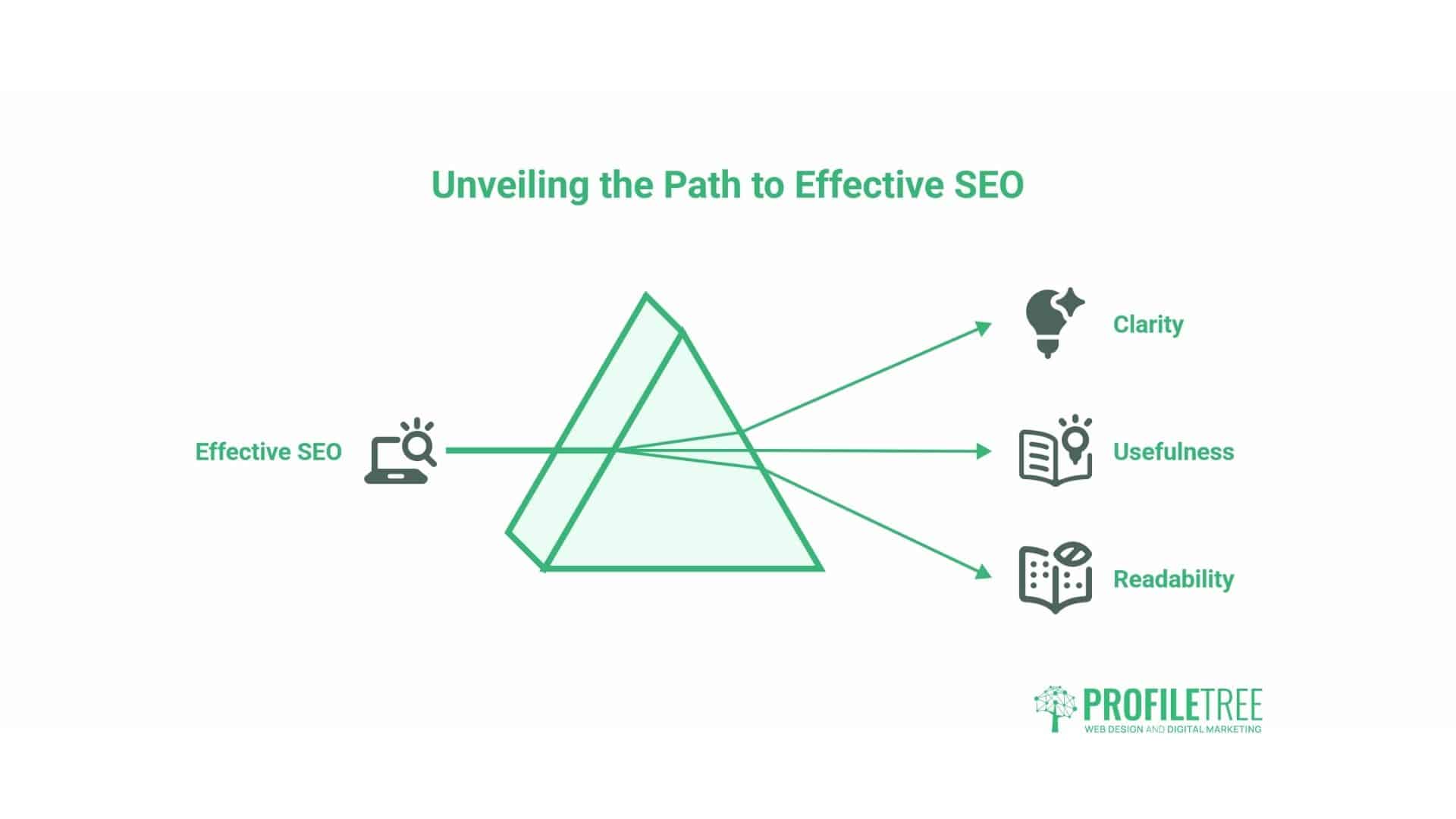
Avoiding over-optimisation is not the same as doing less SEO. It means doing SEO that is genuinely aligned with what search engines now reward, which turns out to be close to what good editorial practice has always recommended: write clearly, say something useful, and make it easy to read.
The most consequential shift behind this is the move from keyword-based ranking towards entity-based ranking. An entity is a distinct, identifiable concept that a search engine can connect to other related concepts: ProfileTree, Belfast and search engine optimisation are all entities. When these appear together with clear factual relationships (ProfileTree is a Belfast-based digital agency offering search engine optimisation, for example), the page becomes easier for search systems to understand without any individual phrase needing to be repeated for emphasis. Building this kind of entity-rich, non-templated content is exactly what a properly briefed content marketing strategy is meant to produce, rather than a stack of loosely related keyword pages.
This same logic extends to how content earns visibility in AI-generated answers, not just traditional rankings. Pages that add something genuinely new to a topic, rather than rephrasing the existing top results, tend to be the ones cited when a searcher gets an AI-generated summary instead of a list of blue links, and the principles behind how to rank in AI search engines overlap almost entirely with the anti-over-optimisation approach set out above.
It is also worth remembering that written content is not the only channel this applies to. A page that pairs a genuinely useful article with a short, relevant video tends to hold attention longer than text alone, and getting the basics of video SEO right, descriptive titles, real transcripts, and structured chapters means that video does not become its own quiet source of over-optimisation through keyword-stuffed titles and descriptions.
None of this removes the need for the fundamentals. An SEO audit checklist still catches the mechanical issues, and understanding the wider risks of getting SEO wrong is still worth doing before a site scales up its content output. What’s changed is the standard those fundamentals now have to clear.
If your site is showing any of the patterns above, whether that’s stalled rankings, a suspicious anchor text profile, or a library of thin location pages, an outside audit is often the fastest way to separate a genuine over-optimisation problem from an unrelated ranking issue. Get in touch with ProfileTree’s team to talk through what a practical recovery plan would look like for your site.
The Bottom Line
Over-optimisation isn’t an SEO problem so much as a symptom: building for the algorithm first and the reader second. The fix isn’t fewer keywords or thinner content; it’s the opposite. Add something no other business in any other town could have written.
That’s good news for most SMEs. A competitor or an AI tool can copy your structure. Neither can copy real, local experience. Start with the audit steps above rather than a full rewrite; most sites need less removed than they expect.
FAQs
What is the fastest way to fix an over-optimised page?
Start by rewriting keyword-stuffed headings and diversifying internal link anchor text; these two changes reduce the most obvious signals without a full rewrite. Then add at least one section with genuine information gain: a real example, a specific detail, or a clearly reasoned opinion not already present in competing results.
Can internal links alone cause a ranking penalty?
A formal manual action from internal linking alone is rare, but a pattern of exact-match anchor text on every link to a particular page can look manipulative and suppress that page’s rankings. Varied, descriptive anchor text used only where it genuinely helps the reader is the standard to work towards.
Does Google penalise AI-generated content specifically?
No, not as a category. Google penalises low-value content regardless of how it was produced. The risk with unedited AI output is that it tends to produce repetitive structure and low information gain, which correlates with over-optimisation signals. Edited, locally specific, genuinely insightful AI-assisted content is treated no differently from human-written content of the same quality.
Is there an ideal keyword density in 2026?
There is no meaningful target percentage, and chasing one is itself a form of over-optimisation thinking. What matters is topic coverage, semantic relevance and whether the page answers the query better than the pages already ranking for it.