
AI Project Management: Strategic Techniques for Success
Table of Contents
Artificial intelligence is changing how project teams plan, execute, and measure work. Where traditional methods rely on manual tracking and reactive decision-making, AI-augmented approaches bring predictive insight, automated scheduling, and real-time visibility to programmes of any scale.
The shift is not simply about adopting new software. Success depends on the quality of the data going in, the governance structures around AI use, and how well teams are equipped to work alongside these tools rather than around them.
This guide covers five core areas of AI project management: the foundational shift from automation to augmentation, the techniques that deliver the greatest returns, the data preparation work that most teams overlook, the UK and EU regulatory considerations that shape responsible deployment, and the skills project professionals need to stay effective in an AI-driven environment.
From Automation to Augmentation: The New Project Management Landscape
The earliest applications of AI in project management focused on automating repetitive administrative tasks: scheduling reminders, status updates, and document generation. Valuable as those gains were, the field has moved considerably further. The more significant opportunity now lies in augmentation, using AI to sharpen human judgment rather than simply replace manual steps.
What Augmentation Actually Means in Practice
Augmentation means giving project managers better information, faster. Instead of waiting for a weekly report to flag a budget overrun, an AI-augmented system surfaces the signal in real time, alongside a projected trajectory and a set of suggested corrective actions. The project manager still makes the call; the AI removes the lag between problem and awareness.
This distinction matters because it shapes how teams should assess AI tools. The question is not “what can this automate?” but “how does this improve the decisions we make?” Tools that score highly on the second question tend to deliver measurable returns. Tools that only address the first often create new maintenance burdens without lifting project outcomes.
The Three Pillars Reshaping Modern Project Delivery
Three capabilities underpin the current generation of AI project management tools. The first is intelligent automation, handling scheduling, data entry, and reporting at speed and without error. The second is predictive analytics, drawing on historical project data to forecast risks, resource gaps, and delivery timelines before they become problems. The third is adaptive planning, where the system recalibrates project parameters automatically as conditions change, rather than waiting for a human to intervene.
Together, these capabilities reduce the proportion of time project managers spend on administrative overhead and increase the time available for stakeholder engagement, risk strategy, and complex problem-solving. For SMEs working with lean project teams, that reallocation of effort is often the most immediate and tangible benefit. Our business analytics tools guide covers the broader suite of platforms supporting this shift.
Why Most Implementations Fall Short
Research consistently shows that the majority of digital transformation initiatives do not deliver their projected benefits. AI project management deployments follow the same pattern. The most common failure modes are not technical. They are organisational: unclear ownership of AI outputs, insufficient training, and a mismatch between the tool’s assumptions and the team’s actual data quality.
Understanding these failure modes before deployment is the most reliable way to avoid them. The sections below address each in turn.
Five Core AI Techniques for Project Success
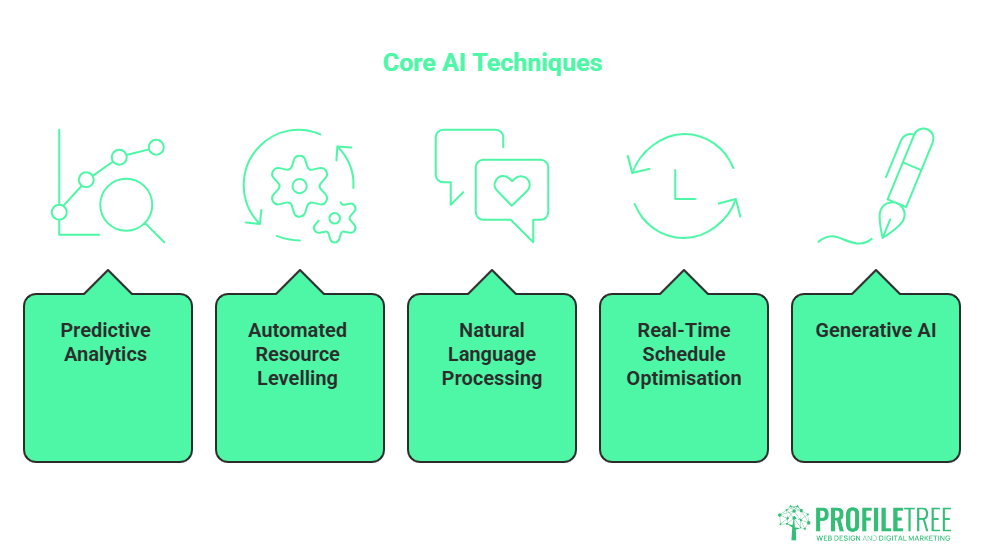
Not every AI capability delivers equal value across every project type. The five techniques below have the strongest evidence base for improving outcomes, and each addresses a distinct phase of the project lifecycle. Applying them selectively, based on where your current process has the greatest gaps, produces better results than introducing all five simultaneously.
Predictive Analytics for Risk Mitigation
Predictive analytics analyses patterns in historical project data to identify which current conditions are most likely to lead to delays, cost overruns, or quality failures. Rather than relying on periodic risk reviews, the system flags emerging issues continuously.
The practical value is significant. A project manager alerted to a procurement risk three weeks before it materialises has options. One alerted on the day has almost none. Predictive risk tools are particularly effective on programmes where similar work has been done before and where there is sufficient historical data to train the models on. Our article on risk management and statistics explains the data requirements in more detail.
Automated Resource Levelling and Capacity Planning
Resource over-allocation is one of the most persistent causes of project slippage, and it is one of the areas where AI delivers the clearest efficiency gains. Automated resource levelling tools continuously match task demand against team availability, flagging conflicts before they create bottlenecks and suggesting reallocation options based on skill profiles and workload data.
The difference between manual resource planning and AI-assisted planning is not just speed. It is completeness. A project manager juggling multiple workstreams cannot hold every dependency in mind simultaneously. An AI system can update its recommendations in real time as the project evolves.
Natural Language Processing for Stakeholder Sentiment
Natural language processing (NLP) tools can analyse communication patterns across emails, meeting transcripts, and project management platforms to surface stakeholder sentiment. A stakeholder who has shifted from engaged to disengaged often signals that shift in their communication before they raise a formal concern. NLP tools make that pattern visible.
For project managers working across multiple stakeholder groups, this capability replaces guesswork with evidence. It also provides an audit trail of engagement that can be valuable for governance purposes, particularly on public sector or regulated projects.
Real-Time Schedule Optimisation
Static Gantt charts do not reflect how projects actually run. Tasks slip, dependencies shift, and priorities change. AI-driven schedule optimisation tools treat the project plan as a live model rather than a fixed document, recalculating the critical path automatically as conditions change and surfacing the earliest point at which a delay will affect the delivery date.
This approach supports more honest conversations with clients and sponsors, because the schedule reflects reality rather than aspiration. It also reduces the administrative effort involved in maintaining plan accuracy, freeing project managers to focus on the underlying causes of slippage rather than the mechanics of documenting it.
Generative AI for Documentation and Reporting
Generative AI tools can draft meeting summaries, produce progress reports from structured data inputs, and generate first-draft risk registers from project briefs. The output requires human review before publication, but the time saving on documentation-heavy programmes is substantial.
The important caveat is that generative AI reproduces patterns from its training data. Where a project involves genuinely novel risks or unusual commercial structures, the AI’s output may miss important nuances. Human review is not optional; it is the control mechanism that makes the technique safe to use. For a broader view of how AI tools are being applied across business functions, see our overview of AI forecasting tools.
The Foundation of Success: Data Hygiene and Legacy Integration
The most capable AI tool will underperform on poor data. This is not a theoretical concern. It is the most frequently cited cause of AI project management implementations that fail to deliver their projected benefits. Before selecting a tool or writing a business case, a project, or an IT team needs an honest assessment of the data they are working with.
Why Legacy Project Data Creates Problems
Most organisations hold years of project data across a mixture of spreadsheets, legacy systems, shared drives, and project management platforms that have been replaced or migrated. This data is typically inconsistent in structure, incomplete in coverage, and contaminated with free-text entries that do not conform to any taxonomy.
AI models trained on this kind of data will reflect its inconsistencies. A risk prediction model trained on data where “delayed” has been recorded as “D,” “delay,” “late,” and “behind schedule” in different projects will produce unreliable outputs. Cleaning this is not a technical afterthought; it is a prerequisite for meaningful results.
A Practical Approach to Data Preparation
Effective data preparation for AI project management involves four steps. The first is taxonomy standardisation: agreeing on consistent definitions for project status, risk category, resource type, and milestone labels, then applying those definitions retrospectively across historical records.
The second is deduplication and gap-filling, identifying duplicate records and deciding whether incomplete records should be enriched, excluded, or flagged as low-confidence training data. The third is vectorisation, converting unstructured text fields into a format the AI can process.
The fourth is validation, running the cleaned dataset through the chosen AI tool and checking whether its outputs align with outcomes that project managers who worked on those historical projects would recognise as accurate.
This work is time-consuming, but it is not technically complex. It can be led by project management office (PMO) staff with guidance from IT, and it pays dividends beyond AI deployment by improving the general quality of project reporting. For more on the broader data challenge, our article on business data and statistics provides useful context.
Integrating Data Across Project Platforms
Few organisations run all their project work through a single platform. Finance data sits in one system, resource data in another, and delivery tracking in a third. Effective AI project management requires these sources to be connected, either through direct integrations or through a data warehouse that consolidates them into a single model.
The integration architecture does not need to be complex, but it does need to be maintained. Stale integrations produce stale AI outputs, which can be more dangerous than no AI at all, because they carry a false impression of currency. Assigning clear ownership of each data feed, with defined refresh schedules and exception alerts, is a governance requirement rather than an IT nicety.
Navigating the UK and EU Regulatory Landscape
For project teams operating in the UK and Ireland, the regulatory environment around AI is an active consideration rather than a future concern. Both the EU AI Act and the UK’s AI regulatory framework place specific obligations on organisations deploying AI in contexts that affect people, including employment decisions, performance management, and resource allocation.
What the EU AI Act Means for Project Management Tools
The EU AI Act classifies AI systems by risk level. Systems used to make or significantly influence decisions about employment, task allocation, or performance assessment are classified as high-risk and subject to mandatory conformity assessments, transparency requirements, and human oversight obligations. An AI tool that automatically reallocates resources or scores individual team members’ performance may fall into this category.
For Irish organisations and Northern Ireland businesses with cross-border operations, this is not an academic point. Deploying a high-risk AI system without the required documentation and oversight controls exposes the organisation to regulatory action. Before committing to any AI project management platform, legal or compliance teams should assess where it sits within the Act’s risk classification framework. Our guide to UK digital compliance covers related obligations for organisations operating online.
UK GDPR and Project Data
Project management data frequently includes personal data: team members’ names, work records, performance notes, and communication logs. Using this data to train or operate AI systems triggers UK GDPR obligations around lawful basis, data minimisation, and the right to explanation where automated decisions are made.
The practical implications include ensuring that AI tools used for performance-related decisions can explain their outputs in plain language, that personal data is not retained in AI training sets beyond its legitimate purpose, and that team members are informed when AI tools are used in ways that affect them. See our GDPR training guide for a team-level breakdown of these requirements.
Building Compliance into the Implementation Plan
Compliance is most cost-effective when it is built into the implementation plan from the outset rather than retrofitted after deployment. The key steps are: conducting a data protection impact assessment (DPIA) before deploying any AI tool that processes personal data; documenting the human oversight controls that apply to AI-generated outputs; and establishing a review process for cases where team members wish to challenge an AI-influenced decision.
Ciaran Connolly, founder of ProfileTree, has noted that UK and Irish SMEs often underestimate the compliance dimension of AI deployment, focusing on capability and cost while leaving governance arrangements vague. That gap tends to surface at the worst possible time, when a decision is challenged, or a regulator asks questions. Getting the governance framework in place early removes that exposure.
Measuring ROI and Building the Skills for the AI Era
Two questions consistently arise in conversations about AI project management: how do you know whether it is working, and what does it ask of the people using it? Both are practical questions with practical answers, and both are better addressed before deployment than after.
A Human-in-the-Loop ROI Framework
The most reliable framework for measuring AI project management ROI focuses on three variables: reduction in unplanned work, reduction in schedule variance, and reduction in the time project managers spend on administrative tasks.
Unplanned work is work that was not in the original plan and consumed capacity that had been allocated elsewhere. AI tools that improve risk prediction and resource levelling should reduce this figure measurably over a series of comparable projects. Schedule variance, the difference between planned and actual delivery dates, is a direct measure of planning accuracy. Administrative time, captured through time-recording data before and after deployment, quantifies the reallocation of effort that augmentation should deliver.
A simple formula: (Hours saved on admin x average hourly cost) + (Reduction in unplanned work x average cost per unplanned task) minus implementation and licensing costs, measured over a 12-month period, gives a defensible ROI figure that most finance teams will accept. It also creates a baseline against which to assess whether the tool is improving over time as it trains on more project data. Our piece on statistics in business decisions covers how to structure data-backed business cases more broadly.
Overcoming Implementation Barriers in UK and Irish Organisations
The most common implementation barriers are not technological. They are resistance from project teams who perceive AI as a surveillance mechanism, a lack of clarity about who is responsible for AI outputs, and insufficient time allocated to data preparation and training.
Addressing the first barrier requires transparent communication about what the AI tool does and does not do, and clear assurances that outputs are reviewed by humans before affecting decisions. The second barrier requires explicit governance documentation. The third requires realistic project planning that treats data preparation as a deliverable, not a background activity.
For public sector and regulated organisations in the UK and Ireland, there is an additional layer: procurement compliance. Many AI tools are US-based, which creates data residency questions under UK GDPR. Checking where data is processed and stored, and whether standard contractual clauses are in place, should be part of the procurement checklist for any AI tool that will handle project data.
The Skills Project Professionals Need Now
The role of the project manager is shifting from administrator to strategist. As AI tools take on scheduling, reporting, and routine risk assessment, the skills that differentiate effective project professionals are changing. Critical evaluation of AI outputs, the ability to interrogate a model’s assumptions and spot when it is producing plausible-sounding but misleading results, is fast becoming a core competency.
Prompt engineering, the ability to give AI tools well-structured, context-rich instructions that produce useful outputs rather than generic ones, is another skill that project teams benefit from developing. So is data literacy: the ability to understand what a dataset represents, where its gaps are, and what conclusions it can and cannot support.
None of these requires a technical background. They require curiosity, scepticism, and a willingness to engage with the tools rather than simply accept their outputs. Structured training programmes can accelerate this development significantly.
Our guide to training teams with AI outlines the key components of an effective upskilling programme, and our project management training resource covers the foundational skills that underpin effective AI-augmented delivery.
Conclusion
AI project management delivers real returns, but only when the foundations are right. Data quality, governance, and team capability matter as much as the tools themselves. For UK and Irish organisations, the regulatory dimension adds an additional layer that cannot be overlooked. Build these elements in from the start, measure outcomes against a clear baseline, and the productivity and delivery gains are well within reach.
Ready to explore AI project management for your organisation? ProfileTree works with SMEs across Northern Ireland, Ireland, and the UK to assess AI readiness, select the right tools, and build the governance frameworks that protect against compliance risk. Talk to our team to start the conversation.
FAQs
How is AI used in project management?
AI is applied across three main areas: automation (handling scheduling, status updates, and reporting), prediction (forecasting risks, resource gaps, and delivery timelines using historical data), and augmentation (giving project managers better information to support faster, more accurate decisions).
Will AI replace project managers?
The evidence points toward transformation rather than replacement. AI handles administrative and analytical tasks with greater speed and consistency than humans, but project management also involves stakeholder relationships, ethical judgment, and context-sensitive decision-making that current AI systems cannot replicate.
What is the first step in implementing AI for a PMO?
Start with a data audit rather than a tool selection. Identify what project data you hold, where it lives, how consistent it is, and whether it covers the outcomes you want the AI to predict. A clear picture of your data estate allows you to assess which AI capabilities are immediately viable and which require preparatory work.
How do you maintain AI compliance with UK GDPR?
Conduct a data protection impact assessment before deploying any AI tool that processes personal data. Confirm that the tool can explain its outputs where those outputs influence decisions about individuals. Check data residency arrangements, particularly for US-based tools.
What are the best AI techniques for resource allocation?
Automated resource levelling and capacity planning tools, which use machine learning to match task demand against team availability in real time, deliver the most consistent results. More advanced implementations use Monte Carlo simulations to model resource scenarios under uncertainty and genetic algorithms to optimise allocation across complex dependency structures.