
Improve Google Analytics Bounce Rate: 10 Pro Tips
Table of Contents
Google Analytics bounce rate is one of the most widely discussed yet frequently misunderstood metrics in digital marketing. Defined as the percentage of single-page sessions where users leave a website without interacting with the page beyond the initial load, bounce rate has traditionally been a key indicator of user engagement and content relevance. When visitors arrive at your site and immediately “bounce” away without clicking links, filling forms, or navigating to other pages, it suggests they either didn’t find what they were looking for or weren’t sufficiently engaged by your content to explore further.
However, interpreting bounce rate requires nuance and context rather than a one-size-fits-all approach. A high bounce rate isn’t necessarily negative—for instance, a blog post that fully answers a reader’s question or a contact page that provides complete information might naturally have elevated bounce rates while still serving users effectively. The key lies in understanding what constitutes a meaningful interaction for your specific website goals and audience behaviour. Modern analytics practices emphasise looking at bounce rate alongside other metrics like time on page, scroll depth, and conversion rates to gain a more comprehensive picture of user engagement and site performance.
At ProfileTree, we’ve helped businesses across Northern Ireland, Ireland, and the UK transform bounce rates from conversion killers into engagement drivers. This comprehensive guide reveals our strategies, tools, and methodologies for diagnosing bounce rate issues and implementing effective solutions.
Understanding Bounce Rate
Before optimising your bounce rate, you must understand exactly what it measures and how Google Analytics calculates this crucial metric.
What Is Bounce Rate in Google Analytics?
Google Analytics calculates bounce rate as single-page sessions divided by all sessions, or the percentage of visits where users viewed only one page before leaving. This metric provides valuable insight into whether your content meets visitor expectations and encourages further exploration of your site.
The definition of bounce rate has evolved with Google Analytics 4 (GA4), which now focuses on “engaged sessions” rather than simple page views. In GA4, an engaged session lasts longer than 10 seconds, includes a conversion event, or involves viewing multiple pages. Your bounce rate in GA4 is essentially the inverse of your engagement rate.
How Does Google Analytics Calculate Bounce Rate?
Google Analytics bounce rate calculation follows this formula: Bounce Rate = (Single Page Sessions ÷ Total Sessions) × 100
For example, if 100 users visit your homepage but only 50 continue to other pages, your bounce rate would be 50%. However, this seemingly straightforward calculation doesn’t account for user satisfaction or content quality – a visitor might spend 20 minutes reading valuable information on a single page before leaving satisfied.
Bounce Rate vs Exit Rate: Key Differences
While bounce rate measures single-page sessions, exit rate indicates the percentage of visitors leaving a specific page after viewing multiple pages. Understanding this distinction helps identify whether visitors leave immediately (bounce) or after engaging with your content (exit).
UK Industry Benchmarks and Analysis
Context is everything when evaluating your bounce rate performance. Here’s how UK businesses across different sectors typically perform.
What Is a Good Bounce Rate for UK Businesses?
Bounce rate benchmarks vary significantly across industries and website types. Based on our experience working with UK businesses, here are the typical bounce rate ranges:
| Industry | Average Bounce Rate | Performance Indicator |
| E-commerce | 40-55% | Product pages should aim for the lower end |
| Lead Generation | 30-45% | High-intent visitors expect immediate value |
| B2B Services | 45-60% | Research-focused visitors need compelling content |
| Content/Blogs | 50-70% | Higher rates are acceptable for informational content |
| Local Services | 35-50% | Location-based searches require quick answers |
Bounce Rate Analysis for Different Page Types
Different page types naturally have varying bounce rate expectations:
- Landing Pages: Should maintain bounce rates below 40% as they’re designed for specific campaigns and user actions.
- Product Pages: E-commerce sites should target 30-45% bounce rates, with higher rates indicating pricing, image, or description issues.
- Blog Posts: Content pages can acceptably have 60-80% bounce rates if visitors find their information quickly.
- Contact Pages: These should have very low bounce rates (under 30%) as visitors typically arrive with specific intent.
Business Impact Analysis
High bounce rates aren’t just vanity metrics – they represent real financial losses that directly impact your marketing ROI and business growth.
The True Cost of High Bounce Rates
High bounce rates directly impact your marketing investment and business growth. Every bounced visitor represents lost potential revenue, which is particularly costly when traffic comes from paid advertising channels.
Consider a London-based e-commerce business spending £5,000 monthly on Google Ads, generating 10,000 visitors with a 70% bounce rate and 2% conversion rate on engaged users. Reducing the bounce rate to 50% could potentially increase conversions by 67%, transforming marketing ROI significantly.
Bounce Rate and SEO Performance
While Google has stated that Google Analytics bounce rate doesn’t directly influence search rankings, user behaviour signals like dwell time and click-through rates do matter. High bounce rates often correlate with poor user experience, which can indirectly affect your SEO performance.
Search engines prioritise pages that satisfy user intent. If visitors consistently leave your pages quickly, it suggests content misalignment with search queries, potentially impacting your rankings over time.
Professional Optimisation Methods
This is where theory meets practice. Here are the proven strategies and techniques we use to systematically reduce bounce rates for our clients.
Step-by-Step Guide to Viewing Bounce Rates
- Step 1: Access Google Analytics and navigate to your property.
- Step 2: Go to Reports > Engagement > Pages and screens.
- Step 3: Add “Bounce rate” as a metric to analyse page performance.
- Step 4: Segment data by traffic source, device, and user demographics.
- Step 5: Identify pages with unusually high bounce rates for investigation
Technical Optimisation Strategies
- Page Speed Optimisation: Slow-loading pages dramatically increase bounce rates. We implement comprehensive speed optimisation, including image compression, code minification, and caching solutions.
- Mobile Responsiveness: With mobile traffic dominating, non-responsive designs cause immediate bounces. Our web development team ensures seamless mobile experiences across all devices.
- Core Web Vitals: Google’s Core Web Vitals (Largest Contentful Paint, First Input Delay, Cumulative Layout Shift) directly impact user experience and bounce rates.
Content and UX Improvements
- Compelling Headlines: Your headline is often the first element visitors see. It should communicate value and encourage further reading.
- Visual Hierarchy: Well-structured content with clear headings, bullet points, and visual elements effectively guides visitors through your message.
- Call-to-Action Optimisation: Strategic placement and compelling copy for CTAs can transform browsers into engaged users.
“After analysing hundreds of websites across the UK and Ireland, I’ve found that bounce rate issues almost always stem from a disconnect between what users expect and what they find. The businesses that succeed in reducing bounce rates obsess over that first impression – ensuring their page loads quickly, the value proposition is crystal clear, and the next step is obvious within the first few seconds,” explains Ciaran Connolly, Director of ProfileTree.
Advanced Analytics Setup
- Event Tracking: Implement comprehensive event tracking to understand user behaviour beyond page views: track scroll depth, video engagement, and button clicks.
- Custom Audiences: Create audience segments based on bounce behaviour to retarget effectively and understand user patterns.
- Attribution Modelling: Understand which traffic sources contribute to high bounce rates and adjust marketing spend accordingly.
Strategies to Reduce Bounce Rate
Moving from diagnosis to action, the tactical approaches deliver measurable bounce rate improvements.
Content Marketing Approach
- Match Search Intent: Align your content precisely with what users expect to find. Analyse search queries, bringing traffic and ensuring your content delivers on those expectations.
- Improve Readability: Use short paragraphs, subheadings, and bullet points to make content scannable. Dense text blocks increase bounce rates.
- Internal Linking Strategy: Guide visitors to related content through strategic internal links, encouraging deeper site exploration.
Technical Implementation
- Exit-Intent Technology: Implement exit-intent popups with valuable offers or content to capture visitors leaving.
- Site Search Functionality: Enable visitors to find specific information quickly, reducing frustration and bounces.
- Related Content Recommendations: Display relevant articles, products, or services to extend the duration of the visit.
Video and Interactive Elements
- Video Content: Embedded videos can significantly reduce bounce rates by engaging visitors immediately. Our video production services create compelling content that keeps users on the page longer.
- Interactive Elements: Calculators, quizzes, and interactive tools provide immediate value while collecting user data.
Case Studies and Results
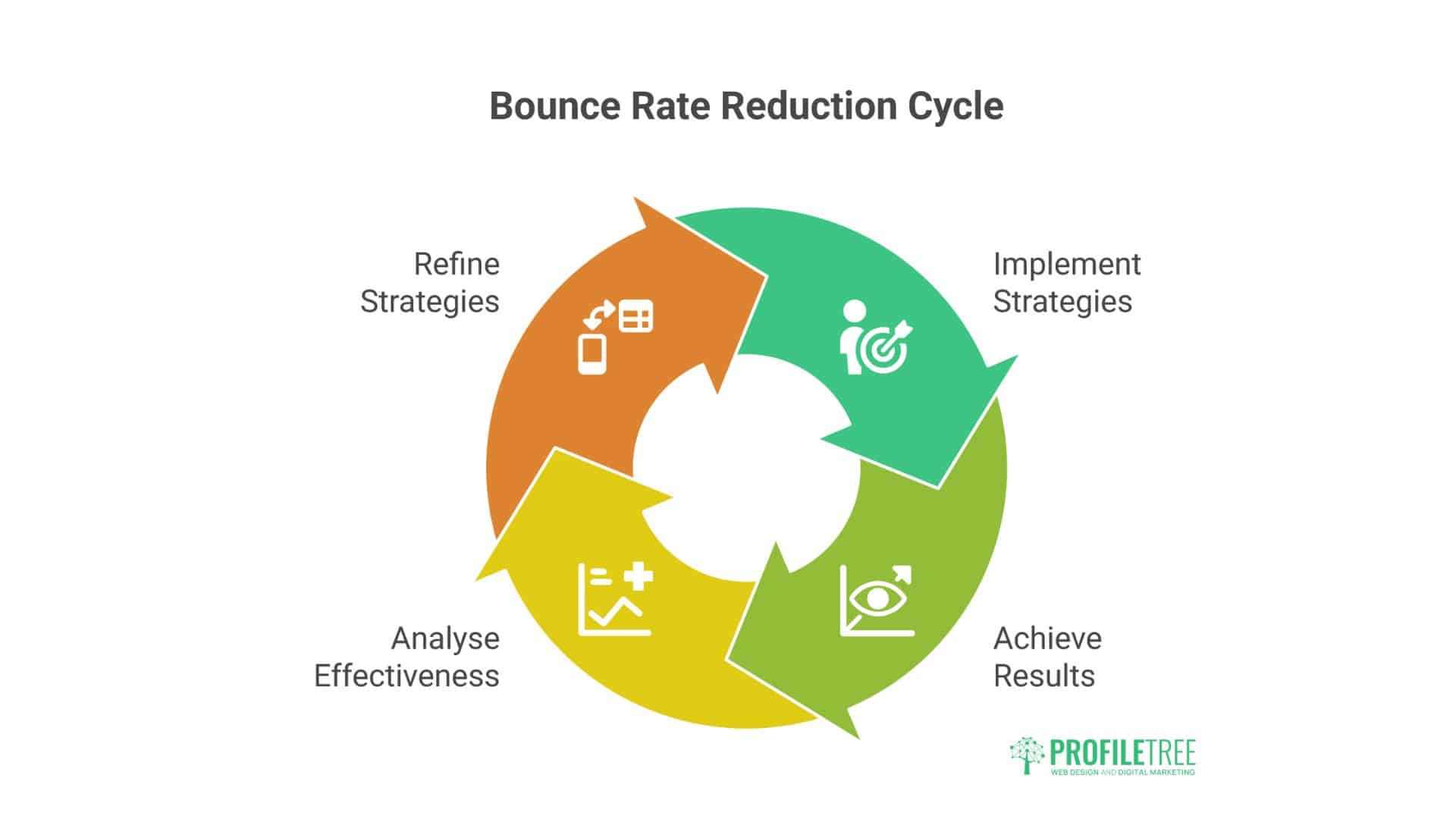
Real results from real businesses. Here’s how we’ve transformed bounce rates for companies across the UK and Ireland.
Belfast E-commerce Success Story
A Northern Ireland-based retailer approached ProfileTree with a 75% bounce rate on product pages. Through comprehensive analysis, we identified primary issues of slow page loading, poor mobile experience, and unclear product information.
Solution Implemented:
- Page speed optimisation, reducing load time from 6 seconds to 2 seconds
- Mobile-first responsive design implementation
- Enhanced product descriptions and high-quality image galleries
- Streamlined checkout process
Results: Bounce rate decreased from 75% to 45% within three months, resulting in a 40% increase in online sales.
B2B Service Provider Transformation
A Dublin-based software company struggled with an 80% bounce rate on its service landing pages despite strong organic traffic.
Our Approach:
- Comprehensive content audit and rewrite focusing on benefits over features
- Implementation of clear value propositions and social proof
- A/B testing of different page layouts and CTA placements
- Addition of video testimonials and case studies
Outcome: Bounce rate improved to 52%, with lead generation increasing by 65% over six months.
AI and Automation in Bounce Rate Optimisation
Technology is revolutionising how we approach bounce rate optimisation. Here’s how artificial intelligence and automation can accelerate your results.
Machine Learning Analytics
Modern bounce rate optimisation utilises AI tools to identify patterns and predict user behaviour. At ProfileTree, we implement AI-driven analytics to:
- Predict which visitors are likely to bounce based on behaviour patterns
- Automatically adjust content recommendations in real-time
- Identify optimal times for displaying engagement elements
Automated Testing Frameworks
Our AI training and implementation services include setting up automated A/B testing for continuous bounce rate optimisation. These systems automatically test headlines, images, layouts, and CTAs, learning from user interactions to improve performance.
Taking Insights from Your Bounce Rate
Raw numbers only tell part of the story. Here’s how to extract meaningful insights that drive smarter business decisions.
Beyond the Numbers
Bounce rate analysis should consider context and business objectives. A high bounce rate isn’t automatically negative if visitors accomplish their goals on a single page. Focus on quality metrics like:
- Time on page for bounced sessions
- Scroll depth before leaving
- Return visitor patterns
- Conversion rate among non-bounced traffic
Segment Analysis
Different traffic sources have varying bounce rate expectations:
- Organic Search: Users with specific queries may bounce after finding answers.
- Paid Search: Should have lower bounce rates due to targeted campaigns.
- Social Media: Often produces higher bounce rates but valuable brand exposure.
- Direct Traffic: Typically shows lower bounce rates from engaged audiences
Advanced Bounce Rate Strategies
For businesses ready to push beyond the basics, these sophisticated techniques can unlock significant competitive advantages.
Personalisation and Targeting
- Geographic Personalisation: Customise content based on visitor location, particularly effective for businesses serving multiple regions across the UK and Ireland.
- Device-Specific Optimisation: Create tailored experiences for mobile, tablet, and desktop users based on their unique needs and behaviour patterns.
- Behavioural Targeting: Use previous visit data to personalise content for returning visitors, showing them relevant information based on past interactions.
Content Hub Strategy
Developing comprehensive content hubs around core topics can significantly reduce bounce rates by providing multiple pathways for visitor engagement. Our content marketing services create interconnected content ecosystems that encourage exploration.
Bounce Rate Optimisation Tools and Technologies
The right tools make all the difference. Here’s your comprehensive guide to the platforms and technologies that power effective bounce rate optimisation.
Analytics and Testing Platforms
- Google Analytics 4: Essential for bounce rate monitoring and analysis.
- Hotjar/Crazy Egg: Heatmap tools revealing user behaviour patterns.
- Optimisely/VWO: A/B testing platforms for systematic optimisation.
- Google Optimise: Free testing tool for smaller-scale experiments
Technical Implementation Tools
- GTM (Google Tag Manager): Crucial for tracking and testing code implementation.
- PageSpeed Insights: Google’s tool for identifying speed optimisation opportunities.
- SEO Tools: Comprehensive analysis of technical factors affecting bounce rates
Common Bounce Rate Mistakes to Avoid
Even experienced marketers fall into these traps. Learn from others’ mistakes to avoid costly optimisation errors.
Over-Optimisation Pitfalls
- Popup Overload: Too many popups can increase bounce rates rather than reduce them.
- Auto-Playing Media: Videos or audio that start automatically often cause immediate exits.
- Complex Navigation: Overly complicated menu structures confuse visitors
Measurement Errors
- Tracking Issues: Incorrect Google Analytics implementation can skew bounce rate data.
- Bot Traffic: Failing to filter bot traffic leads to inaccurate bounce rate calculations.
- Cross-Domain Tracking: Poor implementation affects multi-site user journey analysis
Future of Bounce Rate Optimisation
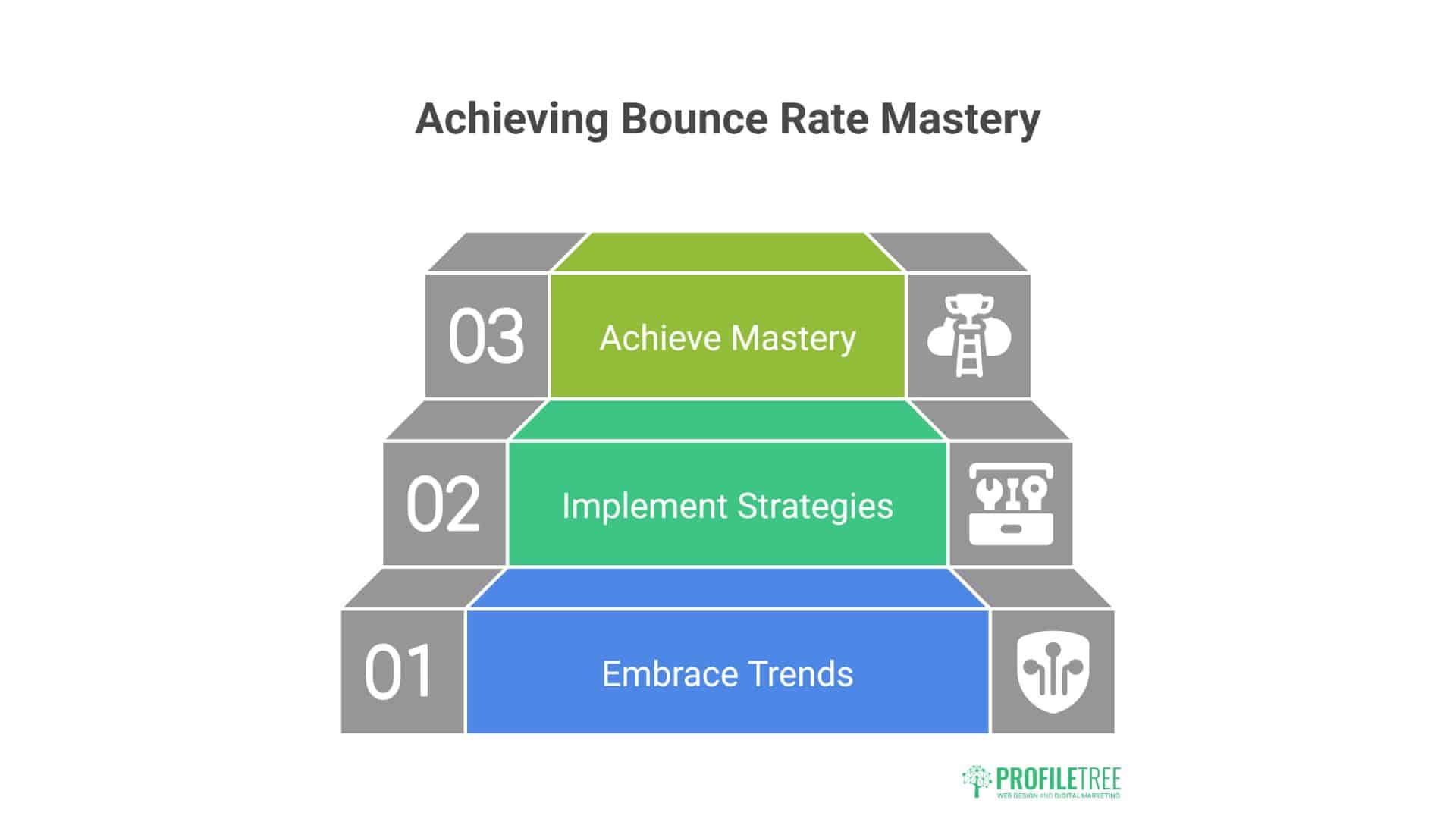
Stay ahead with emerging trends and technologies shaping bounce rate optimisation in the coming years.
Emerging Technologies
- Voice Search Optimisation: As voice queries increase, optimising for conversational search intent becomes crucial for reducing bounce rates.
- Progressive Web Apps: PWA technology can dramatically improve loading speeds and user experience, reducing device bounce rates.
- AI-Powered Personalisation: Machine learning algorithms will increasingly personalise user experiences in real-time, adapting content based on individual behaviour patterns.
Privacy and Analytics Evolution
With increasing privacy regulations and cookie restrictions, bounce rate measurement and optimisation will evolve. Businesses need to prepare for:
- Alternative engagement metrics beyond the traditional bounce rate
- First-party data collection strategies
- Privacy-compliant tracking methods
Conclusion
Understanding and optimising your Google Analytics bounce rate is crucial for maximising your digital marketing investment and improving user experience. High bounce rates signal missed opportunities, wasted advertising spend, and potential SEO challenges that compound over time.
At ProfileTree, we’ve helped businesses across the UK and Ireland transform their bounce rates through comprehensive strategies combining technical optimisation, content improvement, and user experience design. Our integrated approach addresses the root causes of high bounce rates while implementing sustainable solutions for long-term success.
Whether you need web design focused on conversion optimisation, content marketing that engages your audience, or AI-powered analytics to understand user behaviour, our team provides the expertise and tools necessary for bounce rate success.
FAQs
What is a reasonable bounce rate in Google Analytics?
A reasonable bounce rate varies by industry and page type. Generally, 26-40% is excellent, 41-55% is average, 56-70% is higher than average, and above 70% indicates potential issues requiring investigation.
Does time on page affect bounce rate calculation?
In traditional Google Analytics, time on page doesn’t affect bounce rate calculation. However, GA4’s engaged sessions consider sessions lasting over 10 seconds as engaged, effectively reducing the bounce rate for longer visits.
How do I calculate bounce rate manually?
Bounce rate equals single-page sessions divided by total sessions, multiplied by 100. For example: (500 single-page sessions ÷ 1000 total sessions) × 100 = 50% bounce rate.
Should I eliminate all bounces from my website?
Not necessarily. Some bounces are natural and positive, such as users finding contact information or answers to specific questions. Focus on reducing negative bounces while maintaining content that serves single-page user needs.
Transform Your Bounce Rate Into Business Growth
Your bounce rate is costing you money every day. At ProfileTree, we’ve transformed bounce rates for over 200 UK and Irish businesses, turning visitor problems into conversion success.
What You Get With Our Free Bounce Rate Analysis:
✅ Site Audit: Identify exactly why visitors are leaving your key pages
✅ Revenue Impact Report: Discover how much your bounce rate costs you monthly
✅ Quick-Win Fixes: Get 3-5 immediate improvements you can implement within weeks
✅ Custom Strategy: Receive a tailored optimisation roadmap
No obligations. No sales pressure. Just actionable insights.
[Get Your Free Analysis – Call 028 9568 0364 or Email hello@profiletree.com]