
SEO and Website Design: The SME Guide to Getting Both Right
Table of Contents
Most small and medium-sized businesses commission a website and then, a few months after launch, start thinking about SEO. By that point, the decisions that matter most have already been made. URL structures are set. Page hierarchies are locked in. The navigation is live. The hosting environment is running. Retrofitting search optimisation onto a site that was not built with it in mind is possible, but it costs more and delivers less than building it in from the start.
This guide is for business owners across Northern Ireland, Ireland, and the UK who want to understand how SEO and website design interact, what decisions need to be made before a designer opens a wireframe, and what to look for when choosing an agency to handle both.
ProfileTree, a Belfast-based web design and SEO agency, integrates search requirements into every web design brief before any visual design begins. The questions this guide answers are the same ones that shape how that process works in practice.
The Business Case: Why Design Decisions Are Ranking Decisions
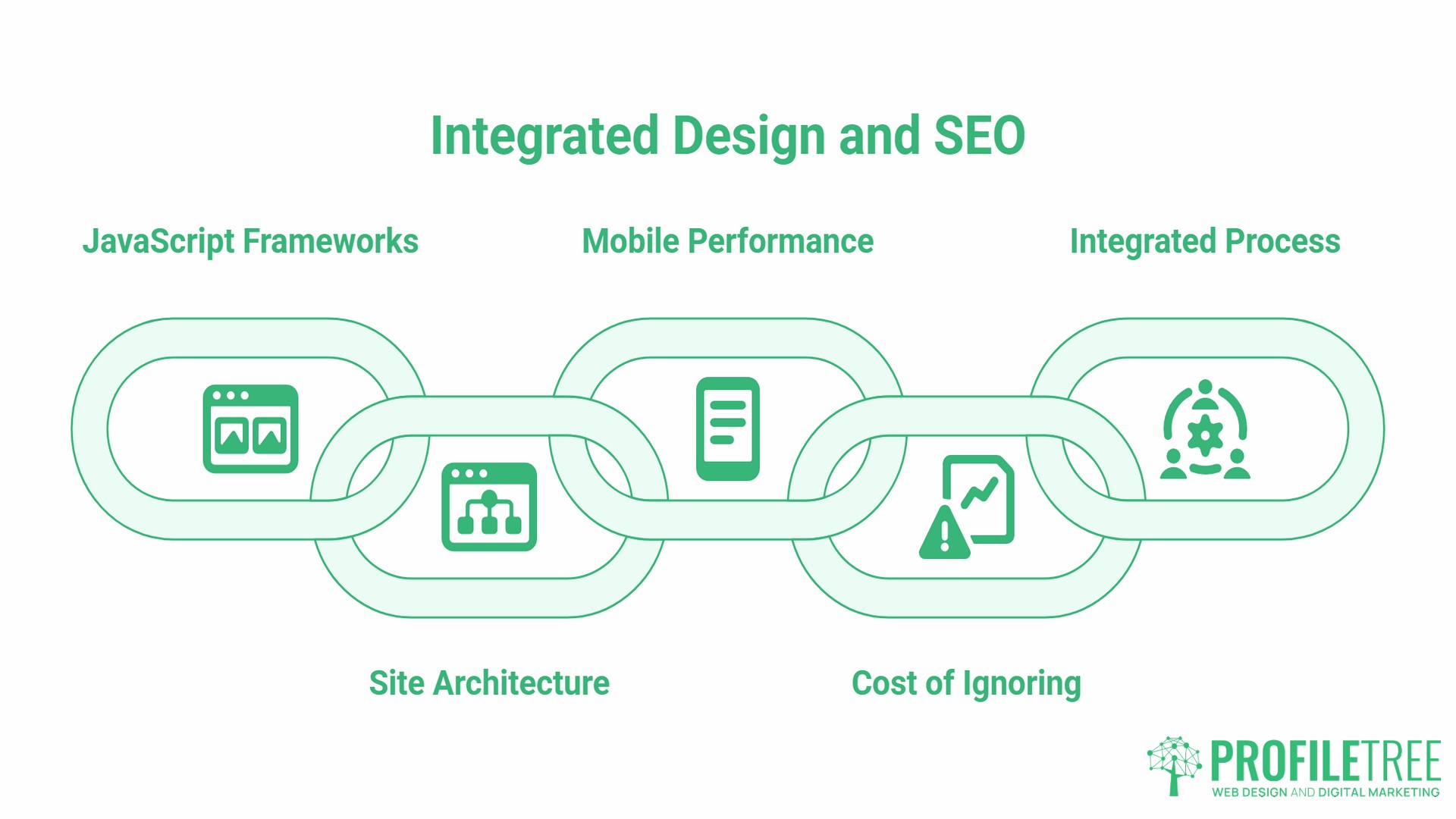
When a designer chooses a JavaScript-heavy framework for visual effect, they are also making an SEO and website design decision. When a developer sets up a flat site architecture with no logical hierarchy, they are constraining which pages can rank and for what. When a template is chosen for its appearance without checking its mobile performance score, that choice affects where the site sits in search results on the devices most of your customers use.
These are not technical footnotes. They are the foundation of whether a site gets found.
The cost of ignoring this at the brief stage shows up later in two ways. First, rankings plateau at positions that generate impressions but no clicks, because the structural signals are weak. Second, fixing the problems requires either significant redevelopment or a site migration, which introduces the risk of losing any existing rankings.
For a Belfast retailer, a Dublin accountancy practice, or a manufacturing business in Antrim, the practical consequence is the same: a website that looks professional but does not generate organic enquiries.
SEO and website design are not two separate services to buy in sequence. They are one integrated decision-making process, and both need to be on the table from the first conversation with your agency.
The Integrated Timeline: Does SEO or Web Design Come First?
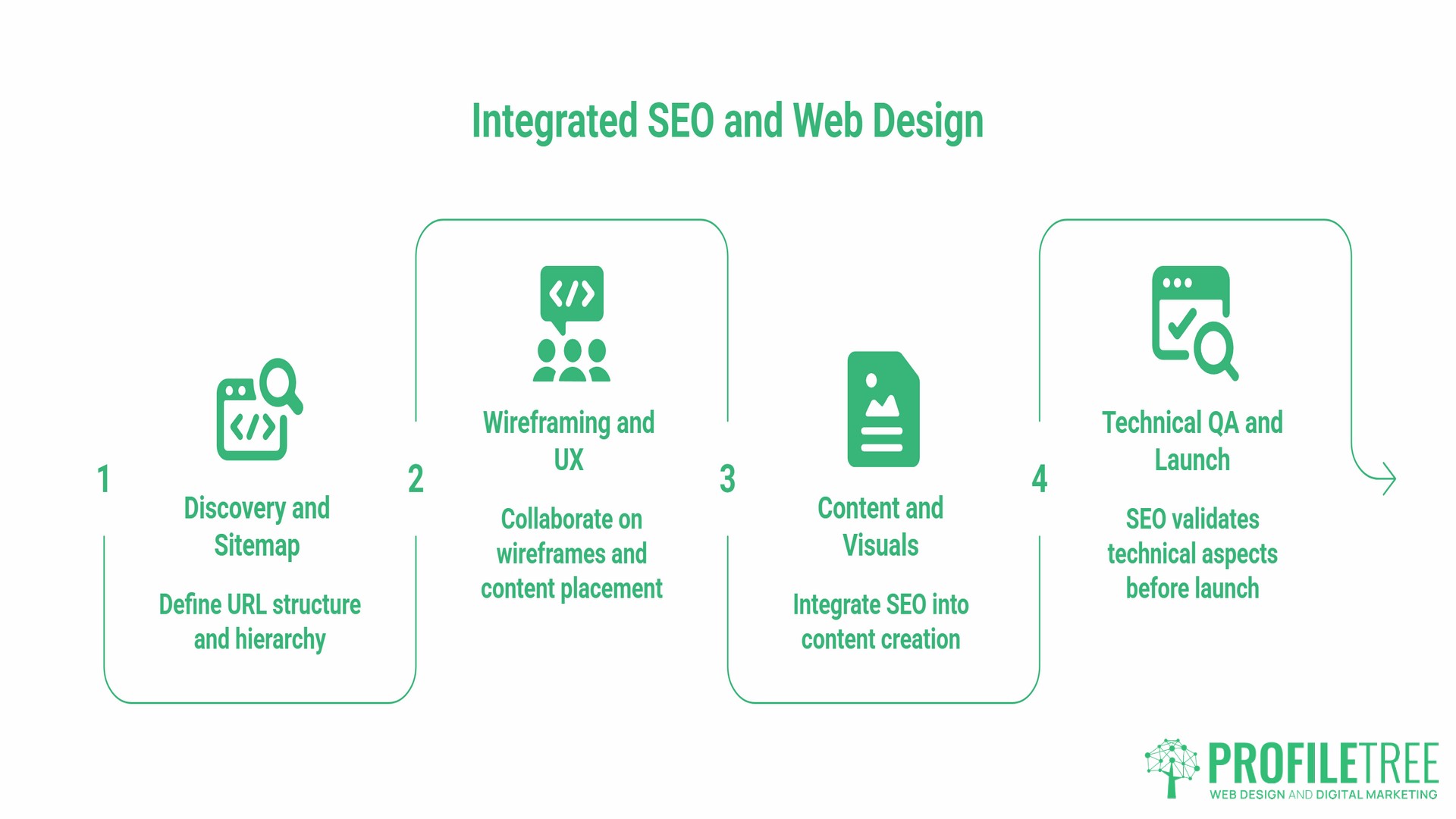
This is one of the most common questions SMEs ask. The honest answer is that SEO work begins before design work, and both run in parallel until launch.
Discovery and Sitemap (SEO Leads)
Before any page is designed, the site’s URL structure and page hierarchy should be defined by search intent. Which pages does the business need? What queries should each page target? How do the pages relate to each other in terms of internal linking and topic clusters?
Getting this right at the outset means the designer is building a structure that Google can crawl efficiently, rather than one that looks coherent visually but sends no clear signals about topical authority.
Wireframing and UX (Collaborative)
Once the page structure is agreed upon, designers and SEOs should work on wireframes together. Decisions about where to place the primary heading, how deep the navigation goes, where the main calls to action sit, and how content sections are sequenced all affect both user experience and how Google interprets the page.
A page where the most important content is buried below the fold, behind an animated entrance sequence, may look polished in a presentation but will underperform in search. Google’s indexing prioritises content that appears early in the HTML source, not content that appears after a JavaScript render.
Content and Visuals (Integrated)
Images, videos, and graphics need to be specified with SEO and website design requirements in mind. File formats, file sizes, descriptive filenames, and alt text are not afterthoughts. They affect page speed, a confirmed ranking factor, and how Google understands what a page is about.
For SMEs using video content, embedding hosted video with proper schema markup can generate rich results in search, giving a page more visual prominence in the SERP without any additional link building.
Technical QA and Launch (SEO Validates)
Before a site goes live, an SEO review should confirm that robots.txt is correctly configured, that canonical tags are in place where needed, that redirect chains from any old pages are resolved, and that the sitemap has been submitted. Launching without this check can mean handing Google a site it cannot index correctly on day one.
“The most expensive SEO mistake we see from SMEs,” says Ciaran Connolly, founder of ProfileTree, “is treating search as something to sort out after the website is live. By then, the architectural decisions have already determined the ceiling for what’s achievable. Building SEO into the brief from the start isn’t a premium add-on; it’s just how websites should be built.”
Technical Pillars of SEO-Friendly Web Design
The following elements are not optional extras. Any SEO and website design project for an SME operating in a competitive market needs to address all of them at the build stage.
Mobile-First vs Mobile-Responsive
These terms are often used interchangeably, but they describe different approaches. Mobile-responsive means a site adapts to smaller screens after being designed for desktop. Mobile-first means the design process starts with the smallest screen and scales up.
Google uses mobile-first indexing across all websites, meaning it crawls and ranks the mobile version of a site, not the desktop version. A site that was designed for desktop and resized for mobile may have content differences, slower load times on mobile, or navigation elements that are difficult to use on a touchscreen. All of these affect rankings.
For SMEs commissioning a new site or a redesign, the question to ask your designer is direct: are you designing this mobile-first?
Core Web Vitals: LCP, INP, and CLS
Google’s Core Web Vitals are page experience metrics that affect rankings. According to Google Search Central documentation, the three measures are:
- Largest Contentful Paint (LCP): How long it takes for the main content of a page to load. Google’s good threshold is under 2.5 seconds. Heavy hero images, render-blocking scripts, and slow hosting all push this up.
- Interaction to Next Paint (INP): How quickly the page responds to user interaction. Sites built on bloated page builders or poorly optimised themes often score poorly here.
- Cumulative Layout Shift (CLS): How much the page visually shifts as it loads. Google’s good threshold for CLS is 0.1 or lower. Cookie consent banners that appear after page load and push content down are a common source of CLS problems, particularly for UK and Irish sites subject to GDPR requirements. If your developer has not accounted for where the consent banner appears and how it affects layout, your CLS score will suffer.
A good web design agency will check Core Web Vitals scores at every stage of development, not just before launch. ProfileTree’s web development services include performance testing at the wireframe, build, and pre-launch stages.
URL Structure and Site Hierarchy
URLs should be short, descriptive, and structured to reflect the site’s topic hierarchy. A service page for a Belfast plumber should live at something like /plumbing-services-belfast/ rather than /page?id=47. The former tells Google exactly what the page is about and where it sits in the site’s structure. The latter tells Google nothing.
For sites with multiple services, locations, or product categories, a clear hierarchy also distributes link equity efficiently. Pages near the top of the hierarchy get more authority; pages buried six clicks deep get almost none.
The UK and Ireland Factor: Compliance and Performance
GDPR, Cookie Consent Banners, and Site Speed
This is a gap that most generic SEO and website design guides miss entirely. For businesses operating in the UK and Ireland, GDPR compliance requires an explicit consent mechanism for non-essential cookies. The way that mechanism is implemented directly affects site speed and Core Web Vitals scores.
Cookie consent scripts that load before the rest of the page can delay the LCP. Banners that appear after initial paint and cause content to shift contribute to CLS. If your web designer has not worked through how to implement consent management without degrading performance, you will pay for that oversight in rankings.
The solution is not to avoid consent mechanisms. It is to specify during the build phase that consent management must be implemented in a way that does not block the critical rendering path or cause a layout shift. This is a technical requirement that should appear in your project brief, not something to resolve after the site is live.
Hosting and Server Location for UK and Ireland Search
For businesses targeting customers in Northern Ireland, the Republic of Ireland, or Great Britain, hosting server location affects latency. A site hosted on a US server will consistently return slightly slower response times for users in Belfast or Dublin than a site hosted in the UK or Ireland.
For most sites, the difference in page speed is modest. But combined with other performance issues, it can contribute to slower LCP scores. Where possible, choosing UK- or Ireland-based hosting, or a content delivery network with strong local nodes, is the more search-friendly option.
Visual Elements: Aesthetics Versus Accessibility
Image Optimisation and Next-Generation Formats
Images are one of the most common causes of slow page load times on SME websites. A homepage hero image exported at full resolution from a design programme and uploaded without compression can easily add several seconds to the LCP on a mobile connection.
The practical requirements are straightforward: images should be exported in WebP or AVIF format where browser support allows, compressed to the smallest file size that preserves acceptable visual quality, and given descriptive filenames and alt text. Alt text serves both accessibility and SEO purposes; it tells screen readers and search engines what the image depicts.
The Problem with JavaScript-Heavy Frameworks
Some visual frameworks and page builders produce sites that look impressive in demos but generate substantial JavaScript payloads that browsers must download and execute before content becomes visible. For users on average mobile connections, this can mean several seconds of waiting.
Search engines have improved their ability to index JavaScript-rendered content, but it is slower and less reliable than indexing static HTML. For most SME sites, a well-built WordPress installation with a lightweight theme will outperform a JavaScript framework site on both speed and crawlability, without sacrificing design quality.
Accessibility (WCAG) as an SEO Signal
Designing for accessibility and designing for search overlap significantly. Pages that use semantic HTML headings in the correct hierarchy (one H1, logical H2 and H3 structure beneath it) are easier for screen readers to navigate and easier for search engines to understand. Pages with sufficient colour contrast, descriptive link text, and keyboard-navigable menus send stronger structural signals to crawlers.
UK businesses may also have compliance obligations under the Equality Act 2010. The same design standards that reduce legal risk also tend to improve search performance.
Content Design: Beyond the Blog Post
Typography, Readability, and Rankings
When assessing how well a page serves users, Google looks at engagement signals: whether visitors stay on a page, how far they scroll, and whether they interact with the content. Poor typography on mobile directly affects these signals. Text that is too small to read on a phone, or paragraphs that run to eight lines without a break, cause visitors to leave early.
Readable typography is not purely an aesthetic decision in the context of SEO and website design. It shapes how long visitors stay on a page and whether they move deeper into the site. Those behaviours feed into the engagement signals that influence rankings over time.
CRO and Search Intent Alignment
Conversion rate optimisation (CRO) and SEO work from the same starting point: understanding what a user is trying to do when they land on a page and making it as easy as possible for them to do it.
A page targeting web design services in Belfast should deliver a clear explanation of what the service covers, evidence that the agency can deliver, and a simple next step. If the page instead leads with a generic agency overview and buries the service details behind three scrolls, both the user and Google receive a weaker signal about what the page is for.
Aligning page content with search intent at the design stage, rather than editing it afterwards, produces better rankings and better conversion rates from the same traffic. ProfileTree’s web development services include CRO as a standard part of the build process, not a separate engagement.
The SEO and Web Design Checklist for SMEs
The following checklist brings together the key requirements from this guide. Use it before signing off on any SEO and website design brief or accepting a completed build.
Before the build starts
- URL structure and page hierarchy are defined by search intent, not by the designer’s navigation preferences
- Primary keyword for each page is agreed and documented in the brief
- Mobile-first design confirmed as the starting point, not mobile-responsive as an afterthought
- Hosting location specified (UK or Ireland preferred for local search targets)
- Consent management approach agreed and scoped to avoid CLS and LCP impact
During the build
- Core Web Vitals scores checked at the wireframe and mid-build stages
- Images exported in WebP or AVIF format with descriptive filenames and alt text
- Heading hierarchy validated (one H1 per page, logical H2/H3 structure)
- Internal linking structure mapped, with the most important service pages linked from multiple locations
- JavaScript payload assessed; render-blocking scripts removed or deferred
Before launch
- robots.txt reviewed and tested
- Canonical tags in place for any pages with similar or duplicate content
- 301 redirects mapped and implemented for any pages, replacing old URLs
- XML sitemap generated and submitted to Google Search Console
- Mobile performance tested on real devices, not just browser emulators
- GDPR consent mechanism live and tested for layout impact
A redesign without this checklist carries real risk. Sites that launch with redirect errors, missing canonical tags, or broken internal structures can lose existing rankings within weeks, rankings that may take months to recover.
For SMEs planning a redesign, ProfileTree’s web design services include a pre-launch SEO validation as standard.
FAQs
Does web design affect SEO?
Yes, directly. Web design decisions determine how easily search engines can crawl and index a site, how fast pages load, how well the site performs on mobile, and how clearly each page signals its topic. A site with poor technical foundations will not rank well, regardless of how much content work or link building is done.
What comes first, SEO or web design?
Effective SEO and website design are parallel processes from the outset. The site’s URL structure, page hierarchy, and content requirements should be defined by search intent before any visual design begins. Wireframing and design then happen alongside ongoing SEO input, with technical validation before launch. Treating them as sequential rather than parallel is where most SME projects go wrong.
Can a poorly designed website hurt SEO rankings?
Yes. Slow page load times, confusing navigation, poor mobile performance, and high bounce rates all signal to search engines that a site is not user-friendly. A site that looks attractive but functions poorly will see users leave quickly, which, over time, suppresses rankings even for pages that were initially ranking well.
Is SEO part of web development or web design?
It spans both. Visual design decisions affect user engagement, readability, and mobile performance. Development decisions affect crawlability, page speed, URL structure, and schema markup. An agency that handles SEO and website design as integrated disciplines from the brief stage will produce stronger results than one treating them as separate services.
How do I make my website design SEO-friendly from the start?
Define your page structure and target keywords before design begins. Choose a lightweight, well-coded framework or CMS. Design for mobile first. Test Core Web Vitals throughout the build. Implement proper heading hierarchy, image optimisation, and internal linking before launch. Use Google Search Console from day one to monitor indexing and performance.
Does my site’s hosting location matter for UK and Ireland SEO?
For businesses targeting customers in the UK or Ireland, hosting on UK- or Ireland-based servers reduces latency and can improve LCP scores. The effect is modest on its own but meaningful when combined with other performance optimisations. It is a simple decision to make correctly at the outset.
Will a website redesign damage my current rankings?
It can, if not managed properly. The main risks are broken redirect chains (pages that previously ranked now return 404 errors), changes to URL structures without 301 redirects, and new pages that lack the internal links the old pages had. A pre-launch SEO audit and a complete 301 redirect map are the minimum requirements for any redesign. ProfileTree’s SEO services include redesign migration support as a specific offering.