
Corporate Animation Production: Belfast and Dublin’s Best Services
Table of Contents
Corporate animation Production transforms complex business messages into memorable visual experiences that employees want to watch and customers genuinely understand. Forward-thinking companies across Belfast, Dublin, and throughout Ireland are discovering that professional animation delivers training outcomes, brand engagement, and communication clarity that traditional methods simply cannot match.
The numbers speak volumes: animated training content increases information retention by 82% compared to text-based materials, while branded animation generates 4.5 times more social shares than static graphics. Professional animation production creates distinct advantages in employee development, customer education, and market positioning for businesses operating in competitive Irish markets.
Yet most companies still rely on PowerPoint presentations, PDF manuals, and talking-head videos that fail to engage modern audiences accustomed to high-quality visual content. The gap between what employees and customers expect and what businesses deliver represents both a challenge and an opportunity for organisations ready to invest in professional animation production.
Why Belfast and Dublin Businesses Choose Professional Animation
Professional animation solves business challenges plaguing companies across Northern Ireland and the Republic. Explainer animations make complex products understandable. Dry compliance training transforms into engaging narratives. Motion graphics make abstract services tangible. Character animation brings brand stories to life and builds emotional connections.
Belfast’s growing technology sector particularly benefits from animation’s ability to simplify technical concepts for non-technical audiences. Software companies use animated demonstrations to showcase functionality without overwhelming viewers with interface complexity. Fintech startups employ motion graphics to explain financial processes that would otherwise require lengthy documentation.
Dublin’s international business hub demands content transcending language barriers and cultural differences. Animation provides a universal visual language communicating effectively across diverse workforce populations and global customer bases. Multinational corporations with Irish headquarters use animation to maintain consistent messaging across all markets, allowing local customisation through voiceover changes.
The creative industries thriving in both cities provide rich talent pools for animation production, combining technical expertise with storytelling capabilities. This concentration of skills makes Belfast and Dublin ideal locations for companies seeking professional animation partners who understand both creative excellence and business objectives.
Cost considerations also favour animation over live-action video for many corporate applications. Once created, animated assets can be updated, repurposed, and localised without expensive reshoots. Characters don’t age, locations don’t require permits, and weather never delays production schedules.
Types of Corporate Animation for Business Success
Corporate animation encompasses distinct formats that serve specific business objectives, from explainer videos that simplify complex services to motion graphics that enhance brand presentations and 3D visualisations that demonstrate product functionality. Each animation type delivers unique advantages: whiteboard animations excel at educational content and process explanation, character-based animations build emotional connections with audiences, and kinetic typography transforms data presentations into engaging visual narratives that maintain viewer attention while communicating key business messages effectively.
Explainer Animations
Explainer animations distil complex propositions into digestible visual stories lasting 60-90 seconds. These productions combine clear narratives, engaging visuals, and strategic messaging to communicate what businesses do, how they do it, and why it matters. Professional explainer animations achieve average view completion rates of 85%, significantly higher than any other video format.
Irish SaaS companies use explainer animations to demonstrate software capabilities without requiring viewers to navigate interfaces. Manufacturing firms showcase production processes through stylised representations highlighting quality and innovation without revealing proprietary techniques. Service businesses visualise intangible offerings through metaphors and analogies that make abstract concepts concrete.
Training and Educational Animation
Animated training content revolutionises employee development by making learning enjoyable rather than endured. Character-based scenarios allow staff to observe best practices and common mistakes without real-world consequences. Interactive animations enable learners to make decisions and see outcomes, improving knowledge retention through active participation.
Health and safety training particularly benefits from animation’s ability to safely demonstrate dangerous situations. Construction companies across Ireland use animated sequences showing accident scenarios that would be impossible or unethical to film. Retail organisations employ character animations to demonstrate customer service excellence in various challenging situations.
Onboarding animations introduce new employees to company culture, values, and procedures through engaging narratives rather than handbook reading. These productions reduce time-to-productivity for new hires while ensuring consistent information delivery regardless of who conducts orientation sessions.
Motion Graphics and Data Visualisation
Motion graphics transform statistics, processes, and relationships into dynamic visual stories that viewers understand instantly. Annual reports come alive through animated infographics that make financial performance accessible to all stakeholders. Marketing presentations gain impact through kinetic typography that reinforces key messages.
Data visualisation through animation helps Belfast and Dublin businesses effectively communicate research findings, market insights, and performance metrics. Animated charts and graphs reveal trends and patterns that static presentations obscure. Complex customer journeys become clear through animated flowcharts that show touchpoints, decision factors, and optimisation opportunities.
Brand Story and Culture Animations
Brand animations communicate company values, mission, and personality through visual narratives that resonate emotionally with audiences. These productions go beyond logos and colour schemes to express what organisations stand for and why they exist. Professional brand animations create memorable impressions that differentiate companies in crowded markets.
Recruitment animations showcase company culture to potential employees, which is particularly important for Belfast and Dublin businesses competing for scarce technical talent. These productions present authentic glimpses into working environments, team dynamics, and growth opportunities that job descriptions cannot convey.
Product Demonstration Animations
Product animations showcase features and benefits without physical limitations. 3D animations reveal internal components, demonstrate assembly processes, and highlight innovations impossible to capture through conventional filming. Software products gain tangible form through interface animations that guide users through key functionalities.
Medical device companies use anatomical animations to show how products interact with human bodies. Engineering firms employ technical animations to demonstrate mechanical principles and performance advantages. Technology companies create product animations that simplify complex architectures into understandable visual representations.
The Animation Production Process for Corporate Projects

Corporate animation production follows a structured workflow that begins with creative briefing and concept development, progresses through scriptwriting and storyboarding phases, and then advances to animation creation and post-production refinement. This systematic process typically spans 6-12 weeks, depending on complexity, requiring close collaboration between clients and animation teams to ensure messaging accuracy, brand alignment, and technical specifications that meet distribution requirements across various platforms and presentation contexts.
Discovery and Strategy Phase
Professional animation production begins with comprehensive discovery sessions that uncover project objectives, audience insights, and success metrics. This phase establishes creative direction while ensuring alignment with broader business goals. Belfast and Dublin animation studios that skip this crucial stage often deliver beautiful animations that fail to achieve intended outcomes.
Audience analysis identifies viewer demographics, knowledge levels, and viewing contexts influencing creative decisions. B2B animations require different approaches from internal training content. Technical audiences appreciate detailed accuracy, while general viewers need simplified representations.
Message architecture determines what information to include, emphasise, or exclude. Professional animators understand that corporate animation must balance completeness with clarity, ensuring key points register without overwhelming viewers with secondary details.
Script Development and Storyboarding
Scripts form animation foundations, establishing narratives that carry viewers through intended journeys. Professional scriptwriters craft concise copy that works harmoniously with visual elements rather than competing for attention. Every word earns inclusion by advancing stories or clarifying concepts.
Corporate animation scripts require particular precision. Compliance training must include mandatory information accurately. Brand stories need to reflect approved messaging frameworks. Product demonstrations must highlight genuine capabilities without exaggeration.
Storyboards translate scripts into visual sequences, showing how animations will look and flow. Professional storyboard artists create detailed frames that allow stakeholders to evaluate concepts before expensive production begins. This stage catches potential issues early, preventing costly revisions during animation phases.
Style frames establish visual languages for projects, defining colour palettes, character designs, typography treatments, and animation techniques. These guides ensure consistency across productions while providing references for all team members.
Design and Asset Creation
Design phases bring storyboards to life through detailed artwork creation. Character designers develop personas that represent target audiences or embody brand personalities. Background artists create environments that support narratives without distracting from the main actions. Graphic designers produce supporting elements, including icons, charts, and interface components.
Professional corporate animation requires design decisions that balance creativity with practicality. Characters must be appealing yet appropriate for business contexts. Colour schemes need to work within brand guidelines while maintaining visual interest. Typography must remain legible across various display sizes and viewing conditions.
Asset libraries streamline future productions by creating reusable elements. Character rigs allow different animations using consistent designs. Background templates enable quick scene creation. Motion graphic toolkits provide consistent visual treatments across multiple projects.
Animation and Motion Design
Animation brings static designs to life through movement that guides attention, explains processes, and creates emotional connections. Professional animators understand timing principles that make motions feel natural rather than mechanical. Easing functions add polish that distinguishes professional work from amateur attempts.
Different animation styles suit various corporate purposes. Smooth character animation works well for training scenarios requiring emotional engagement. Snappy motion graphics suit data presentations demanding clarity and impact. Subtle ambient animations add sophistication to brand stories without overwhelming messages.
Technical execution requires powerful hardware and professional software that many businesses lack internally. Render farms process complex animations efficiently. Version control systems manage iterations across distributed teams. Professional studios invest in infrastructure that ensures reliable delivery schedules.
Sound Design and Voiceover
Audio elements transform good animations into great ones through professional voiceover recording, sound effects, and music selection. Voice talent must match brand personalities while delivering precise, engaging narration. Belfast and Dublin offer diverse voice artists capable of various accents and styles suited to different markets.
Sound effects add dimension to animations, making actions feel substantial and environments believable. Professional sound designers select or create effects that enhance rather than distract, maintaining appropriate volumes and frequencies for comfortable listening.
Music selection requires careful consideration of mood, pace, and rights management. Original compositions provide unique soundtracks that competitors cannot replicate. Library music offers cost-effective solutions when budgets constrain custom composition. Either approach must align with brand guidelines and audience expectations.
Review and Refinement
Professional animation production includes structured review processes that gather stakeholder feedback efficiently. Online review platforms allow distributed teams to comment on specific frames or sequences. Consolidated feedback prevents contradictory revision requests that delay projects and inflate budgets.
Iteration cycles refine animations based on feedback while maintaining project timelines. Professional studios anticipate reasonable revision rounds within quotations rather than treating changes as expensive extras. Clear communication about what constitutes reasonable revisions versus scope changes prevents misunderstandings.
Final delivery includes multiple format exports optimised for intended distribution channels. Web versions balance quality with file sizes for smooth streaming. Presentation versions maintain maximum quality for projection systems. Social media editions include aspect ratios and captions for platform-specific requirements.
Animation Styles and Techniques for Corporate Content
Corporate animation styles range from minimalist flat design and isometric illustrations that convey professionalism and clarity to sophisticated 3D renderings and photorealistic visualisations that precisely demonstrate complex products or services. Style selection should align with brand identity and audience expectations: financial services often benefit from clean, geometric animations that convey trustworthiness. At the same time, technology companies may leverage dynamic motion graphics and particle effects that suggest innovation and cutting-edge capabilities.
2D Character Animation
Two-dimensional character animation creates relatable personas that guide viewers through corporate narratives. This style works particularly well for training content where employees must see themselves in situations. Characters can represent diverse demographics, ensuring all staff members feel included and engaged.
Professional character animation requires an understanding of movement principles that make actions believable. Anticipation prepares viewers for actions. Follow-through adds realism to movements. Secondary animation on clothing or hair adds polish that elevates production quality.
Belfast and Dublin businesses often choose 2D character animation for its balance of engagement and affordability. Production costs remain lower than 3D alternatives while the animation delivers superior results to static presentations or basic motion graphics.
3D Animation and Modelling
Three-dimensional animation provides photorealistic or stylised representations of products, environments, and processes. This technique excels at showing internal mechanisms, demonstrating assembly procedures, and creating immersive experiences that 2D animation cannot achieve.
Corporate 3D animation applications include architectural visualisations for property developers, product demonstrations for manufacturers, and process illustrations for engineering firms. The ability to show objects from any angle and scale provides unmatched flexibility for technical communication.
Professional 3D production requires specialised modelling, texturing, lighting, and rendering expertise. Belfast and Dublin animation studios with 3D capabilities offer advantages for companies needing photorealistic quality or complex technical visualisations.
Motion Graphics and Kinetic Typography
Motion graphics combine graphic design with animation to create dynamic visual communications. This style suits corporate applications requiring a clear information hierarchy, such as financial reports, marketing statistics, and process explanations.
Kinetic typography animates text to reinforce messages through movement. Words appear, transform, and interact in ways that emphasise meaning and maintain attention. Professional motion designers understand typography principles that ensure readability while adding visual interest.
Irish businesses favour motion graphics for their versatility and professional appearance. The style adapts easily to different brand guidelines, works across various content types, and updates efficiently when information changes.
Whiteboard and Sketch Animation
Whiteboard animation simulates hand-drawn illustrations appearing in real-time, creating engaging narratives that feel personal and approachable. This style works well for educational content, explainer videos, and situations where simplicity aids understanding.
Professional whiteboard animation goes beyond basic drawing effects. Skilled artists create custom illustrations that reflect brand identity. Smooth camera movements guide viewer attention. Careful pacing ensures concepts register before moving forward.
Despite apparent simplicity, quality whiteboard animation requires significant expertise. Poor execution results in amateur-looking content that damages rather than enhances brand perception.
Mixed Media and Hybrid Approaches
Combining animation styles creates unique visual experiences that stand out in crowded markets. Live-action footage with animated overlays adds information layers to real-world scenarios. 2D characters in 3D environments provide depth without full 3D production costs.
Professional studios understand how to blend techniques seamlessly. Consistent lighting, colour grading, and motion styles prevent jarring transitions between elements. Thoughtful integration ensures each technique serves specific purposes rather than showing off capabilities.
Optimising Corporate Animation for Internal Training
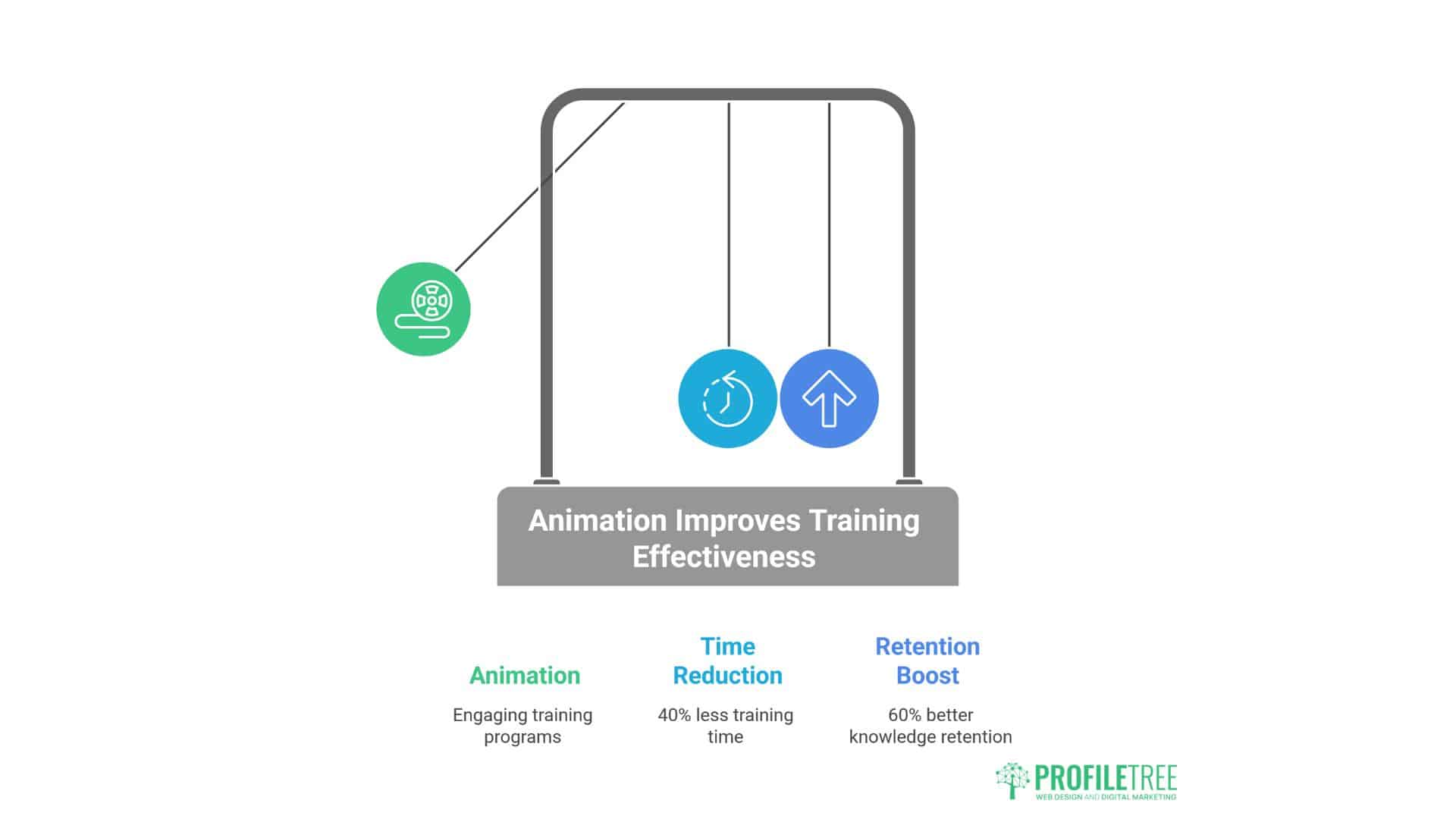
Internal training represents one of the highest-ROI applications for corporate animation. Belfast and Dublin businesses report average training time reductions of 40% and knowledge retention improvements of 60% after implementing animated training programmes.
Microlearning Modules
Short animation segments lasting 2-3 minutes allow employees to learn specific skills or concepts without lengthy time commitments. These bite-sized modules fit into busy schedules, enable just-in-time learning, and facilitate easy review when knowledge needs refreshing.
Professional microlearning animations focus on single learning objectives. Clear introductions establish what viewers will learn. Concise explanations deliver core content. Summary sections reinforce key points. Interactive elements test understanding.
The modular design enables flexible learning paths. Employees can complete required modules while choosing optional content based on their roles or interests. Managers can track completion and comprehension through learning management system integrations.
Scenario-Based Training
Animated scenarios place employees in realistic situations requiring decision-making and problem-solving. Unlike role-playing exercises that many find uncomfortable, animated scenarios provide safe environments for practising skills and learning from mistakes.
Customer service training benefits particularly from scenario animation. Employees observe challenging customer interactions, identify best practices, and understand the consequences of different approaches. Branching narratives allow learners to make choices and see outcomes, improving engagement and retention.
Compliance training through animated scenarios demonstrates real-world applications of policies and procedures. Rather than memorising rules, employees understand why guidelines exist and how to apply them appropriately.
Process Documentation
Animated process documentation clarifies complex procedures that text instructions or static diagrams cannot adequately convey. Step-by-step animations show exact sequences, highlight critical points, and demonstrate correct techniques without ambiguity.
Manufacturing companies use process animations to standardise operations across facilities. IT departments create animated guides for software deployments and troubleshooting procedures. HR teams develop animated workflows for administrative processes that ensure consistency and compliance.
Professional process animations include visual cues that prevent errors. Colour coding distinguishes different stages or components. Callouts highlight important details. Progress indicators show advancement through procedures.
Onboarding Experiences
Animated onboarding programmes introduce new employees to organisations through engaging narratives rather than handbook reading. These productions communicate culture, values, and expectations while providing practical information about policies, procedures, and resources.
Welcome animations featuring CEO messages personalised through animation create memorable first impressions. Virtual office tours familiarise remote employees with facilities they may rarely visit. Department introductions help new hires understand organisational structures and key contacts.
Gamified onboarding animations increase engagement through achievement systems, progress tracking, and friendly competition. New employees earn badges for completing modules, answering quiz questions for points, and comparing progress with cohort members.
Measuring ROI from Corporate Animation Investments
Corporate animation ROI measurement requires tracking specific business metrics beyond view counts, including lead generation increases, sales cycle reductions, training cost savings, and presentation effectiveness improvements, demonstrating tangible value creation. Successful measurement frameworks combine quantitative data, such as website conversion rates and email click-through improvements, with qualitative indicators, like brand perception surveys and stakeholder feedback, that reveal animation’s impact on business credibility, communication clarity, and competitive positioning in the marketplace.
Engagement Metrics
View completion rates provide immediate indicators of animation effectiveness. Professional corporate animations typically achieve 75-85% completion rates, compared to 20-30% for traditional training videos. Higher completion rates translate directly to better information transfer and improved outcomes.
Interaction metrics for interactive animations reveal engagement depth. Click-through rates on embedded calls-to-action, quiz completion percentages, and replay frequencies indicate whether content resonates with audiences. Professional animation studios build analytics capabilities into productions from inception.
Social sharing metrics matter for external-facing animations. Brand story animations that generate organic shares extend reach without additional advertising investment. Employee advocacy programmes benefit from shareable animation content that staff proudly distribute through personal networks.
Learning Outcomes
Knowledge assessment scores before and after animated training implementation quantify learning improvements. Companies typically see 25-40% score increases when replacing traditional training materials with professional animation. More importantly, knowledge retention remains higher months after training completion.
Time-to-competency metrics demonstrate efficiency gains from animated training. New employees reach productivity targets faster when onboarding, which includes animation. Existing staff members master new skills more quickly through animated instruction than traditional methods.
Error reduction provides tangible ROI evidence. Animated safety training reduces workplace accidents. Process animation decreases manufacturing defects. Compliance animation minimises regulatory violations. Each prevented incident represents cost savings that justify animation investments.
Business Impact Measurements
Sales enablement animations accelerate deal closures by helping prospects understand value propositions quickly. Companies report average sales cycle reductions of 23% when incorporating explainer animations into sales processes. Deal sizes often increase as buyers better understand product capabilities and applications.
Customer support cost reductions result from animated FAQ content and troubleshooting guides. Each support ticket prevented through self-service animation saves £15-50 in handling costs. Popular support animations prevent hundreds of tickets monthly, delivering substantial operational savings.
Employee satisfaction improvements from engaging training content reduce turnover costs. Animated onboarding programmes correlate with 35% lower first-year attrition rates. Considering replacement costs averaging £30,000 per employee, retention improvements provide significant returns.
Comparative Cost Analysis
Animation production costs must be evaluated against alternative approaches and their relative effectiveness. While professional animation requires higher initial investments than basic video or written materials, superior outcomes and extended lifespans deliver better total value.
Live-action video production for equivalent content typically costs 40-60% more than animation when factoring in location fees, talent costs, and reshoot requirements. When updates become necessary, animation changes cost less than video reshoots.
Traditional instructor-led training has hidden costs, including trainer salaries, travel expenses, facility rentals, and productivity losses from employee time away from work. Animated training eliminates these recurring costs while delivering consistent, quality experiences.
Choosing the Right Animation Partner in Belfast or Dublin
Selecting the right animation partner requires evaluating technical capabilities, industry experience, and cultural fit alongside practical considerations like project timelines, communication processes, and budget alignment that ensure successful collaboration. Belfast and Dublin animation studios offer distinct advantages: Belfast providers often deliver competitive pricing with access to skilled talent from the region’s strong creative sector. Dublin studios may provide broader international experience and proximity to major corporate clients, making location choice dependent on specific project requirements and business priorities.
Evaluating Portfolio Relevance
Portfolio quality matters less than portfolio relevance when selecting corporate animation partners. Studios creating beautiful entertainment content may lack an understanding of business communication requirements. See examples demonstrating precise message delivery, appropriate tone, and measurable outcomes.
Industry experience indicates familiarity with sector-specific requirements and regulations. Healthcare animations must maintain medical accuracy. Financial animations need compliance considerations. Technology animations require technical precision. Generalist studios may struggle with specialised requirements.
Client calibre suggests capability levels. Studios working with recognised brands demonstrate the ability to meet professional standards and manage complex stakeholder requirements. However, smaller studios hungry for growth often provide superior service and value for emerging companies.
Understanding Production Processes
Professional studios follow structured processes that ensure predictable outcomes. Clear project phases, defined deliverables, and transparent timelines indicate operational maturity. Ad-hoc approaches risk delays, budget overruns, and quality issues.
Communication protocols matter for smooth collaborations. How do studios gather requirements? What review tools do they provide? How do they handle feedback and revisions? Professional partners have answers ready and systems in place.
Technical capabilities determine what’s possible within budgets and timelines. In-house talent provides better control than freelance networks. Established infrastructure enables reliable delivery. Professional software licenses ensure compatibility and quality.
Local Versus Remote Considerations
Belfast and Dublin animation studios offer advantages, including face-to-face meetings, local market knowledge, and simplified project management. Time zone alignment facilitates real-time communication. Cultural understanding ensures appropriate creative approaches.
However, remote studios may provide specialised expertise or better value. Video conferencing enables effective collaboration regardless of location. Cloud-based review tools allow stakeholder participation from anywhere. The key lies in evaluating communication quality rather than physical proximity.
Hybrid approaches combine local project management with distributed production resources. Some Belfast and Dublin agencies maintain a local presence while utilising global talent networks. This model can deliver cost advantages while maintaining service quality.
The ProfileTree Advantage
At ProfileTree, we specialise in corporate animation that drives tangible business outcomes. Our Belfast team combines creative excellence with a deep understanding of what makes corporate communications effective. We’ve helped dozens of Irish businesses transform their training, marketing, and internal communications through strategic animation production.
Our approach begins with thoroughly discovering your objectives, audiences, and success metrics. We develop animation strategies that align with broader business goals rather than creating pretty pictures that miss the mark. Every creative decision supports your intended outcomes.
We excel at translating complex business concepts into engaging visual stories. Whether explaining technical products, demonstrating compliance procedures, or sharing brand values, our animations make the complicated clear and the mundane memorable.
Ciaran Connolly, founder of Profiletree, explains: “Corporate animation isn’t about entertainment—it’s about achieving specific business objectives through visual communication. We’ve seen clients reduce training time by 50% and increase message retention by 75% by replacing traditional materials with strategically designed animations. The key is understanding what drives behaviour change in professional contexts.”
Our integrated digital marketing expertise ensures animations work harder for your business. We optimise content for search engines, social media platforms, and conversion funnels. Animations become assets that attract traffic, generate leads, and support sales teams rather than one-off projects gathering digital dust.
Common Corporate Animation Mistakes to Avoid
Corporate animation projects frequently fail due to unclear objectives, inadequate planning, and unrealistic timeline expectations, resulting in rushed production, compromised quality, and content that fails to achieve intended business outcomes. Common mistakes include overcomplicating messaging with excessive information, choosing inappropriate animation styles that don’t align with brand identity or audience expectations, and neglecting to establish transparent approval processes that lead to costly revisions and project delays that undermine budget and timeline commitments.
Over-Complicating Visual Design
Corporate audiences appreciate professional quality but reject unnecessary complexity. Overly elaborate character designs, excessive visual effects, and cluttered compositions distract from messages rather than enhancing them. Professional animators understand that clarity beats complexity for business communication.
Simple, clean designs often communicate more effectively than intricate alternatives. Focus viewer attention on key information by using colour, movement, and space. Remove elements that don’t directly support communication objectives.
Ignoring Brand Guidelines
Animation offers creative freedom that tempts departure from established brand standards. However, consistency across all communications remains critical for corporate credibility. Professional animation studios work within brand guidelines while finding creative expression opportunities.
Colour palettes must match brand specifications, typography needs to follow established hierarchies, and tone and personality should align with brand positioning. Animation style becomes part of brand identity, requiring thoughtful consideration rather than trendy choices.
Forcing Unnecessary Length
Corporate animations often run longer than necessary because stakeholders want to include everything. Professional animators oppose kitchen-sink approaches, advocating for focused messages that respect viewers time and attention spans.
Optimal lengths depend on content types and distribution channels. Training modules can run longer when viewers expect educational content. Marketing animations need brevity to maintain engagement. Social media content requires even tighter editing for platform algorithms.
Neglecting Accessibility
Professional corporate animation includes accessibility features that ensure all employees and customers can benefit from the content. Captions support hearing-impaired viewers and enable watching in sound-sensitive environments, and audio descriptions assist visually impaired audiences.
Colour contrast ratios must meet accessibility standards. Text sizes need to remain readable on various devices. Animation speeds should allow comfortable comprehension without causing motion sensitivity issues.
Underestimating Update Requirements
Corporate content requires regular updates as products evolve, regulations change, and strategies shift. Animation production plans must consider future modification needs. Rigid approaches that make updates expensive or impossible waste initial investments.
Professional studios create modular animations that allow section updates without complete reproduction. They maintain project files enabling efficient modifications. They document technical specifications, ensuring continuity even if team members change.
Future Trends in Corporate Animation
Corporate animation trends are advancing toward interactive experiences, AI-powered content generation, and immersive technologies like augmented reality overlays that transform passive viewing into engaging, participatory brand experiences. Future developments include real-time animation customisation based on viewer data, voice-activated animated presentations, and integration with virtual meeting platforms that enable dynamic, responsive content delivery tailored to specific audiences and contexts during live business interactions.
Interactive and Personalised Experiences
Corporate animation increasingly incorporates interactive elements that transform passive viewing into active participation. Clickable hotspots provide additional information layers. Branching narratives adapt to viewer choices. Personalisation engines customise content based on viewer profiles.
Belfast and Dublin businesses experiment with animations that respond to real-time data. Sales presentations adapt to prospective industries. Training content adjusts to employee performance. Marketing animations reflect the viewer’s browsing history.
Artificial Intelligence Integration
AI tools accelerate certain animation production aspects while maintaining human creativity for storytelling and strategy. Automated lip-syncing speeds character animation. Machine learning improves motion capture processing. Natural language processing generates initial script drafts.
However, professional oversight remains essential. AI cannot replace the understanding of business objectives, audience psychology, and brand nuance that professional animators provide. The technology augments rather than replaces human expertise.
Extended Reality Applications
Augmented reality animations overlay digital content onto real-world environments through mobile devices. Product demonstrations show virtual objects in actual spaces. Training animations guide employees through physical procedures. Brand experiences create memorable interactions at events.
Virtual reality animation provides immersive experiences for high-value applications. Virtual facility tours allow remote evaluation of manufacturing capabilities. Safety training simulations create realistic hazard experiences without actual danger. Product configurators enable three-dimensional customisation exploration.
Sustainability and Authentic Storytelling
Corporate animation increasingly addresses environmental and social responsibilities as stakeholder expectations evolve. Authentic storytelling about sustainability initiatives, diversity commitments, and community contributions resonates more strongly than traditional capability presentations.
Animation allows companies to visualise future commitments and demonstrate progress toward goals. Carbon reduction roadmaps become understandable through animated timelines. Diversity initiatives gain emotional impact through character-driven narratives. Community investment stories connect local actions to the global effects.
Integrating Animation into Broader Digital Strategies
Corporate animation integration requires strategic alignment with existing digital marketing ecosystems, ensuring animated content complements website design, social media campaigns, email marketing, and sales presentations through consistent visual branding and messaging frameworks. Successful integration involves repurposing animation assets across multiple touchpoints—from website hero sections and social media snippets to sales deck elements and email campaign visuals—maximising content investment while maintaining cohesive brand experiences, reinforcing key messages throughout the customer journey.
Content Marketing Amplification
Animated content forms a cornerstone asset for comprehensive content marketing strategies. Single animations generate derivative content, including blog posts, social media snippets, email campaigns, and presentation slides. This multiplication effect maximises production investments.
SEO benefits from animation when properly optimised. Transcripts provide keyword-rich text content. Engaging animations increase time-on-page metrics. Social shares generate valuable backlinks. Video schema markup improves search visibility.
Multi-Channel Distribution
Professional corporate animations adapt across distribution channels through strategic versioning. Website hero animations capture immediate attention. LinkedIn versions include captions for silent autoplay. Email thumbnails entice click-throughs to landing pages.
Platform-specific optimisation ensures maximum impact. YouTube descriptions include detailed timestamps and links. Instagram versions fit square formats with attention-grabbing openings. PowerPoint exports enable sales team customisation.
Marketing Automation Integration
Animation content powers sophisticated marketing automation workflows. Prospect engagement with explainer animations triggers targeted follow-up sequences. Training completion data informs employee development paths. Support animation views indicate customer success opportunities.
Lead scoring algorithms weight animation engagement heavily, recognising that viewers investing time in video content show genuine interest. Progressive profiling captures information through gated premium animations. Behavioural triggers deliver relevant animations based on previous interactions.
Conclusion: Transforming Corporate Communications Through Professional Animation
Corporate animation represents a strategic investment in communication effectiveness that delivers measurable returns through improved training outcomes, enhanced brand perception, and accelerated business processes. Belfast and Dublin businesses that embrace professional animation production gain competitive advantages in talent development, customer engagement, and market differentiation.
The transformation from traditional corporate communications to animation-powered strategies requires commitment beyond individual projects. Successful programmes integrate animation throughout employee journeys and customer experiences, creating consistent, engaging touchpoints that drive desired behaviours and outcomes.
Professional production quality matters because corporate audiences judge company credibility partially through content quality. Amateur animations using template characters and stock motions signal a lack of investment in communication excellence. Professional animations demonstrating thoughtful design and polished execution reinforce perceptions of organisational competence.
Investment in professional corporate animation pays dividends through multiple vectors. Reduced training costs, improved employee performance, shortened sales cycles, and decreased support burdens combine to deliver returns that justify production investments. Companies report average 6-9 months payback periods for well-executed animation programmes.
For Belfast and Dublin businesses competing in global markets, professional animation levels the playing fields against larger competitors. High-quality animated content creates impressions of scale and sophistication that belie actual company sizes. Small firms can project professional images previously reserved for enterprises with massive production budgets.
The key to animation success lies in strategic planning that aligns production with business objectives. Random animated content without a clear purpose wastes resources and confuses audiences. Professional animation partners help develop comprehensive strategies that ensure every production contributes to broader goals.
Take action today by auditing current corporate communications for animation opportunities. Identify training materials that fail to engage employees. Find complex messages that customers struggle to understand. Discover brand stories that lack emotional resonance. These gaps represent immediate opportunities for animation impact.
Partner with experienced corporate animation specialists who understand business communication requirements. The right production partner becomes a strategic asset, delivering beautiful animations and measurable business improvements through visual storytelling excellence.
Contact ProfileTree’s animation team to explore how professional animation can transform your corporate communications. Visit ProfileTree’s animation services to see examples of our work and discuss your specific requirements. Let’s create animated content that drives real business results for your organisation.
FAQs
What’s the typical cost for corporate animation production in Belfast or Dublin?
Corporate animation production in Belfast and Dublin typically ranges from £2,000-£5,000 for basic motion graphics projects, £5,000-£15,000 for professional explainer animations or training modules, and £15,000-£50,000 for comprehensive animation campaigns including multiple videos and interactive elements. Investment levels depend on animation style, duration, complexity, and customisation requirements.
How long does professional corporate animation production take?
Professional corporate animation production typically requires 4-8 weeks from initial brief to final delivery. Simple motion graphics projects can be completed in 2-3 weeks, while complex character animations or 3D productions may need 10-12 weeks. Timeline factors include script development, stakeholder approvals, revision rounds, and technical complexity.
Should we produce animation internally or hire professional studios?
While basic motion graphics might suit internal production for regular content needs, professional studios deliver superior results for critical corporate communications, including training programmes, brand stories, and sales enablement content. Professional expertise in storytelling, animation principles, and technical execution creates quality differences that influence audience perception and business outcomes.
What makes animation more effective than live-action video for corporate training?
Animation excels at simplifying complex concepts, maintaining consistent quality across productions, and creating scenarios impossible or impractical to film. Animated training content typically achieves 40% better retention rates than live-action alternatives and costs less to update when processes change. Visualising abstract concepts and dangerous situations safely provides unique training advantages.
How do we measure success from corporate animation investments?
Success metrics for corporate animation include engagement rates (view completion, interaction frequency), learning outcomes (assessment scores, time-to-competency), and business impacts (sales cycle reduction, support ticket decreases, employee retention improvements). Professional studios build measurement capabilities into productions and provide analytics dashboards for ongoing performance monitoring.