
How to Add Personality to Your Business’s Social Media
Table of Contents
Most business social media accounts look the same. A promotional graphic on Monday, a product photo on Wednesday, and a quote card on Friday. The content is inoffensive and entirely forgettable.
The problem is not the posting frequency. It is the absence of a recognisable voice. When every post could have come from any business in your sector, there is no reason for someone to follow you specifically, share your content, or think of you when they need what you sell.
Adding personality to your social media is not about being quirky or trying too hard to be funny. It is about making it clear that real people run this business, that they have opinions and a point of view, and that they are worth paying attention to. This guide covers six practical ways to do that, with examples that work for SMEs with modest time and budgets.
1. Tell the Story Behind Your Business
Every business started somewhere. The circumstances that led someone to start a company, the problems they set out to solve, and the decisions they made along the way are all genuinely interesting to the people those decisions affect. That is your audience.
Why Origin Stories Build Trust
Storytelling works on social media because it creates an emotional response that purely informational content does not. A post announcing a new service gets scrolled past. A post explaining why you started offering that service after watching a client struggle with the same problem for two years gets read, liked, and shared.
Trust is built through specificity. Vague origin stories (“we wanted to help businesses grow”) are forgettable because they apply to every company. Specific ones (“we started because our founder spent six months trying to find a web agency that would actually answer the phone”) are memorable because they feel real.
How to Tell It On Social Media
You do not need to write a 1,000-word blog post. A three-paragraph LinkedIn post, a short Instagram caption accompanying a photo from the early days, or a 60-second video of the founder talking directly to the camera are all effective formats. The key is to include something specific: a year, a decision, a setback, a moment when things changed.
The story should connect to something your audience cares about. If you run a web design agency, the story of struggling with a slow, outdated website before you knew how to fix one will resonate with people who are dealing with the same thing right now. That connection is what turns a story into a piece of content people want to share.
2. Show the People Behind the Business
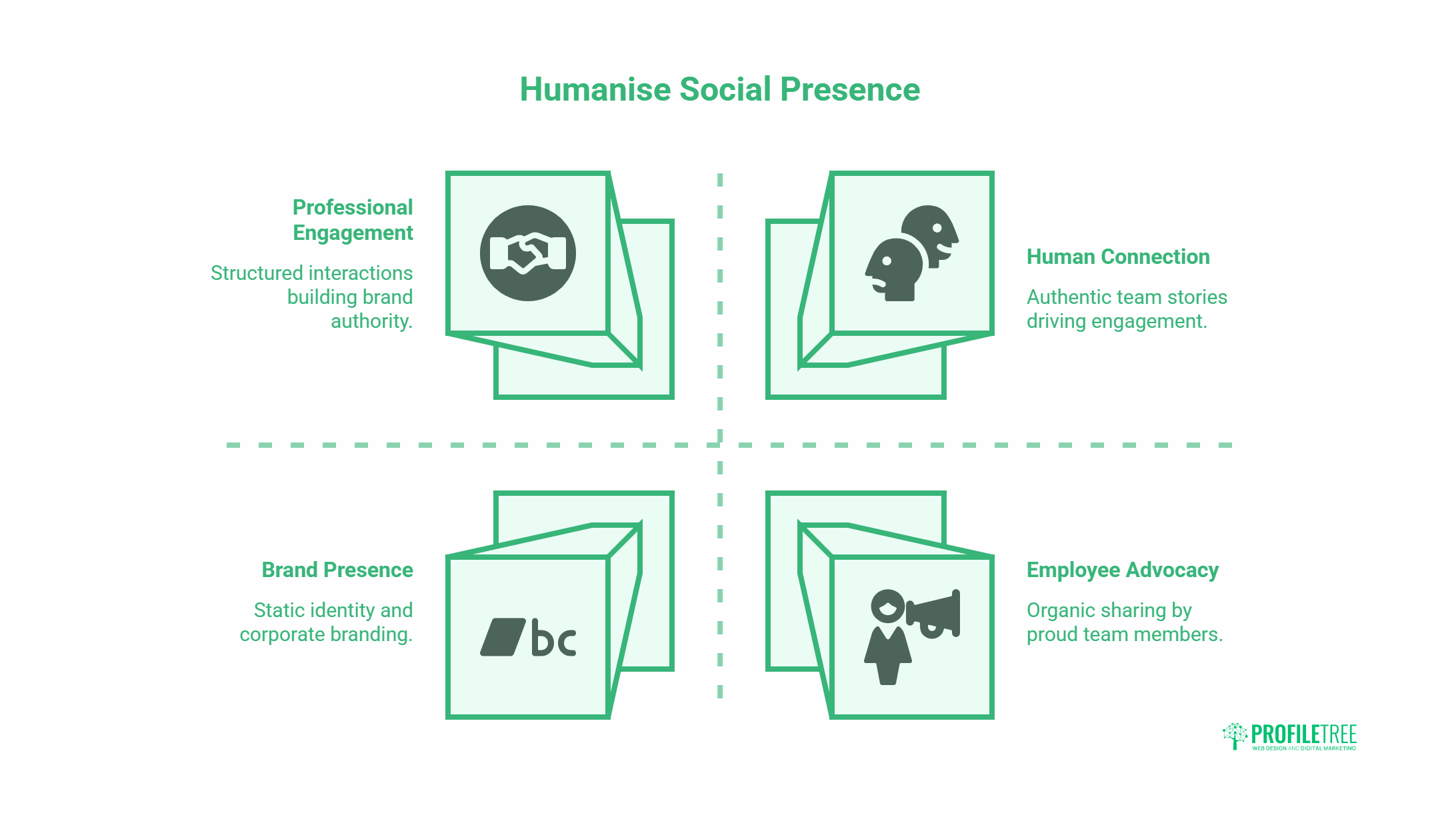
People connect with people, not with logos. One of the fastest ways to add personality to your social media is to feature the team regularly and naturally, rather than keeping everything at the level of the brand.
Team Content That Works Without Being Forced
This does not mean posting a formal group photo once a year and calling it done. It means creating a habit of capturing the people who do the work: someone at their desk in the middle of a project, a brief video of a team member explaining something they know well, a behind-the-scenes shot from a client visit or an event.
The goal is to make the business feel like a place with culture, not just a service provider. When a potential client sees the person they might end up working with before they ever contact you, it removes friction. They already have a mental picture of who they are dealing with.
Turning Employees Into Genuine Advocates
Encouraging team members to share company content with their own networks is a straightforward way to extend organic reach without increasing the content budget. It works best when it is voluntary and when people are sharing things they are genuinely proud of, rather than being asked to broadcast generic promotional posts.
If a team member has done strong work on a project, a short post celebrating that work is something they are likely to want to share. The same applies to professional development, events, and milestones. When employees are proud of what they are part of, the advocacy follows naturally.
3. Write with a Consistent Brand Voice
Brand voice is the personality of your business expressed through language. It determines whether your social media sounds formal or conversational, warm or direct, playful or serious. Most businesses do not have a consistent voice because no one has deliberately decided what that voice should be.
Defining Your Voice Before You Write
The most practical way to define a brand voice is to choose three to five adjectives that describe how you want your business to come across, then test every piece of content against them. If you decide your voice is direct, practical, and unpretentious, a post that opens with “We are thrilled to announce an exciting new development” fails all three. A post that opens with “We have added a new service. Here is what it does and who it is for” passes all three.
This is not about rigid rules. It is about consistency. When someone reads your posts over time, they should develop a clear sense of who you are, not wonder whether they are looking at the same account from one week to the next.
Voice Across Different Platforms
The tone can shift slightly between platforms while the underlying voice stays the same. LinkedIn rewards a slightly more considered tone; Instagram and TikTok reward brevity and informality. But the character of the business should be recognisable in both places. If your business is known for being straightforward and honest, that quality should show up whether you are writing a LinkedIn article or a caption under a product photo.
Ciaran Connolly, founder of ProfileTree, puts it this way: “The businesses that get the most out of social media are the ones that stop trying to sound like a brand and start sounding like the people running the business. Audiences can tell the difference immediately.”
A well-defined voice also makes content creation faster and easier. When there is a clear standard for how the business communicates, decisions about whether a post sounds right become instinctive rather than laboured. If you want support building this out, ProfileTree’s social media marketing service includes brand voice development alongside channel management.
4. Use Trends Selectively and Relevantly
Participating in trending topics, formats, and conversations can give your content a short-term visibility boost and demonstrate that your business is current and aware of what is happening in the world. The keyword is selectively.
When Trend-Following Adds to Your Brand
Trends are worth engaging with when they connect naturally to what your business does or to something your audience cares about. A digital marketing agency joining a conversation about a major social platform update is credible and timely. The same agency posting a meme about a celebrity story that has nothing to do with their audience or services is noise, not personality.
The filter to apply is simple: would my ideal client find this relevant or useful, or does it just show that I know what is happening on the internet? The former builds a connection. The latter is more likely to be ignored or, worse, to make the brand seem unfocused.
Formats that Carry Personality Reliably
Beyond moment-specific trends, certain content formats have a consistent track record for showing brand personality. Short video, in particular, is the format where personality comes through most clearly. Someone talking naturally to a camera, explaining something they know well, carries more personality than any designed graphic. Video content does not need high production values to be effective on social media; it needs to be genuine and useful.
Reactive content, where a business responds to an industry development, a common client question, or a piece of news relevant to their audience, also carries strong personality signals. It demonstrates that there are informed people behind the account who are paying attention.
5. Use and Share User-Generated Content
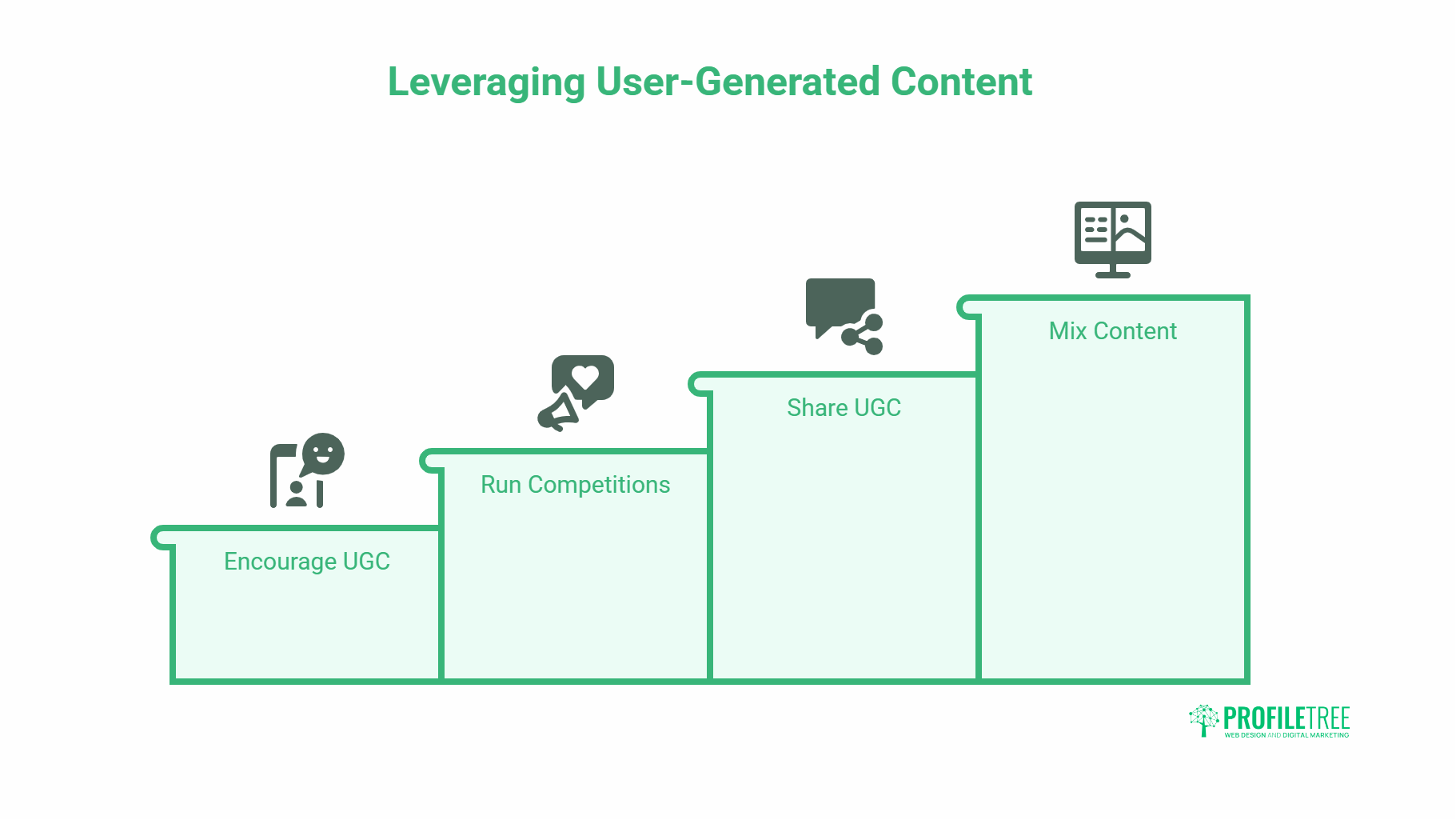
User-generated content (UGC) is anything created by your customers, clients, or followers rather than by your business. Reviews, testimonials, photos of your product or work in use, and client recommendations all fall into this category. It is some of the most effective content a business can share because it is credible in a way that branded content is not.
Why UGC Carries More Weight than Branded Content
According to Nielsen’s Trust in Advertising research, consumers are significantly more likely to trust recommendations from people like themselves than branded content from a company. When someone sees a genuine review or a photo posted by a real client, the trust signal is higher than any amount of polished promotional material.
UGC also reduces the content creation burden on the business. Every piece of content a client or customer creates about your work is a piece of content you did not have to produce yourself.
How to Generate and Use It Practically
The simplest way to encourage UGC is to ask for it at a point when clients are satisfied with the work. After a project completes well, a brief message asking whether the client would be willing to share their experience on LinkedIn or to send a short written testimonial is enough to generate a steady flow of material.
For product-based businesses, running occasional social competitions where customers post photos with your product in exchange for a discount or a feature on your page is a well-established approach. The mechanics matter less than the habit: make it easy for happy customers to talk about you, and then make sure you share what they say.
Showcasing UGC alongside your own content marketing strategy creates a credible mix of voices. Branded content explains and educates; UGC validates. Both serve different jobs in the decision-making process of someone considering using your services.
6. Engage Rather Than Broadcast
Many businesses treat social media as a broadcast channel: they post content and wait for results, but rarely interact with comments, reply to messages promptly, or join conversations that are not directly about them. This approach misses what social media was designed for.
Replies and Comments as Personality Signals
How a business responds to comments on its posts is a public expression of its personality. A thoughtful, specific reply to a question demonstrates expertise and warmth. A generic “Thanks for the comment!” demonstrates neither. People who are considering working with you often look at how a business interacts with others before they ever send a message themselves.
This is particularly true when something goes wrong. A business that handles a critical comment or a complaint with transparency and without defensiveness builds more trust than one that deletes the comment or responds defensively. Audiences know that problems happen; how they are handled is what they are evaluating.
Joining Conversations Beyond Your Own Content
Participating in industry conversations, commenting thoughtfully on posts by other businesses, and engaging with content your clients share are all ways to extend your presence beyond your own feed. This is how social media builds brand recognition over time: through consistent presence across many touchpoints, not just through the posts on your own page.
This kind of engagement also feeds into broader digital strategy. Social media personality is not a standalone feature. It sits alongside SEO, content, and email as one channel in a coordinated approach to building a brand that is recognised and trusted online. If you want to understand how social activity fits into a wider plan, take a look at how ProfileTree approaches digital marketing services for SMEs across Northern Ireland and the UK.
Building a Social Media Presence Worth Following
The six approaches above, telling your story, featuring your team, writing with a consistent voice, engaging with trends selectively, sharing user-generated content, and prioritising genuine engagement over broadcasting, are all within reach of any business regardless of budget or team size. None of them requires expensive tools or large content teams. They require consistency, a clear sense of what your brand sounds like, and a willingness to let real people be visible behind the business.
If you want support putting this into practice, ProfileTree’s social media marketing team works with SMEs across Northern Ireland and the UK to develop brand voice, build content plans, and manage social channels that actually drive enquiries. Get in touch to talk through what would work for your business.
Frequently Asked Questions
How do I find my brand’s social media personality?
Start by listing three to five adjectives that describe how you want your business to come across: direct, warm, expert, informal, or any combination that feels true to how you actually operate. Test every piece of content against those words before you post it. Over time, this consistency creates a recognisable voice. Looking at the accounts of businesses you admire, including those outside your industry, can also help you identify specific qualities you want to build into your own presence.
How often should I post to keep my social media feeling active and personal?
Consistency matters more than volume. Posting three times a week in a voice that feels genuine is more effective than posting daily with generic content. Choose a frequency you can sustain without it becoming purely mechanical, and focus on variety within that schedule: a mix of educational content, team and behind-the-scenes posts, client stories, and reactive commentary on industry news. Quality and regularity together build an audience; frequency alone does not.
Is it unprofessional to show personality on business social media?
No. The assumption that professional means formal is outdated. B2B buyers and consumers alike respond better to businesses that feel approachable and human. Personality does not mean casual or flippant; it means that a real point of view comes through in what you post. Law firms, accountants, and construction companies all benefit from showing the people and thinking behind the business, just in a tone that is appropriate to their sector and client base.
What types of content show brand personality most effectively?
Short-form video is the most effective format for personality, because it is difficult to fake authenticity on camera. Beyond video, behind-the-scenes photos, opinion posts on industry topics, client stories told in specific terms, and genuine responses to comments all signal personality clearly. Designed graphics and promotional posts are the weakest personality formats, which is why many businesses that rely on them exclusively end up with accounts that feel corporate and flat.
How does brand personality on social media affect sales?
Directly, because trust is a precondition for purchase. Research consistently shows that buyers research a business on social media before contacting them. What they are looking for is evidence that the business is credible, that real people run it, and that others have had good experiences with it. A social media presence with clear personality, visible team members, and authentic client content provides that evidence. A feed of product graphics and promotional posts does not. The connection between social presence and enquiry volume becomes clearer once you start tracking where new contacts say they found you.
Should small businesses use humour on social media?
Humour can work well for small businesses, but only when it is genuine. Forced or contrived humour tends to undermine credibility rather than build it, particularly in professional services. The safer approach is to aim for warmth and approachability rather than laughs. If humour comes naturally to the people running the account and it fits the brand voice, it is an asset. If it feels like something the business is performing for the sake of seeming relatable, it is better to drop it and focus on being genuinely helpful and specific instead.