
2D vs 3D Animation in Ireland: How to Choose for Your Brand
Table of Contents
Most businesses pick an animation style by looking at showreels and choosing whatever looks most impressive. That is the wrong starting point. The better question is which format moves your audience to act, fits your budget, and can be produced within your deadline. ProfileTree, a Belfast-based digital agency, has produced animated content for clients across Ireland and the UK, and the pattern is consistent: the right format depends on the job, not on which one looks more advanced.
This guide compares 2D and 3D animation on the things that actually affect a commercial decision, cost, production time, revision flexibility, and which format suits which business goal. It is written for owners and marketing managers who know they need animated video but are not sure which approach is worth paying for. If you want help mapping a format to your objective, ProfileTree’s video production services team works through exactly this decision with clients.
The real choice: business objective, not aesthetics
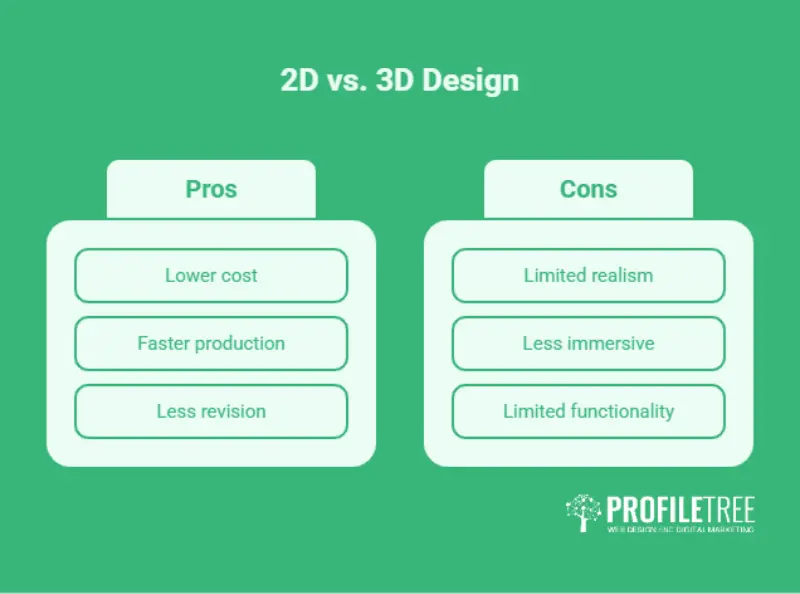
Start with what the animation has to achieve. A product demonstration, a process explainer, a brand story, and a recruitment video all pull in different directions. 2D animation tends to win when the goal is to explain something clearly and quickly. 3D animation earns its higher cost when physical accuracy or spatial realism is part of the message itself.
The aesthetic question matters far less than people assume. Audiences respond to a clear message delivered in a style that suits the brand. A polished 2D explainer can carry as much authority as a 3D production when the execution is strong. The decision should follow the objective, the audience, and the channel the video will live on, which is where a clear digital marketing strategy saves money before a single frame is produced.
2D animation: clear, fast, and well suited to service businesses
2D animation creates movement in two-dimensional space through sequential images and vector graphics. It powers everything from logo animations to detailed explainer videos, and it remains the most common format for commercial work across Ireland.
Its main strength is communication efficiency. Without three-dimensional depth competing for attention, viewers concentrate on the message. That directness suits explainer videos, where every second counts toward understanding. Software companies find 2D particularly effective for demonstrating interfaces, where added realism would distract from the function being shown. Financial services firms in Belfast and Dublin use it to make mortgage processes, investment products, and insurance terms approachable without losing the gravitas those subjects need.
2D also adapts quickly. Characters, backgrounds, colours, and on-screen text can be adjusted with relatively little effort, which matters for SMEs whose messaging changes through the year. A 2D explainer can be refreshed when a service or price changes rather than reshot from scratch. Asset libraries build up over time, so a second or third video in a series costs less than the first.
For brand identity, the illustration style becomes part of the brand language: restrained for a professional services firm, warmer for a consumer brand. That flexibility lets a business keep a consistent look across every animated asset it produces. If you want to see how different visual treatments change the feel of a brand, the ProfileTree guide to animation styles for brands breaks down the main approaches.
3D animation: depth, realism, and physical accuracy
3D animation builds virtual three-dimensional objects that have depth, respond to lighting, and can be viewed from any angle. This is where it earns its place. When the subject is a physical product, a piece of machinery, or a medical device, 3D shows things that cannot be filmed and cannot be faked convincingly in 2D.
Manufacturers use 3D to show products before a physical prototype exists. Architectural practices present building designs with accurate materials and light. Medical device companies demonstrate internal mechanisms that no camera could reach. When texture, reflection, and mechanical movement carry the message, 3D provides a level of precision 2D cannot match.
That capability comes at a cost. Models are built from scratch, textures are applied by hand, lighting is set up much as it would be on a film set, and the finished scenes are rendered, which takes significant computing time. Each stage needs specialist skills, from modellers to riggers to lighting artists. The result is longer timelines and higher prices, justified when the realism is doing real work for the brand, and hard to justify when it is not.
The honest caveat is that 3D’s strengths can become liabilities for the wrong project. The longer production schedule suits planned campaigns rather than fast-moving ones, and a highly produced visual style can overshadow a simple message. Service businesses in particular often find that 3D’s capabilities exceed what their communication actually requires.
Head to head: cost, timeline, and flexibility
The clearest way to compare the two is side by side. The figures below reflect typical ranges for professional commercial work in Ireland and the UK and will vary with complexity, length, and studio.
| Factor | 2D animation | 3D animation |
|---|---|---|
| Typical cost (60-second video) | £2,000 to £5,000 | £5,000 to £15,000 |
| Production time (60 to 90 seconds) | Roughly 3 to 4 weeks | Roughly 6 to 8 weeks |
| Revision effort | Low, often hours | High, can mean re-rendering |
| Best-fit objective | Explainers, process, brand story | Product, machinery, medical, spatial |
| Asset reuse | Strong, builds a library | Limited, scene-specific |
These are starting points for a conversation, not fixed quotes. A simple kinetic-text 2D piece sits at the bottom of the 2D range; a character-driven narrative sits near the top. A short 3D product spin costs far less than a fully modelled environment.
The hidden cost of 3D revisions
The comparison most studios skip is what happens when the brief changes mid-production. This is where the two formats diverge most sharply.
In 2D, changing a character’s clothing colour, swapping a line of on-screen text, or adjusting a scene’s pacing is usually quick. In 3D, the same request can mean retexturing a model, adjusting lighting, and re-rendering the affected scenes, which is measured in hours or days rather than minutes. A late script change that would be trivial in 2D can add meaningful cost and delay in 3D.
That difference matters most for businesses that expect to iterate, testing different messages, adjusting after stakeholder feedback, or producing variations for different channels. If your process involves several rounds of internal sign-off, the revision economics favour 2D heavily. If your content is locked before production starts, the gap narrows.
“The format decision should start with the job, not the showreel,” says Ciaran Connolly, founder of ProfileTree. “For most service businesses, 2D explains faster and adapts better. 3D earns its cost when the product itself is the story, when you genuinely need to show how something is built or how it works.”
Sustainability and procurement
For larger organisations and public-sector buyers, environmental reporting has become part of procurement. 3D rendering is computationally intensive, and cloud-based render farms consume considerable energy, which makes render-heavy 3D production a higher-impact choice than vector-based 2D. Where a supplier’s environmental footprint forms part of a tender or an internal reporting requirement, the lighter technical demands of 2D can count in its favour. This is worth raising early if your organisation reports on its supply-chain emissions, as it can influence both format choice and studio selection.
Industry fit across Ireland and the UK
Technology and SaaS companies lean towards 2D for software demonstrations and feature explanations, where clean motion graphics keep attention on functionality. Financial services use 2D to make complex products understandable while keeping an appropriately serious tone. Healthcare and public-health bodies use simplified 2D illustration for patient education, where clarity matters more than realism. Educational institutions and EdTech firms favour 2D for online learning, where production efficiency lets them cover more material within a fixed budget.
3D earns its place in different sectors. Manufacturers and engineering firms use it to show products and processes that cannot be filmed. Medical device companies rely on it for internal mechanisms and procedures. Property and construction use it for visualising spaces before they are built. The common thread is physical or spatial subject matter where realism is part of the value, not decoration.
From production to distribution
Producing the animation is only half the work. Where it lives and how it is distributed determines the return.
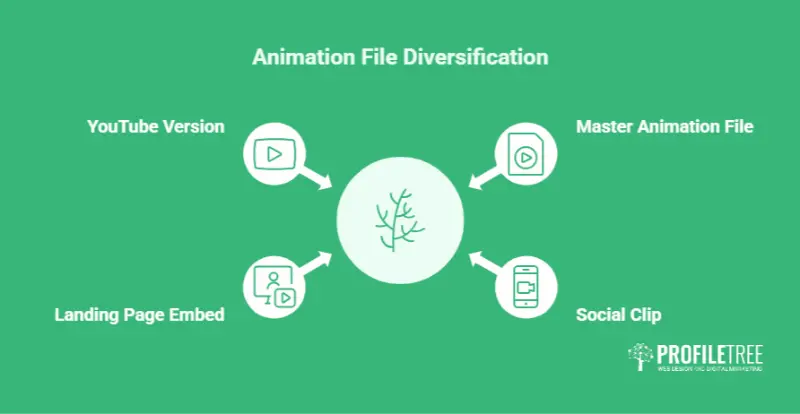
A finished explainer usually performs best embedded on a relevant service or landing page, where it can hold attention and support the page’s message. Done well, this supports both conversion and on-page engagement, though it needs careful handling so the video file does not slow the page down, which is part of building a fast, well-structured website in the first place.
The same master animation can also be cut for different channels rather than reproduced from scratch. A 90-second explainer becomes shorter social clips, a channel trailer, and search-friendly content on YouTube, each version tuned to its platform. The ProfileTree guide to YouTube marketing for business covers how to get sustained value from a single production across a channel.
How AI is changing animation production
AI tools are starting to speed up parts of the 2D workflow, automating some of the in-between frames, assisting with lip-syncing, and helping apply a consistent style across a project. These tools reduce some manual effort without removing the need for creative direction and judgement; a human still decides what the animation says and how it should feel. For businesses planning to produce animated content regularly, understanding where these tools genuinely help is becoming part of the planning, which is one of the areas ProfileTree’s AI training and implementation work covers with clients.
A short decision framework
Five questions usually settle the format choice:
- Is your subject physical and spatial, or abstract and process-based? Physical leans 3D; abstract leans 2D.
- Is realism part of the message, or is clarity the priority? Realism leans 3D; clarity leans 2D.
- Is your deadline under four weeks? A tight deadline leans 2D.
- Will the content need several rounds of revision? Frequent change leans 2D.
- Will you produce a series or a single piece? A planned series favours 2D’s asset reuse.
If most of your answers point to 2D, it is almost certainly the better-value choice. If you are selling a physical, high-specification product where seeing it from every angle matters, 3D is worth the additional cost and time.
ProfileTree’s animation work
ProfileTree’s Belfast team produces both 2D and 3D animation for businesses across Ireland and the UK, with the format chosen to fit the objective rather than defaulting to whichever looks most impressive. The work starts with the business goal, the audience, and where the video will be used, then the production follows from there.
FAQs
Is 2D animation cheaper than 3D?
Usually, yes. 2D animation typically costs less than 3D for an equivalent length because it needs fewer specialist roles, no rendering time, and simpler revisions. For a 60-second video, 2D commonly falls in the £2,000 to £5,000 range, while 3D often runs from £5,000 upward depending on complexity. The gap widens further once revisions are taken into account, since changes in 3D can require re-rendering.
Can you combine 2D and 3D animation?
Yes. Hybrid approaches, sometimes called 2.5D, blend 2D’s efficiency with selective 3D depth, for example a flat illustrated scene with one 3D product element. This can give a sense of depth without the full cost and timeline of a complete 3D production, and it is a sensible middle path when a single element genuinely benefits from realism.
How long does a 60-second animated video take to produce?
A 60 to 90-second 2D animation usually takes around three to four weeks from brief to delivery, covering concept, script and storyboard, illustration, animation, and sound. A comparable 3D piece generally takes longer, often six to eight weeks, because modelling, texturing, rigging, and rendering each add time. Clear briefs and prompt feedback shorten both.
Which format is better for LinkedIn or social ads?
2D tends to suit social and LinkedIn advertising. It allows for fast text overlays, bold colour, and the kind of quick visual hook that works in a scrolling feed, and it loads efficiently on mobile. 3D can work for product-led campaigns, but its slower pacing and heavier files are less suited to short social placements.
Does 3D animation take longer to render?
Yes. Rendering is the stage where 3D scenes are processed into finished frames, and it is computationally heavy, often handled by dedicated render farms. Depending on the complexity and length of the project, rendering can add one to two weeks to the schedule, which is one reason 3D timelines run longer than 2D.
Which businesses get the most from 2D animation?
Technology, financial services, education, and healthcare organisations tend to do well with 2D, along with any business that needs to explain a service clearly or produce content regularly. The format suits abstract or process-based subjects and brands that value clarity and quick turnaround over photorealistic detail.