
Animation production costs in Belfast and Dublin
Table of Contents
A 60 to 90 second business explainer costs much the same whether a studio in Belfast or Dublin produces it. ProfileTree’s own range runs from £3,000 to £6,000 for a standard piece, rising to £6,000 to £12,000 for premium character animation. What changes the cost between them is currency, VAT and, for broadcast work only, tax credits.
For a Northern Ireland business, our animation Belfast page sets out the formats we produce, the process and how to request a quote. This page answers a narrower question: what happens to the price when the choice is between a studio in Belfast and one in Dublin, or when a project crosses the border. For the full breakdown of styles, phases and price drivers, the animated video production guide covers the production side in detail, and businesses based in the Republic can compare the euro price bands on our page about animation services in Ireland.
Studio rates are broadly comparable in the two cities
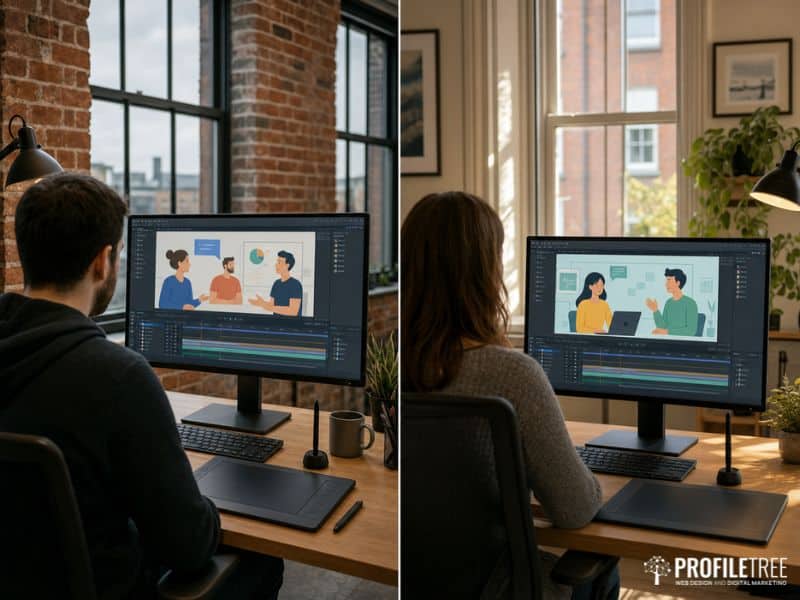
Both cities have experienced corporate animation studios, mature post-production and a deep pool of illustrators, animators and voice artists. A 2D explainer or a motion graphics piece will be produced to a similar standard in either place, and for routine business work the difference in day rates is rarely large enough to decide the commission on its own.
The figures we publish reflect that comparability: our Belfast range for a standard explainer of 60 to 90 seconds, with motion graphics or simple character animation, a professional voiceover and music, is £3,000 to £6,000. Premium work of 60 to 120 seconds, with detailed character animation, custom illustration and sound design, sits at £6,000 to £12,000. On the Irish side, our guidance for the Republic puts simple motion graphics at around €2,000 to €5,000 and detailed 3D work at €10,000 upwards. These are ProfileTree’s own indicative ranges rather than a survey of either market, and a quote for your project will depend on its specifics.
What moves a quote far more than the city is the brief itself. Style is the largest factor, because full character animation takes longer than motion graphics, and 3D takes longer again; our guide to choosing between 2D and 3D animation compares the two on cost and timeline. Length matters next, since every extra second adds animation time and a longer voiceover. Revision rounds, bespoke music, multiple language versions and tight deadlines all add to the figure in either city.
Currency and VAT change the invoice more than the city does
A Belfast studio prices and invoices in pounds sterling, and a Dublin studio in euro. On a project of any size, the exchange rate at the point of payment can move the effective cost by more than the gap between two competing quotes. If your budget is fixed in one currency, convert the other quote at a current rate before comparing them, and agree in the contract which currency the work is priced in so that neither side carries an exchange risk it did not plan for. For a single explainer paid on one invoice the effect is small, but for a retained series billed over several months it is worth settling at the start.
VAT is the second consideration. Northern Ireland follows UK VAT rules for services, while the Republic applies Irish VAT, so a Belfast studio billing a Dublin company, or the reverse, raises the question of where VAT is accounted for. For business customers, the general rule for many services is that VAT is accounted for in the customer’s country under the reverse charge, but the treatment depends on where each party is established and registered.
HMRC’s guidance on the place of supply of services sets out the UK position, and your accountant should confirm how it applies to your contract before the first invoice is raised. Studios that work across the border regularly handle this as routine; the delays come when nobody raises it until the invoice arrives.
Tax credits cut costs only for broadcast and film animation
This is where Belfast and Dublin really differ, and it is also where businesses are most often misled about cost. Both the UK and Irish schemes are designed for qualifying film, television and broadcast animation. An ordinary commissioned explainer, training video or product animation almost never qualifies, so for most corporate budgets neither scheme reduces the price at all.
On the UK side, animation made in Northern Ireland falls under the Audio-Visual Expenditure Credit, which has replaced the older Animation Tax Relief for new productions. For animation the headline credit is 39% of qualifying UK core expenditure, which is worth around 29.25% once the credit is taxed at the main rate of corporation tax. The production must be certified as British under the British Film Institute’s cultural test, at least 51% of its core costs must relate to animation, and it must be intended for broadcast or theatrical release. Advertisements, promotional material and programmes made for training purposes are excluded.
On the Irish side, animation made in Dublin can access Section 481, worth up to 32% of eligible Irish expenditure. The credit is claimed by the producer company against corporation tax, and Revenue pays the difference where the credit exceeds the tax due. Two uplifts can raise the rate to 40%: the Scéal Uplift, for qualifying feature films with a global budget under €20 million, and the visual effects uplift, which took effect in July 2026 and applies to eligible VFX spend between €1 million and €10 million. The project must pass an Irish cultural test and be a genuine film, television or animation production rather than a commissioned corporate piece.
For a typical SME explainer, then, the price difference between the two cities comes down to ordinary commercial rates and currency, with tax playing no part. The incentives start to matter only when a project is large enough and heading for broadcast or cinema, such as a branded series with genuine distribution or animation made as part of a film or television production. If your work is moving in that direction, the choice of jurisdiction has a real financial consequence, and eligibility turns on the details of each production, so treat this section as general guidance and take advice from a qualified tax adviser before budgeting around either credit.
As Ciaran Connolly, founder of ProfileTree, puts it: “The mistake we see most often is a business chasing a tax incentive that was never designed for their kind of video. For a standard explainer, the credits in Belfast or Dublin almost never apply, so the city should come down to who you can sit in a room with and who owns the timeline. Get those two right and the border stops being a problem.”
Cross-border projects overrun on approvals and coordination
Companies with offices on both sides of the border, and businesses in Great Britain working with an Irish studio, sometimes run a single project across two jurisdictions. That works well, provided the arrangements that affect cost are settled at the brief stage rather than discovered halfway through production.
The most common cause of overrun is slow or contradictory sign-off. When stakeholders sit in two locations, decide before work starts who approves the script, the storyboard and the first animation pass, and give one person the final decision at each stage. Late structural changes are expensive because, once full animation has begun, reworking a scene means redrawing and retiming it, and changes that would have taken minutes at the storyboard stage can take days.
Splitting production between a studio in each city to capture a small saving on day rates usually costs more than it saves once the coordination time is counted. One lead studio should own the timeline from start to finish, subcontracting where it needs to, and be held to a single delivery plan. Our page on corporate animation in Northern Ireland describes how we run business projects from brief to delivery.
Contract terms protect the price you were quoted
Wherever the studio is based, a few contract terms decide whether the final invoice matches the quote. Agree the number of revision rounds in writing at the quote stage, because open-ended revision terms are where corporate budgets most often slip. Clearly scoped rounds protect both sides, while a promise of unlimited revisions tends to mean delays once structural changes are requested late.
Confirm what you will own on delivery. Usage rights let you use the finished animation in agreed ways, while the editable project files let you or another studio update it later without paying for the work to be rebuilt. If you expect to change prices, product names or screens within a year or two, the source files are worth more than a small saving on the quote. For the production sequence from discovery and script through storyboarding to final delivery, our video production process guide sets out each stage.
Proximity and fit decide most commissions
Once tax is set aside, which it should be for most corporate work, the choice between the two cities rests on proximity and fit. If face-to-face sessions matter for your project, for example a discovery workshop, a large stakeholder group or a brand that needs careful handling, the closer studio has a real advantage. That points to Belfast for Northern Ireland businesses and those travelling from Great Britain, and to Dublin for businesses in the Republic or reporting to a Dublin head office. If the work can be run over video calls and a shared review tool, location matters far less, and portfolio and process should decide.
Ask to see work in the specific style you are commissioning rather than a general showreel, since a studio that produces most of its work in one template style will find it harder to make something distinct for your brand. Animation often sits within a wider video plan, and our video marketing services cover how animated and filmed content work together across a website and YouTube channel.
FAQs
Does animation cost more in Belfast or Dublin?
Animation does not generally cost more in either city. Creative quality and commercial rates are broadly comparable, and a standard 60 to 90 second explainer costs much the same in either city. The practical differences are the invoice currency and the VAT treatment when the studio and client sit in different jurisdictions.
How much does a business explainer video cost in Belfast?
ProfileTree’s published range for a standard 60 to 90 second explainer is £3,000 to £6,000, and premium character work of up to 120 seconds sits at £6,000 to £12,000. Style, length, revision rounds and voiceover are the main factors in the final quote.
Can a corporate explainer claim Section 481 or the UK animation credit?
A standard corporate explainer usually cannot claim either credit. Both schemes require cultural certification and an intention to broadcast or release the work, and the UK scheme specifically excludes advertising and training content. A website or social media explainer falls outside both, so take advice before assuming any credit applies to larger or broadcast-bound work.
How is VAT handled when a Belfast studio works for a Dublin company?
It depends on where each business is established and registered. For many business-to-business services, VAT is accounted for in the customer’s country under the reverse charge, but your accountant should confirm the treatment for your contract before work starts.
Can one studio handle a project across both cities?
Yes, provided one lead studio owns the timeline and you settle which entity contracts and invoices, in which currency, before production begins. Problems come from split ownership of the schedule rather than from the border itself.
Request a quote for your project
The quickest way to a firm figure is a short brief covering the purpose of the video, its intended length, the style you have in mind and where it will be shown. Send that to our team on 028 9568 0364 or at agency@profiletree.com, and we will come back with a written quote in pounds, the number of revision rounds included and a delivery date.