
AI Marketing Tools for SMEs: What Actually Works in 2026
Table of Contents
AI marketing tools for SMEs in 2026 range from content writers such as Jasper and Copy.ai, to SEO platforms like Surfer SEO and Semrush, to social schedulers such as Buffer and Later, to analytics tools such as GA4 and Hotjar. This guide assesses each category for SME use rather than enterprise budgets or tech teams. ProfileTree, a Belfast-based digital agency and AI training provider, works with small and medium businesses across Northern Ireland and the UK to put these tools into practice.
The gap between SMEs using AI marketing tools and those that are not is widening fast. It is not about budget; most of the tools that make a real difference cost less than £50 a month. It is about knowing which ones are worth learning.
The problem is that most AI marketing tool guides are written for enterprise teams or US-market audiences. They recommend platforms that cost £500 a month, require developer setup, or are simply overkill for a service business in Belfast, Dublin, or Manchester.
This guide covers the AI marketing tools that ProfileTree actually uses and recommends, assessed specifically for small and medium business owners, marketing managers, and in-house teams working without a dedicated tech department. It reflects the tools available as of March 2026; the landscape shifts quickly, so check pricing and features directly with each provider before committing. If you want hands-on guidance rather than a reading list, ProfileTree’s AI training programme covers practical implementation for UK and NI businesses.
AI Content Writing Tools
Content production is where most SMEs feel the time pressure most acutely. These tools do not replace a skilled writer, but they significantly reduce the time from blank page to usable draft.
Jasper
Jasper generates long-form content (blog posts, service page copy, email sequences) using templates built around proven copywriting frameworks. It suits marketing managers producing regular content across multiple channels. Pricing starts at around £39 per month. The main limitation is that output needs careful editing to remove generic phrasing; Jasper writes fluently but rarely writes with genuine insight.
Copy.ai
Copy.ai is better suited to shorter formats: ad copy, social posts, email subject lines, and product descriptions. It works well for SMEs running paid campaigns or managing active social accounts. A free tier is available; paid plans start at around £36 per month. The limitation: it lacks the depth for anything requiring genuine subject matter knowledge.
Writesonic
Writesonic focuses on SEO-optimised content, with competitor analysis baked into the writing workflow. It suits businesses investing in organic search alongside content production. Plans start at around £12 per month. The limitation: the SEO guidance can push writers toward keyword-heavy copy that reads mechanically.
AI Image and Creative Tools
For SMEs without a designer, these tools make it possible to produce consistent, professional-looking visual assets without stock photo subscriptions or Photoshop skills.
Canva AI
Canva’s AI tools (Magic Design, Magic Write, and background removal) sit inside a platform most SMEs already use. For businesses that are not starting from scratch with a new tool, this is the lowest-friction option. The free tier covers most SME needs; Canva Pro costs around £10 per month. The limitation is that outputs can look similar across businesses using the same templates. ProfileTree has a full breakdown of what Canva AI can do for your business if you want to explore it further.
Adobe Firefly
Adobe Firefly generates images and vector graphics from text prompts, built for commercial use with cleaner IP status than many AI image tools. It suits businesses that need original visual content for marketing materials, websites, or advertising. Included in Adobe Creative Cloud plans from around £35 per month. The limitation: it requires some prompt skill to produce results that do not look generic.
Freepik AI
Freepik’s AI image generator offers multiple models optimised for different visual styles, from photorealistic to illustrated. It suits SMEs producing high volumes of social or blog visuals where custom photography would be cost-prohibitive. A free tier is available; premium plans start at around £10 per month. The limitation: output consistency across a campaign requires careful prompt management.
AI SEO Tools
SEO tools with AI capabilities help SMEs identify what to write, how to structure it, and why certain pages are not ranking. Paired with a solid AI in your marketing strategy, these tools can move a business from invisible to competitive in organic search.
Surfer SEO
Surfer SEO analyses the pages currently ranking for your target keyword and tells you exactly how to structure your content to compete: word count, headings, keyword usage, and related terms. It suits content-focused businesses investing in organic traffic. Plans start at around £59 per month. The limitation: it optimises for what is currently ranking, which can lead to content that follows patterns rather than sets them.
Semrush
Semrush covers keyword research, technical site audits, competitor analysis, and rank tracking in one platform. For SMEs serious about organic growth, it covers the most ground of any platform in this category. Plans start at around £99 per month, which makes it a significant investment for a small business. The limitation: the breadth of features means most SMEs use a fraction of what they pay for.
Ahrefs
Ahrefs is particularly strong for backlink analysis and content gap identification, showing which topics competitors rank for that you do not. It suits businesses with an active content or link-building strategy. Plans start at around £82 per month. The limitation: like Semrush, the depth of the platform can overwhelm SME users who are not yet working on advanced SEO.
AI Social Media Tools
The value AI adds to social media management is largely in scheduling intelligence, caption suggestions, and performance analytics. These tools do not replace creative judgment, but they reduce the admin load significantly.
Buffer
Buffer handles scheduling across Instagram, Facebook, LinkedIn, X, and TikTok, with AI suggestions for captions and best posting times. It suits SMEs managing their own social presence without a dedicated team. A free tier is available; paid plans start at around £5 per month per channel. The limitation: the AI content suggestions are useful starting points but frequently need rewriting to avoid generic output.
Later
Later is strong for visual planning, particularly Instagram and Pinterest, with a drag-and-drop content calendar and AI-powered hashtag suggestions. It suits businesses for which visual presentation is central to the brand. Plans start at around £16 per month. The limitation: analytics depth is weaker than Hootsuite or Sprout Social.
Hootsuite
Hootsuite offers the most complete feature set for multi-account social management, including AI-powered content suggestions, sentiment analysis, and team approval workflows. It suits agencies or SMEs managing several brands. Plans start at around £49 per month. The limitation: for a single-brand SME, Hootsuite is often more than is needed and more expensive than the alternatives.
AI Email Marketing Tools
Email marketing remains one of the highest-return channels for SMEs, and AI features (send time optimisation, subject line testing, and automated segmentation) make a measurable difference to open and conversion rates.
Mailchimp
Mailchimp’s AI features include send-time optimisation, subject line suggestions, and predictive audience segmentation. It suits SMEs building and nurturing an email list for the first time. A free tier covers up to 500 contacts; paid plans start at around £10 per month. The limitation: as lists grow, pricing scales quickly and competing platforms offer better automation at higher tiers.
HubSpot
HubSpot integrates email with CRM, landing pages, and lead scoring. For B2B SMEs with a defined sales process, this integration removes a significant amount of manual work. A free tier is available; paid marketing plans start at around £38 per month. The limitation: the full value of HubSpot only becomes apparent once you use several modules together, which takes time to set up.
ActiveCampaign
ActiveCampaign sits between Mailchimp’s simplicity and HubSpot’s complexity. Its automation builder is among the most capable at this price point, with AI-powered send time and predictive content personalisation. Plans start at around £19 per month. The limitation: the learning curve on the automation features is steeper than Mailchimp, which can slow down initial setup.
AI Analytics and Reporting Tools
Most SMEs collect more data than they act on. AI analytics tools close that gap by surfacing patterns and anomalies that would take hours to find manually, and by translating raw numbers into plain-language recommendations.
Google Analytics 4 (GA4)
GA4 uses machine learning to surface predictive metrics, flag unusual traffic changes, and identify which user segments are most likely to convert. It suits any business with a website, which in practice means it is the starting point for almost every SME. Cost: free. The limitation is the interface; GA4’s reporting structure is significantly less intuitive than its predecessor, and most SMEs need time or outside guidance to get useful reports from it.
Hotjar
Hotjar records how visitors actually behave on your website: where they click, how far they scroll, and where they leave. Its AI summarises session recordings and highlights patterns across hundreds of visits. It suits SMEs trying to improve conversion rates on existing traffic rather than just acquire more of it. Plans start at around £32 per month. The limitation: Hotjar shows you what is happening but not always why, which means interpretation still requires judgment.
Looker Studio (formerly Google Data Studio)
Looker Studio connects data from GA4, Google Search Console, Google Ads, and third-party platforms into a single visual dashboard. It suits SMEs or their agencies who want one place to review all marketing performance without logging into multiple tools. Cost: free. The limitation is setup time: building useful dashboards requires someone comfortable with data connections and report design, which is not a five-minute task.
Quick Comparison: AI Marketing Tools for SMEs
| Tool | Category | Best For | Approx. Cost/mo | Key Limitation |
|---|---|---|---|---|
| Jasper | Content writing | Regular blog/copy output | ~£39 | Needs editing for depth |
| Copy.ai | Content writing | Ads, social, short copy | ~£36 | Lacks subject matter depth |
| Surfer SEO | SEO | Content optimisation | ~£59 | Can encourage formula writing |
| Semrush | SEO | Full SEO strategy | ~£99 | Feature-heavy for SMEs |
| Canva AI | Creative | Visual content, low friction | ~£10 | Templates look similar across users |
| Adobe Firefly | Creative | Original commercial images | ~£35 | Needs prompt skill |
| Buffer | Social media | Small team scheduling | ~£5/channel | AI captions need rewriting |
| Later | Social media | Visual brands, Instagram | ~£16 | Weaker analytics |
| Mailchimp | Getting started with email | Free / ~£10 | Pricing scales fast | |
| HubSpot | Email + CRM | B2B with a sales process | Free / ~£38 | Needs multi-module setup |
| GA4 | Analytics | All websites, free baseline | Free | Steep learning curve |
| Hotjar | Analytics | Conversion rate improvement | ~£32 | Shows what, not why |
| Looker Studio | Analytics | Unified marketing dashboard | Free | Setup requires data skills |
“The tools SMEs actually use day-to-day are rarely the ones getting the most coverage. Most of our clients are getting genuine results from a combination of Canva, a content writing tool, and either Buffer or Mailchimp: a stack that costs less than £60 a month combined. The hype around enterprise AI platforms does not reflect the reality for a ten-person business in Belfast or Derry. Start with the basics, get those working, and then layer in more sophisticated tools once you know what you actually need.” Ciaran Connolly, Founder, ProfileTree
How to Choose AI Marketing Tools for Your Business
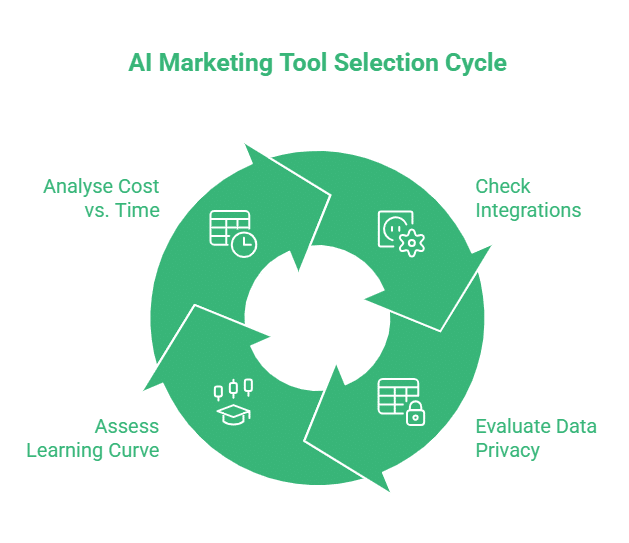
Before committing to any AI marketing tool, ask these four questions:
1. Does it integrate with what you already use?
A tool that does not connect to your CRM, website, or existing marketing stack creates more admin, not less. Check integrations before starting a trial. Most platforms publish a full list of native integrations on their website.
2. Where does your data go?
UK and Irish businesses must comply with GDPR. Before feeding customer data into any AI tool, check where it is processed and stored, whether it is used to train the provider’s models, and what rights you have to delete it. Most reputable platforms address this clearly in their privacy documentation.
3. What is the actual learning curve?
Tools with steep onboarding rarely get used. If your team will not have time to learn a platform in the first two weeks, it will not get embedded. Prioritise tools that deliver value within the first session; Canva, Buffer, and Mailchimp all pass this test for most SMEs.
4. What is the true cost versus time saving?
Calculate the cost in staff time, not just subscription fees. A £50 per month tool that saves five hours of work per week is worth far more than a free tool that delivers marginal improvements. Assign a value to your time before evaluating any platform.
Common AI Tool Adoption Mistakes SMEs Make
These patterns show up repeatedly when businesses adopt AI marketing tools without a clear plan.
Buying multiple tools before mastering one
The most common mistake is subscribing to three or four tools in the first month, using none of them consistently, and then deciding AI tools do not work. Pick one tool per category, use it for 90 days, and measure the output before expanding.
Publishing AI output without editing
Unedited AI content tends to be generic, occasionally inaccurate, and identifiable to readers. Every piece of AI-generated content needs a human review for accuracy, tone, and genuine insight. The tools produce volume; quality is still a human responsibility.
Choosing tools based on features rather than fit
A tool with 50 features you do not need is less useful than a simpler platform that solves one problem well. Match tools to actual workflow gaps, not impressive feature lists or competitor recommendations.
Skipping the free trial
Most AI marketing tools offer free trials. Use them with real projects rather than feature tours. The difference between a tool that fits your workflow and one that does not becomes clear immediately when you try to complete actual work.
For businesses that want structured guidance on which AI tools to adopt and how to integrate them, ProfileTree’s AI training programme for SMEs covers practical implementation across Northern Ireland and the UK.
AI Tool Adoption Among UK SMEs: What the Data Shows
ProfileTree’s own research into AI adoption rates among UK SMEs in 2025 found that awareness of AI tools significantly outpaces actual implementation. Most SME owners have heard of the major platforms, but fewer than half have embedded any AI tool into a repeatable workflow. Statista’s data on AI adoption in marketing tracks this gap globally, and the pattern holds for UK SMEs specifically.
The gap is not knowledge; it is confidence and clarity. Business owners are unsure which tools are worth the learning curve and which will be obsolete in 12 months. That uncertainty is reasonable. The AI tools market is genuinely volatile.
The answer is to focus on tools with established business models and large user bases: Canva, Mailchimp, Semrush, Buffer, rather than chasing the newest platform. Stability and a strong support ecosystem matter more for SMEs than the latest features.
For more details on what SMEs can realistically achieve with AI implementation, see the ProfileTree guide to SMEs successfully implementing AI solutions.
Frequently Asked Questions: AI Marketing Tools
What is the best AI tool for marketing?
There is no single best AI marketing tool; it depends on your biggest bottleneck. For content production, use Jasper or Copy.ai. For SEO, Surfer SEO or Semrush. For social media scheduling, use Buffer or Later. For email, Mailchimp or ActiveCampaign. Start with the tool that addresses the task taking the most time in your current workflow.
Are AI marketing tools worth it for small businesses?
Yes, for the right tasks. AI tools deliver the most value in high-volume, repeatable work: producing first drafts, scheduling posts, segmenting email lists, and auditing website content. They are less useful for strategy, creative direction, and relationship-driven marketing, which still require human judgment.
How much do AI marketing tools cost?
Entry-level tools range from free (Canva, Mailchimp, Buffer) to around £50 per month (Jasper, Surfer SEO). Enterprise platforms such as Semrush and HubSpot scale to £100 and above per month. A functional SME stack covering content, social, and email can be assembled for £60 to £80 per month if you choose carefully.
Can AI replace a marketing agency?
AI tools handle production and optimisation tasks well, but they do not replace strategic thinking, creative direction, or the client relationships that agencies build over time. Most SMEs benefit from a combination: AI tools for volume work, and agency support for strategy, campaigns, and specialist services such as web design, video, or SEO.
What AI tools does ProfileTree recommend for SMEs?
For most SMEs starting out, we recommend Canva AI for visuals, Buffer or Later for social scheduling, Mailchimp or ActiveCampaign for email, and Surfer SEO or Semrush if organic search is a priority. These tools are well-supported, have clear pricing, and integrate with most common business platforms. We cover practical implementation for all of these in our AI training programme.
How do I get started with AI marketing tools?
Start with one tool that addresses your biggest time drain. Sign up for a free trial, complete one real task rather than just a feature tour, then assess whether the output is worth the cost and learning time. Add tools gradually once you have the first one embedded in your workflow. Trying to adopt multiple platforms at once is the most common reason SME teams abandon AI tools entirely.