
Implementing AI Solutions for SMEs: Case Studies and Results
Table of Contents
Most guides to implementing AI solutions spend more time on potential than on practice. What does a real SME AI project look like? What does it cost? Where do they stall, and what do the businesses that succeed do differently?
This guide answers those questions with evidence: five real small business AI case studies from the UK and Northern Ireland, the five phases of a working AI implementation plan, an honest cost breakdown, and the grant funding routes most SMEs never pursue.
If you’re a business owner or marketing manager evaluating AI solutions for SMEs, or thinking about implementing AI solutions for the first time, this is the practical starting point, and AI training for business is often the fastest route to building the internal confidence Phase 5 talks about.
AI Adoption for SMEs: The 2026 Starting Point
Understanding where SMEs currently sit with AI adoption shapes every decision that follows. The picture in 2026 is more nuanced than either the hype or the scepticism suggests.
Why 2026 Is the Practical Year for Small Business AI
Earlier AI adoption cycles required enterprise budgets and specialist data science teams. That barrier’s dropped substantially: off-the-shelf platforms now bring AI capabilities into the tools SMEs already use, no-code automation tools connect AI functions to most common business software without development work, and the practical entry point for most small businesses is a focused process improvement.
The limiting factor for most SMEs isn’t access to tools. It’s knowing which problem to solve first, having data that’s clean enough to work with, and building internal confidence through one well-executed pilot before expanding. Implementing AI solutions doesn’t have to begin with a wholesale transformation; it begins with one well-defined business problem and a 90-day pilot.
The Real Cost of AI Implementation for SMEs
Cost is one of the most searched questions around AI implementation for SMEs, and one of the least honestly answered. The table below breaks it down across three realistic tiers based on published SME implementation data.
| Tier | What It Covers | Typical First-Year Cost | Examples |
|---|---|---|---|
| Entry (off-the-shelf) | AI writing, chatbots, process automation via SaaS platforms | £250–£2,500 | Microsoft Copilot, Tidio, Zapier AI, Jasper |
| Mid (platform integration) | AI connected to CRM, e-commerce, or ERP; demand forecasting add-ons | £3,000–£15,000 setup plus SaaS fees | HubSpot AI, inventory forecasting tools, AI scheduling |
| Advanced (custom build) | Machine vision, bespoke ML models, custom AI workflows | £15,000–£50,000+ | Quality control vision AI, predictive maintenance systems |
For most SMEs exploring AI solutions, the realistic first-year cost when beginning to implement AI solutions sits below £2,500 using off-the-shelf tools. The higher tiers only make sense once a pilot has proven value and the business has a clear brief for what deeper AI implementation for SMEs should achieve.
Common AI Adoption Challenges for SMEs
The barriers that stop SME AI projects from delivering follow a consistent pattern across sectors. Knowing them before you start means you’ll plan around them, not discover them mid-project.
Data quality is the most common failure point: if the underlying data is inconsistent, siloed, or incomplete, AI outputs will be too. The businesses that succeed in implementing AI solutions invest in a data audit and cleanup phase before deploying any tool.
Scope creep is the second most common problem. SMEs that define their first AI adoption project as ‘improve our marketing with AI’ rarely see clear results; those that define it as ‘reduce email response time by 30% using an AI drafting tool’ create the conditions for a measurable win.
Resistance from staff is almost always about job security. Businesses with the highest AI adoption rates are transparent from the start: AI removes dull, repetitive work so the team can focus on higher-value tasks. That framing, delivered before deployment, consistently produces better outcomes.
On GDPR, most SMEs stall unnecessarily. Enterprise platforms (Microsoft Copilot, Google Workspace AI, HubSpot AI) operate under data processing agreements that prevent your data from being used to train the underlying model. For customer-facing AI, a brief privacy policy disclosure is required. Those two steps cover the practical compliance requirements for most entry-level AI adoption projects.
Small Business AI Case Studies: UK and Ireland
The following small business AI case studies draw on documented SME implementations across the UK, Northern Ireland, and Ireland. Each is presented as an honest account of what worked, what required adjustment, and what the business learned.
Case Study 1: Northern Ireland Manufacturer: Predictive Maintenance
A mid-sized manufacturing firm in Northern Ireland with around 45 employees was experiencing irregular downtime on two production lines. The cost was not limited to the repair itself; the knock-on scheduling disruption and premium charges from external contractors for emergency callouts compounded the impact.
Implementing AI solutions here meant connecting vibration and temperature sensors on key machinery to an AI monitoring system trained on 18 months of historical maintenance logs. The data preparation phase (cleaning date formats, merging records across two spreadsheet systems, and removing duplicates) took three weeks and proved to be the most important step in the project.
After a six-month pilot, unplanned downtime fell by 17%. Maintenance scheduling shifted from reactive to planned, cutting contractor emergency call-out costs by approximately a third. Total implementation cost, including hardware and setup, was around £22,000, funded in part through an Innovate UK BridgeAI award.
Case Study 2: Belfast Retailer: Inventory Demand Forecasting
A Belfast-based independent retailer with both a physical store and an e-commerce operation was carrying too much slow-moving stock while regularly running short of fast movers. Buying decisions had relied on the owner’s intuition and a spreadsheet updated monthly.
The business integrated a demand-forecasting tool as part of a broader SME digital transformation project. The tool analysed 24 months of sales data, seasonal patterns, and promotional uplift; implementation took four weeks, including two weeks to standardise historical data across two systems. Within the first full quarter, over-ordering on slow lines dropped by 22%.
Case Study 3: Dublin Professional Services Firm: AI-Assisted Communication
A Dublin-based consultancy with seven staff was spending a disproportionate amount of fee-earner time on routine client communications: progress updates, scheduling confirmations, and follow-up emails. The firm trialled an AI drafting tool integrated into its email platform.
The approach was deliberately narrow: AI-generated drafts only, and every outgoing message required human review before sending. This governance boundary maintained client trust while saving an estimated eight to ten hours of fee-earner time per week. Draft quality improved once the firm created a brief internal style guide (20 bullet points on tone and client terminology); that two-hour investment paid back within the first week.
Case Study 4: County Down Food Producer: Machine Vision Quality Control
A County Down food producer with 30 employees was experiencing a bottleneck from manual visual inspection at the end of its production line. The business piloted a machine vision system trained on roughly 4,000 labelled images over six weeks. AI implementation for SMEs at this level requires patience in the training phase; the quality of the labelled data directly determines the accuracy of the system.
After the pilot, automated inspection caught 94% of defects that manual inspection had identified, with a false-positive rate below 2%. The production bottleneck was effectively removed. Total implementation cost, including hardware, was around £18,000.
Case Study 5: Northern Ireland Marketing Agency: AI Content Workflow
A small marketing agency serving Northern Ireland SMEs introduced an AI-assisted content production workflow to help clients maintain consistent blog and social output without proportional increases in agency fees.
The process ran in three stages: AI drafted based on a detailed brief; a human editor rewrote for tone, accuracy, and client voice; a second pass checked brand compliance. Output per editor increased by approximately 60% without a measurable drop in client satisfaction. As a practical model for AI solutions for SMEs in professional services, this hybrid approach proved more sustainable than either full automation or full manual production.
The Five-Phase AI Implementation Plan for SMEs
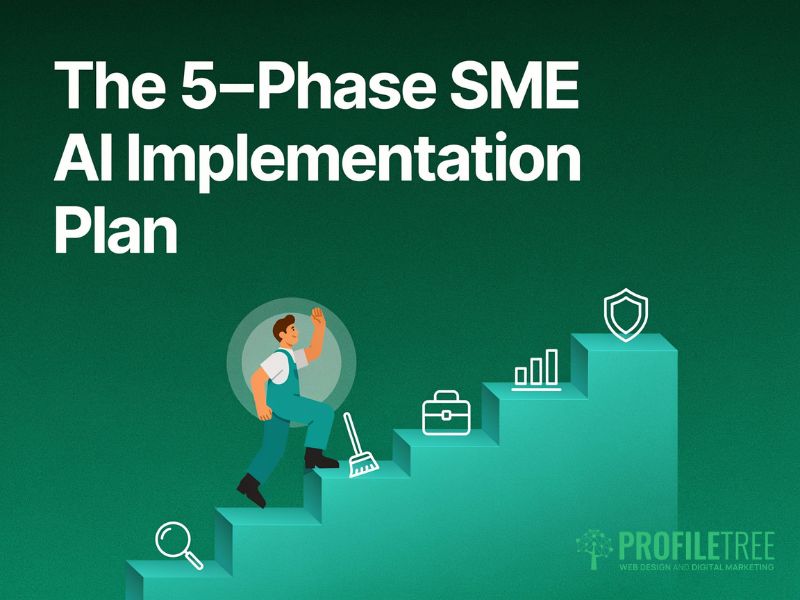
The five phases below reflect how successful AI implementation for SMEs actually unfolds. They are sequential for good reason. Skipping Phase 2 is the single most common cause of project failure, regardless of industry or budget.
Phase 1: Identify One High-Impact, Low-Complexity Problem
List the three to five most time-consuming, repetitive, or error-prone processes in your business and score each on two dimensions: potential impact if improved (time saved, cost reduced, revenue gained) and implementation complexity (data availability, integration requirements, change management). AI performs well on data and rules; it performs poorly on nuanced judgment without considerable training data. The first AI adoption project should sit in the high-impact, low-complexity quadrant, producing a measurable win that builds internal confidence for the next.
Phase 2: The Data Spring Clean
This is the phase most SMEs skip and later wish they had prioritised. Before implementing AI solutions reliably, the data the system will learn from or operate on needs to be clean, consistent, and structured.
For most small businesses, that means auditing data sources (spreadsheets, CRM records, accounting exports), standardising formats, removing duplicates, and consolidating into a single source of truth. The Belfast retailer case study above is typical: data preparation took twice as long as tool deployment, and it was the more important of the two.
If your business doesn’t yet have a clean, consistent data set for the process you want to automate, build that first. AI built on messy data produces messy outputs, and they’ll destroy confidence faster than almost anything else.
Phase 3: Tool Selection: Build or Buy
The vast majority of SMEs should buy, not build. Custom AI development requires data science expertise, sustained time, and ongoing maintenance costs that aren’t realistic for most small businesses without a technology function.
The practical question is which category of off-the-shelf tool fits your use case. The table below gives a working framework for common SME applications.
| Function | Recommended Tool Type | Approx. Monthly Cost | Implementation Difficulty (1–5) |
|---|---|---|---|
| Content drafting | AI writing assistant | £30–£100 | 1 |
| Customer service | AI chatbot platform | £50–£200 | 2 |
| Process automation | Workflow automation with AI | £20–£100 | 2 |
| Data analysis and reporting | Business intelligence AI | £25–£30 per user | 2 |
| Demand forecasting | Sector-specific AI or ERP add-on | £100–£500 | 3 |
| Machine vision or quality control | Custom or platform vision AI | £500+ plus hardware | 4–5 |
For businesses that need specialist guidance through the tool selection phase, ProfileTree’s AI implementation services for SMEs cover strategy, tool selection, and integration support.
Phase 4: Pilot With Defined Success Criteria
Run your first AI adoption project as a time-limited pilot with success criteria set before you start. Avoid the common trap of deciding a tool’s working based on how it feels to use, not what it has measurably changed.
Set two or three specific metrics before deployment: for a chatbot, average first-response time and queries resolved without escalation; for a content tool, time per output and editor revision hours. Measure the baseline before deploying, track during the pilot, and make a data-based decision at the end.
Phase 5: Governance, Compliance, and Staff Adoption
UK AI governance for SMEs doesn’t need to be complex, but it does need to exist. A one-page internal AI policy covers the governance requirements for most SMEs: what tools are authorised, what data they can access, what requires human review, and who is responsible. Under UK GDPR, the key obligations are transparency with customers where AI affects decisions, data minimisation, and a record of what tools access what data; for most entry-tier implementations, this amounts to a privacy policy update and an internal tool log.
Staff adoption is consistently underestimated at this stage. Teams that are most resistant to AI tools at the start of implementing AI solutions often become the most enthusiastic advocates once they’ve seen the tools remove dull, repetitive work rather than replacing the tasks that require their judgment.
“The SMEs that succeed with AI are the ones that start with a specific, honest problem. At ProfileTree, we have supported businesses across Northern Ireland and Ireland through AI implementation for SMEs long enough to know that the first win, however modest, is the most important one. It builds the internal confidence that every subsequent project depends on. Our approach is to help businesses find that first problem, prove the value, and build from there.”– Ciaran Connolly, Founder, ProfileTree
How to Choose AI Solutions for Your Business
Choosing the right AI solutions for SMEs is less about comparing tools and more about matching a tool’s capabilities to a specific, documented problem. The following framework gives a practical basis for evaluation.
Five Questions to Answer Before Selecting Any AI Tool
What specific outcome am I trying to achieve, and how will I measure it? A tool that can’t be connected to a measurable business outcome isn’t ready to deploy.
What data does the tool need, and do I have it in usable form? If the answer to the second part is no, data preparation comes before tool selection. This is the lesson every small business AI case study in this guide reinforces.
How does this tool integrate with my existing systems? Integration friction is one of the most common causes of AI adoption project abandonment. Check native integrations and API availability before you commit.
What are the data processing and GDPR implications? Review the data processing agreement for any tool before you deploy it. Enterprise platforms don’t use your data for model training. Consumer-grade tools may, unless you opt out.
What does the first 90 days look like? Any credible AI tool vendor should be able to describe what a pilot looks like, what the onboarding involves, and what success metrics are realistic. If the answers are vague, so is the value.
AI ROI for SMEs: What to Realistically Expect
Return on investment from implementing AI solutions depends on the application and implementation quality. The table below sets out realistic timelines based on published SME adoption research.
| Application Area | Typical Time to Measurable ROI | Realistic SME Outcome |
|---|---|---|
| Content drafting and marketing copy | Immediate to 4 weeks | 30–50% reduction in content production time |
| Customer service chatbots | 4–8 weeks | 20–40% reduction in first-response time |
| Invoice and scheduling automation | 2–4 weeks | 5–15 hours saved per staff member per week |
| Inventory demand forecasting | 3–6 months (requires data accumulation) | 15–25% reduction in overstock and stockout costs |
| Predictive maintenance (manufacturing) | 6–12 months | 10–20% reduction in unplanned downtime |
| Machine vision quality control | 3–6 months (training period required) | Automated defect detection matches manual inspection accuracy |
UK and Northern Ireland Funding for AI Projects
Grant funding for SME digital transformation with AI is one of the most underused resources available to small businesses in the UK and Northern Ireland.
| Region | Programme | What It Covers | Notes |
|---|---|---|---|
| UK-wide | Innovate UK BridgeAI | AI adoption support and funded pilot projects | Rolling application windows; verify current status directly with Innovate UK |
| Northern Ireland | Invest NI Go Succeed | Funded digital and AI mentoring for NI businesses | Delivered via regional advisers; eligibility varies by sector and size |
| Republic of Ireland | Enterprise Ireland Digital Discovery | SME digital transformation funding, including AI | Up to 50% of the eligible costs for Enterprise Ireland-supported companies |
| Republic of Ireland | LEO Trading Online Voucher | Up to €2,500 for digital tools, including AI software | Broad eligibility; straightforward application process |
Grant programmes change regularly. You’ll want to verify current eligibility and application windows directly with the funding body. What matters is that this funding exists, and most eligible SMEs aren’t actively pursuing it.
For businesses that want support in identifying relevant AI funding alongside implementation planning, ProfileTree’s digital strategy team advises SMEs on both.
FAQs
These are the questions SMEs ask most often when they’re weighing up whether and how to start with AI.
What does implementing AI solutions actually cost for a small business?
Cost splits across three tiers: off-the-shelf tools (chatbots, writing assistants, workflow automation) at £20 to £200 per month; platform integrations with a CRM or ERP at £3,000 to £15,000 setup plus SaaS fees; and advanced custom builds such as machine vision at £15,000 to £50,000 or more. For most SMEs starting their AI adoption journey, the realistic first-year cost sits below £2,500 using off-the-shelf tools with staff training prioritised. The small business AI case studies in this guide illustrate all three tiers.
How do SMEs measure the ROI of AI implementation?
The most reliable approach is to set two or three specific, measurable metrics before the project starts: for a customer service chatbot, average first-response time and queries resolved without escalation; for a content tool, time per output and editor revision hours. Measure the baseline before deployment, track during the pilot, and make a data-based decision at the end. AI solutions for SMEs that skip this step tend to run on intuition and rarely build the internal evidence needed to justify further investment.
Do SMEs need technical staff to implement AI solutions?
Not for entry-level implementations. The current generation of no-code and low-code AI tools isn’t designed for developers; Microsoft Copilot, HubSpot AI, and Zapier AI all work through interfaces that require no coding knowledge. The more valuable investment is training existing staff to understand AI capabilities and limitations, write effective prompts, and review outputs critically; for more complex AI implementation for SMEs, a specialist partner is often more cost-effective than an internal hire.
How do I keep business data secure when implementing AI solutions?
The key distinction is between enterprise AI platforms and consumer-grade tools, and the difference matters. Enterprise products such as Microsoft Copilot for Business, Google Workspace AI, and HubSpot AI operate under data processing agreements that explicitly state your business data is not used to train the underlying model. Consumer-grade tools such as the free tier of ChatGPT have historically used conversation data for model improvement, though this can be turned off in account settings. Before deploying any tool, read the data processing agreement and confirm your data handling obligations. For customer-facing AI adoption, a transparency disclosure in your privacy policy is required under UK GDPR.
What AI solutions work best for SMEs in Northern Ireland?
The starting point is the same regardless of geography: identify one specific, high-impact problem and choose a tool designed for that problem. For Northern Ireland SMEs, the most common successful entry points are AI-assisted customer communication, content and marketing automation, and administrative process automation. ProfileTree, a Belfast-based digital agency founded in 2011 with over 1,000 projects completed and a 5-star Google rating, has supported SME digital transformation with AI across Northern Ireland and Ireland. The small business AI case studies in this guide are drawn from that experience.