
Ultimate Guide to Search Engine Marketing for Tourism Businesses
Table of Contents
Tourism businesses rely on the internet to reach new customers. Most people research their trips and holidays online before they leave home. As such, it’s a must to understand search engine marketing for tourism businesses.
Yet, there is one trouble here. That is, tourism businesses already have a lot on their plate. Many operate with small teams, doing everything from managing accounts and providing tours to handling customer service. This means that it’s hard to find time for marketing as well.
This is a big problem for any small business, as there’s a massive learning curve involved with any new marketing activity. To make things easier, we’ve created this guide to help you better understand and implement search engine marketing for your striving tourism business.
First, let’s start with the basics.
What is Search Engine Marketing for Tourism Businesses?
Search engine marketing (SEM) is a broad term, comprising any strategy to attract new customers through search engines, like Google. Professional implementation combines organic SEO, strategic paid advertising, and advanced Google product integration to maximise visibility and bookings.
Understanding SEM becomes absolutely critical when you consider that the vast majority of web traffic across all industries comes from search engines in one form or another. Additionally, other traffic sources typically come into play later in your sales funnel. That is, most of your first-visit traffic normally comes from SEM, while other channels like social or email begin to drive traffic once users are already aware of your brand.
This effect is amplified for tourism businesses because your target first-visit users are usually in other towns, cities or countries. As such, effective SEM in the tourism industry is absolutely critical.
Modern Tourism Marketing Challenges
Contemporary tourism marketing requires sophisticated digital strategies that address:
- Mobile-First User Behaviour: Over 70% of travel research now happens on mobile devices, demanding responsive web design and mobile-optimised booking systems
- AI-Powered Personalisation: Modern travellers expect personalised recommendations and content tailored to their specific interests and booking history
- Multi-Channel Customer Pathways: Today’s customers interact across websites, social media, email, and review platforms before making booking decisions
- Real-Time Availability Integration: Seamless booking systems that sync inventory across multiple platforms prevent overbooking and improve customer experience
Strategic SEM Framework for Tourism
In this guide, we’re going to outline a comprehensive approach, using a mixture of Google Maps optimisation, content marketing excellence, professional video production, and advanced analytics. This proves the most cost-effective way to build a strong SEM foundation, as poorly managed PPC can often offer a poor return on investment.
Professional digital agencies specialising in tourism marketing understand these complexities and provide integrated solutions that address technical requirements while maximising marketing effectiveness.
Google Maps and Local SEO for Tourism Businesses
Google Maps is sort of an unsung hero of SEO and search engine marketing. It’s a real local SEO powerhouse, but most people underestimate the volume of traffic which can be accessed through this platform.
Even better, effective SEM through Google Maps takes structured effort rather than overwhelming technical complexity. The crux here is that Google Maps is the top channel for users seeking information through locally modified keywords. In other words, when people are seeking information relating to a particular location, Google Maps is their first port of call.
Optimise Your Google My Business Profile
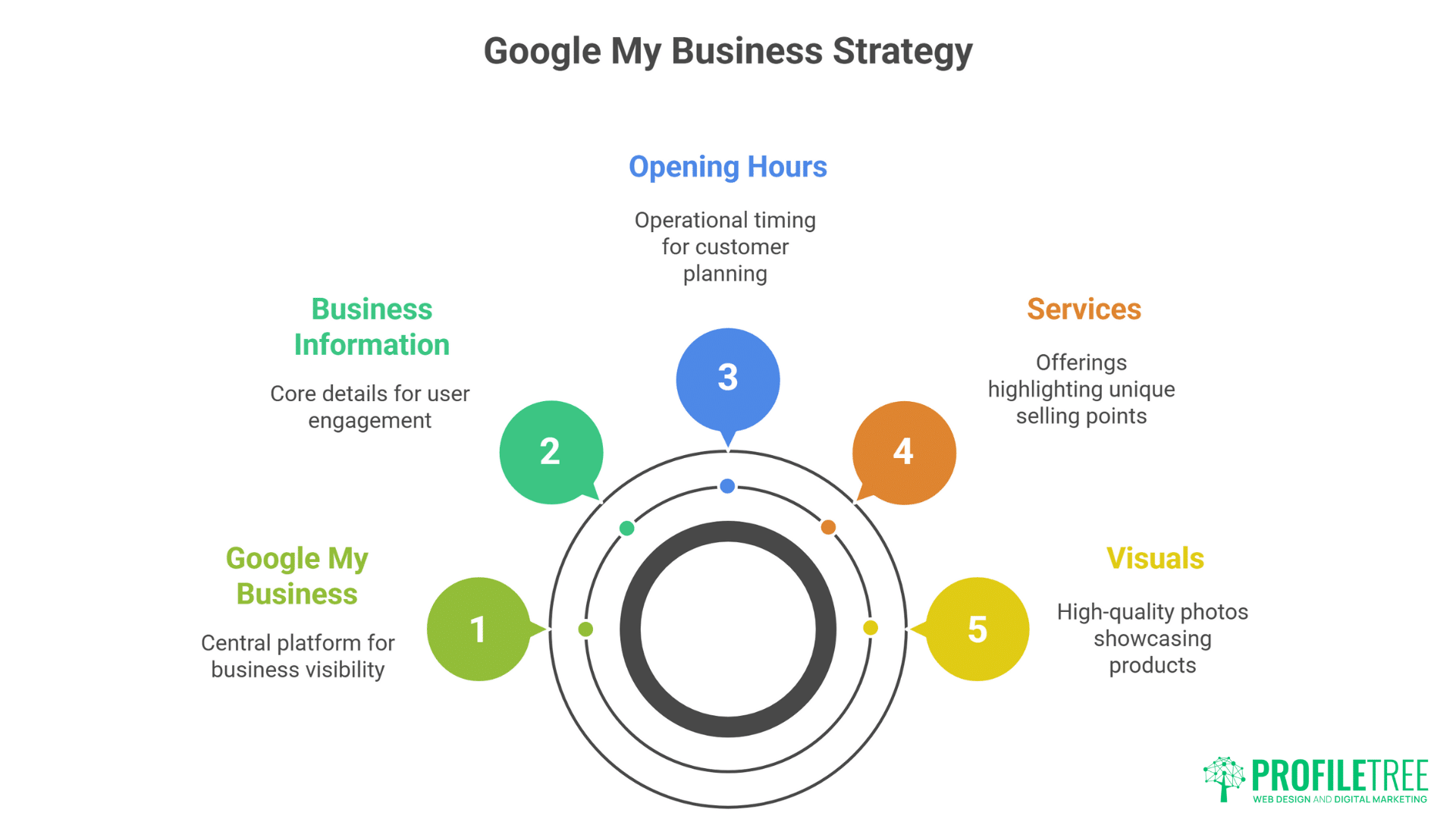
Google My Business is a free business listing and directory service. This might sound a little dry, but it has a huge impact on how your site attracts visitors. The key to understanding why is thinking about Google’s business model.
Essentially, Google’s goal is to match users to the information they’re looking for. How effectively they can do this depends on what information they have about your business. Google My Business lets you give them the info they need in a neat little package.
This includes critical information about your business, such as:
- Name, address, and contact details
- Opening hours and seasonal variations
- Services and unique selling propositions
- High-quality photos showcasing your offerings
- Direct booking links and contact methods
Advanced GMB Optimisation Strategies
The first rule here is to ensure that these are fully present, accurate, and up to date. It’s also important that your Google My Business data is consistent with the information in other online directories and your website.
Once you have these things in place, you can then start seeking out similar citations from other major online directories to boost the credibility of your Google My Business profile.
Following these steps will help your business to be displayed more prominently in local searches. However, there is still work to be done. That is, once you’ve got to the top of Google Maps and the local SERPs, it’s time to start thinking about maximising click-throughs.
Encourage Customer Reviews
The key here is making your Google Maps and Google My Business presence as enticing as possible to users. This is where you need to start using your creative marketing skills. One of the best ways to do this is using social proof and FOMO marketing.
Essentially, most people trust their peers more than they trust marketing departments. Social proof is all about making use of this fact to gain more customers for your products and services. To do this, you need to use stories from previous clients to show off how much they loved your business.
The easiest way to do this is to encourage them to leave reviews at the point of sale or service delivery. The better your overall review profile, the better the chance you’ll have of attracting customers.
Users’ fear of missing out also comes into play here. When people read stories of others having amazing experiences, this makes them more inclined to book a tour, as they’re afraid of missing out on experiencing it for themselves.
Professional Review Management Systems
Modern digital marketing strategies incorporate automated review generation systems that:
- Send follow-up emails requesting reviews at optimal timing
- Provide direct links to preferred review platforms
- Monitor review sentiment across multiple platforms
- Generate professional responses that maintain brand voice
- Integrate review data into broader marketing analytics
Customer Questions and Answers
Google Maps also provides a very helpful question-and-answer section. However, many businesses fail to take advantage of this because they don’t understand the benefits it offers. They might also have practical concerns.
Fully optimising your Google My Business profile will only get you so far. At least, it will help you cover basic information, but some users will have more specific queries. For example, if your business can accommodate certain disabilities or dietary requirements
Responding to customer queries on Google My Business is a great way to get around this. Even better, responding to queries projects the image of a business that cares about its customers, which can help to improve conversions.
AI-Improved Customer Service Integration
Modern businesses exploit AI chatbots and automated response systems to handle common queries instantly while escalating complex questions to human representatives. This approach ensures 24/7 availability while maintaining a personal touch when needed.
AI training for tourism businesses helps staff understand how to use these tools effectively while maintaining authentic customer relationships that drive bookings and repeat business.
Content Marketing Excellence for Tourism
Content marketing represents the second stream of your search engine marketing strategy. Professional content creation attracts users through valuable information while establishing your business as a trusted authority in your tourism niche.
Creating quality content and strategic content development requires understanding your audience’s questions, concerns, and decision-making process. Different content channels can have a massive impact on the success of your search engine marketing efforts.
Blogging for Tourism Businesses
Blogging is one of the most cost-effective ways for businesses in any niche to reach new customers. This is because using a blog is such a cheap and easy way to write content for search engines.
This is also a great chance to target customer concerns and queries. Creating content for your blog is all about identifying common search terms relating to your business or industry and publishing articles that meet the needs of these users.
This requires a process of keyword research in order to determine the search queries you should target, as well as what users are hoping to achieve when they search for these terms.
Professional Content Strategy Development
Successful tourism content marketing requires:
- Comprehensive Keyword Research: Understanding seasonal search patterns, local terminology, and competitor gaps
- Content Calendar Planning: Aligning content publication with travel booking seasons and local events
- SEO-Optimised Writing: Balancing search engine requirements with engaging, helpful content for readers
- Multi-Format Content Creation: Developing blogs, guides, infographics, and interactive content that serves different user preferences
- Content Performance Analysis: Tracking which topics drive the most traffic and conversions
Professional content writing services understand tourism industry nuances and create content that both ranks well and converts readers into customers. Expert writers craft compelling narratives that inspire travel while incorporating technical SEO elements naturally.
Video Content Strategy
Though we’ll talk more comprehensively about it in a few sections, creating high-quality videos relating to your business and what it has to offer is another great SEM content strategy. It’s true that it requires more initial investment than blogging, however, you can also expect to see an excellent return on investment.
There are a number of huge benefits to using a video content strategy.
More searches than ever include a video carousel above the primary results list. These spots are less competitive, as many businesses don’t invest in video content at all. This means it’s much easier for video content to rank highly.
Additionally, featured snippets in the SERPs often prioritise blog articles with embedded videos, meaning that creating video content is an easy way to secure the zero position for search queries, especially for keywords seeking out specific information or questions.
Finally, video content can be repurposed for use on other marketing channels. Specifically, you can use your videos to great effect as email, social and PPC collateral. This means it’s easy to safeguard the ROI of your video content strategy.
YouTube Strategy for Tourism
YouTube functions as the world’s second-largest search engine, making YouTube strategy essential for tourism businesses:
- Channel Optimisation: Professional channel setup with consistent branding and clear value propositions
- SEO-Optimised Video Content: Strategic keyword integration in titles, descriptions, and tags
- Consistent Publishing Schedule: Regular content creation that builds subscriber loyalty and search authority
- Community Engagement: Active response to comments and community posts that build relationships
- Performance Optimisation: Data analysis that informs content strategy and optimisation decisions
“Professional video content has transformed how tourism businesses connect with potential customers,” notes Ciaran Connolly, Director of ProfileTree. “Our clients typically see 40% higher booking rates when they integrate professionally produced videos into their marketing strategies.”
User-Generated Content Integration

As the name suggests, user-generated content is anything that is created by your customers. This can include photos, reviews, blogs and even social media posts. This is a cheap and easy way to get your name out there.
You basically don’t have to lift a finger.
The key is ensuring that you have a presence on the right platforms to take advantage of user-generated content. For tourism businesses these include:
- Social networks, especially Facebook and Instagram
- Review sites, like TripAdvisors
- Booking platforms that advertise experiences
- YouTube for customer testimonial videos
- Professional websites with integrated social feeds
For small tourism businesses, it’s generally best to centre your user-generated content strategy on known platforms. The reason for this relates to their domain authority. In terms of SEO, high authority sites have a much better chance of ranking than lower ones.
This means you’ll likely have trouble competing with the major players on some generic tourism-related search terms. For example, TripAdvisor is in a much better position to rank for a term like Kayak tours Northern Ireland, than a small local watersports company.
As they say, if you can’t beat ‘em, join ‘em.
Accepting this, your best bet is to try and take advantage of TripAdvisor’s high ranking for your desired terms. User-generated content, in the form of reviews, photos and stories, helps to do this. Specifically, it achieves two things:
- Funnels referral traffic to your site
- creating natural backlinks, which improves your site’s domain authority
It’s easy to encourage user-generated content, either through online marketing channels or when you’re face to face with your customers.
Video Production for Modern Tourism Marketing
Professional video production has become essential for tourism marketing success. Modern travellers expect immersive, high-quality content that showcases experiences before they book.
Video marketing requires strategic planning that balances production costs with long-term marketing benefits. Professional video production creates assets that serve multiple marketing channels while establishing credibility and driving conversions.
Strategic Video Content Types
- Destination Showcase Videos: Professional cinematography that captures the essence of locations, attractions, and unique experiences. These evergreen assets provide long-term marketing value across multiple platforms.
- Experience Documentation: Behind-the-scenes content showing real customer interactions, authentic moments, and detailed experience previews that build confidence and excitement.
- Educational Content: Instructional videos covering travel planning, local culture, historical context, and practical advice that establish experience while serving customer needs.
- Customer Success Stories: Professional testimonial production that captures authentic customer experiences in compelling, shareable formats.
- Live Streaming Integration: Real-time content that creates urgency, showcases authentic experiences, and builds community engagement.
Advanced Video SEO Strategies
Professional video production includes strategic SEO optimisation:
Technical Implementation
- Schema markup integration for improved search visibility
- Mobile-responsive video players that improve user experience
- Fast-loading video compression that maintains quality while improving page speed
- Closed captioning for accessibility and additional keyword opportunities
- Strategic thumbnail design that improves click-through rates
Content Optimisation
- Keyword-rich titles and descriptions that balance SEO with compelling messaging
- Strategic video length based on platform requirements and user behaviour data
- Engaging opening sequences that reduce bounce rates and improve watch time
- Clear calls-to-action that guide viewers toward booking decisions
- Cross-platform optimisation for different social media requirements
Professional Production Advantages
Working with experienced video production teams offers a range of valuable advantages. Their technical proficiency ensures access to professional-grade equipment, lighting, and editing, producing cinema-quality content that far surpasses what basic tools can achieve. This level of quality can significantly improve the impact and credibility of your brand’s message.
Beyond technical skill, these teams excel in strategic planning. They understand how to tailor different video formats to meet specific marketing objectives and connect with diverse audience segments. Their streamlined production processes also allow for the creation of multiple assets within a single session, saving both time and resources.
Professional production teams also help maintain brand consistency, ensuring your visual identity and messaging remain uniform across all content. Finally, their experience enables performance optimisation, using proven techniques and insights to create videos that drive higher engagement and better conversion rates.
The Power of Social Media: Engaging with Travellers
Social media isn’t just a platform for broadcasting messages; it’s a vibrant space to connect with potential travellers, build relationships, and fuel their wanderlust. Yet, with so many platforms vying for attention, choosing the right ones and engaging your audience effectively is important. Here’s how:
Choose the Right Platforms
Before diving in, understand your target audience and travel niche. What kind of travellers are you trying to reach? Are they adventure seekers on Instagram, budget-conscious backpackers on Pinterest, or luxury travellers on Facebook? Research which platforms resonate most with your target audience:
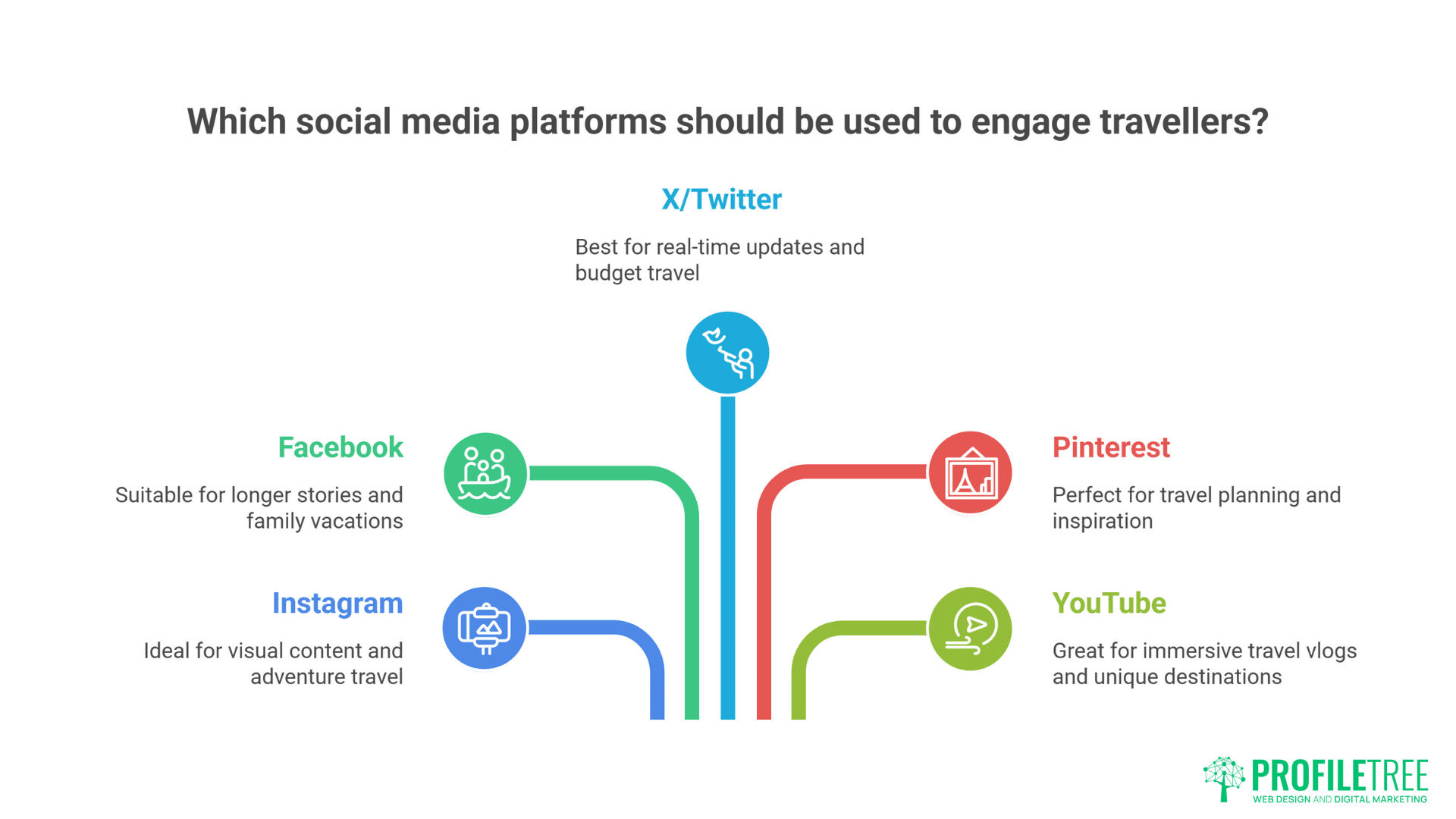
- Instagram: Ideal for visually stunning destinations, travel experiences, and user-generated content. Perfect for adventure travel, luxury escapes, and visually-driven niches.
- Facebook: Diverse platform for sharing longer stories, engaging in discussions, and running targeted ads. Good for family vacations, cultural experiences, and historical destinations.
- X/Twitter: Real-time platform for sharing quick updates, travel tips, and engaging in conversations. Suitable for budget travel, flash deals, and trendy destinations.
- Pinterest: Inspiration board for travel planning and dream destinations. Perfect for visually appealing content, travel guides, and itinerary inspiration.
- YouTube: Immersive platform for showcasing travel vlogs, destination videos, and behind-the-scenes glimpses. Ideal for adventure travel, cultural experiences, and unique destinations.
Remember, don’t spread yourself thin. Choose 2-3 platforms where you can be truly active and engaged.
Go Beyond Posting
Passive posting isn’t enough. To truly captivate travellers, you need to interact and build relationships, which you can do by creating engaging travel content on social media. This involves using a mix of interactive and dynamic strategies.
Interactive content such as polls, live Q&A sessions, and user-generated posts like travel photos or destination tips can spark meaningful conversations and keep audiences involved. Contests and giveaways offering travel-related prizes further boost excitement, attract new followers, and encourage participation.
Collaborating with influencers is another effective way to expand your reach. By partnering with travel influencers who share your brand values and appeal to your target audience, you can tap into their established communities and build credibility. Responding promptly and personally to comments and messages also shows genuine care, helping to foster trust and stronger relationships with your audience.
Live events, such as destination streams, interviews with local experts, or virtual tours, add an immersive element that brings experiences to life. Meanwhile, features like Stories and Reels are perfect for sharing short, engaging updates, behind-the-scenes moments, and quick bursts of inspiration to keep your audience coming back for more.
Use Social Media Advertising
Social media advertising allows you to target specific traveller segments based on demographics, interests, travel behaviour, and even location. This laser-focused targeting ensures your message reaches the ideal audience, maximising your ad spend and attracting qualified leads.
- Highlight Special Offers and Deals: Target ads showcasing exciting promotions, packages, or last-minute deals to travellers actively searching for travel options.
- Promote Specific Destinations or Experiences: Tailor ad campaigns to specific destinations or activities based on user interests and travel preferences.
- Retarget Website Visitors: Capture website visitors who haven’t booked yet and entice them with targeted ads reminding them of your offerings.
- Lookalike Audiences: Utilise platform features to reach new audiences with similar characteristics to your existing customer base.
Though, remember, social media is a journey, not a destination. Be patient, experiment with different strategies, track your results, and adapt your approach to keep your audience engaged and interested. By utilising the power of social media effectively, you can turn online interactions into real-life bookings and build a loyal community of passionate travellers around your brand.
Building Relationships with Email Marketing
Forget generic blasts sent to everyone on your list. Today’s savvy travellers crave personalised experiences, and email marketing offers a powerful platform to cultivate meaningful connections and nurture leads through the travel journey. Here’s how:
Personalisation is Key
Imagine sending the same email promoting family resorts to solo adventure seekers. It wouldn’t resonate, right? That’s why segmentation is key. Divide your email list into groups based on:
- Demographics: Age, location, income, etc.
- Interests: Travel style, preferred destinations, activities, etc.
- Travel preferences: Budget, luxury vs. budget-friendly, family travel, etc.
- Past behaviour: Website visits, booking history, email engagement, etc.
By sending targeted emails tailored to each segment’s specific needs and desires, you increase engagement, open rates, and ultimately, conversions.
Nurturing Leads Through the Travel Funnel
Travellers rarely make bookings on impulse. Instead, they spend time researching, comparing options, and envisioning their ideal trip before committing. Email automation provides a powerful way to guide potential customers through each stage of this decision-making process with relevant, timely, and personalised messages.
A well-structured sequence might start with welcome emails that set the tone, introduce your brand, and provide valuable resources, such as travel guides or destination tips. Inspiration emails can then keep the dream alive by showcasing captivating visuals, exciting experiences, and authentic customer testimonials. Educational emails help build trust and authority by offering destination insights, packing advice, cultural tips, and answers to common questions.
As interest grows, promotional emails can present tailored deals, time-sensitive offers, and personalised recommendations based on user preferences and browsing behaviour. Finally, re-engagement emails are essential for reconnecting with inactive subscribers, using exclusive incentives or reminders about abandoned carts to bring them back into the booking journey.
Remember, automation doesn’t mean impersonal. Use dynamic content to personalise email elements like names, destinations, and offers, making them feel relevant and special.
Seamless Integration
Email marketing doesn’t exist in a silo. Integrate it seamlessly with your other marketing channels for a unified customer experience:
- Social media: Capture email sign-ups through social media contests, offer exclusive email content to followers, and share snippets of your email campaigns on social platforms.
- Website: Promote email sign-ups on your website, integrate lead capture forms, and personalise website content based on subscriber segments.
- Paid advertising: Use retargeting ads to reach website visitors who haven’t subscribed yet and entice them with email-specific offers.
- Influencer marketing: Collaborate with travel influencers to promote your email list sign-up through their blog posts, social media content, or video descriptions.
Track your email marketing performance closely. Analyse open rates, click-through rates, and conversion rates to understand what resonates with your audience and refine your strategy for even better results.
Bonus Tip: Utilise A/B testing to compare different subject lines, content formats, and calls-to-action to identify what resonates best with your audience and continuously optimise your email campaigns for maximum impact.
By prioritising personalisation, nurturing leads through the travel funnel, and integrating email with other marketing channels, you can transform your email marketing into a powerful relationship-building tool that drives bookings and fosters long-term customer loyalty for your travel business.
Performance Measurement: From Clicks to Conversions
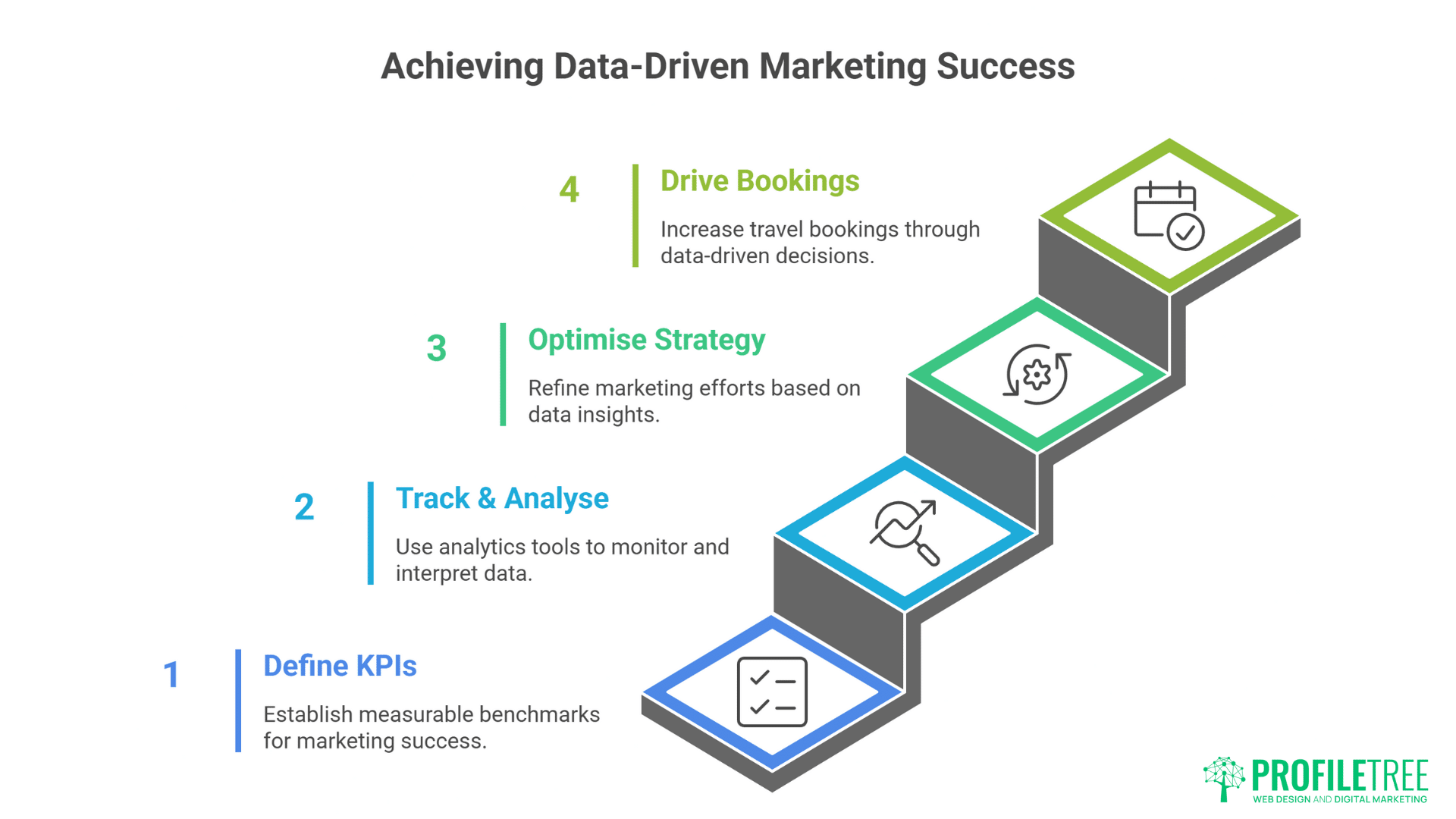
Any business, big or small, operating in the travel and tourism industry must understand the impact of their efforts. Tracking data and analysing key performance indicators (KPIs) allows you to optimise your strategy, maximise your budget, and, ultimately, drive more bookings. Let’s explore the metrics that matter and how to use them effectively.
Defining Your KPIs
KPIs are the measurable benchmarks that gauge the success of your marketing efforts. Each business has unique goals, so choosing the right KPIs is vital. For travel and tourism, consider these key areas:
Website Traffic
- Unique Visitors: Number of individual users visiting your website.
- Pageviews: Total number of pages viewed on your website.
- Session Duration: Average time users spend on your website.
- Bounce Rate: Percentage of visitors leaving after viewing one page.
Engagement
- Click-Through Rate (CTR): Percentage of users who click on a specific link, e.g., in ads or emails.
- Social Media Engagement: Likes, comments, shares, and messages on your social media platforms.
- Email Open Rates & Click-Through Rates: Percentage of email recipients who open your email and click on links within it.
Conversions
- Leads Generated: Number of potential customers who submit contact information through forms or enquiries.
- Bookings: Number of travel bookings made through your website or other channels.
- Revenue Generated: Total sales generated from your marketing efforts.
Tracking and Analysing
Utilise analytics tools like Google Analytics and social media platform insights to track your KPIs. But simply collecting data isn’t enough. You need to analyse it effectively:
- Segmentation: Segment your data by campaign, platform, audience, or other criteria to understand where your performance shines and where it needs improvement.
- Benchmarking: Compare your results to industry benchmarks or past performance to gauge your progress and identify areas for improvement.
- Attribution Modelling: Understand which marketing channels and touchpoints contribute most to conversions, allowing you to allocate resources effectively.
- Funnel Analysis: Analyse each stage of the travel booking funnel (awareness, interest, consideration, decision, booking) to identify bottlenecks and optimise conversion rates.
Modern analytics demands a sophisticated approach that combines advanced setup with precise interpretation. This includes improved e-commerce tracking to fully analyse the booking funnel, custom event tracking to capture engagement milestones and user behaviour, and audience segmentation to uncover behavioural patterns and enable personalisation.
Attribution modelling plays a key role in understanding multi-channel customer pathways, while establishing seasonal benchmarks ensures accurate performance comparisons and more informed decision-making.
Search Console Optimisation
Professional SEO services include comprehensive search console management:
- Keyword performance monitoring and opportunity identification
- Click-through rate optimisation through improved meta descriptions
- Core Web Vitals monitoring for technical SEO health maintenance
- Mobile usability tracking and continuous improvement initiatives
- Rich snippet implementation and performance monitoring
Data-Driven Decision-Making
Turn your data insights into actionable strategies. This means using what you learn to drive smarter marketing decisions. Start by doubling down on what works—identify the campaigns, content formats, and platforms delivering the best results and focus more resources on them. At the same time, refine your strategy by addressing underperforming areas through testing new approaches, experimenting with different formats, or optimising your website based on user behaviour patterns.
Data can also power deeper personalisation. By segmenting your audience more precisely, you can tailor your messaging to resonate with specific groups, boosting engagement and conversions. Finally, use these insights to allocate resources wisely, ensuring your budget is invested in the channels and campaigns most likely to deliver strong returns.
Remember, measurement is an ongoing process. Regularly monitor your KPIs, analyse your data, and adapt your strategy based on insights to ensure your marketing efforts are effective, efficient, and aligned with your goals. Also, utilise A/B testing to compare different approaches, such as ad copy, website layouts, or email subject lines, and identify what resonates best with your audience for continuous improvement.
Professional Tourism Marketing Solutions
Many tourism businesses struggle to implement comprehensive search engine marketing strategies while managing daily operations. Professional digital marketing agencies specialising in tourism provide knowledge, tools, and dedicated resources that deliver superior results.
ProfileTree offers integrated tourism marketing solutions that combine technical skill with creative excellence and measurable results. Our complete approach makes sure all marketing channels work together effectively to maximise booking potential and sustainable business growth.
Experience Gaps and Competitive Market Challenges
Many businesses face resource and experience gaps that hinder their marketing potential. Limited time makes it difficult to consistently create content and manage campaigns, while a lack of technicality can hold back advanced SEO efforts and website development.
Budget constraints may also prevent access to premium marketing tools and software. On top of this, there’s often a need for objective performance analysis, strategic recommendations, and scalable marketing systems that can support ambitious growth plans.
Competitive market challenges add another layer of complexity. In saturated local markets, sophisticated differentiation strategies are essential to stand out. Seasonal business fluctuations demand flexible and responsive campaigns, while managing marketing across multiple locations requires consistent coordination.
For those targeting international audiences, navigating cultural nuances and technical considerations becomes critical. Additionally, integrating marketing systems with booking platforms is often necessary to streamline operations and maximise results.
Comprehensive Digital Solutions
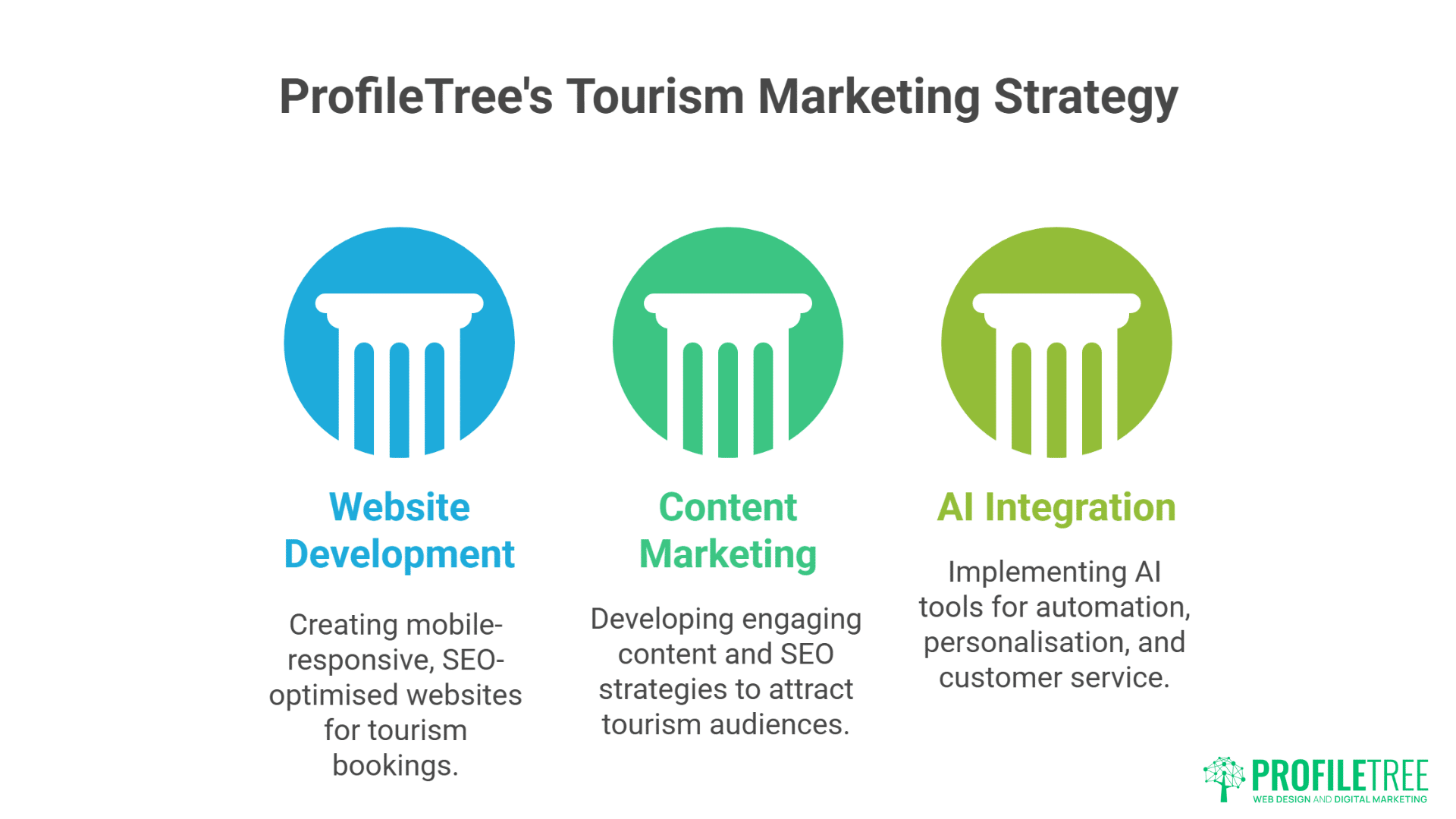
ProfileTree’s integrated approach covers every aspect of tourism marketing, from technical website development to creative content production. Our specialist teams work together to deliver coordinated campaigns that maximise your marketing investment, while building sustainable competitive advantages.
Website Development and Design
- Mobile-responsive websites optimised for tourism booking conversions
- Advanced booking system integration with inventory management
- Technical SEO implementation for maximum search visibility
- User experience optimisation based on tourism industry best practices
- Website maintenance and security management for reliable performance
Content Marketing and SEO
- Strategic keyword research and competitive analysis for tourism markets
- Professional content creation including blogs, guides, and landing pages
- Local SEO optimisation and Google My Business management
- Link building campaigns targeting relevant tourism and travel websites
- Content performance analysis and continuous optimisation
AI Integration and Digital Training
- Marketing automation system implementation and management
- AI chatbot development for improved customer service and booking support Team training programmes for effective AI tool adoption and usage
- Personalisation engine development for better customer experiences
- Data analysis and insight generation using advanced AI tools
Conclusion
Travellers today are savvy digital consumers, turning to search engines for inspiration, planning, and booking their dream vacations. Ignoring search engine marketing (SEM) in today’s landscape is like having a hidden gem with no map–potential travellers won’t find it. Implementing effective SEM strategies tailored to the travel industry can unlock immense potential, attracting qualified leads, driving bookings, and propelling your business towards success. By understanding your target audience, utilising emerging trends and data-driven approaches, you can explore the ever-evolving search landscape and create a winning SEM strategy.
Remember, the journey begins with a single search, and your business can be the answer waiting to be discovered. Don’t miss out on the opportunity to connect with travel-ready audiences and turn their online searches into real-life bookings. Start your SEM journey today!
FAQs
What are the biggest benefits of using SEM for my tourism business?
SEM drives website traffic, boosts brand awareness, generates targeted leads, increases booking conversions, and delivers measurable ROI. Tourism businesses often see notable gains in visibility and bookings within 3–6 months.
How long does it take to see results from SEM?
Results depend on competition, budget, and campaign scope. Organic SEO typically takes 3–6 months to show measurable gains, while paid ads can deliver immediate qualified traffic. Local SEO often yields results within 4–8 weeks with consistent effort.
How much should I budget for comprehensive tourism SEM?
Tourism SEM budgets depend on market competition, business size, and growth goals, typically ranging from £1,500 to £8,000+ per month. Well-executed campaigns often deliver ROI within 6–12 months.
What should I look for in an SEM agency for tourism businesses?
Choose agencies with proven tourism experience, measurable results, transparent pricing, full-service offerings (SEO, content marketing, video production, AI integration), and strong communication. Favour those familiar with seasonal tourism trends and local market dynamics.
Can I manage tourism SEM myself effectively?
While possible, effective SEM requires significant time investment, technical knowledge, advanced tools, and ongoing education. Many tourism businesses achieve better results partnering with professional agencies while focusing internal resources on core business operations and customer service excellence.
Ready to Transform Your Tourism Marketing Strategy?
ProfileTree’s Belfast-based team specialises in turning tourism marketing challenges into profitable business growth. Whether you need professional web design, strategic SEO, video production, AI integration, or a complete digital marketing strategy, our experienced team delivers measurable results for tourism businesses across the UK and Ireland.
Contact ProfileTree today to discover how professional tourism marketing and integrated digital services can drive bookings and business growth.
Nicely written page. I honestly like the subject matter covered here. I’ll come back every now and then for more posts like this one.