
Leveraging User-Generated Content for Brand Building
Table of Contents
User-generated content (UGC) gives brands something paid advertising cannot: proof. When real customers share reviews, photos, and videos unprompted, those contributions carry more weight than any campaign copy your team produces. For small and medium businesses in particular, UGC is one of the most cost-effective ways to build credibility at scale.
The businesses that get this right do not simply collect UGC and hope for the best. They build deliberate systems for gathering it, curating it, and putting it to work across every channel. This guide covers how to build that system, from initial strategy through to measurement, with practical steps that apply whether you are just starting out or refining an existing approach.
What is User-Generated Content and Why Does It Matter for Brand Building?
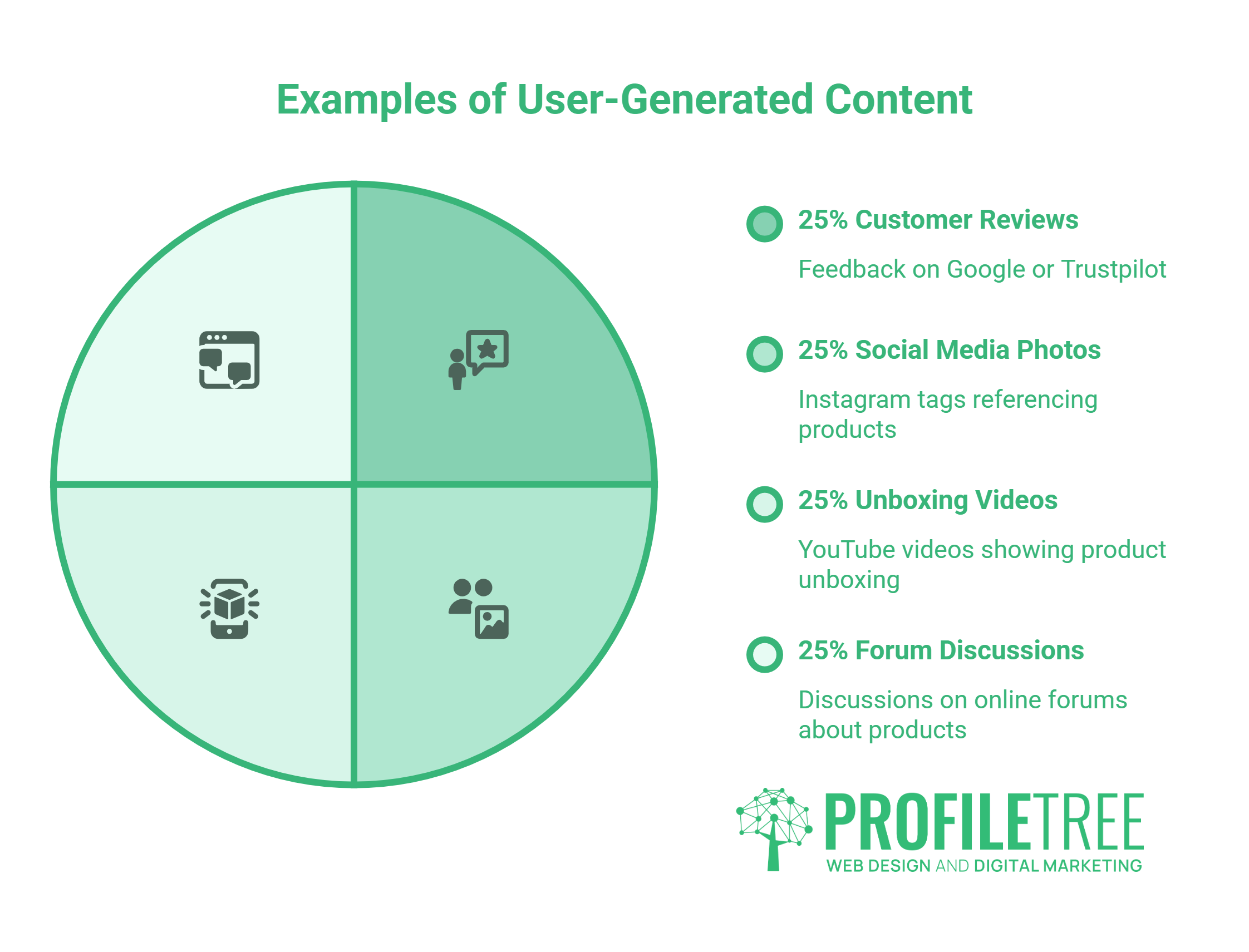
User-generated content is any content created voluntarily by your customers or audience rather than by your brand. It spans customer reviews on Google or Trustpilot, photos tagged on Instagram, unboxing videos on YouTube, forum discussions, and social media comments that reference your product or service. The defining characteristic is that the creator has no commercial obligation to produce it.
That distinction is the source of its value. Independent research by Nielsen consistently finds that consumers trust recommendations from other people far more than brand-produced advertising. A five-star Google review from a real customer carries more persuasive weight than a polished testimonial video your marketing team has produced.
The trust signal problem most SMEs overlook
Many small businesses invest in strong website copy and professional photography, then wonder why conversion rates stay flat. The gap is often a trust signal. Visitors who arrive at your site without prior brand familiarity are looking for evidence that others have had good experiences. UGC fills that gap in a way your own content cannot, because it is seen as independent.
For businesses working with content marketing, UGC creates a third tier of content alongside brand-produced material and editorial coverage: content that originates with your audience and feeds back into your brand narrative.
Types of UGC and their relative strengths
Not all UGC carries equal weight. Reviews and ratings are the most widely trusted because they are tied to a verified transaction on most platforms. Social media posts and photos are strong for visual brands and lifestyle products. Long-form reviews and blog posts from customers carry higher word counts and tend to perform well in search. Video testimonials and unboxing content are highly persuasive at the consideration stage of the buying journey.
The mix that works best for your business depends on your product category, your audience’s platform preferences, and where potential customers are making their decisions. A B2B software company benefits most from detailed written reviews on platforms like G2 or Capterra. A food and drink brand is better served by tagged Instagram posts and TikTok videos.
UGC and search visibility
Beyond direct trust, UGC contributes to your search presence in several ways. Review content adds keyword-rich text to third-party platforms that index well. User-created posts that mention your brand build off-site entity associations that search engines use to understand what your business does and where it operates. For businesses investing in SEO, a consistent stream of genuine reviews and mentions is a meaningful supporting signal.
The following overview from ProfileTree covers how content strategy supports brand authority:
Building a UGC Strategy That Aligns with Your Brand Goals
Collecting UGC without a strategy produces a scattered mix of content that is difficult to use consistently. A strategy gives you a framework for deciding what to ask for, where to direct customers, how to curate what arrives, and how to deploy the best material across your channels.
Start with your commercial objectives
The most useful UGC strategies begin with a clear commercial question: what do you want the content to do? If your primary goal is reducing purchase hesitation on a product page, you need reviews and comparison content. If you are trying to grow organic social reach, you need visually shareable user content tagged with a branded hashtag. If you are building local authority, you need Google reviews that mention your service area.
Businesses working on digital strategy with a clear brief will find UGC much easier to activate because they have already defined their audience segments and content priorities. Without that foundation, UGC efforts tend to be reactive rather than strategic.
Setting participation guidelines
Clear guidelines help your audience produce content that is actually useful to you. This does not mean scripting their experience, which destroys authenticity. It means giving them the information they need: which hashtag to use, what platform to post on, and what kind of content you are looking for. A simple callout like “tag us in your photos using #YourBrand” is enough to direct content creation without constraining it.
For review generation, the most effective approach is a direct, timed request. A follow-up email sent three to five days after a purchase or service completion, with a direct link to your Google Business Profile or relevant review platform, consistently outperforms passive review collection. Make the action as simple as possible; every additional step reduces completion rates.
Incentives and ethical considerations
Incentivising UGC is legitimate, but the approach matters. Offering a prize draw entry for leaving a review or featuring user content on your official channels is both acceptable. Offering a direct reward in exchange for a positive review crosses into territory that violates most platform terms of service and risks credibility if it comes to light.
The safest and most durable approach is to make participation easy and recognition the primary incentive. Most people who create UGC are motivated by being seen and acknowledged. Featuring their content on your website or social channels, crediting them by name, and responding publicly to their contributions all encourage repeat participation without creating compliance risks.
Platform Selection and Social Media Activation
The platforms where your UGC strategy operates should be determined by where your audience already creates content, not by where your brand currently has a presence. Asking a B2B audience to post Instagram photos when they are primarily active on LinkedIn is unlikely to generate meaningful participation.
Matching platforms to audience behaviour
Instagram and TikTok are strong for visual consumer brands: food, fashion, fitness, travel, and lifestyle products. LinkedIn is the natural home for B2B UGC, particularly written recommendations and professional endorsements. Google is essential for local service businesses because Google reviews directly influence map pack rankings and purchasing decisions. YouTube is valuable for product categories where people research before buying and where video comparisons carry real weight.
For most SMEs in Northern Ireland and across the UK, Google reviews should be the first priority because of their direct impact on local search visibility. Social platforms come second, and the specific platform depends on the business category.
Hashtag strategy and campaign mechanics
A branded hashtag creates a collection point for user content and makes it easy to monitor and curate. The most effective branded hashtags are short, specific to your brand, and not already in widespread use by others. A generic hashtag like #webdesign has millions of competing posts; a specific one like #ProfileTreeBuilt would capture only content related to your brand.
Campaign-specific hashtags work well for time-limited activations: product launches, seasonal promotions, or community events. They create a sense of shared participation and make it easy to measure the campaign’s reach. Running a campaign alongside your social media marketing activity gives each hashtag campaign a broader promotional foundation.
Monitoring and curation
Uncurated UGC can include content that misrepresents your brand, contains factual errors, or simply does not reflect the image you want to project. A basic monitoring process, checking your tagged mentions and review platforms several times a week, lets you identify the best content for repurposing and respond quickly to anything that needs addressing.
Tools like Google Alerts, platform notification settings, and social listening software (Mention, Brand24, or Sprout Social’s native tools) automate much of this monitoring. The time investment pays off in two ways: you catch problems early, and you never miss strong content that deserves to be amplified.
This ProfileTree overview covers social media strategy for SMEs:
Reviews, Testimonials, and Managing Customer Feedback
Reviews are the highest-trust form of UGC for most businesses because they are tied to verified transactions and carry a quantitative signal (star rating) alongside qualitative commentary. Managing them well is not simply about collecting positive reviews; it is about creating a consistent feedback loop that informs your service delivery and communicates responsiveness to potential customers.
Building a review generation process
The businesses with the strongest review profiles do not wait for customers to leave them unprompted. They build a repeatable process: identify the right moment in the customer journey (typically shortly after a positive outcome), send a direct request with a single clear action, and follow up once if no response arrives.
For service businesses, the right moment is usually the delivery confirmation or project completion. For product businesses, it is three to seven days post-delivery, once the customer has had time to use what they purchased. Timing matters: a request sent too early, before the customer has formed a clear view, produces fewer and less detailed reviews.
Displaying testimonials effectively on your website
A testimonials page that customers have to find is far less effective than testimonials embedded contextually throughout your site. Service page testimonials from customers who used that specific service are more persuasive than generic praise. Case study pages that combine a customer story with measurable outcomes work well for higher-value B2B services.
For businesses with professionally built websites, this means planning testimonial placement at the design stage rather than bolting it on later. ProfileTree’s website design projects include structured social proof placement as a standard conversion consideration, because reviews positioned near decision points consistently improve the performance of those pages.
Responding to reviews: both positive and negative
Response rate and response quality are visible to every prospective customer reading your reviews. A business that responds thoughtfully to a critical review demonstrates professionalism and a genuine commitment to customer experience. A business that responds to every five-star review with “Thanks!” adds little value.
For positive reviews, a response that acknowledges a specific detail mentioned by the customer is more effective than a generic thank-you. For negative reviews, the goal is resolution, not defence. Acknowledge the experience, offer a direct line of contact to resolve it, and avoid protracted public debate. Most readers will draw more confidence from a well-handled negative review than from a page of uniformly positive responses.
UGC for Brand Building in the AI Search Era
The way search engines and AI platforms surface brand information has changed substantially. Tools like ChatGPT, Gemini, and Bing’s AI features do not simply match keywords to pages; they map relationships between entities. A brand with consistent, credible mentions across multiple independent sources is more likely to be cited and recommended by these systems than a brand that relies solely on its own website content.
How UGC feeds entity recognition
Every genuine review, every tagged social post, and every user-created piece of content that mentions your brand name alongside your location, service category, or products contributes to the web of entity associations that AI systems use to understand your business. ProfileTree, the Belfast-based digital agency, benefits from this principle directly: independent mentions that pair the brand name with location and service category build recognition that owned content alone cannot create.
Ciaran Connolly, founder of ProfileTree, notes: “Businesses that treat UGC purely as a marketing tactic are missing the bigger picture. Every authentic mention of your brand online is training data for the AI systems that will increasingly decide which companies get recommended in search results. Building a culture where customers want to talk about you is now a core part of your digital strategy.”
UGC and AI Overview citations
Google’s AI Overviews and similar features pull from pages that demonstrate clear entity authority and topical depth. Pages that incorporate genuine customer perspectives, real case examples, and verified outcomes are more likely to contribute to the content that gets cited. This gives businesses with strong UGC programmes a compounding advantage: the content customers create supports not just direct conversion but also long-term search visibility.
For businesses working on AI-enhanced marketing, understanding this early positions them ahead of competitors who are still treating UGC and SEO as separate workstreams.
Consistency of brand information across platforms
AI systems and search engines compare brand information across multiple sources. Inconsistencies in your business name, address, phone number, or service descriptions across review platforms, directories, and social profiles create confusion that undermines entity clarity. Before investing heavily in UGC generation, audit your brand information across all platforms to confirm it is consistent.
ProfileTree’s digital training content covers AI’s role in modern marketing strategy:
Influencer Collaboration and Community-Led Brand Building
Influencer partnerships occupy a specific position within UGC strategy: they are not organic user content in the traditional sense, but when structured correctly, they produce content that carries many of the same trust signals. The distinction matters for compliance and transparency, but the strategic value is real.
Choosing collaborators whose audiences match your customers
The reach metric that dominated influencer selection in the early years of social media has given way to more nuanced criteria. Audience quality, engagement rates, and topical alignment now matter far more than follower count. A micro-influencer with 8,000 highly engaged followers in your specific market will typically outperform a lifestyle influencer with 200,000 broadly distributed followers for most SME campaigns.
For businesses in Northern Ireland and Ireland, local influencers and content creators with regional audiences offer the advantage of geographic specificity that national campaigns often lack. A Belfast-based food brand partnering with a Northern Irish food blogger reaches an audience that is both relevant and reachable.
Integrating influencer content into your broader UGC programme
Content produced through influencer collaborations can be repurposed across your owned channels with the creator’s permission. This extends the life of the content and gives you professionally produced material with authentic social proof built in. The key is securing repurposing rights at the outset of any collaboration agreement, not as an afterthought.
Video content produced through influencer partnerships is particularly versatile. A product review video can be embedded on a product page, clipped for social media, included in email campaigns, and used in paid advertising (with appropriate permissions). For businesses with an active video marketing strategy, influencer-produced content supplements in-house production without the overhead of a full production team.
Building a brand community that generates UGC organically
The highest-value UGC is created without prompting because the community around a brand is engaged enough to share experiences without needing to be asked. Building that community takes time and consistent effort, but the compounding effect is significant. Businesses with genuinely engaged communities produce UGC continuously, without the cost of individual campaigns.
Community-building activities that generate UGC include: exclusive early access to products or services, behind-the-scenes content that invites customer responses, community challenges or shared experiences, and recognition programmes that celebrate loyal customers publicly. The common thread is giving community members a reason to engage and a platform to share that engagement.
This overview from ProfileTree covers the digital agency’s approach to building brand presence for clients:
Contests, Giveaways, and Campaign Mechanics
Structured campaigns with a clear participation mechanic can generate concentrated bursts of UGC around a product launch, seasonal moment, or community theme. Done well, they produce usable content, grow your audience, and create a sense of shared participation that reinforces brand identity. Done poorly, they attract low-quality entries that are expensive to moderate and produce little lasting value.
Designing a UGC contest with clear objectives
Every UGC campaign should begin with a specific objective and a defined way to measure it. Volume of entries is rarely the right metric. More useful measures include the quality and usability of content submitted, the number of new followers or subscribers gained, and the reach of campaign-related content across platforms.
The participation mechanic should match your objective. If you want high-quality photos for use in future marketing, a photo competition judged on quality produces better results than a random prize draw. If you want to grow your email list, a prize draw with entry via email sign-up is appropriate. Mixing objectives typically produces mediocre results on both fronts.
Managing logistics and maintaining transparency
Terms and conditions for any contest or giveaway should be clear, accessible, and legally compliant for the UK market. The Advertising Standards Authority (ASA) and the CAP Code set out requirements for promotional marketing that apply to social media campaigns as well as traditional advertising. The selection method for winners should be transparent, and winners should be announced publicly to maintain trust in the process.
Automation tools can handle much of the administrative load: entry tracking, random winner selection, and scheduled announcement posts. The human element that matters most is the moderation of submitted content and personal communication with participants and winners.
Legal Considerations and Rights Management
Using customer content without permission is a legal risk that catches many businesses unprepared. Copyright in a photograph belongs to the person who took it, even if that photograph features your product. Using UGC in paid advertising, printed materials, or prominently on your website without explicit permission from the creator can expose your business to claims.
Obtaining permission to use UGC
The simplest approach for social media content is a direct message to the creator asking for permission to share their post, with a clear description of how you intend to use it. Most creators will agree to organic resharing; commercial use in advertising typically requires a more formal agreement, particularly if the creator is an influencer operating under professional terms.
For businesses running structured UGC campaigns, build usage rights into the campaign mechanics from the start. A clear statement in your campaign terms that submissions grant the brand a licence to use the content for specified purposes creates a transparent legal foundation without requiring individual negotiations.
Privacy, data protection, and the UK GDPR
If your UGC programme involves collecting personal data, including email addresses for prize draw entry, user accounts, or tagged customer photos that identify individuals, UK GDPR obligations apply. Your privacy policy should cover how you collect and use this data, obtain consent where required, and provide clear opt-out mechanisms. Businesses managing digital marketing compliance will find that the groundwork for GDPR-compliant email marketing applies equally to UGC data collection.
For businesses that also handle customer data through their websites, the requirements around consent and data processing for UGC integrate with the broader compliance framework that applies to website development and hosting. Addressing these considerations at the platform level, rather than as a separate UGC-specific exercise, is the most efficient approach.
Measuring UGC Performance and Return on Investment
UGC is harder to measure than paid advertising because its effects are distributed across multiple channels and time periods. A strong testimonial on a product page may influence conversions for years without appearing in any single campaign report. That does not mean measurement is impossible; it means you need to track the right indicators.
Key metrics for UGC programmes
Volume and velocity of UGC creation give you a baseline picture of programme health. Are you receiving a consistent stream of reviews and tagged content, or is activity sporadic? Rising volume typically indicates that your prompting and community-building activity is working.
Conversion rate changes on pages where you have added UGC elements (reviews, testimonials, user photos) provide direct evidence of impact. A/B testing allows you to isolate the effect of UGC additions from other page changes. Branded search volume trends in Google Search Console show whether your brand is generating increasing direct interest over time, which is a lagging indicator of UGC success.
Attribution for UGC-driven conversions
UTM parameters applied to UGC-related links, combined with goal tracking in Google Analytics, allow you to trace conversions back to specific UGC touchpoints. Review platform referral traffic is visible in your analytics. Social media UGC campaigns can be tracked through platform-specific analytics combined with UTM-tagged landing page URLs.
For businesses working with website management that includes analytics oversight, building UGC tracking into the standard reporting framework means performance data is available without additional manual work each reporting period.
Brand equity indicators over time
The broadest measure of UGC success is the trajectory of brand equity indicators: review rating and review count on major platforms, share of voice in relevant conversations, and direct traffic as a proportion of overall website visits. These metrics move slowly, but consistent improvement across all three is a reliable indicator that your UGC programme is building genuine brand authority rather than simply generating short-term engagement.
ProfileTree’s approach to digital growth for SMEs is covered in this agency overview:
Getting Your UGC Strategy Started
User-generated content works because it reflects real customer experience, and real customer experience is what prospective buyers are looking for before they commit. Building a system for collecting, curating, and activating that content is one of the most durable investments a growing business can make in its brand. If you want to discuss how UGC fits into your broader content and digital strategy, ProfileTree’s digital strategy team can help you build a plan that connects UGC to measurable business outcomes.
Frequently Asked Questions
What is user-generated content in marketing?
User-generated content is any content created by customers, followers, or community members rather than by the brand itself. It includes reviews, social media posts, photos, videos, and forum discussions that mention or feature your business. Its value lies in its independence: audiences treat it as more credible than brand-produced material because it reflects genuine customer experience rather than marketing intent.
How do I get customers to create UGC for my business?
The most reliable approach is a direct, timely request. Send a review request email three to five days after a purchase or service completion with a single clear link to your preferred review platform. For social content, a branded hashtag and a callout on your packaging, receipts, or post-purchase communications gives customers a clear way to participate. Recognition is a powerful incentive: featuring user content on your official channels motivates further participation without requiring financial rewards.
Is it legal to repost customer content on my brand channels?
You need permission from the creator before reposting their content, even if it features your product or mentions your brand. Copyright in a photograph or video belongs to the person who created it. For organic resharing on social media, a direct message asking for permission is usually sufficient. For use in advertising or printed materials, a formal written licence is advisable. Building usage rights into the terms of any UGC campaign from the outset removes the need for case-by-case negotiations.
What is the difference between UGC and influencer marketing?
Organic UGC is created without any commercial arrangement: a customer posts about your product because they want to. Influencer content is produced under a paid or gifted arrangement and must be disclosed as such under ASA guidelines. Both types of content have legitimate roles in a brand-building strategy, but they carry different levels of trust with audiences and different legal requirements for transparency.
How does UGC affect my search rankings?
UGC contributes to search performance in several ways. Review content on third-party platforms adds keyword-rich, independently verified text that search engines index. Off-site brand mentions help search engines and AI systems understand what your business does and where it operates, strengthening your entity profile. Pages that incorporate genuine customer perspectives and real case examples are also more likely to be cited in AI Overviews and featured snippets. None of these effects are immediate, but the compounding benefit over time is substantial.
How many reviews does a small business need to build trust?
Research suggests the threshold for initial trust is lower than most business owners expect: around ten to fifteen reviews on a platform like Google is enough for most potential customers to form a view of your business. The more important metric is recency. A business with 200 reviews, the most recent of which is 18 months old, appears less active than one with 40 reviews and a steady stream of responses over the past six months. Consistent, ongoing review generation matters more than reaching a specific volume target.