
Travel Video Production for UK Tourism Brands
Table of Contents
Tourism and hospitality businesses across the UK face a straightforward problem: potential visitors decide where to go long before they book, and increasingly that decision is shaped by video. A hotel that looks extraordinary in a 90-second reel will win consideration over a competitor with a static image gallery, regardless of which property is objectively better.
What separates effective travel video production from a collection of pretty footage is strategy. The planning decisions made before a crew arrives on location determine whether the finished content earns bookings or simply earns views.
This guide covers the full picture for UK tourism brands and hospitality businesses: the types of travel content that perform, the logistics specific to filming in the UK, how to measure the return on a production investment, and how to build a distribution strategy that puts your content in front of the right audiences.
Types of Travel Video Production for UK Businesses
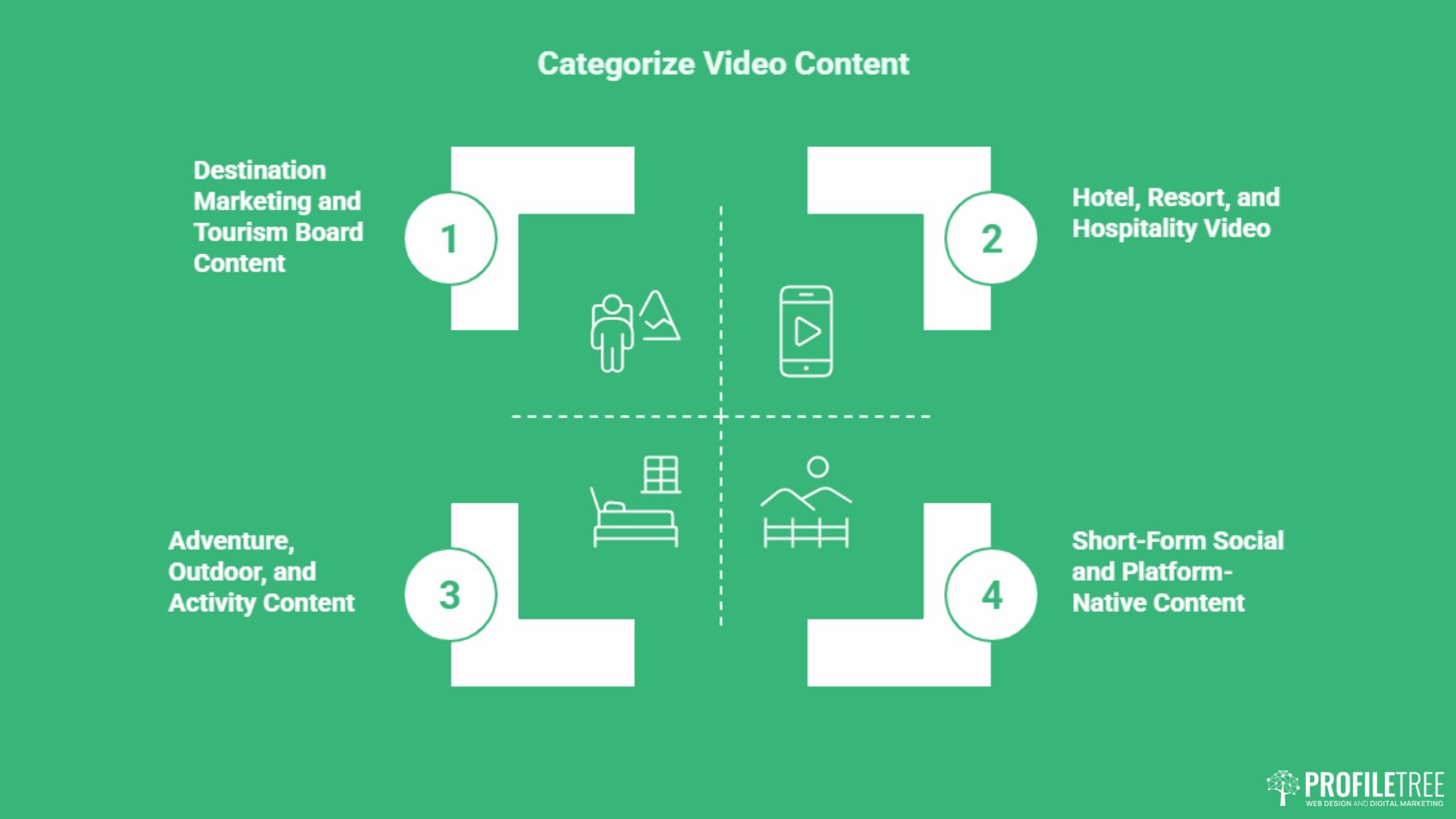
The phrase “travel video” covers a wide range of formats, and the right choice depends entirely on your objective, your audience, and the platform you are targeting. Understanding these distinctions before briefing a production team saves time and budget.
Destination Marketing and Tourism Board Content
Tourism boards and destination management organisations typically commission long-form showcase films that capture the character of a place: scenery, culture, food, and people. These are designed for broadcast, cinema advertising, and YouTube pre-roll, where a viewer has the attention span to follow a narrative.
The goal is emotional pull rather than direct conversion. A well-produced destination film builds desire over months, not days, and the return is measured in visitor numbers rather than click-through rates. Tourism marketing strategies for bodies such as Tourism Ireland and Visit Belfast typically allocate a significant share of their annual media budget to this format precisely because the long-term attribution is consistent and measurable.
Hotel, Resort, and Hospitality Video
Hotels and resorts operate in a different commercial environment. Their video needs to convert a viewer who is actively comparing properties, so the format is shorter, the pacing is faster, and the focus is on the specific details that influence a booking decision: room quality, food presentation, facilities, and location.
A property video for a website or booking platform runs between 60 and 120 seconds. A social media cut for Instagram Reels or TikTok runs between 15 and 30 seconds and prioritises visual impact over information. Both can be produced from a single shoot by planning the shot list carefully in advance. For a broader context on hospitality digital marketing, the hotel marketing statistics from ProfileTree’s research highlight how video consistently outperforms static imagery for engagement on booking platforms.
Adventure, Outdoor, and Activity Content
Outdoor activity providers, adventure tourism operators, and rural experience brands face a different challenge: the product is inherently experiential, which means the video needs to convey sensation and energy, not just aesthetics. Drone footage, GoPro-style POV sequences, and fast editing with natural audio are the standard tools.
This format performs particularly well on YouTube and in paid social campaigns targeting audiences with demonstrated interest in outdoor activities. It is also one of the formats where the gap between amateur footage and professional production is most visible to the viewer, making professional travel video production a measurable commercial advantage rather than a discretionary upgrade.
Short-Form Social and Platform-Native Content
Platform-native content (vertical video shot specifically for TikTok, Instagram Reels, and YouTube Shorts) is now a standard deliverable rather than an afterthought. Audiences on these platforms scroll at speed, which means the first two seconds of a clip must earn the viewer or lose it. The production approach, framing, and editing rhythm are fundamentally different from those of a long-form film.
The strategic advantage for tourism businesses is that short-form content can be produced in volume from a single location shoot. A two-day production schedule in Northern Ireland, for example, can yield a full destination film, four property videos, and a library of 20 to 30 short clips suitable for social scheduling across several months. Pairing this output with a structured social media strategy is where production investment converts into consistent audience growth.
UK Filming Logistics: Permits, Regulations, and Planning
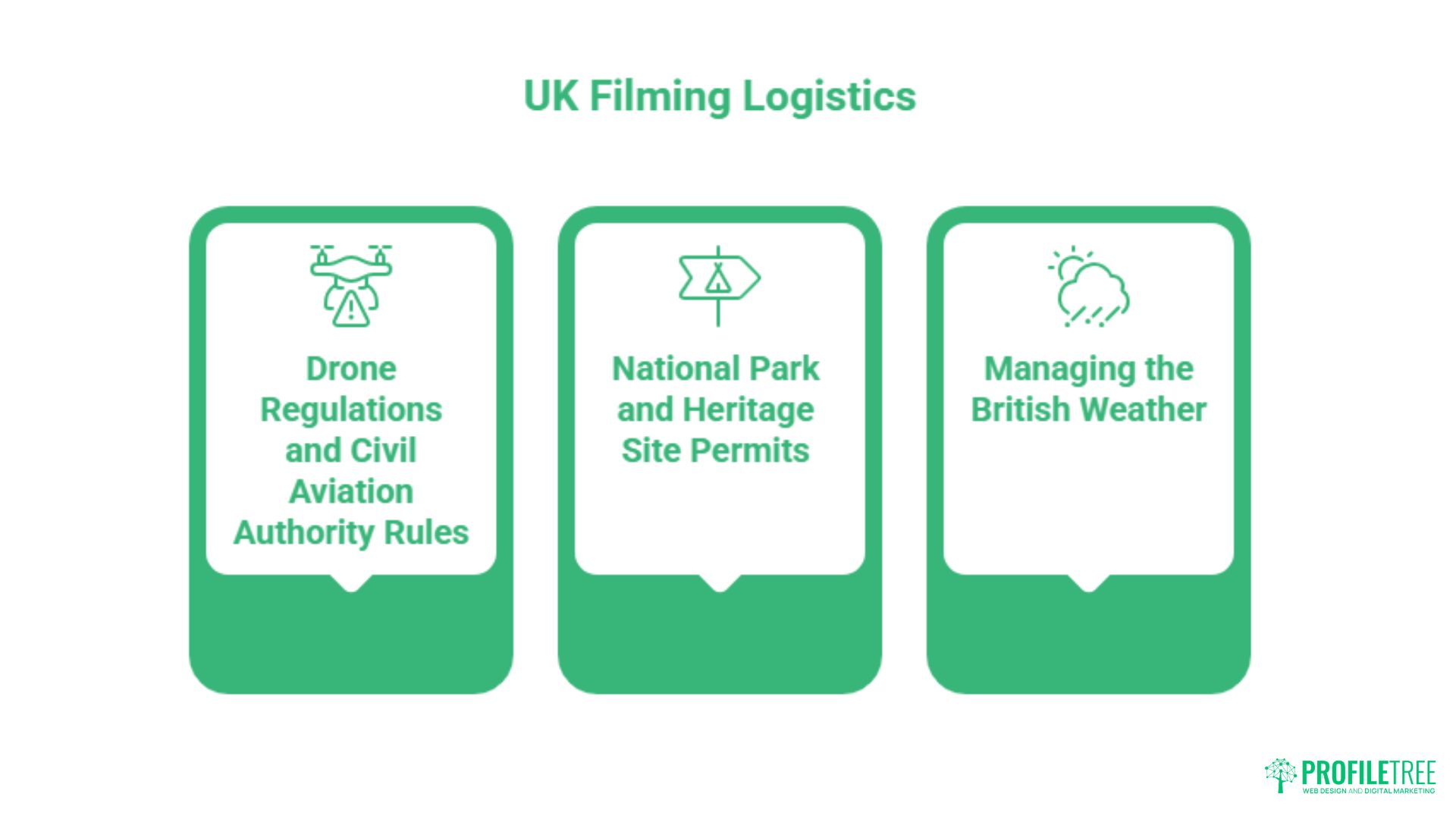
Filming in the UK involves a layer of regulatory and logistical complexity that is easy to underestimate. Production teams working with tourism brands need to plan for this in advance, because permit delays and regulatory oversights cost time and money that cannot be recovered on location.
Drone Regulations and Civil Aviation Authority Rules
Drone footage has become a default expectation in destination and hospitality video, and for good reason: aerial shots provide scale and context that ground-level cameras cannot replicate. However, operating a drone commercially in the UK requires compliance with Civil Aviation Authority regulations, which vary significantly by location and aircraft category.
In most urban areas, including central London and Edinburgh, drone operations require specific permissions from the CAA and, in some cases, from local authorities and landowners separately. Restricted airspace zones cover airports, military sites, and certain government buildings. Planning a shoot that relies on aerial footage without confirming airspace permissions in advance is one of the most common and costly mistakes in travel production.
Rural locations and national parks carry their own requirements. Snowdonia, the Lake District, and the Cairngorms all have specific guidelines around commercial filming, with some areas requiring applications to be submitted four to eight weeks before the shoot date. Building permit acquisition into the production timeline from the outset avoids the situation where a crew travels to a location only to be unable to operate legally.
National Park and Heritage Site Permits
Every major UK national park has a designated authority that handles commercial filming applications. Costs and lead times vary: some parks charge a daily location fee for commercial productions, others require evidence of public liability insurance above a minimum threshold, and others restrict filming during specific seasons to protect wildlife and visitor experience.
Northern Ireland has its own distinct set of locations and governing bodies. The Giant’s Causeway, the Causeway Coastal Route, and the Mourne Mountains are all managed by separate authorities, and filming at each requires advance contact and, in most cases, a formal application. For brands exploring what Northern Ireland can offer as a filming destination, the cities and regions guide on Connolly Cove provides useful context on the range of locations available across the country.
Managing the British Weather
Weather is not an obstacle unique to the UK, but the unpredictability of British conditions at any time of year makes production scheduling genuinely complex. A shoot planned around golden-hour coastal light in October may encounter solid overcast from arrival to departure.
Professional productions handle this through contingency scheduling: building at least one weather cover day into the production plan, identifying interior or sheltered alternative locations for every planned exterior shot, and briefing the client before the shoot on what the realistic options are if conditions change. Brands working with an experienced video marketing team should expect this contingency planning to be built into the production brief rather than handled ad hoc on the day.
Sustainable Travel Video Production
Sustainability has moved from a niche concern to a standard consideration for UK tourism boards and hospitality brands, many of whom now require evidence of low-impact production practices from their agency partners. Visit Britain, VisitScotland, and Tourism Ireland have all published sustainability frameworks that extend to the marketing activity they commission.
Reducing the Footprint of a Film Crew
A standard commercial film crew generates a measurable carbon footprint through travel, accommodation, equipment transport, and power consumption on location. Productions that take sustainability seriously approach each of these areas deliberately rather than treating them as fixed costs.
Common approaches include consolidating travel itineraries to reduce crew vehicle movements, sourcing accommodation locally to the shoot location rather than commuting from a distant city base, using battery-powered lighting rigs in place of generator-dependent equipment where light levels allow, and choosing local suppliers for catering and logistics.
None of these measures compromises production quality. They do require advance planning and a willingness to brief the production team on the client’s sustainability requirements before the pre-production phase begins.
Carbon Offsetting and Documentation
For tourism clients who need to report on the sustainability credentials of their commissioned content, carbon offsetting provides a measurable mechanism. Several UK-based offsetting schemes allow productions to calculate the estimated emissions from a shoot and purchase verified offset credits to balance them.
What matters commercially is documentation: clients commissioning content for use in government-funded tourism campaigns or for brands with published net-zero commitments need a paper trail that demonstrates the production was handled responsibly. Building this reporting into the post-production deliverables, rather than leaving it as a voluntary addition, is increasingly expected rather than exceptional.
Eco-Tourism and Sensitive Environment Filming
A specific category of travel video production involves filming in ecologically sensitive environments: coastlines, peatlands, ancient woodlands, and wildlife habitats. UK national parks and natural heritage bodies have specific protocols for commercial filming in these areas, and breaching them carries both reputational and legal risk.
For tourism brands, working with a production team that understands these environments and has experience navigating the relevant access agreements is not merely preferable; it is necessary. The social media tourism marketing space increasingly rewards content that demonstrates authentic respect for the places it features, and audiences are increasingly alert to the difference between genuine environmental awareness and superficial visual aesthetics.
Measuring the ROI of Travel Video Production
The single most common failure point in travel video commissioning is the absence of a measurement framework. Brands invest in production and distribution, see the content perform well on social platforms, and then find it difficult to connect that performance to the business outcomes that matter: bookings, enquiries, and revenue. Defining success metrics before production begins is not a post-campaign task; it is part of the brief.
Moving Beyond Views and Engagement
Views and engagement rates are useful indicators of content quality and audience relevance, but they are not business outcomes. A destination film that generates 200,000 views tells you the content connected with an audience; it does not tell you how many of those viewers subsequently made an enquiry or a booking.
The metrics that matter for commercial travel clients include view-through rate (the percentage of viewers who watched beyond the 30-second mark), click-through rate from video to booking or enquiry page, assisted conversions tracked through UTM parameters or dedicated landing pages, and direct attribution from retargeting campaigns served to viewers who engaged with the original video.
Building this attribution infrastructure before the content goes live requires coordination between the video production team, the brand’s analytics setup, and the distribution strategy. Brands with a structured digital marketing approach in place will find this integration straightforward; those without one will need to establish basic tracking before the campaign launches.
Cost Benchmarks for UK Travel Video Production
Production costs for travel videos in the UK range significantly based on crew size, shoot duration, post-production complexity, and the type of content being produced. As a general benchmark, a single-day location shoot with a professional crew of four to five people, including a director, camera operator, sound recordist, and drone operator, typically starts from £3,000 to £5,000 for the production day alone, before post-production costs.
A full destination film with two to three shoot days, aerial footage, interview sequences, and a full edit with music licensing runs considerably higher, typically from £15,000 upwards for a finished broadcast-quality piece. Short-form social content produced as part of a larger shoot is substantially more cost-efficient per deliverable than standalone short-form productions.
All prices and figures in this guide are indicative UK examples and correct at the time of writing; use them as a benchmark rather than fixed quotations.
As Ciaran Connolly, founder of Belfast digital agency ProfileTree, puts it: “The brands that get the best return from video production are the ones that treat it as a content system rather than a one-off project. One well-planned shoot can feed a brand’s social, website, and paid media channels for six to twelve months. The cost per piece of content, when you look at it that way, is far more competitive than most brands expect.”
Multi-Platform Repurposing as a Commercial Strategy
The economics of travel video production improve substantially when a single shoot is planned to deliver multiple formats simultaneously. A two-day location shoot that is briefed and shot with multi-platform distribution in mind can yield a full destination film, a 60-second website version, four to six vertical social clips, and a library of B-roll footage usable in email marketing and paid advertising.
This approach requires more detailed pre-production planning, specifically a shot list that accounts for both horizontal and vertical framing at every location, but it does not require significantly more shooting time. The value of pairing this content output with a structured content marketing strategy is that the production investment is amortised across a sustained campaign rather than a single activation.
Building a Distribution Strategy Around Your Travel Content
Production is the beginning of the investment, not the end of it. Travel video content that is produced professionally and then uploaded to a YouTube channel without a distribution plan will not perform at the level the production budget justified. Distribution strategy determines how many of the right people see the content and what action they take as a result.
YouTube as a Long-Term Discovery Channel
YouTube is the primary discovery platform for destination and hospitality content outside of paid social. Viewers searching for destination-specific content, travel inspiration, or reviews of specific properties use YouTube’s search function in a way that is comparable to Google search, and the platform’s algorithm rewards consistent publishing, strong watch time, and viewer engagement over time.
For tourism brands, this means treating YouTube not as a hosting platform for polished films but as a channel with its own editorial strategy: regular publishing, keyword-optimised titles and descriptions, chapter markers that improve watch time, and end screens that guide viewers toward the next relevant piece of content or toward a booking page. ProfileTree’s video marketing services cover this channel management layer alongside production, which is where most of the long-term value is generated.
Paid Social Distribution for Travel Content
Organic reach on social platforms for brand content has declined consistently over the past several years, for travel and hospitality brands, paid distribution is now a practical necessity rather than an optional supplement to organic activity.
Short-form video performs particularly well in paid social environments because the format is native to the platforms where it runs, the content does not feel intrusive in the way that static image ads can, and the targeting options for travel intent audiences are increasingly sophisticated. Retargeting campaigns served to viewers who watched more than 50% of a destination film are consistently among the highest-performing conversion mechanisms in tourism digital marketing.
A structured digital strategy that maps production output to paid distribution channels from the outset produces a more coherent campaign than one where distribution is planned after the content is finished.
Website Integration and SEO Value
Video embedded on a website has a measurable effect on the metrics that influence search rankings: average time on page increases when video is present, bounce rates typically decrease, and pages with embedded video are more likely to earn backlinks from other sites that reference the content. For tourism and hospitality brands, this means the production investment has a residual SEO benefit beyond its direct marketing value.
The technical side of video integration matters. Autoplaying background video should be implemented without audio and with a fallback for slower connections. Embedded YouTube or Vimeo players should be loaded with lazy loading enabled to avoid penalising page speed scores.
Brands working on their website performance alongside their video strategy will find that both objectives reinforce each other when the technical implementation is handled correctly. ProfileTree’s website development team handles video integration as part of broader site builds, ensuring content and performance are optimised together rather than treated as separate workstreams.
AI Tools in Travel Content Distribution
AI tools are changing how travel content is created, optimised, and distributed at scale. Automated caption generation, AI-assisted video editing for social clips, and algorithm-driven content scheduling are now accessible to brands without dedicated in-house production teams.
More significantly for the distribution side, AI-powered advertising platforms can now optimise video ad delivery in real time based on viewer behaviour, serving different edits of the same content to different audience segments automatically.
Tourism brands with a library of multi-format video content are in the strongest position to take advantage of these tools, because the AI optimisation works best when it has multiple creative variants to test. ProfileTree’s AI transformation services include practical guidance on integrating these tools into existing marketing workflows without requiring significant technical investment from the brand.
Conclusion
Travel video production for UK tourism brands is no longer a question of whether to invest, but how to invest wisely. The difference between content that earns bookings and content that earns views is planning: pre-production strategy, realistic measurement frameworks, sustainable production practices, and a distribution plan built before the crew arrives on location. Brands that treat video as a content system rather than a one-off project consistently see a stronger return on their production investment.
ProfileTree works with tourism and hospitality businesses across Northern Ireland, Ireland, and the UK on video production, YouTube channel management, and integrated digital campaigns. Talk to the team to discuss your next travel video project.
FAQs
Do we need permits to film in UK national parks?
Yes. Every major UK national park has a designated authority that handles commercial filming applications, and most require applications to be submitted several weeks before the shoot date. Permit requirements, fees, and lead times vary between parks. Productions in Northern Ireland at sites such as the Giant’s Causeway also require advance contact with the relevant managing authority. Building permit acquisition into the pre-production timeline from the outset avoids costly delays on location.
What drone regulations apply to travel filming in the UK?
Commercial drone operations in the UK are regulated by the Civil Aviation Authority. Operators must hold appropriate qualifications and, depending on the aircraft category and location, may require specific operational authorisations from the CAA. Central London, Edinburgh city centre, and areas near airports and military sites have restricted airspace that requires additional permissions.
How long does a typical tourism video project take from brief to delivery?
A well-planned travel video production typically runs six to ten weeks from initial brief to final delivery. Pre-production, including location scouting, permit applications, shot list development, and logistics planning, usually takes two to four weeks. The shoot itself may last 1 to 3 days, depending on the scope. Post-production, including editing, colour grading, music licensing, and client revisions, typically adds three to four weeks.
Can you produce vertical video edits for TikTok and Instagram Reels?
Yes, and this should be planned from the outset rather than treated as a post-production afterthought. Vertical content performs best when shot with vertical framing in mind: subject placement, movement, and composition are fundamentally different. A production that is briefed to deliver both horizontal and vertical formats will produce better results than one where social clips are extracted from a horizontal master edit after the shoot.
How do you handle bad weather during a UK location shoot?
Weather contingency is a standard part of professional production planning. This means building at least one weather cover day into the schedule for multi-day productions, identifying interior or sheltered alternative locations for every planned exterior shot, and briefing the client before the shoot on what the decision-making process will be if conditions deteriorate. The key is establishing the contingency plan in advance, so decisions can be made quickly on the day without disrupting the overall production timeline.