
Enterprise Technical SEO Services for Maximum Performance
Table of Contents
Your website is haemorrhaging traffic through technical issues you don’t even know exist. While you obsess over keywords and backlinks, crawl errors block Google from indexing your most valuable pages. Site speed issues cause visitors to abandon before the content loads. Mobile rendering problems destroy user experience for 60% of your audience. Technical SEO isn’t just another optimisation checkbox – it’s the foundation determining whether your content ever reaches its intended audience. ProfileTree’s technical SEO services have recovered millions in lost organic traffic for enterprises across Ireland and the UK by fixing the invisible problems that are destroying search performance.
The Hidden Technical Disasters Killing Enterprise SEO
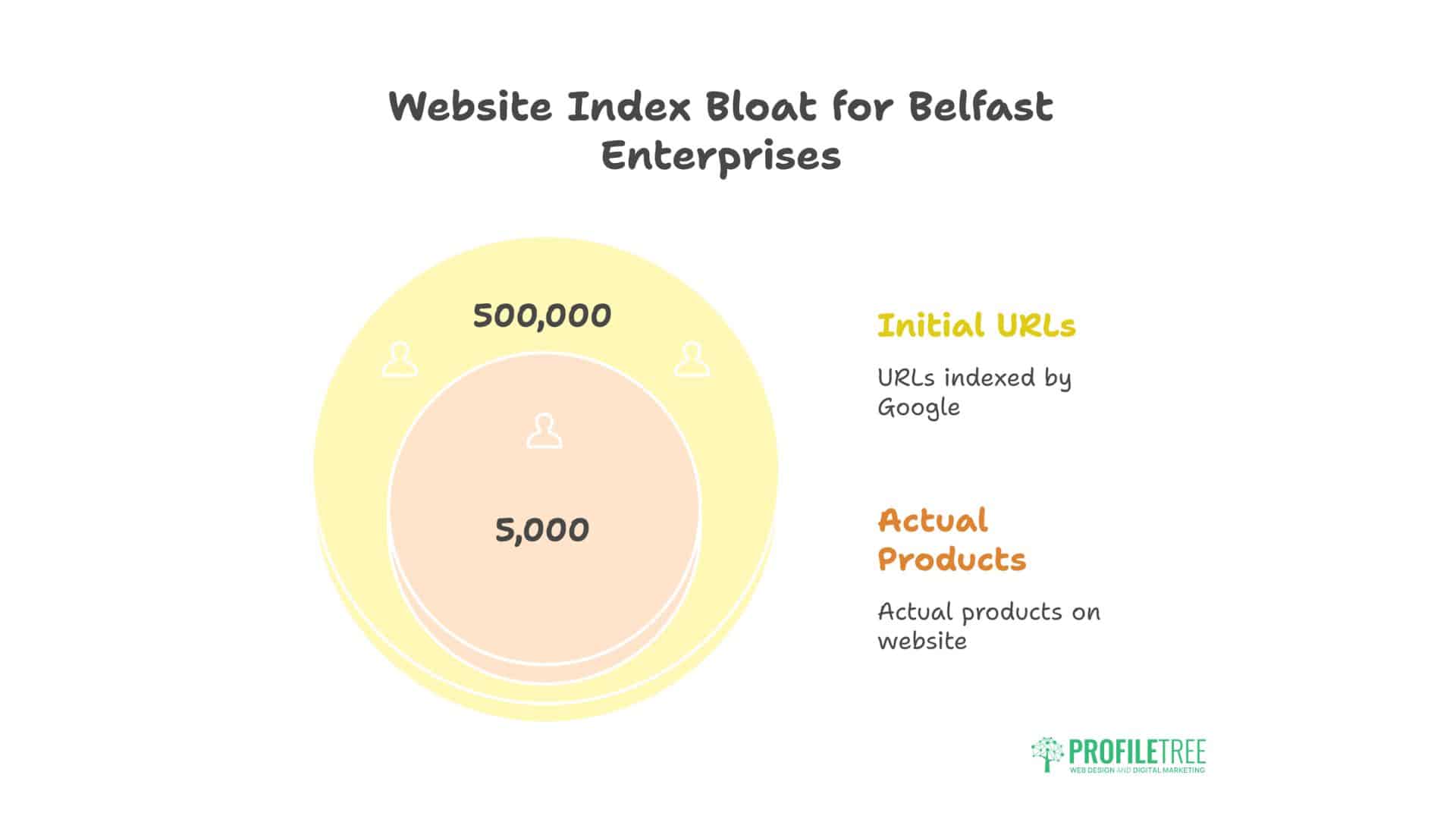
Large websites face exponential technical complexity that smaller sites never encounter. A 10-page website might have 100 potential technical issues, while a 10,000-page enterprise site has 10 million potential problems. Each product page, category listing, filtered result, and dynamic URL creates crawl paths that confuse search engines. Belfast enterprises running e-commerce platforms discovered that Google had indexed 500,000 URLs when they had only 5,000 products. This index bloat dilutes ranking power while wasting crawl budget on worthless pages.
Site architecture problems compound as organisations grow through acquisition, platform migration, and departmental silos. The marketing team launches microsites without IT knowledge. Regional offices create subdirectories following different structures. Product teams implement a filtering system, generating infinite URL combinations. Legacy redirects chain through multiple hops. What started as organised architecture becomes an unmappable maze where search engines get lost and valuable content remains undiscovered.
JavaScript rendering issues plague modern enterprise websites built on React, Angular, or Vue frameworks. These technologies create beautiful user experiences but nightmares for search engines. Content that appears instantly to users might take 30 seconds for Googlebot to render – if it renders at all. Critical content hidden behind JavaScript interactions never gets indexed. Dublin tech companies lose 70% of their content to rendering problems they don’t know exist.
Mobile-first indexing caught enterprises unprepared despite years of warning. Desktop sites carefully optimised over decades suddenly became irrelevant as Google switched to mobile-first. Responsive design isn’t enough when mobile versions hide content, disable functionality, or load differently. Enterprise sites built desktop-first now scramble to retrofit mobile experiences while haemorrhaging rankings. The technical debt from years of desktop-focused development requires systematic reconstruction.
Core Web Vitals transformed technical SEO from optional to mandatory. Largest Contentful Paint, First Input Delay, and Cumulative Layout Shift aren’t just metrics – they’re ranking factors. Enterprise sites loading megabytes of JavaScript, dozens of third-party scripts, and unoptimised images fail these critical thresholds. A Manchester manufacturer saw traffic drop 40% overnight when Core Web Vitals became ranking factors. Recovery requires fundamental technical transformation, not superficial optimisation.
Watch our technical approach: How to Audit Your Website for Free
Comprehensive Crawl Optimisation for Maximum Visibility
Comprehensive crawl optimisation ensures search engine bots can efficiently discover, access, and index every critical page on your website while avoiding crawl budget waste on low-value content that dilutes your site’s overall authority. Strategic crawl optimisation involves technical implementations, including XML sitemap refinement, robots.txt configuration, internal linking structure enhancement, and crawl rate optimisation that collectively maximise search engine visibility while preventing indexation of duplicate, thin, or irrelevant pages that could harm rankings.
Understanding and Maximising Crawl Budget
Crawl budget isn’t unlimited – Google allocates finite resources to each website based on authority, freshness, and technical health. Enterprise sites waste precious crawl budget on duplicate content, infinite scroll pagination, and session IDs. Every crawl spent on worthless pages is a crawl that does not reach valuable content. Large e-commerce sites often waste 90% of crawl budget on filtered results and parameter variations, while important category pages go months without crawling.
Log file analysis reveals the brutal truth about crawler behaviour. Most enterprises never examine server logs, missing critical insights about how search engines interact with their sites. ProfileTree’s log analysis shows Googlebot’s crawl patterns, identifying orphaned sections, crawl traps, and resource waste. A Cork retailer discovered Googlebot spent 60% of its visits crawling out-of-stock products from three years ago while ignoring new product launches.
Crawl prioritisation ensures search engines find your most valuable content first. XML sitemaps, internal linking hierarchies, and crawl directives guide bots to essential pages. However, most enterprises use generic sitemaps that list every URL equally. Strategic crawl management involves dynamic prioritisation based on business value, content freshness, and conversion potential. Revenue-generating pages need aggressive crawling, while archived content can wait.
Crawl efficiency optimisation reduces server load while improving indexation. Efficient URL structures, proper canonicalisation, and clean redirects help crawlers navigate effectively. Parameter handling tells Google which URL variations to ignore. Pagination strategies prevent infinite crawl loops. These optimisations mean crawlers index more valuable content per visit, improving overall site visibility.
International crawl management becomes critical for multi-region enterprises. Hreflang implementation, regional sitemaps, and geo-targeted crawl strategies ensure proper international indexing. Without proper configuration, Google crawls the wrong regional versions, shows incorrect content to users, and wastes crawl budget on duplicate international content. Belfast businesses serving UK and Irish markets need sophisticated crawl strategies to manage both Google.co.uk and Google effectively.ie.
Eliminating Crawl Errors and Obstacles
404 errors seem harmless individually, but become catastrophic at scale. Enterprise sites accumulate thousands of broken links through product discontinuation, category restructuring, and content migration. Each 404 represents lost link equity, poor user experience, and wasted crawl budget. More critically, excessive 404s signal poor site maintenance, reducing Google’s trust and crawling frequency.
Redirect chains create cascading problems that search engines won’t follow. Enterprises accumulating redirects through multiple migrations often have chains five or six hops deep. Google follows a maximum of two redirects before giving up. Link equity dissipates with each hop. Page load times increase. Users encounter delays. A London financial services firm had 15,000 redirect chains averaging four hops – fixing them recovered 30% organic traffic within weeks.
Soft 404s poison technical SEO invisibly. Pages returning 200 status codes but displaying error content confuse search engines. “Product not found” pages, empty category listings, and “coming soon” placeholders appear successful to crawlers but provide no value. Google eventually identifies soft 404s and treats them as errors, but not before wasting significant crawl budget and diluting site quality signals.
JavaScript crawl blocks prevent modern content from being indexed. Lazy-loaded images, dynamically inserted content, and client-side rendered elements often remain invisible to search engines. Enterprises using progressive web apps or single-page applications face particular challenges. Critical content requiring user interaction never gets crawled. ProfileTree’s technical audits regularly discover 40-50% of enterprise content blocked by JavaScript implementation issues.
Robot.txt misconfigurations accidentally block important content from crawling. Complex enterprises often have conflicting directives from different departments, staging site rules accidentally pushed to production, or overly aggressive blocking to protect server resources. One Dublin e-commerce site blocked its entire product catalogue through a single wildcard rule for development servers. These devastating mistakes go unnoticed until traffic disappears.
Learn advanced techniques: How to Use YouTube: A Complete Beginner’s Guide
Site Speed Optimisation at Enterprise Scale
Enterprise-scale site speed optimisation requires addressing complex performance challenges, including massive content volumes, multiple server environments, global content delivery networks, and sophisticated caching architectures that demand specialised technical expertise beyond standard website optimisation approaches. Enterprise-level speed optimisation involves coordinated improvements across database queries, server response times, image compression systems, JavaScript bundling, CSS optimisation, and third-party integration management that collectively ensure consistent performance across thousands of pages while maintaining functionality for complex business applications and user interactions.
Frontend Performance Engineering
Resource loading optimisation transforms page speed through intelligent prioritisation. Critical CSS inline, JavaScript deferred, images lazy-loaded – these techniques aren’t new, but become complex at enterprise scale. Marketing tags, analytics scripts, personalisation tools, and conversion pixels create resource competition. The average enterprise page loads 150+ requests from 50+ domains. Orchestrating this chaos requires systematic optimisation beyond basic performance tips.
Image optimisation alone can reduce page weight by 80%. But enterprises struggle with millions of product images, user-generated content, and legacy assets. Automated image optimisation pipelines using next-gen formats (WebP, AVIF), responsive images, and CDN transformation become essential. A Birmingham retailer reduced average page weight from 8MB to 1.5MB through systematic image optimisation, improving Core Web Vitals scores from failing to passing.
Third-party script management requires diplomatic technical leadership. Marketing wants tracking pixels, sales demands chat widgets, and legal requires cookie notices. Each script adds weight and processing overhead. Tag management systems help, but often become performance bottlenecks themselves. ProfileTree implements strict performance budgets, async loading strategies, and script auditing processes that maintain functionality while preserving performance.
CSS and JavaScript optimisation goes beyond minification and concatenation. Modern build processes using tree-shaking, code-splitting, and dynamic imports dramatically reduce bundle sizes. However, enterprise sites often run legacy code alongside modern frameworks, creating bloated bundles and execution bottlenecks. Systematic refactoring, progressive enhancement, and strategic modernisation unlock massive performance gains.
Font loading strategies prevent invisible text and layout shifts. Enterprise brand guidelines often specify custom fonts that delay rendering. Font-display properties, subset loading, and variable fonts reduce impact. However, many enterprises still load entire font families for occasional bold text. Optimised font strategies improve perceived performance while maintaining brand consistency.
Backend Infrastructure Optimisation
Server response time optimisation starts with database query efficiency. Enterprise sites running complex queries across millions of records create bottlenecks before content generation begins. Slow queries cascade through caching layers, CDNs, and ultimately to users. Database indexing, query optimisation, and architectural improvements can reduce server response times from seconds to milliseconds. A Cardiff SaaS platform reduced average response time by 70% through database optimisation alone.
Implementing a caching strategy requires understanding content volatility and user patterns. Static content benefits from aggressive browser caching, while dynamic content needs intelligent server-side caching. Personalised content challenges traditional caching approaches. Multi-layer caching strategies using browser cache, CDN cache, application cache, and database cache create performance while maintaining freshness. However, misconfigured caching causes stale content, cache stampedes, and performance degradation.
CDN configuration extends beyond basic static asset delivery. Modern CDNs provide edge computing, image transformation, and security features. However, enterprises often use CDNs as simple file servers, missing advanced optimisation opportunities. The edge side includes computing functions and intelligent routing, transforming CDNs from asset delivery to application acceleration platforms. Geographic distribution ensures global performance for international enterprises.
Application performance monitoring identifies bottlenecks that are invisible during development. Production traffic patterns, real-world data volumes, and user behaviour reveal missed performance problems. Memory leaks, connection pool exhaustion, and garbage collection pauses appear under load. Continuous monitoring with tools like New Relic or Datadog enables proactive optimisation before users notice degradation.
Infrastructure scaling strategies ensure performance during traffic spikes. Auto-scaling, load balancing, and database replication handle varying loads. However, many enterprises still run fixed infrastructure, suffering during peaks and wasting resources during valleys. Cloud-native architectures enable elastic scaling but require fundamental application changes. The investment pays dividends through consistent performance and reduced infrastructure costs.
Explore our comprehensive SEO services designed for enterprise performance.
Mobile Performance Excellence
Mobile-specific optimisation requires strategies different from desktop performance. Limited processing power, unreliable networks, and battery constraints create unique challenges. Mobile users expect instant response despite these limitations. Adaptive serving, network-aware loading, and progressive enhancement deliver excellent mobile experiences without sacrificing desktop performance.
AMP alternatives provide speed without Google’s framework limitations. While AMP delivers guaranteed performance, many enterprises find its restrictions limiting. Progressive Web Apps, optimised mobile templates, and performance-focused frameworks achieve similar speeds with greater flexibility. The key is meeting Core Web Vitals thresholds regardless of technology choice.
Touch interaction optimisation ensures responsive mobile experiences. Tap targets, swipe gestures, and touch feedback need careful implementation. Many enterprise sites simply shrink desktop interfaces, creating frustrating mobile experiences. Purpose-built mobile interactions, optimised for thumb reach and touch accuracy, dramatically improve engagement and conversion rates.
Network resilience strategies maintain functionality on poor connections. Service workers, offline caching, and progressive loading ensure content remains accessible. Enterprise sites assuming high-speed connectivity lose customers on mobile networks. Graceful degradation, skeleton screens, and intelligent prefetching create a perception of speed even on slow connections.
Battery efficiency considerations influence mobile performance strategies. Heavy JavaScript processing, continuous animations, and frequent network requests drain batteries quickly. Users abandon battery-draining sites regardless of content value. Efficient code, reduced processing, and intelligent resource loading preserve battery life while maintaining functionality.
Advanced Indexing and Rendering Solutions
Advanced indexing and rendering solutions address complex technical challenges when search engines encounter JavaScript-heavy applications, dynamic content loading, and single-page applications requiring specialised rendering capabilities beyond traditional HTML crawling. Enterprise-level indexing optimisation involves implementing server-side rendering, pre-rendering systems, structured data markup, and advanced crawling directives that ensure search engines can properly process and index sophisticated web applications while maintaining fast user experiences and comprehensive content discovery across complex site architectures.
JavaScript SEO Mastery
Server-side rendering implementation definitely solves JavaScript SEO challenges. SSR delivers fully rendered HTML to search engines, ensuring perfect indexation. However, enterprise applications built as SPAs require significant refactoring for SSR. Next.js, Nuxt, and similar frameworks enable SSR, but migration complexity deters many enterprises. The investment returns through improved indexation and performance make the SSR transformation worthwhile.
Dynamic rendering serves different content to bots and users: pre-rendered HTML for search engines and JavaScript applications for users. This approach maintains existing applications while solving indexation problems. However, implementation complexity and potential cloaking concerns require careful execution. Google officially supports dynamic rendering, but the technical implementation must be flawless to avoid penalties.
Progressive enhancement strategies build crawlable foundations enhanced with JavaScript. Core content loads in HTML, and JavaScript adds interactivity. This approach ensures search engines access content even if JavaScript fails. However, many modern frameworks assume JavaScript is available, making progressive enhancement challenging. Architectural decisions during development determine SEO success years later.
Hydration optimisation balances server and client rendering. Initial content renders server-side for SEO and performance. JavaScript “hydrates” the page, adding interactivity. However, hydration mismatches cause errors, performance problems, and user experience issues. Careful implementation ensures smooth transitions between server and client states.
Testing JavaScript rendering reveals indexation problems before they impact rankings. Google’s Mobile-Friendly Test, Rich Results Test, and URL Inspection tool show rendering results. But enterprises need systematic testing across thousands of pages. Automated rendering tests, monitoring, and alerts catch problems before Google does. Prevention beats correction in JavaScript SEO.
Structured Data Implementation
Schema markup at scale requires systematic implementation and governance. Enterprise sites benefit from extensive structured data – products, reviews, organisations, events, FAQs. But manual implementation across thousands of pages proves impossible. Automated schema generation, template-based implementation, and programmatic validation enable enterprise-scale structured data.
Rich results optimisation captures SERP features, driving significant traffic. Featured snippets, knowledge panels, and rich cards provide visibility beyond traditional rankings. However, earning rich results requires a perfectly structured data implementation. Missing required properties, incorrect formatting, or validation errors prevent rich results. Systematic testing and monitoring ensure consistent, rich results.
Knowledge Graph integration establishes entity relationships and authority. Google understands entities, not just keywords. Structured data helps Google understand your organisation, products, and relationships. Connected entities build topical authority through proper markup. Enterprise sites that properly implement entity markup see improved rankings across related queries.
Product feed optimisation for Google Shopping and other platforms requires pristine data. Accurate prices, availability, descriptions, and images drive shopping success. However, maintaining accuracy across thousands of products challenges enterprises. Automated feed generation, validation, and monitoring ensure product data remains accurate. Integration with inventory systems prevents overselling and availability issues.
FAQ and How-to schema capture voice search and featured snippets. Question-based queries dominate voice search and mobile. Properly structured FAQ content appears directly in search results. However, many enterprises miss these opportunities due to poor implementation. Strategic FAQ schema deployment captures valuable SERP real estate.
Infrastructure and Architecture Optimisation
Infrastructure and architecture optimisation addresses foundational technical elements, including server configurations, database architecture, content delivery networks, and hosting environments that directly impact search engine crawling efficiency and user experience performance. Enterprise-level infrastructure optimisation involves strategic decisions about server locations, load balancing configurations, database query optimisation, caching layer implementation, and scalable architecture design that ensures consistent performance under high traffic loads while supporting complex SEO requirements across multiple domains, subdomains, and international market segments.
URL Structure and Information Architecture
URL optimisation at enterprise scale prevents exponential complexity growth. Clean, logical URLs improve crawlability and user experience. However, enterprises accumulate URL patterns through platform changes, departmental differences, and technical debt. Session IDs, tracking parameters, and filter combinations create millions of URLs from thousands of pages. Implementing a systematic URL strategy reduces complexity while maintaining functionality.
Information architecture redesign improves findability for users and search engines. Deep, complex hierarchies bury valuable content, and flat structures lack organisation. The optimal architecture balances depth with accessibility. Most content should be within three clicks of the homepage, but enterprise sites average six to eight clicks to reach product pages. Architecture redesign dramatically improves crawl efficiency and user experience.
Faceted navigation management prevents crawl budget waste and duplicate content. Filters and sorting options help users, but create SEO nightmares. Every combination generates unique URLs with duplicate content. Canonical tags, parameter handling, and AJAX implementation manage faceted navigation. However, most enterprises implement these facets without considering the impact of SEO. Proper configuration maintains usability while preventing indexation problems.
Pagination strategies affect crawl efficiency and user experience. Traditional pagination creates crawl chains and orphaned pages. Infinite scroll breaks SEO and accessibility. Load more buttons hide content from search engines. The optimal solution depends on content type and user behaviour—E-commerce benefits from traditional pagination with view-all options. Content sites might use infinite scroll with proper implementation. Strategic pagination balances all requirements.
Internal linking optimisation distributes authority and improves crawlability. However, enterprise sites often have poor internal linking through siloed development. Product pages don’t link to related products, blog posts don’t reference products, and category pages lack contextual links. Systematic internal linking using automated rules, associated algorithms, and strategic placement dramatically improves rankings.
Migration and Consolidation Strategies
Platform migration without traffic loss requires meticulous planning and execution. Enterprise migrations involve millions of URLs, complex redirects, and significant risk. One mistake can destroy years of SEO value. ProfileTree’s migration methodology includes comprehensive auditing, staged migration, and continuous monitoring. We’ve successfully migrated sites with 10+ million pages without traffic loss.
Domain consolidation combines multiple properties for enhanced authority. Enterprises often run separate domains for brands, regions, or products. Consolidation concentrates authority, simplifies management, and improves rankings. However, poor consolidation destroys individual site equity. Strategic consolidation preserves value while creating a stronger unified presence.
HTTPS migration remains incomplete at many enterprises. Security certificates, mixed content warnings, and redirect chains complicate HTTPS implementation. But Google requires HTTPS for optimal rankings. Systematic HTTPS migration ensures a smooth transition, including certificate management, content updates, and redirect implementation. Performance overhead from encryption requires optimisation to maintain speed.
Subdomain versus subdirectory decisions impact SEO significantly. Subdomains are treated as separate sites, diluting authority. Subdirectories consolidate authority under the main domain. However, technical constraints often force subdomain usage. Strategic architecture maximises SEO value within technical limitations. Many enterprises benefit from subdomain consolidation but never attempt it due to complexity.
Legacy system integration maintains historical SEO value during modernisation. Old platforms often contain valuable content and links, which a complete replacement loses. Integration strategies preserve SEO equity while enabling modern functionality. APIs, proxies, and careful routing also maintain legacy value during transformation.
Security and Trust Optimisation
Security implementation affects SEO beyond HTTPS requirements. Hacked sites face severe ranking penalties. Malware infections get flagged in search results. Security vulnerabilities destroy user trust. Enterprise security requires continuous monitoring, rapid response, and proactive protection. Investment in security protects SEO investment.
Trust signals influence rankings indirectly but significantly. Privacy policies, terms of service, and contact information build trust. Security badges, certifications, and testimonials reinforce credibility. But many enterprises bury trust signals or omit them entirely. Prominent trust signals improve conversion and may influence rankings.
Spam protection prevents user-generated content from destroying SEO. Comments, reviews, and forums attract spam without moderation. Spam content dilutes quality signals and attracts penalties. Automated moderation, manual review, and no-follow policies protect against spam impact. However, many enterprises lack proper spam protection and suffer invisible SEO damage.
Brand protection through technical SEO prevents reputation damage. Negative SEO attacks, scraping, and impersonation threaten enterprise brands. Monitoring, legal action, and technical countermeasures provide protection. However, most enterprises remain unaware of attacks until damage occurs. Proactive brand protection preserves SEO value and reputation.
Compliance requirements increasingly affect technical SEO. GDPR, CCPA, and accessibility laws influence implementation: cookie notices, consent management, and data handling impact performance and crawlability. Balancing compliance with SEO requires careful technical implementation. Non-compliance risks penalties beyond just rankings.
Monitoring, Measurement, and Continuous Improvement
Monitoring, measurement, and continuous improvement establish systematic tracking frameworks that identify performance trends, technical issues, and optimisation opportunities through comprehensive data analysis rather than reactive problem-solving approaches. Effective monitoring systems combine real-time alerts for critical issues like crawl errors or page speed degradation with detailed performance analytics that enable data-driven decision-making, competitive benchmarking, and iterative refinements that maintain and improve search engine visibility as algorithms evolve and business requirements change over time.
Enterprise SEO Monitoring Systems
Real-time monitoring catches problems before they impact rankings. Enterprise sites change constantly through content updates, product changes, and technical deployments. Any change can accidentally break SEO. Continuous monitoring alerts to problems immediately. However, most enterprises rely on periodic audits, discovering problems weeks later. Real-time monitoring prevents minor issues from becoming major disasters.
Custom dashboards track KPIs specific to business objectives. Generic SEO metrics miss enterprise nuances. Revenue per organic visitor, product page rankings, and category visibility matter more than overall traffic. Custom dashboards focusing on business metrics guide optimisation priorities. ProfileTree creates dashboards aligning SEO metrics with enterprise goals.
Competitive monitoring reveals opportunities and threats. Enterprises compete against multiple competitors across different verticals. Monitoring competitor technical implementations, content strategies, and ranking changes provides intelligence. But manual competitive monitoring doesn’t scale. Automated tracking across competitors identifies gaps and opportunities systematically.
Alert systems enable rapid response to critical issues. Ranking drops, crawl errors, and performance degradation require immediate attention. However, enterprises often discover problems through declining revenue weeks later. Sophisticated alerting based on statistical anomalies enables proactive response. Early intervention prevents minor issues from becoming traffic disasters.
Log analysis provides truth about search engine behaviour. GSC data is sampled and delayed, while server logs show every crawler interaction immediately. However, due to their volume and complexity, most enterprises never analyse logs. Automated log analysis reveals crawl patterns, errors, and opportunities invisible in standard reporting.
Performance Tracking and Optimisation
Core Web Vitals monitoring ensures continuous compliance. Google’s thresholds evolve, and site performance fluctuates. One poor deployment can push scores below passing. Continuous monitoring with real user metrics (RUM) provides accurate performance data. But most enterprises rely on lab data, missing real-world performance problems.
Conversion impact analysis connects technical improvements to business value. Faster sites convert better, but quantifying impact challenges enterprises. A/B testing technical improvements measure the real impact of conversion. This data justifies continued technical investment. ProfileTree’s implementations consistently show 20-40% conversion improvements from technical optimisation.
Traffic recovery tracking measures intervention effectiveness. Technical fixes should restore lost traffic, but recovery patterns vary. Some fixes show immediate impact, others take months. Understanding recovery timelines sets appropriate expectations. Documentation enables learning from each recovery, improving future responses.
Resource utilisation monitoring prevents performance degradation. Server resources, crawl budget, and CDN usage require monitoring. Inefficient resource use increases costs and degrades performance. Optimisation reduces costs while improving performance. Many enterprises save thousands monthly through resource optimisation.
ROI calculation for technical SEO investments guides budget allocation. Technical SEO requires significant investment, but returns aren’t always obvious. Calculating prevented losses, recovered traffic, and improved conversion demonstrates value. ProfileTree provides detailed ROI analysis to justify technical investments to stakeholders.
Explore our website development services that ensure technical excellence from the ground up.
Common Enterprise Technical SEO Failures
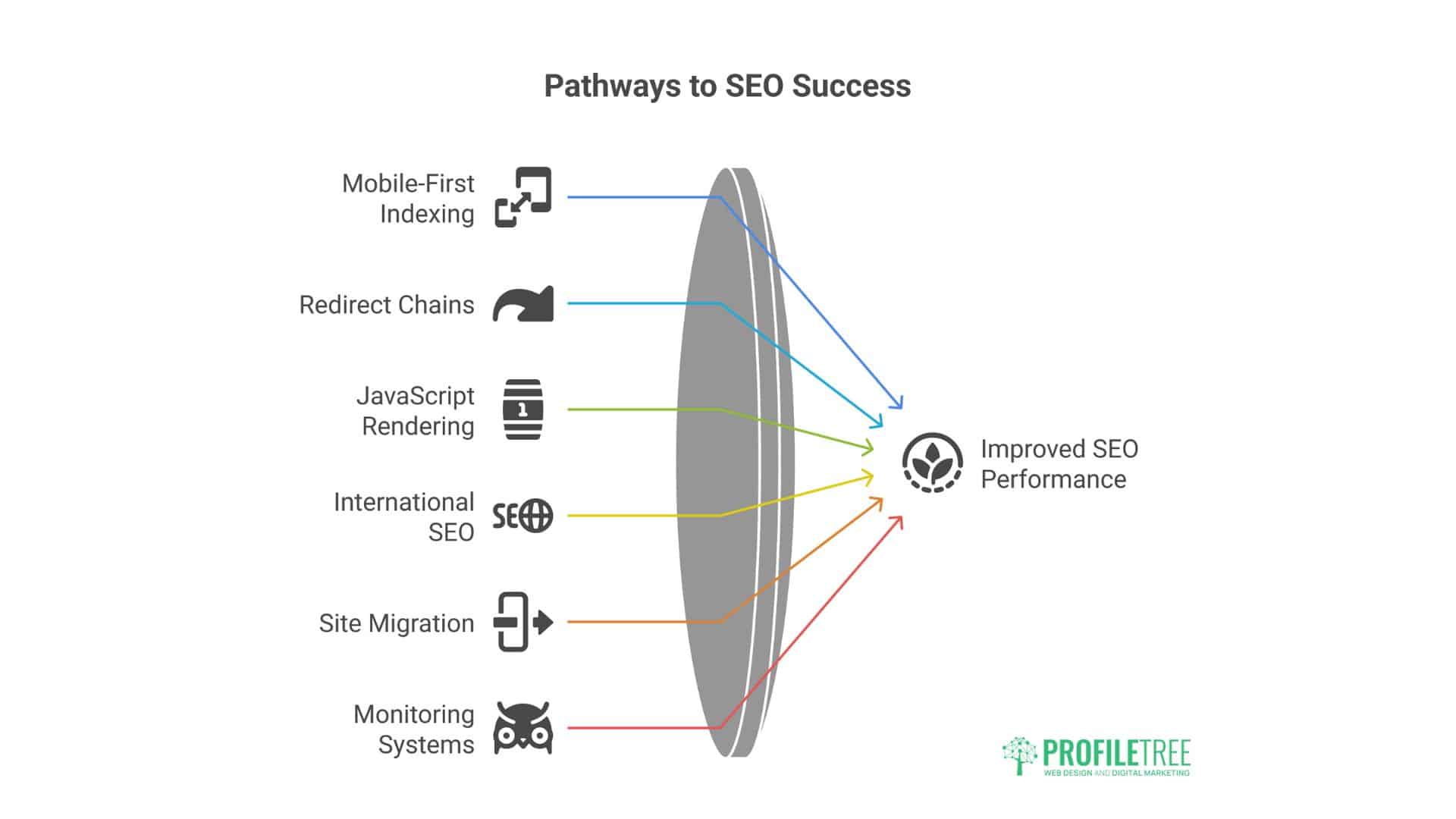
Common enterprise technical SEO failures include neglecting mobile-first indexing optimisation, implementing faulty redirect chains that waste crawl budget, and deploying JavaScript frameworks without proper server-side rendering, which prevents search engines from effectively indexing dynamic content. Additional frequent mistakes involve inadequate international SEO implementation with incorrect hreflang tags, poor site migration planning that results in massive ranking losses, and insufficient monitoring systems that allow critical technical issues to persist undetected for months while competitors gain market advantages through superior technical implementation.
Organisational Silos Creating Technical Debt
Development teams implementing features without SEO consideration create massive technical debt. Product filters generating infinite URLs, JavaScript frameworks hiding content, and platform choices limiting flexibility accumulate problems. By the time SEO gets involved, architectural decisions are fixed. Retrofitting SEO into completed development costs 10x more than building it in initially.
Marketing teams launching campaigns without technical coordination cause crawl and indexation chaos. Microsites on different platforms, tracking parameters creating duplicates, and temporary pages becoming permanent pollute technical SEO. Each campaign adds technical debt that’s never addressed. Years of accumulated campaign debris drag down entire sites.
IT security measures inadvertently blocking SEO create invisible barriers. Aggressive firewalls block crawlers, CloudFlare challenges Googlebot, and security headers prevent rendering, which seem like protection but destroy visibility. Security and SEO must collaborate, not compete. Many enterprises unknowingly block crawlers while wondering why rankings decline.
Content teams publishing without technical optimisation waste opportunities. Missing meta descriptions, duplicate content, and poor internal linking limit content impact. Beautiful content hidden behind technical problems never reaches its audience. Content and technical teams must coordinate for maximum impact.
Regional offices creating autonomous implementations fragment technical consistency. Different platforms, naming conventions, and technical standards create management nightmares. Central technical governance with local flexibility balances autonomy with consistency. But most enterprises lack technical governance, suffering from fragmented implementations.
Budget and Resource Allocation Mistakes
Underinvestment in technical SEO compared to content and links limits overall success. Enterprises spend millions on content that never gets properly crawled. Link building to technically broken sites wastes investment. Technical foundation enables other SEO investments. However, technical work seems less tangible than content or links, and it is receiving smaller budgets.
Reactive fixing rather than proactive prevention creates expensive emergencies. Waiting until traffic drops to address technical issues costs more than prevention. Emergency fixes under pressure lead to mistakes. Proactive technical maintenance prevents most problems, but enterprises typically ignore technical SEO until a crisis hits.
Platform selection without SEO consideration creates permanent limitations. Choosing platforms based on features without evaluating SEO capabilities locks in problems. Some platforms simply can’t do proper SEO regardless of effort. Platform selection should include a comprehensive SEO evaluation. Migration costs make platform mistakes extremely expensive.
Outsourcing technical implementation without proper oversight leads to poor quality. Offshore development might save money initially, but it often creates technical debt. Without SEO expertise to review implementation, problems accumulate invisibly. Quality technical implementation requires expertise that many enterprises lack internally.
Short-term thinking prevents long-term technical investments. Technical improvements often take months to show ROI. Quarterly pressure drives focus on quick wins over fundamental fixes. But technical debt compounds exponentially. Long-term technical investment returns multiples of short-term tactics.
The ProfileTree Advantage in Technical SEO
ProfileTree’s technical SEO advantage stems from combining deep technical expertise with practical business implementation experience gained through optimising enterprise websites across diverse industries, including e-commerce, SaaS, and professional services. Our systematic approach integrates advanced technical auditing capabilities with ongoing performance monitoring and strategic optimisation, delivering measurable improvements in search visibility, organic traffic growth, and conversion performance while maintaining website functionality and user experience standards that support long-term business objectives.
Our Proven Enterprise Methodology
The discovery phase, revealing hidden technical problems, uses proprietary auditing tools and methodologies developed over years of enterprise engagements. We examine over 200 technical factors, analysing millions of URLs to identify issues. Our discoveries consistently shock enterprises that thought their sites were optimised. The depth of our analysis exceeds standard technical audits by orders of magnitude.
A prioritisation framework focusing on maximum impact ensures that resources target the highest-value improvements. Not all technical issues matter equally. We quantify potential impact, implementation effort, and risk for every issue. This data-driven prioritisation delivers rapid ROI while building toward long-term excellence. Enterprises see measurable improvements within weeks, not months.
Implementation excellence through experienced technical specialists distinguishes ProfileTree from generalist agencies. Our team includes former Google engineers, enterprise architects, and platform specialists. We don’t just identify problems – we fix them. Our implementation expertise spans every major platform and technology stack.
Validation and testing ensure improvements work as intended and prevent unintended consequences. Every change gets tested across devices, validated against SEO requirements, and monitored for impact. Our systematic validation catches problems before they reach production. This rigorous approach ensures improvements actually improve rather than create new problems.
Knowledge transfer enables internal teams to maintain improvements, ensuring sustainable success. We don’t create dependency—we build capability. Our engagements include training, documentation, and ongoing support. Your team learns to identify and prevent technical issues independently, multiplying engagement value beyond immediate improvements.
Results That Speak for Themselves
Traffic recovery examples from technical interventions demonstrate our expertise. A Dublin e-commerce site recovered 2.5 million annual visits through crawl optimisation. A Manchester manufacturer increased organic traffic 180% by fixing JavaScript rendering. A Belfast SaaS platform doubled conversions through Core Web Vitals optimisation. These aren’t exceptional results—they’re typical ProfileTree outcomes.
Performance improvements documented through detailed measurements prove our impact. We provide comprehensive before/after analysis, including traffic, rankings, crawl stats, and performance metrics. Our improvements are quantifiable, not theoretical. Every engagement includes a detailed ROI calculation demonstrating the value delivered.
Platform expertise across major enterprise systems ensures we can help regardless of your technology. Magento, Shopify Plus, Salesforce Commerce Cloud, custom builds – we’ve optimised them all. Our platform expertise means faster implementation with fewer surprises. We know platform limitations and workarounds from experience.
Industry recognition and certifications validate our expertise. Google Partner status, platform certifications, and industry awards demonstrate our capabilities. But credentials matter less than results. Our client retention and referral rates prove satisfaction better than any certificate.
Ongoing innovation keeping pace with search engine evolution ensures continued success. We invest heavily in research, testing, and tool development. Our methodologies evolve with search engines. Clients benefit from continuous innovation without additional investment. Staying static means falling behind – we ensure you stay ahead.
FAQs
How much should enterprises budget for technical SEO services?
Enterprise technical SEO typically requires £5,000-£20,000 monthly, depending on site size and complexity. Initial audits cost £10,000-£30,000 for a comprehensive analysis. Implementation projects range from £20,000 to £200,000 based on scope. Ongoing monitoring and optimisation run £3,000-£10,000 monthly. However, ROI typically exceeds 300% within 12 months. Traffic recovery alone often justifies the entire investment within months.
How long before we see results from technical SEO improvements?
Quick wins appear within days—fixing critical crawl blocks shows immediate impact. Core Web Vitals improvements take 28 days to reflect in rankings. Major architectural changes require 3-6 months for full impact. JavaScript rendering fixes show results within 2-3 weeks. Overall transformation typically takes 6-12 months, but improvements accumulate continuously.
Can technical SEO recover traffic lost to algorithm updates?
Yes, if technical issues caused the decline. Many attributed algorithm penalties are actually technical problems coinciding with updates. We’ve recovered significant traffic by fixing technical issues post-update. However, content quality and link penalties require different solutions. Technical SEO enables recovery but doesn’t guarantee it for non-technical penalties.
Should we rebuild our site or fix existing technical problems?
It depends on the technical debt level and platform limitations. Minor issues warrant fixing, but fundamental platform limitations might require rebuilding. We provide a detailed analysis comparing fix versus rebuild costs and benefits. Many enterprises need rebuilding but fear migration. Others consider rebuilding when fixes would suffice. Our assessment offers clarity.
How do you prioritise technical issues with limited resources?
We quantify potential impact using traffic data, ranking potential, and conversion influence. Quick wins with high impact get priority. We consider implementation complexity and resource requirements. Dependencies between issues affect sequencing. Our prioritisation framework, refined across hundreds of enterprises, maximises ROI within constraints.
What’s the difference between technical SEO and regular SEO?
Technical SEO ensures search engines can crawl, render, and index content. Regular SEO focuses on content and links. Technical SEO is the foundation—without it, other SEO efforts fail. Think of technical SEO as infrastructure and regular SEO as traffic generation. Both are essential, but technical problems invalidate other investments.
Transform Your Technical SEO Today
Technical SEO determines whether your content ever reaches its intended audience. The most brilliant content, powerful links, and perfect keywords mean nothing if technical problems prevent indexation. Every day, technical issues persist, you haemorrhage traffic to competitors with inferior content but superior technical implementation. The gap between technically optimised and technically broken sites widens exponentially as search engines become more sophisticated.
ProfileTree is the premier technical SEO service provider for enterprise organisations. Our proven methodology, developed through hundreds of enterprise engagements, delivers measurable results within weeks. We don’t just audit problems—we fix them. Our team’s deep technical expertise spans every platform, technology, and challenge enterprises face.
Our SEO services go beyond surface-level optimisation to fundamental technical transformation. We identify the invisible problems destroying your organic performance and implement solutions that recover lost traffic while preventing future issues. Our combination of technical expertise, enterprise experience, and proven methodology ensures your success.
The choice is simple: continue losing traffic to technical problems you don’t understand, or partner with experts who transform technical disasters into competitive advantages. Your competitors are already optimising their technical foundations. Every day you delay falls further behind. The technical debt accumulating on your site compounds daily, becoming more expensive to fix tomorrow than today.
Contact ProfileTree immediately to discuss your technical SEO challenges. Whether recovering from traffic loss, preparing for migration, or proactively optimising for growth, we provide the expertise, resources, and results you need. Don’t let technical problems continue destroying your organic visibility. Transform your technical SEO from liability to advantage today.