
Grammarly and Content Strategy: What AI Editing Cannot Do Alone
Table of Contents
Grammarly content sits at an odd point in most marketing teams’ content workflow. It catches typos before a client sees them, but it has no idea whether a headline matches your target keyword, or whether your brand voice sounds like you on a Tuesday morning versus a Friday afternoon. For SMEs across Northern Ireland, Ireland and the UK trying to scale content output without losing quality, that gap matters more than the grammar checker itself.
This guide looks at where Grammarly content genuinely earns its place in a professional content workflow, where UK English settings and compliance issues trip up teams that generic guides skip, and where a human strategist still has to take over from AI editing tools.
The Role of AI Editors in Modern Content Creation
Grammarly content tools do one job well: they flag spelling slips, punctuation errors and basic clarity issues faster than a human proofreader working alone. For a small marketing team producing blog posts, ad copy and social captions across several channels, that speed adds up across a busy week.
AI editing tools like Grammarly sit at the start of a content workflow rather than the end of one, in theory. In practice, most teams bolt them on as a last-minute check, which wastes a large share of what the tool can actually offer. Used properly, AI editing becomes part of the drafting process itself, not just a spellcheck run before hitting publish.
Why ‘Correct’ Isn’t Always ‘Effective’
A sentence can pass every grammar check Grammarly runs and still fail to persuade anyone. Short, fragmented sentences work well in advertising copy. Grammarly’s clarity suggestions often push writers toward longer, smoother constructions that read fine in isolation but flatten the punch out of a call to action. Treat its suggestions as a first pass, not a final verdict on your brand voice. If a suggestion softens the one line you actually wanted readers to recall, it’s fine to reject it. AI editing tools are built to reward consistency and clarity, not the deliberate roughness that gives a brand its personality.
Integrating Grammarly Into Your Content Production Pipeline
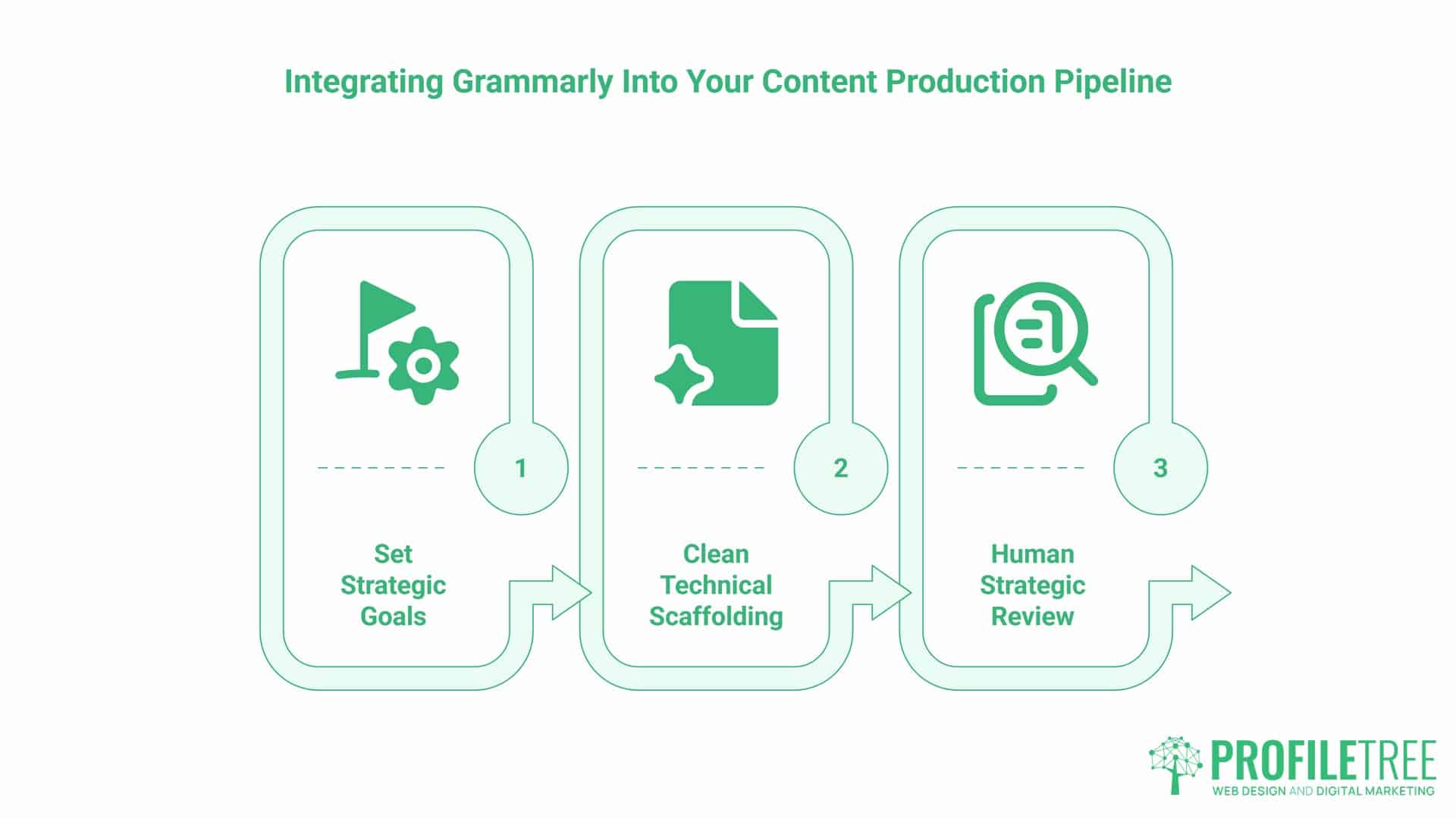
Most teams install Grammarly and treat it as an afterthought, running a quick check right before publishing. That approach wastes most of its value inside a proper content workflow. A well-designed content workflow places Grammarly earlier, and treats the final review as a separate, human step with its own time and ownership.
Phase 1: Setting Strategic Goals and Domain Constraints
Before drafting starts, set Grammarly’s goals settings to match the piece: audience, formality, domain and intent. A LinkedIn thought-leadership piece and a Google Ads headline require different settings within the same content workflow, and skipping this step is why so much AI-assisted content reads the same across channels. Getting this right at the start also protects your brand voice from being flattened into one generic tone across every format.
Phase 2: The First Pass, Cleaning the Technical Scaffolding
Once a draft exists, run it through Grammarly for the mechanical layer: spelling, grammar, punctuation and basic readability. This is the stage where Grammarly content genuinely saves time within a content workflow. It clears the small errors that would otherwise eat into an editor’s attention, leaving that attention free for judgment calls rather than typo-spotting. This is the point where AI editing earns its keep, and where most teams stop, when there’s still a strategic stage to come.
Phase 3: The Human Strategic Review, Where Grammarly Stops
This is where a content workflow needs a person with context: someone who knows the brand voice, the target keyword, the campaign goal and the audience. Grammarly cannot tell you whether a paragraph answers the search intent behind a query, whether your internal links point to the right service page, or whether a joke lands with a UK audience the way it would with a US one. Budget real editorial time for this stage. Skipping it is how technically correct, strategically pointless content ends up published, polished by AI editing tools, but missing the point of the piece.
Advanced Features for Marketing Teams
Grammarly Business adds features that individual writers rarely touch, and these are the features worth understanding if you’re managing content across a team rather than writing solo.
Custom Style Guides and Brand Tones
Grammarly Business lets teams set custom style guides and brand tone presets, so ten different writers produce copy that reads as one voice rather than ten. For agencies and in-house teams juggling multiple writers on the same account, this is the feature that actually justifies the upgrade from the free version, because it protects brand voice at scale rather than leaving it to individual judgment.
Set it once, and every piece of Grammarly content produced afterwards inherits the same tone rules, which matters as much for a five-person marketing team as it does for a much larger one.
Using Snippets for Consistent Messaging
The snippets feature stores approved boilerplate: standard product descriptions, disclaimers, CTAs, so writers pull from an approved library instead of rewriting the same line slightly differently each time. This matters more than it sounds for regulated or compliance-sensitive sectors, where a slightly reworded disclaimer can create a genuine problem, and it keeps brand voice consistent across dozens of pieces without extra editorial oversight on every single one.
Plagiarism Checks and Ethical AI Considerations
The plagiarism checker is a useful safety net for catching accidental duplication, particularly when several writers or AI drafting tools are contributing to the same content calendar. It won’t tell you whether a piece offers anything genuinely new compared with what’s already ranking for that topic, and it has no view on SEO structure at all. That’s a separate, strategic question, and one that a plagiarism score can’t answer on its own.
| Grammarly’s strength | Where a strategic partner takes over | |
|---|---|---|
| Language | Spelling, grammar, punctuation | Brand voice and tone of voice consistency |
| Structure | Basic readability scoring | SEO structure: headings, keywords, internal links |
| Search | None | Search intent match, ranking potential |
| Compliance | Generic dictionary | Sector-specific regulated terminology |
| Originality | Duplication detection | Genuine information gain versus competitors |
The UK and Ireland Context: Localisation and Nuance
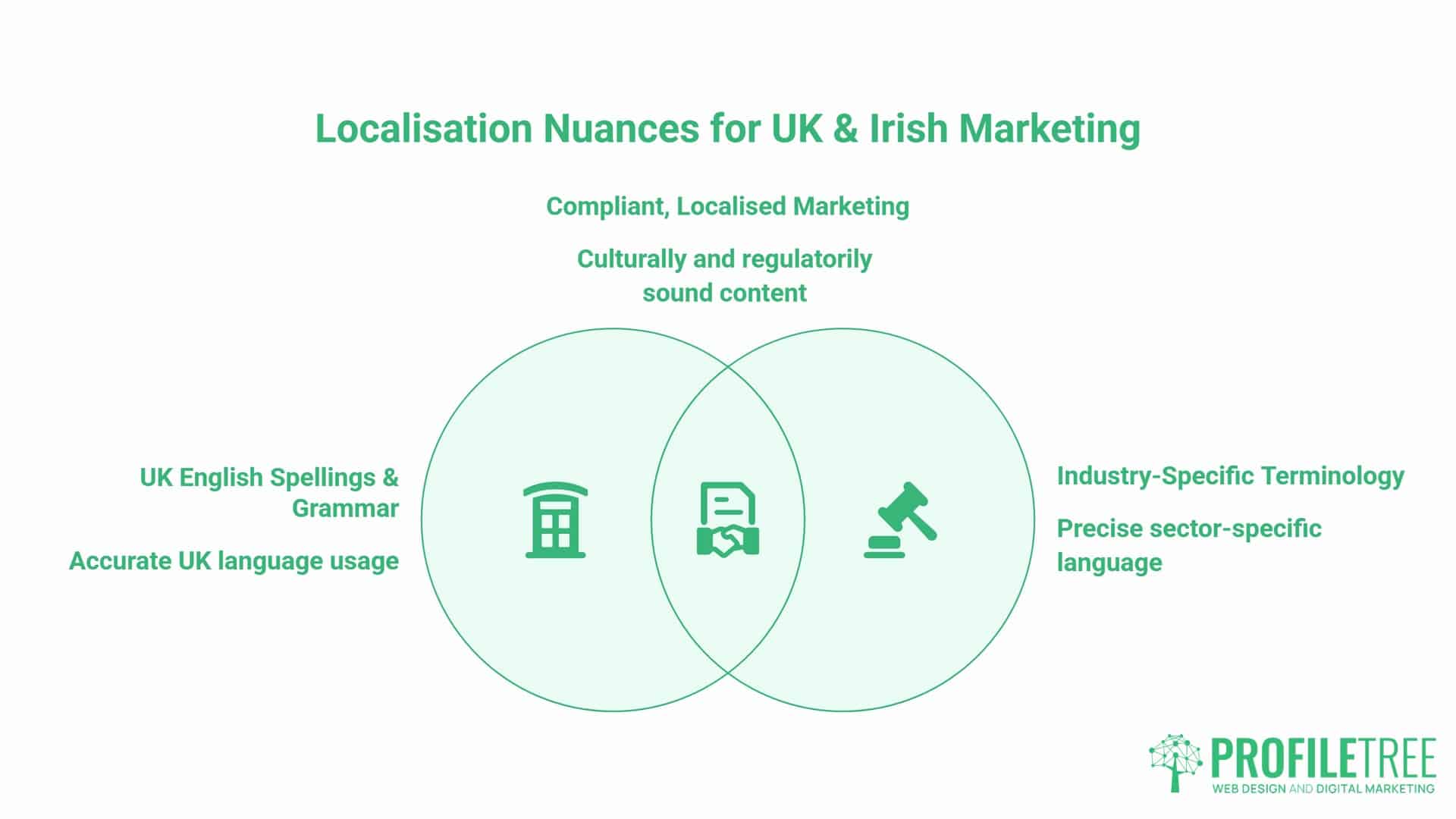
Most guides to using Grammarly in marketing are written for a US audience using US settings by default. UK and Irish teams need a different approach to UK English, and this is the part most competitor content skips entirely.
Navigating UK vs US English in Global Campaigns
Grammarly’s language setting needs to be changed manually to UK English inside the app; it doesn’t infer this from your location or your audience. Once set, it will flag American spellings like “optimize” and “color” and suggest the UK English equivalents, “optimise” and “colour”.
If your team runs campaigns for both UK and international audiences from one account, check the UK English setting per document rather than assuming it carries over, since a single missed toggle can leave US spellings sitting in content meant for a UK reader. Getting UK English right isn’t just a style preference for Northern Irish, Irish and British SMEs, it’s part of sounding like a business that actually understands its own market.
Managing Industry-Specific Terminology
Grammarly’s dictionary doesn’t automatically recognise UK sector-specific terms, regulatory phrasing, or industry shorthand common in fields like financial services, legal services or healthcare marketing. Teams working in regulated sectors should build a custom dictionary of approved UK English terms early, rather than accepting every suggested “correction” to specialist language that Grammarly simply hasn’t seen before.
In compliance-sensitive industries, a suggestion that simplifies wording can occasionally strip out the precise language a regulator expects. Treat any suggestion that touches regulated terminology as one to check with a compliance-aware editor before accepting it, since AI editing tools have no concept of what a regulator will and won’t accept.
Where a Strategic Partner Picks Up the Slack
Grammarly content handles the mechanical layer of a content workflow well. What it can’t do is the strategic layer: deciding what to write about, how to structure it for search, and how to make it sound like your brand rather than a competent stranger’s.
SEO Structure vs Grammatical Correctness
Grammarly doesn’t check keyword placement, heading hierarchy, internal linking, or whether a piece actually answers the query it’s trying to rank for. A perfectly grammatical article can still have weak SEO structure and be effectively invisible to search engines. This is where SEO support earns its place alongside an editing tool rather than instead of one, mapping keywords to headings, checking internal link structure, and making sure the SEO structure of a page actually answers the question a reader typed in.
Injecting Brand Personality and Emotive Copy
Grammarly’s suggestions tend to smooth writing toward a neutral, competent middle ground. That’s useful for internal documents and unhelpful for marketing copy that needs a distinct brand voice. ProfileTree founder Ciaran Connolly puts it this way:
“Grammarly will clean up your grammar, but it has no opinion on your market and no memory of what your last campaign sounded like. That’s still a job for a person who knows the brand.”
Getting brand voice right, and keeping it consistent across every piece of Grammarly content your team produces, is exactly the kind of work a content marketing partner does alongside the tool, not instead of it.
Training Your Team: Moving From Tool-Users to Content Strategists
The teams that get the most value from Grammarly aren’t the ones who use it hardest; they’re the ones who understand exactly where its judgment ends, and theirs begins within the wider content workflow. Building that understanding across a marketing team is a training exercise, not just a software rollout.
Structured digital training or a wider AI training programme helps writers move from accepting every AI editing suggestion by default to making an informed call on each one, which is the difference between a team that uses AI editing tools well and one that just uses them a lot. For SMEs weighing up broader AI transformation across marketing and operations, content is usually the easiest and lowest-risk place to start.
Making Grammarly Content Part of a Bigger Strategy
Grammarly content is a genuinely useful layer in a marketing content workflow. It catches errors faster than manual proofreading, keeps a team’s brand voice consistent once set up properly, and frees editorial time for the decisions that actually need a person: what to say, how to structure it, and whether it fits the brand.
None of that builds a content strategy on its own. A business that treats Grammarly and AI editing tools as the whole editing process, rather than one stage in it, will still publish grammatically correct content with weak SEO structure that struggles to rank or convert. Pairing the tool with clear digital strategy and proper SEO structure is what turns clean copy into content that actually does a job for an SME rather than just reading well.
Frequently Asked Questions
Does Grammarly improve my SEO ranking?
Not directly. Grammarly improves readability and reduces errors, which support user experience signals that search engines value. It doesn’t handle keyword strategy, heading structure or internal linking, so it works alongside SEO structure work rather than replacing it.
Is Grammarly Business secure for sensitive client data?
Grammarly Business includes enterprise-level encryption and admin controls suited to teams handling client content. UK firms handling personal data should still check Grammarly’s current data processing terms against their own GDPR obligations before sharing sensitive material.
Can I set my brand tone to British Professional?
Yes. Grammarly Business allows custom tone and style presets, so you can define a formal UK English tone once and apply it consistently across every writer on the account.
How do I stop Grammarly content from sounding robotic?
Set the intent to “Persuade” or “Tell a Story” rather than the default, and be willing to reject clarity suggestions that strip out short, punchy sentences. Grammarly’s default settings favour smooth, neutral prose over a distinctive brand voice.
Is the plagiarism checker reliable for marketing content?
It’s a solid safety net for catching accidental duplication, particularly across multiple writers. It doesn’t assess whether your content says anything new compared with competitors, which is a separate strategic check.