
Short-Form Video: Strategy, Platforms and Long-Form Growth
Table of Contents
Short-form video wins attention; long-form video wins customers. Short-form means a vertical clip under three minutes made for TikTok, Instagram Reels or YouTube Shorts, built around a single idea, while long-form is the horizontal video someone actively chooses to sit through. For most UK and Irish businesses, the split that works is short-form for discovery and long-form for the depth that turns a viewer into an enquiry, which is why the short-form vs long-form video decision matters more than the platform decision.
This guide covers what short-form video does for a business, which platform suits which type of company, the production and compliance decisions that trip most SMEs up, and the three-step model for turning YouTube Shorts viewers into long-form subscribers. It also covers UK revenue estimates, the monetisation thresholds changing in February 2027, and the technical setup that makes producing both formats practical rather than exhausting. Whether you bring in video marketing services or manage production in-house, the frameworks here are built for real production constraints.
What Short-Form Video Actually Means for a Business
Short-form video, in practical terms, means any video designed primarily for mobile-first viewing in a vertical format. TikTok built the category. Instagram Reels and YouTube Shorts followed with their own versions. The three now compete for the same viewing time, though they attract different audiences and reward different content.
The 60-second ceiling that defined the format early on no longer applies. A YouTube Short can run to three minutes, and TikTok accepts uploads far longer than the minute that once defined the category. For a business owner, the working definition is simpler: short-form video is video built around one clear idea, delivered before the viewer has any reason to scroll past.
Strategy for an SME is not the same as strategy for a consumer brand or an influencer. A food producer in County Down, a solicitor’s firm in Belfast and a manufacturing company in Derry have different objectives, and virality is almost never one of them. The goal is usually one of three things: visibility with a specific local audience, trust with buyers who are already considering the brand, or search presence on platforms where video competes directly with written content.
That last point is the one most owners miss. A Short answering a specific question can keep surfacing for months, long after the feed has moved on.
Which Platform Fits Your Business
Platform choice matters more than most guides acknowledge, and getting it wrong wastes months. The table below gives a practical overview for UK and Irish businesses.
| Platform | Strongest fit | Organic reach difficulty | Main advantage |
|---|---|---|---|
| TikTok | B2C, hospitality, retail, food and drink | Lower (high algorithmic amplification) | Fastest discovery for new audiences |
| Instagram Reels | Brands already active on Instagram | Medium | Google indexing, longer content shelf life |
| YouTube Shorts | B2B, professional services, any existing YouTube presence | Medium | Appears in Google search, builds on long-form channel authority |
| LinkedIn video | Accountants, solicitors, consultants, and engineering firms | Medium | Reaches buyers the consumer feeds rarely touch |
TikTok: reach and discovery
TikTok distributes almost entirely through its recommendation feed rather than through follower relationships, and its algorithm rewards content that taps into trends and audio. A new account with no following can still land in front of a sizeable audience, which is harder to achieve on platforms that distribute mainly to existing followers. TikTok’s sixth Digital Services Act transparency report put its EU audience at 178 million people a month across the second half of 2025, up from 169 million in the first half of the year.
Content works best here when it feels quick and unpolished. Viewers decide quickly whether to stay, so lead with the hook rather than the logo. Local accents, recognisable settings and trending audio all help a clip travel. ProfileTree’s breakdown of UK TikTok statistics covers the demographics in more detail.
Instagram Reels: polish and loyalty
Reels expects a cleaner finish than TikTok: consistent branding, decent lighting, a clear visual identity. It indexes well and surfaces within Instagram search, which gives a Reel a longer shelf life than a TikTok post.
For businesses that already have an Instagram following, Reels is the fastest way to put that audience to work. Tutorials, before-and-after clips and product walkthroughs perform reliably, particularly when filmed in a real setting rather than a studio. ProfileTree’s guide to Instagram Reels for business goes deeper into format and posting approach.
YouTube Shorts: search and staying power
Shorts is the platform SMEs overlook most often and underestimate most consistently. Shorts appear in Google search results, and they live on the same channel as a business’s longer content. A company that has already invested in explainer videos, case study walkthroughs or training material can cut Shorts from that footage and extend its reach without filming again. Because a Short competes in Google as well as in the feed, the title and description do as much work as the footage; ProfileTree’s guide to ranking videos on YouTube sets out which signals carry that weight.
LinkedIn: the B2B channel most SMEs ignore
For professional services, LinkedIn deserves a second look. DataReportal’s Digital 2026: Ireland report put LinkedIn at 3.70 million registered members in Ireland in late 2025, a count of accounts rather than active users, and short videos there reach decision makers the consumer feeds rarely touch. An accountant, solicitor or engineering firm will get more from a 60-second explainer on LinkedIn than from chasing TikTok trends. The tone is practical and informative, and one clip cut from a longer talk can do real work in front of the right buyers.
If you are choosing where to start, run a trial of six to eight weeks on a single platform and measure completion rates and profile visits. That will tell you more than any generic recommendation.
Short-Form vs Long-Form Video: The Direct Comparison
Before getting into strategy, the YouTube Shorts vs long-form video differences need to be clear. YouTube Shorts and long-form videos operate on different technical specifications, reach audiences through different discovery mechanisms, and generate revenue through different routes. Here is the side-by-side picture.
| Feature | Short-Form (YouTube Shorts) | Long-Form Video |
|---|---|---|
| Max duration | Up to 3 minutes | No limit (typically 5 to 45 min) |
| Aspect ratio | 9:16 vertical | 16:9 horizontal |
| Primary traffic source | Shorts feed (algorithmic) | Home / Search / Subscriptions |
| Viewer relationship | No prior connection needed | Typically subscribed or searching |
| Engagement type | Passive scroll-stop | Active, deliberate viewing |
| Watch time weighting | Completion rate | Absolute minutes watched |
| Monetisation route | Ad revenue share (lower RPM) | Ad placements + memberships + affiliates |
| YPP eligibility | 1k subs + 10M Shorts views / 90 days | 1k subs + 4,000 watch hours |
| Ideal content type | Single tip, hook, teaser | Tutorial, deep-dive, case study |
The eligibility thresholds matter for new channels. Most UK creators building an audience from scratch will qualify for long-form monetisation (1,000 subscribers and 4,000 watch hours) before they have hit 10 million YouTube Shorts views in 90 days. That is not a reason to avoid short-form video; it is a reason to use YouTube Shorts as an audience-building tool rather than a direct revenue source from day one.
Those numbers are about to move. YouTube confirmed on 10 August 2026 that new applicants from 1 February 2027 will need 8,000 qualified watch hours over 365 days or 20 million qualified Shorts views over 90 days, and that channels already in the Partner Programme keep their status. Fan funding and shopping thresholds stay as they are, at 500 subscribers plus either 3,000 watch hours or 3 million Shorts views. For a business channel starting now, the practical read is to build the long-form watch hours while the lower bar still applies.
For a full breakdown of how the Partner Programme works and what each route pays in practice, ProfileTree’s guide to YouTube monetisation covers eligibility, memberships and Super Thanks in detail.
The Algorithm Split: How YouTube Distributes Short-Form vs Long-Form Video
YouTube does not run a single recommendation engine. It operates two distinct systems that evaluate YouTube Shorts vs long-form video content by completely different signals, and understanding that split is the foundation of any workable short-form video strategy: if you’re not clear on this, you’ll optimise for the wrong things.
How the YouTube Shorts feed works
The YouTube Shorts feed prioritises completion rate and immediate engagement signals: shares, comments, and rewatches within the first 48 hours. Discovery is entirely algorithmic, not subscription-driven. It’s one of the most powerful aspects of the platform.
This creates a specific targeting opportunity. A viewer watching a YouTube Short about editing transitions has demonstrated a precise interest signal, and it’s one you can act on. That signal’s more useful than a general subscriber count because it tells you exactly what they want next. The practical implication for your short-form video strategy: Shorts should address narrow, specific questions rather than broad topics.
How the long-form video algorithm works
The long-form video recommendation engine weights watch time and session duration. A ten-minute video where 60% is watched generates more algorithmic authority than a YouTube Short with 90% completion, because the absolute viewing time is higher. That’s why long-form video builds ranking authority over months, while short-form video performance is typically front-loaded in the first 48 to 72 hours.
The two systems are separate rather than competing. There is nothing in how the two are built to suggest that publishing Shorts reduces long-form reach, and subscribers acquired through Shorts are tracked separately rather than being folded into long-form engagement rates.
Understanding how YouTube search and metadata interact with short-form vs long-form video is a related but distinct discipline. ProfileTree’s YouTube SEO guide covers keyword strategy, title optimisation, and the signals that determine where each format surfaces in search results.
The Hybrid Funnel: Converting YouTube Shorts Viewers into Subscribers
The core short-form vs long-form video strategy is this: YouTube Shorts provides the reach, and long-form video provides the revenue. Building a deliberate bridge between them is what separates a short-form video strategy that grows a business from one that simply accumulates views. The funnel has three steps.
Step 1: Use YouTube Shorts as trailers
Each YouTube Short should create a genuine information gap rather than deliver a complete tip. Introduce a problem and offer the first step of the solution. The remaining steps live in a specific long-form video.
The short-form video structure that works consistently: hook in the first two seconds, problem statement from seconds two to eight, partial solution from seconds eight to twenty-five, then a specific verbal call to action naming the exact long-form video. Generic CTAs such as ‘watch my other videos’ don’t convert well. Specific CTAs such as ‘I break down all five steps in the full tutorial, linked in the description’ convert at a much higher rate. It’s the specificity that drives the click.
Ciaran Connolly, founder of ProfileTree, a Belfast-based digital marketing agency established in 2011, frames the short-form vs long-form video relationship this way: “Shorts are the fame and long-form is the fortune. We see this pattern consistently with clients building video strategies from scratch. The Shorts get the attention, but it is the longer content where viewers decide whether they trust you enough to act on your recommendations.”
Step 2: Implement the related video technical link
YouTube Studio includes a feature that allows a YouTube Short to link directly to a designated long-form video. This solves the core problem that short-form video descriptions aren’t clickable within the Shorts feed itself.
To set this up: open YouTube Studio, go to the Short’s edit page, and look for the ‘Related video’ option under the Details tab. Select the long-form video you want to drive traffic towards. It’s one of the most underused tools in YouTube Studio. Most creators mention their channel verbally but do not configure the Related Video link, which means they lose the viewers who respond to a visual prompt rather than an audio CTA. Set it on every YouTube Short without exception.
Step 3: Pin a comment with the link
The pinned comment on a YouTube Short is the second conversion point, and it is almost universally skipped. After publishing each short-form video, immediately pin a comment that names the related long-form video and gives one-sentence context for what additional value it provides. Viewers who scroll past the description without reading it will see the pinned comment. Both touch points together cover the two main conversion paths from short-form video to long-form subscriber.
The short-form to long-form video conversion checklist
- Related Video link configured in YouTube Studio
- Pinned comment with link and one-sentence context
- Specific verbal CTA in the YouTube Short naming the long-form video
- Short-form and long-form videos address the same specific question at different depths
- End screen on long-form video referencing relevant YouTube Shorts
Production: DIY or a Professional Video Service
The production decision is where most SMEs get stuck. The common advice is that a smartphone is all you need, and for some content that is accurate. A quick tour of a new product, a staff introduction or a behind-the-scenes clip of a project in progress can perform well without professional equipment.
The problem is that the threshold for what counts as good enough keeps rising. Audiences have become more selective, and a poorly lit, badly framed clip with weak audio says something about a brand that the content itself cannot undo. The real dividing line is not DIY against professional. It is between content that builds trust and content that quietly erodes it. A 30-second clip filmed on a recent smartphone, in good natural light, with clean audio and captions added, can work well. A clip filmed in a corridor with background noise and no captions is worse than not posting at all.
A smartphone is enough when:
- The content is a staff introduction or behind-the-scenes footage where authenticity is the point
- The product is visually appealing, and a quick demonstration carries it
- Speed of publishing matters more than finish, as with topical commentary
- You are joining a trend where raw, unpolished content matches the format convention
Professional production earns its cost when:
- The content will be used across multiple channels and campaigns
- The product or service is premium and quality signals pricing
- You are filming clients or partners who need a comfortable, well-run environment
- You are batching a full content calendar, where consistency matters more than any single clip
Batching is the part worth understanding, because it changes the economics. Rather than shooting clips one at a time as they are needed, a batched shoot produces a run of clips in one session, covering different topics, formats and platform requirements. Those assets are then distributed over several weeks with consistent quality throughout. ProfileTree’s video production and marketing service works with businesses across Northern Ireland, Ireland and the UK on exactly this model, producing batched short-form content ready to publish across TikTok, Reels and YouTube Shorts.
If the gap is skills rather than time, digital training brings an in-house team up to speed without handing the work over entirely.
Technical Setup for Short-Form vs Long-Form Video Production
Your equipment and workflow should support your short-form video strategy without requiring a separate shoot for each format. Two decisions made at the filming stage determine whether producing YouTube Shorts alongside long-form content is practical or it’s a constant headache.
Film in 4K, crop to vertical for YouTube Shorts
Film all long-form video content in 16:9 format at 4K resolution. When creating YouTube Shorts, crop to 9:16 from the 4K master. The extra resolution handles the crop without visible quality loss. Filming in 1080p and then cropping to vertical gives you a noticeably softer short-form video that doesn’t match the quality of the long-form original. The 4K-crop approach means every long-form filming session simultaneously produces material for YouTube Shorts, with no additional setup time.
This single decision is the most efficient change most dual-format creators can make. It removes the need to schedule separate filming sessions for content you’ve already shot.
Prioritise audio for both formats
Poor audio ends a video faster than poor lighting or shaky framing in both short-form and long-form video, but the consequences are more immediate in YouTube Shorts. Short-form video viewers are frequently in public spaces without headphones. If the audio isn’t clear, a significant portion of your YouTube Shorts audience will scroll on before the point lands.
The minimum setup for dual-format production: a clip-on lavalier microphone or a directional microphone mounted close to the speaker. This matters more for short-form video than for long-form, because long-form video viewers have already committed to the content and are more likely to persist through minor audio issues.
Edit long-form video first, extract YouTube Shorts during the edit
The most time-efficient short-form vs long-form video workflow: complete the long-form video edit first, then identify Short-worthy moments during the review pass. Do not plan YouTube Shorts separately, and do not extract them before the long-form edit is finalised. Moments often land differently in the edit than they did during filming; it’s the edit pass where you discover what actually works as a stand-alone hook.
Batch your filming as well. Setting aside a single morning to shoot several videos, then editing and scheduling them across the following weeks, is the only sustainable rhythm for a team that also has a business to run.
Compliance, Consent and Captions in the UK and Ireland
This is the section most guides skip, and it is the one that costs businesses when they get it wrong.
If you are filming staff, customers or members of the public, GDPR applies. You need a lawful basis for filming anyone identifiable, and in practice, that usually means asking for their consent. Filming in a public space is treated differently in Northern Ireland and the Republic of Ireland than in England and Wales, so take specific advice rather than assuming a single rule covers all your locations.
Music is the other common trap. Using a trending audio track without clearing the rights can get a video muted or taken down, which removes the organic reach you have built. For business accounts, the safer route is royalty-free audio or the licensed libraries available inside each platform for business profiles.
Captions are not optional. Plenty of your audience will be watching on a commute or in a shared office with the sound off, and a clip without captions gives them nothing to follow. Assume silent viewing is the default and caption everything. Platform auto-captioning is a starting point rather than a finished job: it needs editing for technical vocabulary, local place names and anything specific to Northern Ireland or Ireland.
Short-Form Video Across Different Sectors
The right approach shifts depending on what you sell. A retailer chasing impulse buys has little in common with a solicitor building credibility. Four common business types show how differently the format behaves.
Retail and hospitality
For shops, cafés and restaurants, short-form video sells atmosphere as much as product. Quick demonstrations, kitchen preparation clips and genuine customer reactions turn browsing into visits, and limited-time offers create urgency the format handles well. TikTok and Reels are the natural primary channels, and a tracked offer code is the simplest way to tie a video to actual footfall.
Professional services
Accountants, solicitors and consultants often assume video is not for them. The opposite holds. Short clips answering a common client question position the firm as the obvious place to call, and the aim is credibility rather than reach. LinkedIn and YouTube Shorts suit this work best, because a series of plain-English answers keeps surfacing in search long after posting.
Trades and local service businesses
Plumbers, electricians and landscapers have a natural advantage: their work is visual and satisfying to watch. Before-and-after clips, quick maintenance tips and honest “here is what went wrong” videos build the trust that wins local jobs. Location tagging matters more for these businesses than for anyone else, since a clip tagged to a specific town is far more likely to reach people who can actually book the service.
Cross-border considerations
Businesses serving both the Republic and Northern Ireland face a quiet complication: currency, trending audio and even the dominant platform can differ across the border. A homeware brand in Newry sells in sterling to customers in Belfast and in euros to customers in Dundalk, so a single price overlay on a video confuses half the audience.
The fix is to separate what genuinely differs from what does not. The creative idea, the hook and the product stay the same; the price, the call to action and sometimes the audio track change by audience. Film the core clip once, then produce two cut-downs: one tagged to a Northern Ireland location with a sterling price, the other tagged to a Republic location in euros. Schedule each to the audience it suits, using county-level tags rather than a blanket “Ireland” tag that dilutes both. Border-county audiences often behave differently from the national average, so watch which side performs and shift effort accordingly.
Selling Directly Through TikTok Shop in Ireland
For retailers and product businesses, short-form video now connects straight to a checkout. TikTok Shop launched in Ireland in December 2024 and dropped its invite-only model in May 2026, opening the platform to any Ireland-based registered business. TikTok reports triple-digit growth in Irish seller numbers since launch and a sixfold rise in creators on its Irish affiliate programme. Shoppable clips and LIVE sessions turn discovery into a sales channel rather than an awareness exercise.
Who can sell and how to join
TikTok Shop in Ireland has been open to all Ireland-based registered businesses since May 2026. A registered business signs up through the TikTok Seller Centre using a phone number, email or existing TikTok account, then verifies its identity and address. You will need business details and, depending on seller type, a VAT number, so have registration and tax paperwork to hand before you start. Current processing times and document requirements are published in the TikTok Seller Centre and are worth checking before you begin, since they change.
What the setup involves
The practical work splits into three parts: listing your catalogue, linking products to video content, and handling fulfilment. Shoppable videos place a product link at the foot of a clip, while LIVE shopping lets you demonstrate items and answer questions in real time, which works particularly well for skincare, food and fashion.
Fulfilment is the part that owners underestimate. Orders need reliable stock, packaging and a returns process before you drive any traffic, because a strong video that leads to a slow or messy delivery does more harm than no video at all.
Whether it suits your business
TikTok Shop suits product businesses with visual, impulse-friendly items and the capacity to fulfil orders quickly. A craft food producer, a clothing boutique or a homeware maker fits the model far better than a service firm, which will get more from lead-focused content than from a storefront. Treat it as one channel within a wider plan: it performs best alongside a steady content calendar and a clear view of margins. ProfileTree’s overview of e-commerce in Ireland covers the wider trading picture.
Measuring Short-Form Video Beyond Views
Views are a vanity metric in isolation. What matters is whether the content reaches the right people and whether those people do anything as a result. Ignore likes as a primary measure: watch time and completion rate tell you whether the content holds attention, while click-throughs and tracked enquiries tell you whether it moves the business.
| Metric | What it tells you | Where to find it |
|---|---|---|
| Completion rate | Whether your content holds attention to the end | Platform analytics (all three platforms) |
| Profile visits from video | Whether viewers want to learn more about the business | TikTok, Instagram, YouTube analytics |
| Link clicks from bio | Whether video is driving traffic to your website | Instagram and TikTok analytics, Google Analytics referral data |
| Search visibility | Whether Shorts are appearing for relevant queries | YouTube Studio, Google Search Console |
| Inbound enquiries referencing video | Direct commercial attribution | Sales conversations and CRM notes |
None of these is as immediate as a paid search conversion, but they compound. A library of clips covering the questions your prospects are asking becomes a discovery asset that keeps working long after the posting window closes. For professional services in particular, the quality of enquiries from video-sourced leads tends to be stronger than from cold search traffic: a prospect who has watched ten clips explaining your process and your team arrives at a consultation already trusting you.
Tying video to commercial results is where many owners get stuck. ProfileTree’s guide to using social media to increase sales is a useful companion when mapping content to revenue, and brand storytelling examples show how a consistent narrative lifts otherwise ordinary clips.
Monetisation Realities for UK Short-Form and Long-Form Video Creators
Most YouTube monetisation data is published in US dollars and reflects American audience demographics. UK and Irish short-form vs long-form video creators operate in a different revenue environment, and it’s a gap that affects where you should invest production time.
Why the RPM gap between YouTube Shorts and long-form video is so large
RPM (Revenue per Mille) is earnings per thousand views after YouTube’s 45% revenue share on long-form. The gap between YouTube Shorts and long-form video RPM is substantial, and it comes down to how ads are served. Long-form videos carry pre-roll, mid-roll, and post-roll placements, each with its own bid. YouTube Shorts carries only a brief feed-based ad with a much lower bid floor.
The revenue case in any YouTube Shorts vs long-form video comparison is not the direct RPM; it is the downstream conversion. A YouTube Short generating 100,000 views in a B2B niche might earn £4 to £9 in direct ad revenue (a directional estimate, not a guarantee). If 0.5% of those viewers go on to watch a related long-form video, the resulting 500 long-form views at a B2B RPM of £7 to £16 generate more in ad revenue than the Short itself earned. The short-form video’s value is in who it sends to your long-form content, not what it earns directly.
UK RPM estimates by niche
The figures below are directional estimates based on creator community data and should not be treated as guaranteed earnings. Actual YouTube Shorts vs long-form video RPM varies by audience demographics, ad competition level, and seasonal factors, including Q4, which consistently sees the highest ad spend across all niches.
| Niche | YouTube Shorts RPM (GBP, est.) | Long-Form Video RPM (GBP, est.) |
|---|---|---|
| Finance / Business | £0.04 to £0.10 | £8 to £18 |
| Tech / Software | £0.03 to £0.08 | £6 to £14 |
| B2B / Marketing | £0.03 to £0.09 | £7 to £16 |
| Lifestyle / Vlog | £0.02 to £0.05 | £2 to £5 |
| Gaming | £0.01 to £0.04 | £1.50 to £4 |
Monetisation routes that only long-form video unlocks
Ad revenue is one part of a YouTube income structure. Long-form video supports monetisation routes that YouTube Shorts cannot access directly: channel memberships, Super Thanks, affiliate product demonstrations with sufficient context, and direct promotion of services or courses.
From 1 February 2027, the split gets sharper for smaller channels, because Shorts ad and subscription revenue sharing will require 10 million qualified Shorts views in the previous 90 days, with long-form earnings continuing underneath and Shorts revenue resuming automatically once a channel crosses back over that line. For Northern Ireland and Irish businesses using YouTube as part of a wider digital marketing strategy, long-form video is the format that moves viewers from awareness to commercial enquiry, and the format where the short-form vs long-form video investment difference shows up in revenue terms.
Recommended Short-Form vs Long-Form Video Ratios by Niche
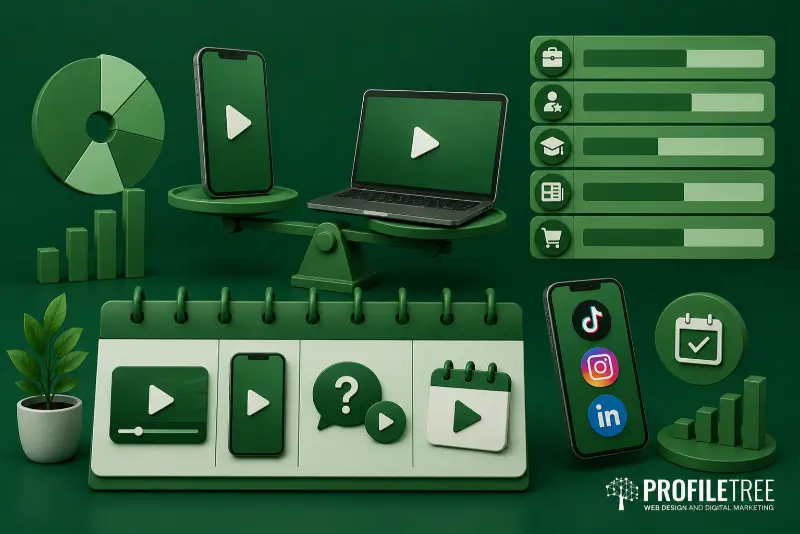
A single short-form vs long-form video ratio doesn’t work for all channels. The right balance between YouTube Shorts and long-form content depends on your niche, audience behaviour, and production capacity. Treat these as a baseline for your short-form video strategy and adjust based on which format is driving channel page visits.
| Channel Niche | YouTube Shorts % | Long-Form Video % | Rationale |
|---|---|---|---|
| B2B / Professional Services | 20% | 80% | Decision-maker audiences choose depth over discovery |
| Entertainment / Lifestyle | 60% | 40% | Mobile-first audience, short-form video velocity more important |
| How-To / Tutorial | 40% | 60% | YouTube Shorts test topics; long-form delivers the full guide |
| News / Commentary | 50% | 50% | Immediacy vs analysis serve different viewer needs |
| E-commerce / Product | 30% | 70% | Products need long-form video depth to convert buyers |
The optimal weekly publishing cadence
For channels targeting growth rather than maintenance, this schedule balances short-form vs long-form video production effort against algorithmic presence.
- Monday: publish the week’s long-form video
- Tuesday: publish a YouTube Short derived from the long-form video’s key point
- Thursday: publish a standalone short-form video addressing a specific question in your niche
- Saturday: publish a YouTube Short that teases the following week’s long-form topic
This schedule creates three feed appearances per week from one long-form session and two short filming slots. The Tuesday YouTube Short builds a direct traffic bridge to the Monday long-form video while engagement is still highest. The Saturday short-form video builds anticipation, which improves the following long-form video’s Day 1 performance.
For a business posting to TikTok, Reels or LinkedIn rather than running a YouTube channel, two to three posts a week is a sustainable starting point. A business that posts twice a week every week will outperform one that posts daily for a month and then stops, because platform algorithms reward accounts that publish consistently, and audiences build habits around accounts that are reliably present. Whichever cadence you settle on, the clips need a topic pipeline behind them. Planning video inside a single content marketing plan, alongside blog posts and email, is what stops a channel from running dry by week six.
Putting Your Short-Form Video Strategy Together
The short-form vs long-form video decision isn’t binary; it’s a sequencing question. Start with one strong long-form video covering your core topic. Extract three YouTube Shorts from it. Post one short-form video per week for three weeks, each with the Related Video link configured and a pinned comment in place. Track which YouTube Short’s generating the most channel page visits.
That single metric tells you more about what your audience wants to go deeper on than any competitor analysis, and it’s free to track in YouTube Studio. Build your next long-form video around the winning YouTube Shorts topic. That is the YouTube Shorts vs long-form video cycle in practice. Repeat the cycle. Most channels don’t. That’s why it works for those who do. Within two to three months, you’ll have a clear picture of which topics work in both formats and where your production time is best spent.
ProfileTree has delivered over 1,000 projects for businesses across Northern Ireland, Ireland, and the UK since 2011, developing short-form video strategy and long-form video plans that work within real production budgets and timelines. ProfileTree’s video marketing services cover both the strategic framework and the production support that makes a dual-format approach sustainable, backed by a 5-star rating from over 450 verified Google reviews.
FAQs
Do YouTube Shorts hurt the reach of long-form video on the same channel?
No. The Shorts feed and the standard long-form recommendation algorithm operate as separate systems, and there is nothing in how they are built to suggest that publishing short-form video reduces long-form distribution. Subscribers gained through Shorts are tracked separately from long-form viewers.
Can I monetise both YouTube Shorts and long-form video on one channel?
Yes. Since February 2023, YouTube’s Partner Programme has allowed ad revenue sharing across both short-form and long-form videos on a single channel. Current eligibility thresholds differ: 1,000 subscribers plus 4,000 watch hours for long-form video monetisation, or 1,000 subscribers plus 10 million YouTube Shorts views in 90 days for short-form video monetisation. Both rise for new applicants on 1 February 2027, to 8,000 qualified watch hours or 20 million qualified Shorts views, and from that date, Shorts revenue sharing itself requires 10 million qualified Shorts views every 90 days. Channels already in the programme are not affected by the new entry bar. Most creators building from scratch will still qualify for long-form video monetisation first.
How long should a short-form video be for a business?
The optimal length depends on the platform and on what you are trying to say. Shorter clips are easier to finish, and completion rate is the signal the Shorts feed weighs most heavily, so a tight 15 to 30 seconds is a sensible default to test first. On TikTok and Reels, 30 to 60 seconds gives business content a little more room. For tutorials needing more context, 45 to 60 seconds is workable, but the hook must land within the first two seconds. Testing both lengths with your own audience is more reliable than any universal rule.
Which platform should a UK B2B company start with?
YouTube Shorts is usually the strongest starting point, because the content is indexed by Google and lives alongside longer-form assets on a channel that builds ongoing authority. LinkedIn video is worth considering for high-ticket professional services where the audience is already active on the platform. TikTok is increasingly used by younger decision makers as a discovery tool, though it requires a content approach that respects the platform’s more informal conventions.
How much does professional short-form video production cost in the UK and Ireland?
Cost depends on crew size, location and how much editing the footage needs, so any single figure is misleading. The structural point matters more than the number: commissioning clips one at a time is the expensive route, because you pay setup and travel every time. Batching a day of filming into a run of clips spreads that fixed cost across all of them, which is why the per-clip price drops sharply. Ask any supplier for a day rate and a clip count rather than a price per video, then compare on that basis.
Do I need expensive equipment to start with short-form video?
No. A recent smartphone covers almost all short-form content, and audiences on these platforms value authenticity over polish. Spend on a tripod and a clip-on microphone before you think about a camera. The point at which professional production makes commercial sense is when the content represents your brand in a first-impression context.
Are captions necessary for short-form video?
Yes, without exception. Plenty of your audience will be watching on a commute or in a shared office with the sound off, and without captions they have nothing to follow before scrolling past. All three major platforms offer auto-captioning, but the output should always be reviewed before publishing, especially for proper nouns, technical terms and local place names.
Can businesses in Ireland sell through TikTok Shop?
Yes. TikTok Shop launched in Ireland in December 2024 and has been open to all Ireland-based registered businesses since May 2026, when it moved off its invite-only model. Sign-up runs through the TikTok Seller Centre, and you will need business details and, depending on seller type, a VAT number. Check current processing times and onboarding requirements directly with TikTok, since these change.
Should I run a separate YouTube channel just for short-form video content?
No. Running separate channels splits subscriber growth, divides watch time signals, and makes it harder for the algorithm to understand what your channel covers. YouTube has handled both short-form and long-form video on a single channel since Shorts monetisation opened in February 2023. Keeping everything together lets the algorithm correlate viewing patterns across your content and allows subscribers to discover both formats from the same channel page.