
Facebook Algorithm Changes: What Businesses Need to Know
Table of Contents
Algorithm changes on Facebook determine which posts appear in users’ News Feeds, ranking content based on relationship signals, engagement history, content type, and recency. Meta updates these ranking signals regularly. Businesses that understand which signals carry the most weight can maintain organic reach even as the platform reduces distribution for low-engagement content.
Facebook’s organic reach has been falling for over a decade. For most business pages, a post now reaches between 2% and 6% of followers without paid promotion, down from roughly 16% in 2012, according to data published by Hootsuite. The reason is the algorithm: a ranking system that decides, for each individual user, what’s worth showing.
That ranking system isn’t static. Meta adjusts it regularly, sometimes with formal announcements, sometimes without. Each adjustment shifts the balance between content types, interaction signals, and account relationships. For businesses relying on Facebook as an organic channel, keeping pace with those shifts is a practical requirement, not an optional extra.
This guide covers how the algorithm works, what recent changes have emphasised, and what your social media marketing strategy should look like in response.
What the Facebook Algorithm Prioritises
Facebook’s algorithm doesn’t make a single decision about a post. It makes a separate prediction for every user who might see it, estimating the probability of different interactions: will they stop scrolling, like it, comment, share it, or hide it? The feed is built from those predictions, stacked in order of expected value for each user.
Four signals carry the most weight in that prediction.
Relationship Strength
Posts from people and pages a user regularly engages with rank higher. If someone consistently likes, comments on, or shares content from a particular page, that page’s future posts are surfaced more often. Pages a user has never interacted with, regardless of how many followers they have, start from a much weaker position.
Content Type Preference
The algorithm tracks which content formats each user engages with most. Someone who watches videos to completion sees more video in their feed. Someone who clicks links frequently sees more link posts. This means there is no universally “best” format; the ideal format depends on what your specific audience responds to.
Post Engagement Rate
Early engagement velocity matters. A post that generates comments and shares in the first hour signals to the algorithm that it’s worth showing to more people. Posts that get ignored early are quickly deprioritised. This is why posting time still matters, even though Meta has never confirmed a universal best time.
Recency
Newer posts are weighted over older ones for most users, though older posts that are still generating active discussion can resurface. Publishing consistently is more effective than publishing in bursts.
Recent Algorithm Changes to Know
Meta has made several significant adjustments to how content is ranked and distributed over the past two years. Some have fundamentally changed what works for business pages.
Original Content Now Receives a Reach Bonus
Meta introduced explicit support for original content in 2023 and reinforced it in subsequent updates. Pages that publish content created by the account owner receive stronger distribution than pages that share or repost content from other sources. Reposting other people’s videos or embedding external links without added commentary has become a weaker strategy as a result.
Reels Now Receive Preferential Distribution
Meta began prioritising short-form video through Reels in 2022, and that preference has held. Reels receive wider distribution than standard video posts or image posts for most account types. They also appear in the Reels tab, giving them a second surface for discovery beyond the main feed. For businesses not currently producing short-form video, this represents the single biggest gap between current practice and where the algorithm rewards effort. A well-considered video marketing approach is now a core part of Facebook presence, not an optional addition.
Comment Quality Is Weighted Over Comment Quantity
The algorithm has become better at distinguishing between comments that represent genuine conversation and those generated by engagement-bait tactics. Posts that use phrases like “tag a friend” or “comment YES if you agree” may be downranked. Comments with longer text and back-and-forth replies carry more weight than single-word responses, according to Sprout Social’s annual index.
Link Posts Remain Deprioritised
Posts that contain outbound links, directing users away from Facebook, continue to receive lower organic distribution than posts that keep users on the platform. This has been the case since 2018 and shows no sign of reversing. If a link to external content is necessary, placing it in the first comment rather than the post body is a widely used workaround.
Group Content Has Expanded Reach
Content posted to, or shared from, Facebook Groups reaches a larger percentage of group members than equivalent content on a business page. Meta has consistently invested in Groups as a community feature, and the algorithm reflects that. For businesses in local markets or niche industries, building a presence within relevant groups can produce better organic results than publishing exclusively to a page.
Transparency Tools Give Users More Control
Meta has expanded user-facing controls, including the ability to prioritise specific accounts through the Friends and Favourites setting, snooze accounts for 30 days, and access a chronological feed. These controls mean the algorithm’s effect on any given follower depends partly on the choices that follower has made. A user who has added a page to their Favourites list will see that page’s content consistently; a user who never interacts with a page may stop seeing it entirely.
How Businesses Should Respond
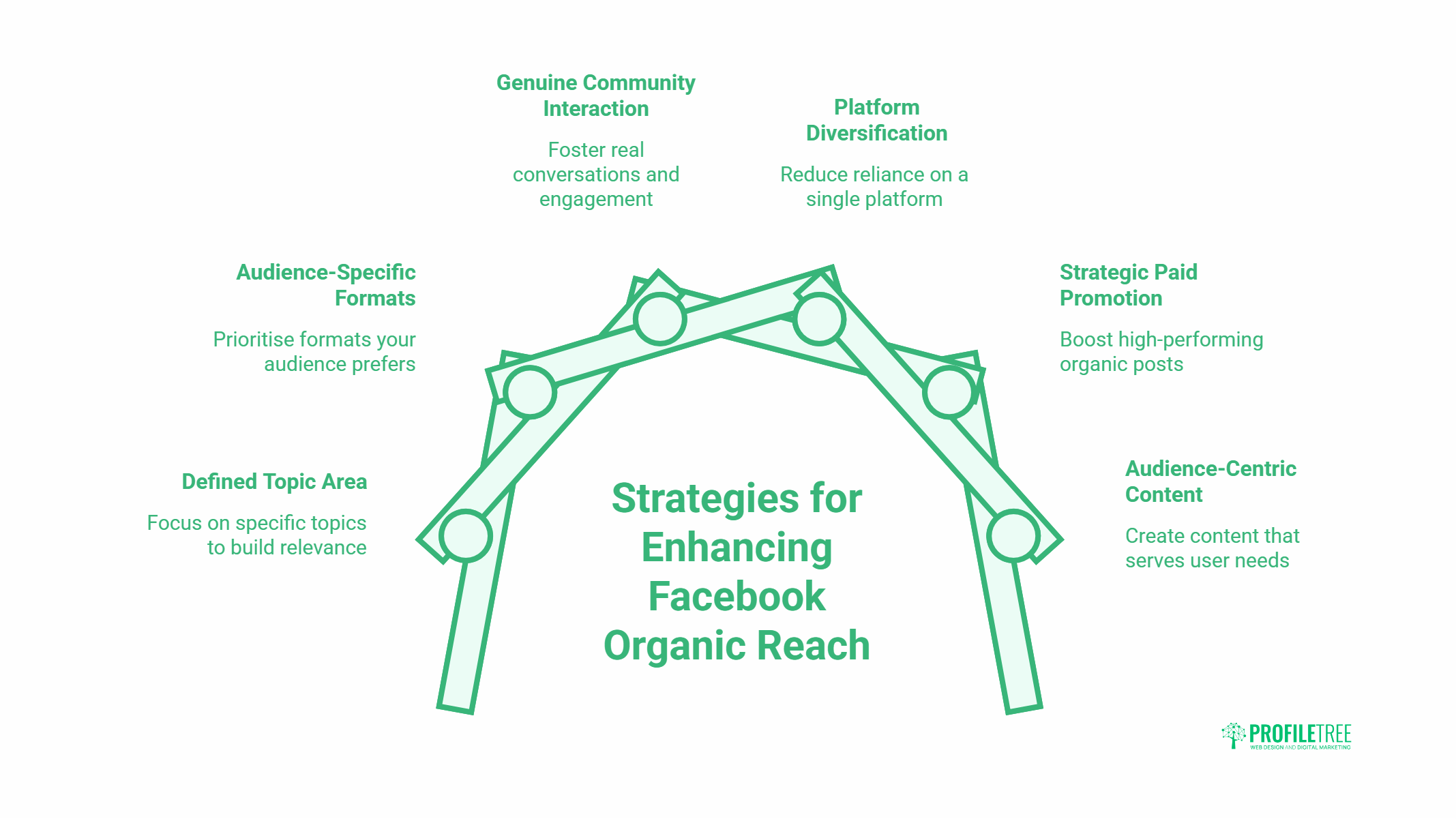
Understanding the algorithm is only useful if it changes how you publish. These are the adjustments that translate directly into better organic performance.
Focus on a Defined Topic Area
Pages that publish consistently on a specific topic build stronger relevance signals than pages that post broadly across unrelated subjects. An accountancy firm that consistently publishes about tax planning for small businesses will outperform the same firm posting a mix of industry news, staff birthdays, and motivational quotes. The algorithm appears to reward topical consistency at the page level, not just the post level.
“Facebook’s algorithm is essentially a signal about what its users want to see. Businesses that chase engagement tactics without understanding that signal tend to see short-term spikes and long-term decline. We work with SMEs across Northern Ireland and Ireland who’ve found that consistent, specific content on a defined topic outperforms viral-bait almost every time.”Ciaran Connolly, Founder, ProfileTree
Prioritise Formats Your Audience Actually Uses
Check your Facebook Page Insights before committing to a format strategy. If your audience watches the video to completion, invest in the video. If they click links despite the reach penalty, your content may be strong enough to compensate. Format trends published by Meta or third-party tools reflect averages; your audience’s behaviour is the relevant data point for your page specifically.
Build Genuine Community Interaction
Posts that generate real conversation rank higher than posts that generate passive likes. Asking specific questions, sharing opinions that invite a response, and publishing content that’s genuinely useful to a narrow audience all tend to produce more substantive comments than broad, generic content. Replying to comments, particularly within the first few hours after publishing, also strengthens the engagement signal.
Reduce Dependence on a Single Platform
Facebook’s organic reach has declined consistently since 2012, and there’s no structural reason to expect that trend to reverse. A digital strategy that relies on Facebook as a primary traffic or lead source carries real risk. Building owned channels alongside your Facebook presence, including an email list, a website with strong SEO, and a presence on other platforms where your audience is active, means algorithm changes have less total impact on your reach.
Use Paid Promotion Strategically
Boosting high-performing organic posts is generally more cost-effective than promoting content that didn’t perform organically. If a post generates strong engagement without promotion, it has already signalled its relevance to the algorithm; a modest boost at that point extends reach to a qualified audience. Promoting weak content simply to get it seen rarely produces results worth the spend.
Invest in Content That Serves Your Audience
The algorithm changes, but audience intent doesn’t. Content that teaches something specific, answers a real question, or gives people a concrete reason to act tends to perform across algorithm shifts because it consistently generates the interactions the algorithm rewards. A well-built content strategy is the most durable response to algorithm volatility, because it aligns with user intent rather than gaming a specific signal.
ProfileTree works with businesses across Northern Ireland and Ireland on digital marketing support that includes social media strategy, content planning, and organic growth. If your Facebook reach has declined and you’re not sure what’s driving it, we can review your page performance and suggest practical adjustments.
Frequently Asked Questions
How Often Does Facebook Change Its Algorithm?
Meta adjusts its ranking signals continuously, with minor updates happening throughout the year. Major changes, those that meaningfully shift distribution patterns for business pages, tend to coincide with product announcements or platform strategy shifts. Meta publishes formal guidance on significant changes through the Meta for Business newsroom.
Why Has My Facebook Page Reach Dropped?
Declining reach usually has one of three causes: reduced posting frequency, a drop in early engagement in the first hour after posting, or a broader algorithm update that has deprioritised the content format you rely on. Check Page Insights for engagement rate trends before assuming the cause is algorithm-related.
Does the Facebook Algorithm Favour Video Content?
Short-form video through Reels currently receives preferential distribution compared to image posts and link posts. Standard video posts (non-Reels) still perform better than link posts on average, but the Reels format has a meaningful reach advantage. This reflects Meta’s strategic investment in competing with short-form video platforms.
Do Hashtags Help Facebook Reach?
Hashtags have a limited and inconsistent effect on Facebook reach compared to their role on platforms like Instagram or LinkedIn. Meta has not confirmed that hashtags improve distribution. Some accounts report marginal gains from using one or two relevant hashtags; using many hashtags in a Facebook post has no demonstrated benefit and can reduce readability.
Should I Post More or Less Frequently to Improve Reach?
Posting frequency matters less than engagement rate per post. Publishing five posts a week that generate little interaction typically produces worse results than publishing two posts that generate genuine comments and shares. Most business pages see better results from three to four high-quality posts per week than from daily posting of weaker content.
Does Paying for Ads Affect Organic Reach?
Meta has stated that running paid advertising does not directly affect organic reach. There is no confirmed mechanism by which spending on ads boosts unpaid post distribution. Any correlation seen between ad spend and organic performance is more likely explained by the fact that businesses investing in paid also tend to invest more in content quality overall.
What Types of Posts Does the Facebook Algorithm Penalise?
Explicit engagement-bait (“share this post”, “tag someone who needs to see this”, “comment YES if you agree”), posts with outbound links, reposted content without added commentary, and posts that have generated a high number of “hide” or “report” signals are all given lower distribution by the algorithm.
Aligning Your Facebook Strategy With the Algorithm
Facebook’s algorithm rewards content that earns genuine attention. What’s changed is how precisely Meta can measure that attention and how quickly it deprioritises content that doesn’t earn it. For most businesses, the practical response is straightforward: focus on a defined topic, publish formats your specific audience engages with, and build community interaction rather than chasing passive likes. For tailored guidance on your social media presence, talk to the ProfileTree team.