
How to Navigate Algorithm Changes and Protect Your Business
Table of Contents
Algorithm changes are one of the most disruptive forces in digital marketing, and most small business owners find out about them the hard way: through a sudden drop in traffic, a collapse in social reach, or a Google ranking that quietly disappears overnight. Businesses with a clear digital marketing strategy, genuinely useful content, and a presence across multiple channels tend to absorb these shifts far better than those relying on a single tactic.
This guide sets out what actually changed across 2026’s confirmed Google updates, how that plays out for small and medium businesses in Northern Ireland, Ireland, and the rest of the UK specifically, and what to do about it: before, during, and after an update lands.
What Are Algorithm Changes, and Why Do They Happen?
An algorithm is simply the set of rules a platform uses to decide what to show a user and in what order. Google uses algorithms to rank search results. Instagram, Facebook, LinkedIn, YouTube, and TikTok each run their own, deciding what appears in feeds, suggested content, and in-platform search.
None of these systems is static. Most changes are small and unannounced, happening hundreds of times a year. A handful are large enough that Google publicly confirms them and logs them on its Search Status Dashboard because the shift in rankings is broad enough to warrant documentation.
The stated reason is almost always user experience: platforms want to surface the most relevant, useful content to keep people engaged. Google’s Helpful Content system, now built permanently into the core ranking rather than sitting as a separate signal, was designed around exactly this: rewarding content written for people, not for search engines. Instagram’s long shift away from a chronological feed towards an interest-based model was framed the same way, showing users more of what the platform predicts they actually want to see.
There’s a commercial motivation running alongside that too. When organic reach falls, paid promotion becomes more attractive, and the shift from “social graph” reach (content from accounts you follow) to “interest graph” reach (content the algorithm predicts you’ll engage with) means a business can no longer rely on follower count alone to guarantee visibility. If your digital marketing strategy still assumes that an audience you built five years ago will reliably see what you post today, that assumption is worth revisiting.
What Confirmed Updates in 2026 Actually Tell Us
It’s worth being precise here because much of what circulates about “the latest Google update” is speculation rather than confirmed fact. Google logs every confirmed ranking change on its own Search Status Dashboard, and the pattern across 2026 has been faster and busier than in previous years.
Confirmed Google ranking updates so far in 2026:
| Update | Rolled out | Completed | Focus |
|---|---|---|---|
| December 2025 Core Update | 11 December 2025 | 29 December 2025 | Broad core ranking |
| February 2026 Discover Update | 5 February 2026 | Staged, English-US first | Google Discover specifically |
| March 2026 Spam Update | 24 March 2026 | 25 March 2026 | Spam and guideline violations |
| March 2026 Core Update | 27 March 2026 | 8 April 2026 | Broad core ranking |
| May 2026 Core Update | 21 May 2026 | 2 June 2026 | Broad core ranking |
| June 2026 Spam Update | 24 June 2026 | 26 June 2026 | Spam and guideline violations |
A few things stand out. First, the gap between the March and May core updates was unusually short, closer to six weeks than the three-to-four-month spacing that had been typical. Second, with the exception of the Discover-focused update in February, which specifically staged its rollout by language and country, starting with English-language US users, Google’s core updates in 2026 rolled out globally, affecting all regions and languages at the same time. That matters for anything you read claiming Google updates hit the UK weeks after the US: for core updates specifically, that isn’t how the current rollout process works. What genuinely differs by market is how quickly UK-based commentary and tools pick up on the shift, not when Google’s systems actually apply it.
Google has also been consistent on one point worth repeating to anyone tempted to react on day one: wait until a rollout is confirmed complete, then wait at least another week, before drawing conclusions from Search Console data. Daily fluctuations during an active rollout aren’t a reliable signal.
How Algorithm Changes Actually Affect UK and Irish SMEs
The scale of the impact depends on where your digital presence is concentrated and how diversified your traffic actually is, not on your postcode.
Search: What Google Is Actually Rewarding
The consistent thread across the Helpful Content system and the various spam updates is a move towards rewarding content that demonstrates genuine expertise, real experience, and authentic authority. Pages built primarily to rank, thin content, keyword stuffing, and low-effort AI-generated text have been systematically deprioritised. Pages that answer real questions in depth, demonstrate first-hand experience, and earn genuine engagement have held their positions or improved.
If your website’s content was written quickly, without a clear strategy behind it, a core update is exactly the kind of event that exposes that. This is where a proper SEO audit earns its cost: it tells you whether a drop is a content quality issue, a technical one, or genuinely nothing to do with you at all.
Social Media: Reach Is No Longer Guaranteed
Organic social reach has been declining for years across most major platforms. Facebook’s organic reach for business pages sits in the low single digits for most industries, which is exactly the gap our Facebook Live audience engagement guide was written to address. Instagram has moved hard towards Reels and AI-recommended content, meaning posts from accounts a user already follows now compete directly with content from accounts they’ve never encountered. LinkedIn has increased the weight it places on native documents, videos, and posts that generate genuine comments over those that simply accumulate likes.
The practical result for a business posting regularly: your existing followers are no longer reliably seeing what you post. If your entire social media marketing approach is built on posting to an audience you’ve already built, you’re working against the algorithm rather than with it. The tactics that worked in 2019 need real updating for the current environment, whether that’s a shift in format, a change in posting cadence, or simply a more realistic view of what organic reach alone can deliver.
YouTube: A Genuinely Different Algorithm
YouTube’s algorithm deserves separate treatment because it behaves differently to feed-based platforms. Rather than prioritising recency or follower relationships, it optimises for watch time and session duration: does this video keep someone on the platform, and does it prompt them to watch something else straight after? Content that earns long watch sessions and drives further viewing gets rewarded with recommendations, which makes YouTube one of the more stable platforms for business content, because the reward structure favours genuine value over trend-chasing or platform-native formats.
For businesses weighing up video as part of their strategy, understanding how YouTube SEO works is worth the time. Our earlier video marketing campaign guide covers how to plan content that compounds rather than disappearing after a week. YouTube is the world’s second-largest search engine, and its algorithm is one of the more predictable once you understand what it’s actually optimising for.
A Step-by-Step Framework for Responding to an Algorithm Update
When a core update rolls out or a social platform changes how it distributes content, the worst response is panic editing. Making sweeping changes to a site or a content calendar during an active rollout rarely helps and usually makes diagnosis harder later.
Step 1: Confirm Whether You’ve Actually Been Affected
Not every traffic drop is algorithm-related. Before drawing conclusions, check Google Search Console for the affected URLs and look at impressions and average position, not just clicks. A drop in clicks with stable impressions points to a CTR issue, meaning your title tag or meta description needs work, not your content. A drop in both impressions and position is more likely to be an algorithmic signal. Cross-reference the date against Google’s Search Status Dashboard, which logs every confirmed rollout with start and end times.
If you don’t have Search Console set up or haven’t looked at it in months, that’s the first problem to fix, and it’s a five-minute job with the right help. Once it’s in place, analytics tools built for small businesses and social analytics tools can help build the monitoring habit that speeds up diagnosis next time.
Step 2: Audit the Affected Content Honestly
Once you’ve confirmed algorithmic impact, look honestly at the pages or content that dropped. Does this content demonstrate genuine expertise and real experience? Does it answer the question in full, or circle around the topic without landing anywhere? Is there evidence of first-hand knowledge: specific examples, real data, a clear point of view?
Google’s own quality guidance boils down to one question: would someone reading this page feel they got what they came for, or would they need to go elsewhere? If the honest answer is the latter, the content needs meaningful improvement, not a light refresh or a changed date. A structured content audit across your existing library, rather than page-by-page guesswork, is usually the faster route to an honest answer.
Step 3: Improve Depth, Not Just Length
A common mistake after a hit is simply making content longer. Length isn’t the issue; depth is. A 3,000-word article that says nothing new won’t recover just by becoming a 4,000-word article that still says nothing new. What the Helpful Content system rewards is content that covers a topic with genuine authority: specific examples, clear explanations of how things actually work, acknowledgement of nuance and trade-offs, and material that could only have been written by someone with real knowledge of the subject.
This is where content marketing strategy becomes the practical foundation of SEO performance rather than a separate activity sitting alongside it. Businesses that have invested consistently in content that genuinely serves their audience tend to be the most resilient when a core update lands.
Step 4: Strengthen Your E-E-A-T Signals
E-E-A-T, Experience, Expertise, Authoritativeness, and Trustworthiness, is Google’s framework for evaluating content quality. For a business website, that means making the experience and credentials behind the content visible and verifiable: author bios with real information, links to professional profiles, references to specific projects or outcomes, and clear contact and business details throughout.
As Ciaran Connolly, founder of ProfileTree, puts it: “The businesses that consistently perform well after algorithm changes are the ones that were already doing the right thing, creating content that genuinely helps their customers rather than content that was gamed for a position.”
Step 5: Diversify Your Traffic Sources
The deepest structural lesson from any change in an algorithm is that dependence on a single channel is a business risk, not a marketing detail. If 80% of your website traffic comes from Google organic search, a core update can materially affect revenue. If 90% of your customer reach comes from a single Instagram page, a change to the feed algorithm can cut visibility overnight.
A more stable approach distributes audience across multiple channels: organic search, email subscribers, YouTube, LinkedIn, and direct traffic built on brand recognition. That doesn’t mean maintaining an active presence everywhere at once. It means building at least two or three channels to a level where each can carry weight independently. ProfileTree’s approach to digital marketing strategy for SMEs is built on exactly this principle: strategy first, channel execution second, rather than channel activity without a plan behind it.
Building Algorithm Resilience Into Your Digital Strategy
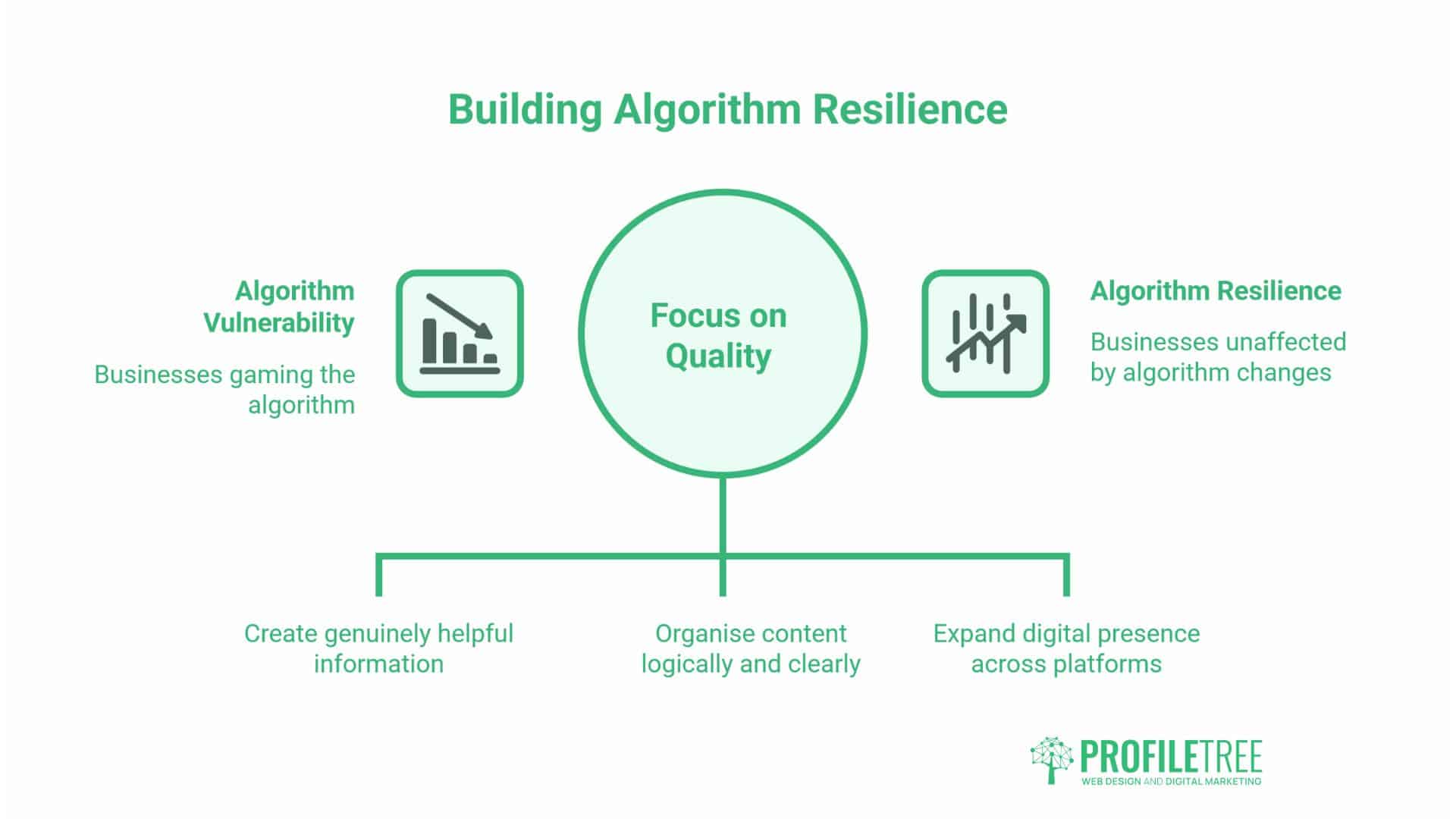
The businesses least affected by algorithm changes share a common trait: they weren’t trying to game the algorithm in the first place. Their content was genuinely useful, their websites were well-structured, and their digital presence spanned more than one channel. Updates that penalise low-quality content simply don’t touch sites that have never published low-quality content.
Invest in Owned Channels
Email lists, YouTube subscribers, and podcast audiences are owned channels. They aren’t subject to feed algorithms or platform reach restrictions in the way social media is. Building an email subscriber list is one of the more effective ways to create a traffic source that platform-level algorithm changes genuinely cannot touch.
Treat Video as a Long-Term Asset, Not a Campaign
Video on YouTube compounds over time in a way social posts generally don’t. A well-made, genuinely useful video can keep earning views and traffic years after publication if it addresses a question people consistently search for. Short-form social video and longer-form YouTube content serve different strategic purposes and shouldn’t be treated as interchangeable outputs from the same shoot.
For SMEs that haven’t invested in video production yet, the barrier to entry is lower than most assume. It doesn’t require broadcast-level equipment. It requires clear planning, a consistent approach, and content that addresses genuine customer questions rather than generic brand messaging. Where budget allows, animation can also fill gaps that live-action video can’t, particularly for explaining a process or a service that’s hard to film.
Build the Skill In-House
One of the most practical forms of algorithm resilience is having someone inside the business who understands how these systems work and can monitor changes as they happen, rather than finding out three months later from a client complaint. Many SME owners and marketing managers across Northern Ireland and the wider UK are working without this foundation, not because it’s complicated, but because nobody has ever walked them through it directly. Digital training programmes specifically for business owners and existing teams can close that gap without requiring a full-time in-house specialist.
Understand Where AI Fits
Understanding the role data plays in AI implementation is increasingly relevant here, too. AI-powered search features from Google, Bing, and ChatGPT add another layer to how content is discovered and cited, which makes the underlying content quality signals more important, not less, because there are now more systems evaluating the same content for different reasons.
How Algorithm Changes Are Reshaping AI Search Results
Search is no longer only Google’s ten blue links. AI-powered search tools, including Google’s AI Overviews, Microsoft Copilot, and ChatGPT’s search feature, are now a meaningful part of how people find information, and they operate under different rules to traditional organic search.
AI systems pull from multiple sources and synthesise them into a single answer. Ranking well in traditional search does not automatically mean being cited in an AI answer. The content characteristics that earn AI citations are specific: self-contained sections that answer a question fully, factual statements with clear attribution, tables and structured data, and content that covers multiple sub-questions within one topic rather than skating across the surface of several.
What This Means for Your Content Structure
If your pages are written as flowing editorial articles without clear answer blocks, AI systems tend to pass over them in favour of pages that give a direct, extractable answer at the start of each section. This doesn’t require rebuilding your content from scratch. It requires a shift in how sections are written: lead with the answer, then follow with supporting detail, evidence, and nuance.
Pages that earn AI citations also tend to share one other trait: they’re kept genuinely current. A refreshed publication date alone doesn’t do this; the content itself needs new information, because AI systems weigh recency heavily when they’re trying to give an accurate, current answer.
The Opportunity for Local and Specialist Businesses
Most AI search citations currently favour large publishers. Local and specialist businesses producing high-quality, topic-specific content are underrepresented in AI answers relative to their actual usefulness. That gap is genuinely worth targeting, and it connects directly to AI-driven local SEO strategies as a growing, practical area of digital marketing rather than a future one.
As these platforms mature, Microsoft’s Copilot, for instance, has increased the weight it places on structured data and verified business information for local queries. The same principles apply across the board: clear entity signals (your business name, location, and service category, stated consistently), and content that demonstrates real expertise rather than surface-level coverage.
Measuring and Monitoring Algorithm Impact Over Time
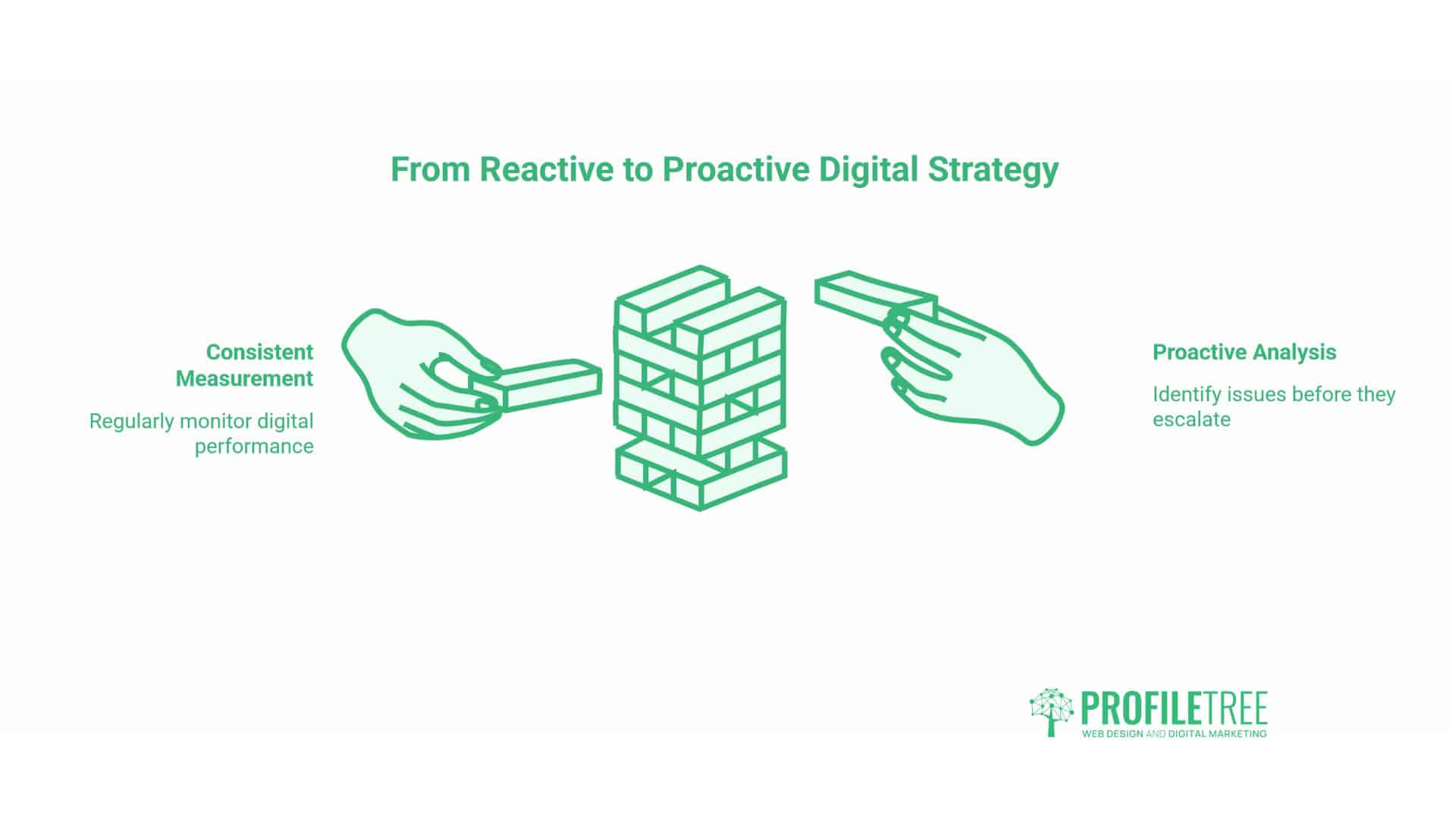
Understanding whether your digital strategy is actually working and whether an algorithm change is affecting you requires consistent measurement rather than reactive checks. Most businesses only look at analytics once something has already gone wrong, by which point a problem that started three months ago has already done its damage.
The Metrics That Actually Matter
Clicks and impressions in Search Console are the starting point, but they don’t tell the full story alone. Average position tells you whether content is moving up or down over time. CTR tells you whether the right people find your result worth clicking on. If impressions are holding steady but CTR is dropping, the issue is almost always your title tag and meta description, not the underlying content itself.
For social media, reach and engagement rate per post are more useful indicators than follower count. A declining engagement rate on a growing account is a clear signal that content is being shown to fewer people than the audience size suggests, which usually means the algorithm has deprioritised that account type or content format specifically. Measuring ROI from digital marketing campaigns means pulling these individual metrics together into a view that connects activity to commercial outcome: enquiries, calls, form submissions, or purchases, not just traffic for its own sake.
Build a Simple Monitoring Routine
A monthly review of Search Console, alongside a look at your top-performing social posts from the previous four weeks, takes around thirty minutes and gives you a baseline that makes algorithm impacts visible early. You’ll see position changes before they translate into traffic drops, and you’ll spot which content types are performing and which are declining well before it becomes urgent.
A content audit conducted every six to twelve months adds a deeper layer: systematically examining which pages drive traffic and which don’t, and making genuine decisions about what to improve, consolidate, or retire. Businesses that audit their content regularly are far better positioned to respond to a core update because they already know the state of their digital assets, rather than discovering it under pressure. If you’ve had an organic traffic drop and are trying to diagnose the cause, consistent historical data makes that process considerably faster. Without it, you’re working from guesswork.
Where Algorithm Risk Typically Shows Up for SMEs
| Area of exposure | What tends to happen | Where it gets addressed |
|---|---|---|
| Website content quality | Thin or templated pages lose ground first when a core update lands | Content marketing, SEO |
| Single-channel dependency | Reach collapses when one platform’s algorithm shifts | Digital marketing strategy |
| No monitoring routine | Drops go unnoticed for months, making diagnosis harder | Digital training, ongoing SEO support |
| Weak E-E-A-T signals | Content without visible expertise or authorship struggles to hold position | Content marketing, website development |
| No owned channels | No fallback when a platform restricts organic reach | Video production, YouTube marketing, email |
What This Means for Your Business
Algorithm changes are a permanent feature of digital marketing, not a temporary disruption to wait out. The businesses that handle them best aren’t necessarily the ones with the deepest technical SEO knowledge. They’re the ones who’ve built their digital presence on genuine quality: content that actually serves their audience, a presence across multiple channels, and a monitoring routine that catches problems early rather than three months late.
If you’re based in Northern Ireland, Ireland, or anywhere else across the UK and want a clear-eyed view of how your current digital strategy would hold up against the next core update, ProfileTree’s digital training and digital marketing strategy services are built to give you that clarity without needing a full agency retainer to get started.
FAQs
How often does Google change its algorithm?
Google makes thousands of minor, unannounced changes each year. Confirmed core updates, the broad ones significant enough for Google to log publicly, have happened roughly every six to twelve weeks through 2026, a noticeably faster pace than the three-to-four-month spacing seen in earlier years.
How long does it take to recover from a Google algorithm update?
Minor volatility often settles within one to two weeks as a rollout completes. Drops genuinely tied to content quality typically take longer, often showing meaningful recovery only at the next core update, since Google needs to re-crawl and reassess the affected pages rather than adjusting instantly.
Is my site being penalised, or is this just an algorithm change?
These are different things. A manual penalty comes with a specific notification in Search Console explaining the violation. A core update is not a penalty and comes with no notification; it’s a broad re-evaluation of how content is ranked across the entire web, and your site is being re-rated against everyone else’s, not singled out.
Are algorithm updates the same in the UK as in the US?
For Google’s confirmed 2026 core updates, yes, the rollout has been global and simultaneous, affecting all regions and languages at the same time rather than reaching the UK weeks after the US. The exception worth knowing about is updates aimed specifically at a feature like Google Discover, which have sometimes staged by language and country, starting with English-language US users before expanding.