
Strategic Social Media for Product Launches: The Definitive Guide
Table of Contents
A product launch lives or dies by the quality of its strategy. Posting on the day and hoping for shares is not a plan; it is a gamble. The businesses that generate genuine commercial momentum from social media launches are those that build deliberate, phased campaigns weeks in advance, match their messaging to platform behaviour, and measure outcomes against revenue, not just reach.
This guide on social media for product launch sets out the full strategic framework for a social media product launch: from the psychology of pre-launch anticipation, through real-time execution, to post-launch retention. It also addresses the compliance landscape that UK and Irish marketers must navigate, and the B2B vs B2C platform decisions that most generic guides still get wrong.
Whether you are launching a physical product, a SaaS tool, or a professional service, the principles here apply. Read on for a practical, stage-by-stage playbook built for SMEs across Northern Ireland, Ireland, and the UK.
Beyond the Buzz: Why Product Launches Fail Without Strategy
Most product launches underperform not because the product is poor, but because the social media activity around it lacks strategic architecture. There is a consistent pattern: brands create content in the final week before launch, publish across every available platform on launch day, and measure success by counting likes. That approach produces noise rather than conversions.
The Difference Between Posting and Strategising
Posting is tactical. It fills a content calendar. Strategising, by contrast, means defining who you are trying to reach, which platform behaviour you are working with rather than against, and which business metric you are ultimately trying to move. A post with 2,000 impressions that drives 40 product enquiries outperforms one with 20,000 impressions and no downstream action.
For SMEs especially, this distinction matters because budgets are finite. Connecting social media activity to sales outcomes requires setting that intention before the first piece of content is written, not after the campaign ends.
Why Generic Guides Miss the Mark
The majority of social media launch guides are written by US-based SaaS companies advising enterprise-level marketing teams. Their advice on influencer budgets, paid media spend, and platform mix rarely translates to the reality facing a Northern Irish manufacturer launching a new product line, or an Irish professional services firm introducing a new offer.
Regional platform behaviour differs meaningfully from US norms. WhatsApp, for example, is a significant B2B networking channel in the UK and Ireland in ways that American guides routinely overlook. LinkedIn engagement patterns, influencer disclosure regulations under the ASA, and GDPR requirements around social lead generation all create a compliance context that most generic resources ignore entirely.
Setting Commercial Objectives First
Before any content is planned, three questions need clear answers: what does success look like in revenue terms, who specifically is the buyer, and how long is the decision cycle? A product with a 24-hour impulse purchase cycle needs a different launch structure than one requiring a three-month procurement process. Aligning social media objectives to these commercial realities is the foundation of any effective launch strategy. Visits to your core marketing strategy should be considered the strategic anchor point, not an afterthought.
The Three-Phase Strategic Social Media Framework
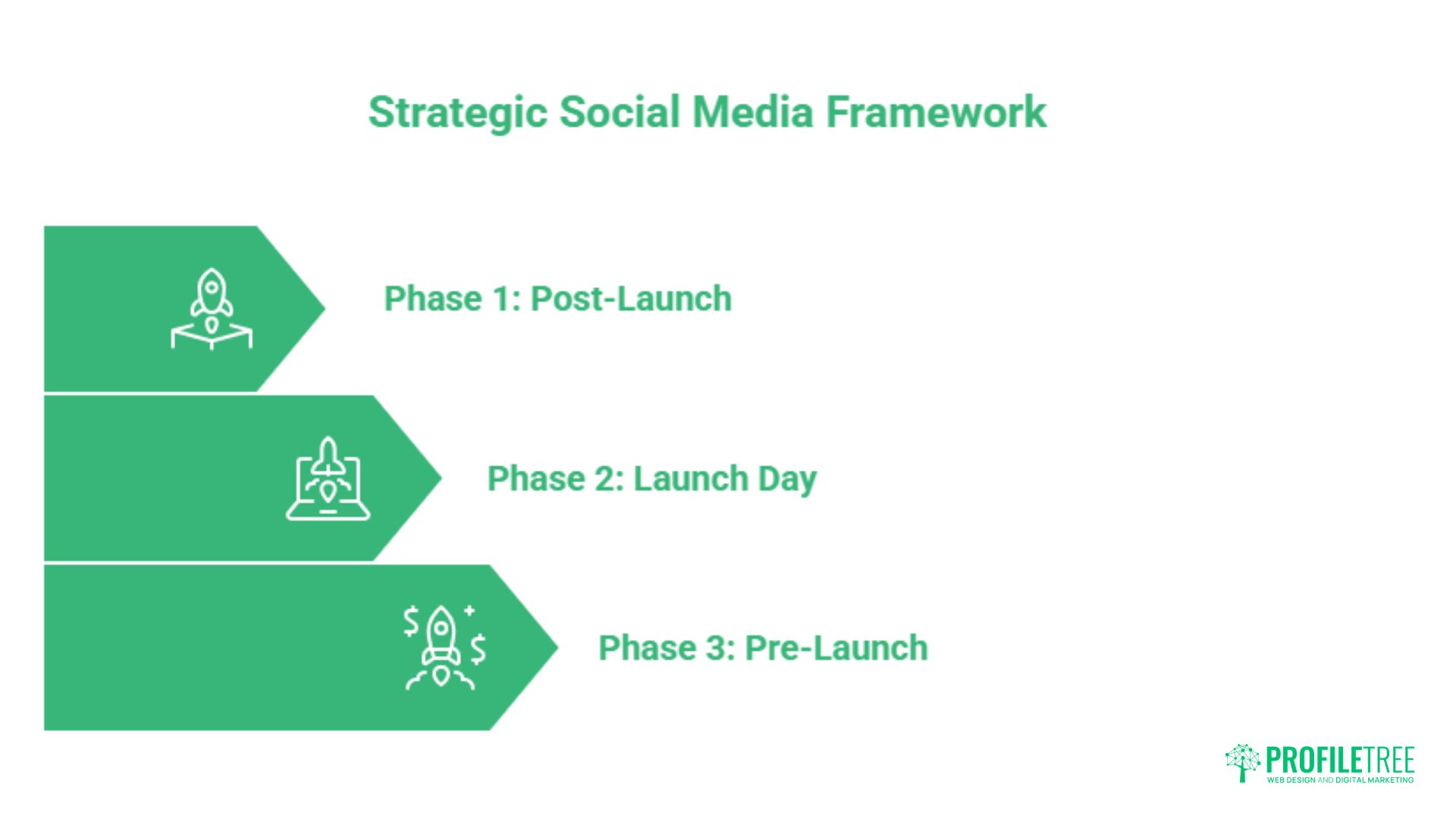
Structuring a launch around three distinct phases (pre-launch, launch day, and post-launch) is not a new idea, but most brands collapse these phases into one another. The discipline of treating them as separate strategic modes, each with its own objectives, content types, and success metrics, is where the real difference is made.
Phase 1: Pre-Launch and the Psychology of Anticipation
The pre-launch phase is where the majority of strategic work happens, and where most brands invest the least time. The goal is not to drive immediate sales but to manufacture a state of informed anticipation in your target audience: they know something is coming, they understand broadly what it is, and they care enough to be watching.
The psychology behind this is straightforward. People assign more value to things that feel scarce or imminent. A well-constructed teaser sequence, built over four to six weeks, creates the conditions for that perception without requiring a large paid media budget. The mechanics typically involve staged content releases: a vague teaser three to four weeks out, a clearer product hint two weeks out, a named reveal with a waitlist or early-access sign-up one week out, and a countdown in the final days.
For B2B products, this sequence often works best when rooted in the problem rather than the product. Leading with the pain point your product solves, gathering genuine responses from your target audience via polls or questions, and then positioning the product as the answer creates a narrative arc that feels earned rather than imposed. Pairing this with a structured social media content strategy ensures the pre-launch content is consistent in tone and sequencing rather than ad hoc.
One important pre-launch tactic that is rarely discussed in launch guides is the internal social launch: seeding the announcement with your existing customers, partners, and professional network before the public launch. These people are your most credible amplifiers because their endorsements carry authentic trust signals that paid promotion cannot replicate.
Phase 2: Launch Day Execution and Real-Time Response
Launch day is the moment when planned strategy meets live audience behaviour, and the two rarely align perfectly. The brands that handle this well are those with clear escalation processes in place: someone monitoring comments and questions in real time, a rapid-response content plan for common objections, and the agility to shift messaging based on what the audience is actually saying.
Live video on launch day consistently outperforms static content in terms of engagement, but it requires preparation. Founder-led live streams, product demonstrations, and Q&A sessions work well when the presenter is comfortable, and the technical setup is reliable. Recording even a short professional video in advance gives you a fallback and extends the content lifecycle well beyond launch day itself. ProfileTree’s video marketing services can support this kind of content production at whatever scale your launch requires.
Platform-specific launch activity should reflect where your audience spends time, not where you are most comfortable posting. A B2C product targeting 25 to 40-year-olds in the UK will perform very differently on TikTok versus LinkedIn. A B2B professional services offer should almost certainly lead on LinkedIn and use other channels in a supporting role.
Phase 3: Post-Launch Momentum and Retention
The 30 days following a launch are when most brands disengage, having spent their creative energy on the launch itself. This is a significant missed opportunity. The immediate post-launch window is when buyers are making final decisions, when first users are forming opinions they will share publicly, and when the algorithm is determining the long-term visibility of your launch content.
Post-launch social media activity should shift in register: from persuasion to validation. User-generated content, early customer testimonials, case study content, and candid responses to any criticism all build the kind of social proof that sustains commercial momentum.
Turning first buyers into advocates through genuine follow-up, personalised acknowledgement, and opportunities to share their experience is consistently underestimated as a launch tactic. Structuring this with a proper approach to customer feedback and content means post-launch content feeds directly into future strategy rather than disappearing into the archive.
The Launch Timeline: A Four-Week Planning Framework
A structured timeline prevents the common failure mode of front-loading all activity onto launch week. The table below maps key activities across the four weeks before launch and the two weeks after, with clear objectives for each phase. This is a practical benchmark; adjust the timings based on your product’s complexity and the length of your audience’s decision cycle.
| Timeframe | Focus | Key Activities | Primary Platform(s) |
|---|---|---|---|
| T-minus 30 days | Build audience | Publish named teaser; launch early-access sign-up; seed internal network; begin influencer briefings. | LinkedIn, Instagram |
| T-minus 14 days | Create anticipation | Share early customer responses; address objections publicly; reshare UGC; begin long-tail paid retargeting. | LinkedIn, Instagram, Email |
| T-minus 7 days | Build urgency | Countdown posts; behind-the-scenes content; PAA-style Q&A posts addressing buyer questions; influencer content published | All active platforms |
| Launch day | Convert attention | Live video or founder statement; paid promotion activated; real-time comment management; cross-channel coordination | All active platforms |
| Post-launch week 1 | Validate and sustain | Case study content, deeper product education posts; community building; performance review against commercial KPIs | LinkedIn, Instagram, Paid |
| Post-launch week 2+ | Build retention | Case study content, deeper product education posts; community building, performance review against commercial KPIs | LinkedIn, YouTube, Email |
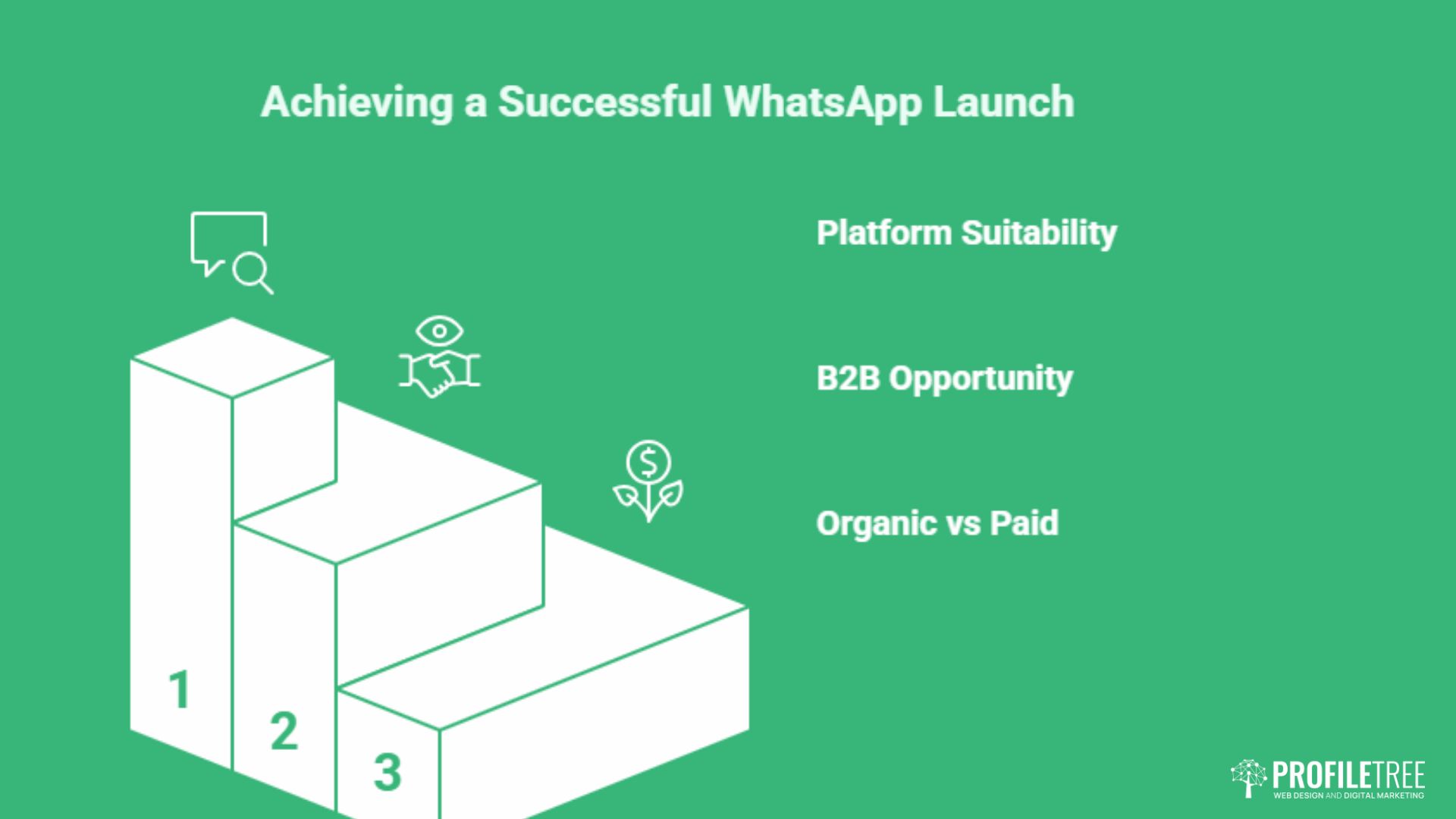
Platform Suitability: B2B vs B2C at a Glance
Choosing the wrong platform for a launch is not just a wasted effort; it can actively dilute the credibility of the launch by placing content in front of an audience that has no relevant intent. The table below outlines platform suitability across common launch objectives.
| Platform | Best For | B2B or B2C | Typical UK/Ireland Cost (Paid) |
|---|---|---|---|
| Professional audiences, lead gen, thought leadership | B2B primarily | £4 to £9 per click | |
| Visual products, brand awareness, direct commerce | B2C primarily | £0.40 to £1.50 per click | |
| TikTok | Viral potential, younger demographics, product demos | B2C primarily | £0.20 to £1.00 per click |
| X (Twitter) | Real-time commentary, news-driven launches, media pickup | Both | £0.30 to £2.00 per click |
| YouTube | Product demos, long-form education, evergreen reach | Both | £0.05 to £0.30 per view |
| WhatsApp/Broadcast | B2B relationship networks, warm audiences, UK/Ireland specific | B2B primarily | Organic or minimal |
All prices and figures in this guide are indicative UK examples and correct at the time of writing; use them as a benchmark rather than fixed quotations.
The B2B WhatsApp Opportunity Most Guides Ignore
UK and Irish business networks use WhatsApp for professional communication at a rate that significantly exceeds the US market. For B2B product launches, a well-timed message to a curated WhatsApp broadcast list of warm contacts, partners, and existing customers can generate early engagement and word-of-mouth that no paid platform can replicate.
This is not spam; it is direct, permission-based communication with people who already have a relationship with your business. The key discipline is keeping the list tightly curated and the message genuinely useful rather than promotional in tone.
Organic vs Paid: Choosing the Right Balance
A launch does not require a large paid media budget to succeed, but paid activity at the right moment significantly accelerates the reach of organic content that is already performing. The most cost-efficient approach for SMEs is to run organic content first, identify which posts generate genuine engagement without promotion, and then use paid boosting to extend the reach of those specific pieces.
This avoids the trap of spending budget on content that the audience has not validated, which is one of the most common and most expensive mistakes in launch campaigns. If you want to build deeper capability in this area, ProfileTree’s digital training programme covers paid social strategy in practical detail for SME marketing teams.
Launching in the UK and Ireland: Compliance, Regulation, and Regional Nuance
This is the section that most social media launch guides skip entirely, and it is the section that most UK and Irish marketing teams need most. Influencer marketing, social lead generation, and platform advertising in the UK and Ireland operate within a specific regulatory framework that differs meaningfully from the US environment in which most launch advice is written.
ASA and CMA Rules for Influencer-Led Launches
The Advertising Standards Authority (ASA) and the Competition and Markets Authority (CMA) have clear, enforceable requirements for influencer content in the UK. Any content that has been paid for, gifted, or otherwise incentivised must be labelled as an advertisement. This means “#gifted”, “#ad”, or equivalent clear disclosure, placed at the start of the caption rather than buried within it or hidden beneath a “more” cut-off on a long post.
Failing to label paid or gifted influencer content is not just an ethical issue; it is a compliance risk. The CMA has issued formal enforcement actions against brands and influencers in the UK, and the ASA regularly publishes rulings that name brands involved in undisclosed advertising. For a product launch, where credibility is everything, an ASA ruling in the weeks following your launch would be severely damaging.
Ciaran Connolly, founder of ProfileTree, notes: “Influencer marketing in the UK and Ireland has to be built on transparency from the outset. Disclosing a commercial relationship does not reduce the impact of influencer content; an honest endorsement from a credible voice carries far more weight than a hidden one, and it protects both the brand and the creator.”
GDPR and Social Lead Generation
Using LinkedIn Lead Gen Forms, Facebook lead ads, or Instagram sign-up prompts as part of a pre-launch campaign requires careful attention to GDPR compliance for UK and EU audiences. Specifically, the purpose for which data is collected must be clearly stated at the point of collection, consent must be freely given and specific, and you must be able to demonstrate that consent if asked.
This has practical implications for how you construct a pre-launch waitlist or early-access sign-up. Your form must explain what people are signing up for, how their data will be used, and who holds it. A generic “sign up for updates” form without this information is non-compliant. For businesses operating across the UK and the Republic of Ireland, both the UK GDPR and the EU GDPR apply, and while they are largely aligned post-Brexit, there are nuances worth checking with a qualified data protection adviser.
Regional Platform Behaviour in the UK and Ireland
Northern Ireland, Ireland, and the wider UK have social media audience characteristics that differ from global averages in ways that affect content strategy. LinkedIn penetration among professional audiences in Belfast, Dublin, and other urban centres is high relative to population size, making it a disproportionately effective channel for B2B launches. Instagram performs strongly for consumer product launches across all age groups, but TikTok adoption among 30 to 45-year-old consumers in Ireland and the UK has grown faster than many marketing teams have anticipated.
For businesses based in or serving Northern Ireland specifically, the cross-border nature of the market creates an opportunity to reach Irish audiences through the same campaign without material additional cost, provided the messaging is appropriately inclusive in tone rather than specifically Northern Irish in framing. If you are exploring what that kind of regional launch looks like in practice, the context of cities across Northern Ireland gives a useful background on the regional audience landscape.
Measuring What Matters: Social KPIs Tied to Business Goals
The single most common failure in post-launch reporting is measuring social media performance using social media metrics. Reach, impressions, and follower growth tell you something about audience exposure; they tell you very little about commercial impact. A launch that generates 500,000 impressions and six sales has underperformed a launch that generates 8,000 impressions and 60 sales, but the first will look better in a standard social media report.
The Metrics That Actually Matter
The metrics that connect social media performance to business outcomes are conversion rate (the percentage of social traffic that completes a desired action), cost per acquisition (the total campaign spend divided by the number of buyers or leads generated), and share of voice (your brand’s proportion of the total social conversation around your product category during the launch window).
Share of voice is particularly underused as a launch metric. It measures not just how much noise your launch made, but how much of the relevant conversation you owned relative to your competitors and the general topic. A launch that dominates share of voice in its category creates a perception of market leadership that outlasts the launch campaign itself. Pairing this with a broader approach to maximising digital marketing ROI ensures your reporting framework connects social activity to commercial outcomes from the outset.
Building a Feedback Loop Between Social and Sales
Real-time social data from a launch is among the most valuable market research you can generate, yet most businesses do not have a process for getting it to the people who can act on it. Comments, questions, and objections surfacing on social channels during a launch reveal what your audience does not yet understand about your product, what concerns are stopping them from buying, and what aspects of the product resonate most strongly.
Building a simple feedback loop, where a nominated person collects and categorises these inputs daily during the launch period and shares a brief summary with the product and sales teams, costs nothing and can materially influence how you adjust your messaging mid-campaign. It also generates insight that directly informs the next launch cycle, compressing the learning curve with each successive campaign.
When to Adjust and When to Stay the Course
One of the harder judgments in a live launch campaign is knowing when declining engagement signals a need for tactical adjustment versus when it simply reflects the natural attention curve of a launch event. A useful rule of thumb: if a content type or platform is consistently underperforming against its benchmarks for three consecutive days, adjust; if it underperforms on one day during a broader pattern of positive engagement, stay the course.
Reactive over-adjustment is one of the leading causes of incoherent launch messaging, as brands abandon a working strategy because one post did not land as expected. If your team needs to build confidence and capability in making these calls, structured digital skills training can significantly reduce the guesswork.
Conclusion
A social media product launch without strategic architecture is just a series of posts. The businesses that generate real commercial outcomes are those that plan in phases, match platform choice to audience intent, comply with UK and Irish regulations, and measure results against revenue rather than reach.
If you are planning a launch and want a strategic partner who understands the regional market, get in touch with the ProfileTree team to discuss how we can support your next campaign.
FAQs
How far in advance should I start my social media product launch?
For most SME product launches, a four-week build-up is the practical minimum. This allows enough time to build genuine anticipation, brief any influencers or partners, construct a waitlist or early-access mechanism, and produce the content needed for each phase without rushing.
Which social media platform is best for a B2B product launch?
LinkedIn is the primary platform for B2B launches in the UK and Ireland, and this is unlikely to change in the near term. Its professional audience targeting, long-form content capability, and lead generation forms make it the most direct route to decision-makers in most B2B sectors.
Do I need a large budget for a social media product launch?
No, but you do need to be strategic about how you allocate whatever budget you have. The most cost-efficient approach is to begin with well-crafted organic content, identify which posts generate genuine engagement without paid support, and then boost those specific pieces with a modest paid budget at the moment they are already performing.
What are the ASA rules for influencer content during a product launch?
Any content that has been paid for, gifted, or otherwise incentivised must be labelled clearly as an advertisement under ASA and CMA guidelines. The disclosure label (“#ad” or “Paid partnership with [brand]”) must appear at the start of the caption, not buried in a list of hashtags or placed below a “see more” cut-off.
How do I generate launch buzz without a product sample to send out?
Behind-the-scenes content and founder-led storytelling are the most effective alternatives when product sampling is not possible. Documenting the development process, sharing the problem the product was built to solve, and bringing your audience into the decision-making behind design or feature choices creates a narrative investment that generates genuine interest before the product is available to experience.