
How to Calculate Social Media ROI for Your Business
Table of Contents
Social media takes up budget, staff time, and management attention. Whether it pays back more than it costs is a question every business owner should be able to answer clearly. Most cannot, not because the data does not exist, but because the calculation is rarely built properly.
To calculate social media ROI, it involves three things: knowing what you actually spent (which is almost always more than the ad budget), knowing what came back (which is almost always harder to attribute than it looks), and understanding the gap between the two. Get those three things right, and you have a figure you can take to a finance director or board.
This guide walks SMEs through the full process across Northern Ireland, Ireland, and the UK.
What Social Media ROI Actually Measures
Return on investment is a ratio: what you gained relative to what you spent. For social media, it is usually expressed as a percentage.
The core formula is straightforward:
ROI = ((Return − Investment) ÷ Investment) × 100
A result above 0% means you made more than you spent. A result below 0% means you did not. A 100% result means you doubled your investment.
Where it gets complicated is in defining “return” and “investment” accurately. Most businesses undercount their investment and overcount or misattribute their return. Both errors produce a misleading figure.
Monetary versus non-monetary returns
Not every return from social media lands directly in a bank account. Brand awareness, customer retention, and reduced support costs are genuine business outcomes, even when they do not appear on a sales report. The challenge is assigning a monetary value to them.
For a clear, defensible ROI figure, start with direct revenue attribution. Non-monetary returns can be tracked separately as supporting metrics. Mixing them into the core ROI calculation without a reliable valuation method produces a number that looks good but does not hold up to scrutiny.
Why engagement metrics do not belong in the formula
Likes, shares, comments, and follower counts are performance indicators, not returns. They may correlate with outcomes, but correlation is not the same as causation. A post can go viral and generate zero sales. A post with minimal engagement can drive significant website traffic that converts.
Track engagement as a leading indicator of content quality. Do not include it in your ROI calculation unless you can demonstrate a verified financial value per engagement for your specific audience. The social media analytics tools you use will surface these figures clearly, but correctly is an important step.
Step 1: Set Clear, Measurable Objectives Before You Spend
ROI can only be calculated against a defined goal. Vague objectives, such as “improve brand presence,” cannot be measured, so they cannot be included in any ROI formula.
Before launching a campaign, define what a successful outcome looks like in concrete terms. Common objectives for SMEs include:
Lead generation: a specified number of enquiry form submissions, phone calls, or email sign-ups attributed to social traffic.
Direct sales: a specified volume or value of transactions where the buyer’s journey included a social media touchpoint.
Website traffic: a specified increase in sessions from social referral sources, leading to measurable on-site actions.
Customer retention: reduced churn or increased repeat purchase rate among customers who engage with your social content.
Each objective maps to a different set of metrics and a different method for assigning monetary value. Defining objectives upfront makes later calculations possible. It also protects you from the most common trap in social media reporting: measuring what is easy to count rather than what actually matters.
Connecting objectives to your wider digital strategy
Social media objectives do not exist in isolation. A lead generation goal on LinkedIn only makes sense if the landing page it points to is built to convert, and if the sales process downstream can handle the enquiries it produces. This is a point Ciaran Connolly, founder of ProfileTree, consistently makes when reviewing new client campaigns: the social strategy conversation almost always surfaces gaps in the wider digital setup that would undermine ROI improvements, regardless of how well the social content performs. A considered social media marketing strategy treats each channel as one part of a connected system, not a standalone activity.
Step 2: Build Your Complete Investment Figure
The investment side of the ROI formula is where most calculations go wrong. Businesses typically count ad spend and stop there. The real figure is consistently higher.
Ad spend and platform costs
Include every pound spent on paid promotion: Meta Ads, LinkedIn Ads, TikTok Ads, X Ads, and any boosted posts. This is the most visible cost and the easiest to capture accurately from platform billing accounts.
Content creation costs
Every piece of social content has a production cost, even if it is not paid to an external supplier. Written posts, graphics, short-form video, and longer video content all consume time or money. For businesses producing video content, the investment is particularly easy to undercount. Camera equipment, editing software, presenter time, and post-production work all belong in the cost column. For SMEs working with external video marketing support, the production fee is the clearest line item, but it still needs to be allocated to the specific campaigns that use the content.
Labour and management time
This is the most frequently omitted cost. If a member of staff spends eight hours a week managing social media, that time has a cost based on their salary and on-costs. For UK employers, the true cost of employment is typically 20-30% above the headline salary, once employer National Insurance and pension contributions are included. That figure belongs in your investment calculation. The same applies to time spent on strategy, reporting, and attending agency briefings. If it took staff hours, it cost money.
Tools and software
Scheduling platforms, social listening tools, analytics dashboards, design software licences, and CRM integrations all contribute to the cost of running social media. Apportion these costs to the period being measured. Annual subscriptions should be divided by 12 and billed monthly rather than charged for the entire period in which the invoice falls.
Agency and freelance fees
Include the full retainer or project fee for any external support. A note specific to businesses operating across Northern Ireland and the Republic of Ireland: where agency fees are invoiced in euros or sterling, convert to a single currency before combining with other cost figures. Exchange rate variance over a quarterly reporting period is worth factoring in, particularly if you are running campaigns in both jurisdictions simultaneously.
Step 3: Track and Calculate Your Return
Calculating the return requires tracking mechanisms to be in place before the campaign starts. Retrospective attribution is unreliable. Set up the following before you spend.
UTM parameters
UTM parameters are tags added to URLs shared on social media. When a user clicks a link with UTM tags, Google Analytics records the source of the click, the campaign it was associated with, and the medium that delivered it.
Every link you share on social media should carry UTM parameters. Without them, traffic from your social channels arrives in analytics as “direct” traffic, and the return cannot be attributed. This is one of the most common reasons businesses underestimate the performance of their digital marketing campaigns: the traffic is arriving, but it is not being recorded as social-originated.
Conversion tracking in GA4
Google Analytics 4 tracks user events rather than sessions. To calculate revenue from social media, mark the specific actions that represent a return as conversion events in GA4: form submissions, phone call clicks, and purchase completions. Once those events are live, GA4 can show you how many were driven by social traffic and, if you have e-commerce tracking enabled, the revenue value associated with each.
For service businesses without direct e-commerce, assign a monetary value to each conversion event based on your average deal value and close rate. If your average client value is £3,000 and you close one in four enquiries, each form submission is worth £750. Use that figure in your ROI calculation.
For a fuller picture of how to use Google Analytics to measure content and campaign performance, the Google Analytics for content marketing guide covers the setup steps in detail.
CRM attribution
For businesses with longer sales cycles, a CRM system provides attribution data that Google Analytics alone cannot. When a lead enters the CRM, record the source. When a deal closes, record the value. Over time, this gives you the average revenue per social-attributed lead, which is a more accurate return figure than website data alone.
Direct versus indirect revenue
Direct revenue is the value of transactions that can be clearly traced back to a social media source through your tracking. Indirect revenue includes leads that entered through social and converted later via a different channel, or customers who engaged with your social content during their consideration phase before contacting you through an untracked route.
For the core ROI calculation, use only direct revenue. Track indirect indicators separately and reference them as supporting evidence when presenting results to stakeholders.
Step 4: Understand Attribution Before You Draw Conclusions
Attribution is the most technically complex part of measuring social media ROI, and it has become more challenging as privacy regulations and tracking restrictions have reduced data accuracy.
Attribution models explained
An attribution model is a rule for assigning credit for a conversion to a specific touchpoint.
Last-click attribution assigns 100% of the credit to the final touchpoint before a conversion. If someone found you on LinkedIn, spent a week reading your blog, then clicked a Google Ad and converted, the Google Ad gets all the credit. Social media’s contribution to the journey is invisible.
First-click attribution assigns credit to the first touchpoint. If a LinkedIn post started the journey, it receives the credit regardless of what happened between that point and the conversion.
Multi-touch attribution distributes credit across all touchpoints in the journey. This is closer to reality for most buying journeys, but requires more data and a more capable analytics setup to implement properly.
For SMEs, last-click attribution is the default in most analytics tools and consistently undervalues social media’s contribution to conversions. If your ROI figures look inexplicably low, check which attribution model is in use before concluding that social is not working. Reviewing marketing analytics statistics can also help calibrate what strong performance looks like across channel types.
The UK GDPR tracking gap
Cookie consent requirements under UK GDPR mean a meaningful proportion of your website visitors opt out of tracking. For some UK business websites, this can represent 30-40% of sessions going unmeasured. GA4’s modelled conversions use machine learning to estimate conversions in the gap left by non-consenting users, but modelled data should be labelled as such in any reporting.
Dark social (sharing via private channels such as WhatsApp, direct messages, and email) is another attribution gap. When someone shares your content privately, and the recipient visits your site directly, that visit registers as direct traffic, not social. There is no perfect solution to this, but branded direct traffic growth is a reasonable proxy indicator of dark social activity.
The UK GDPR and its implications for digital marketing are covered in more detail if you need to review your consent setup before improving your tracking.
How AI tools are changing attribution
For SMEs without dedicated data analysts, AI-powered analytics tools are becoming a practical alternative to manual UTM tracking and spreadsheet-based attribution. These tools can surface patterns across multiple data sources, flag attribution anomalies, and produce plain-language reporting without requiring specialist technical skills. Understanding the cost-benefit analysis of AI implementation for your business is a useful starting point before committing to a particular tool or approach.
Step 5: Run the Calculation and Apply the Formula
Once you have your investment figure and your attributed return, the calculation itself is straightforward.
ROI = ((Return − Investment) ÷ Investment) × 100
A worked example using sterling figures:
- Total attributed return: £18,000
- Total investment (ad spend + content + labour + tools + agency fees): £8,500
- ROI = ((18,000 − 8,500) ÷ 8,500) × 100 = 111.8%
This means for every £1 invested in social media during this period, the business generated £2.12 in return.
What counts as a good result?
A commonly cited benchmark is a 5:1 ratio (400% ROI) as a marker of strong performance. In practice, what constitutes a good result varies significantly across industries, channels, and business models. B2B businesses targeting LinkedIn tend to see lower volume but higher-value conversions. A single qualified lead worth £15,000 over twelve months of professional services work produces a very different ROI calculation than fifty £300 e-commerce orders from Meta Ads.
Compare your results against your own previous periods first. For a broader context on digital marketing ROI benchmarks, the Maximising ROI in digital marketing campaigns guide covers how to evaluate performance across channel mix.
Presenting ROI to stakeholders
Finance directors and board members will scrutinise the investment figure as carefully as the return. A fully itemised cost breakdown, including staff time, demonstrates rigour and pre-empts the most common challenge to social media ROI figures: the failure to account for indirect costs.
Present the calculation alongside a clear explanation of the attribution model used and any known tracking gaps. Acknowledging the limitations of your data is more credible than presenting a figure as definitive when it cannot be. The ICO’s guidance on analytics and cookie consent is worth referencing in stakeholder reporting if your consent rates are materially affecting your tracked conversion volumes, as it provides regulatory context for why data gaps exist.
The ROI of Organic Social Media
Calculating ROI for paid social is relatively straightforward because the investment is clearly defined. Organic social media is harder because the cost is almost entirely labour.
To calculate organic social ROI, use the same formula but replace ad spend with the full staff time cost of producing and managing organic content. If your social media manager spends 30% of their time on organic content and their total employment cost is £35,000 per year, the annual organic social investment is £10,500. Measure the revenue or lead value attributable to organic social traffic using the same GA4 and CRM tracking methods, then apply the formula.
Many businesses find that organic social has a positive ROI when measured honestly, particularly when brand awareness and search uplift effects are included as supporting metrics alongside the direct attribution figure. Social media’s role in increasing social media marketing and sales performance is well established, but it requires consistent measurement to demonstrate.
Building a Repeatable Measurement Framework
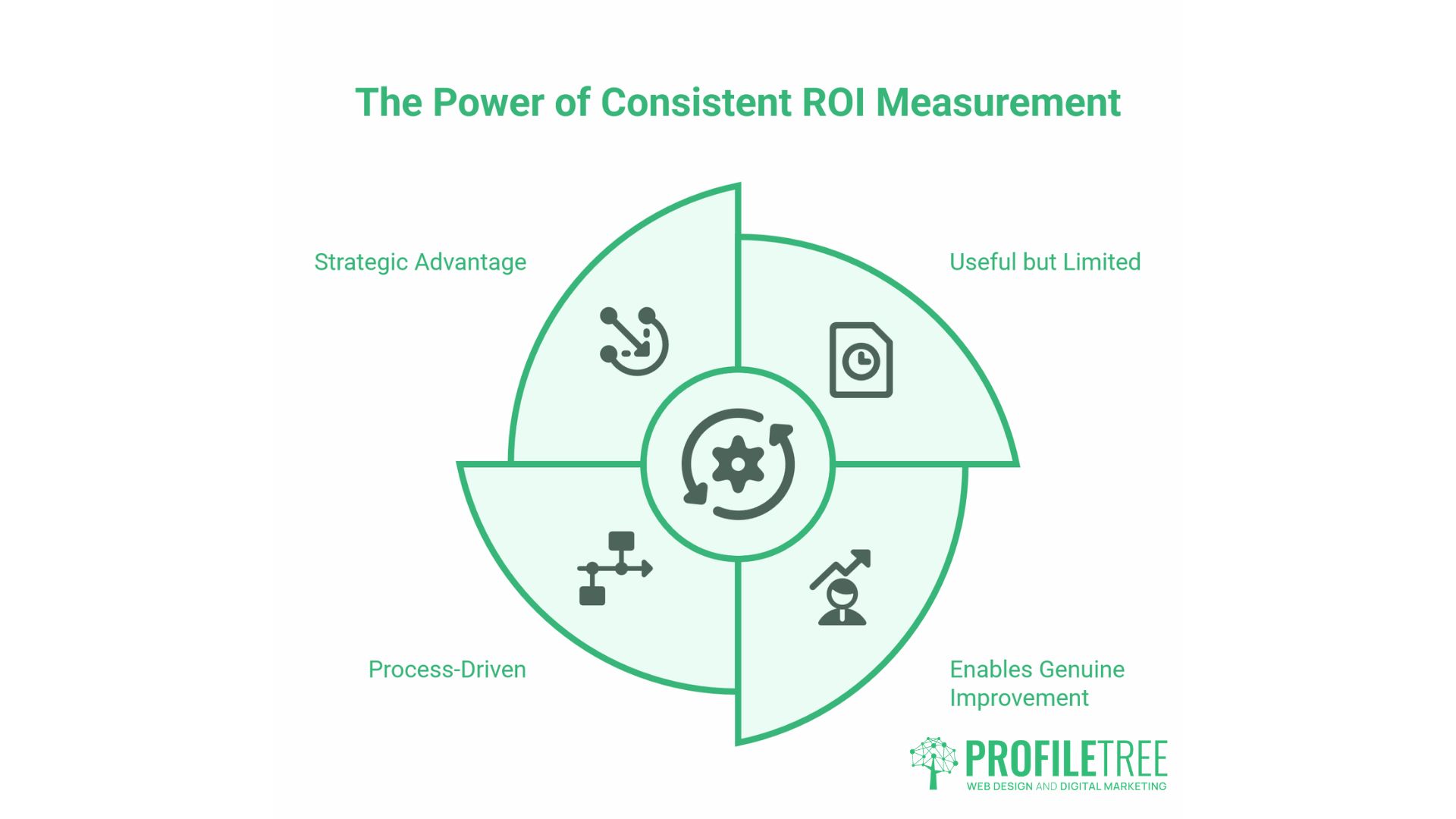
Running an ROI calculation once, after the fact, is useful. Running it consistently across every campaign period is what enables genuine improvement. The difference is in the process.
The elements of a repeatable framework are:
A UTM naming convention: consistent source, medium, and campaign naming across all social channels so GA4 data is comparable over time.
Defined conversion events: the same conversion events tracked from one period to the next, with documented monetary values assigned.
A standard cost tracking record: a simple spreadsheet that captures all investment categories each month, including staff time estimates, so the input data is consistent.
A fixed reporting cadence: monthly or quarterly, depending on campaign length, with a standard format that stakeholders recognise and can interrogate.
For teams that lack the in-house expertise to build or maintain this framework, ProfileTree’s digital training programmes offer practical analytics setup, GA4 fundamentals, and social media measurement. The aim is for businesses to own their own measurement capability rather than depending on a supplier to produce reports they cannot interrogate.
Conclusion
Accurate social media ROI comes down to two things: counting the full investment, including staff time, and tracking returns through properly configured analytics. Get both right consistently, and budget decisions become straightforward.
If your tracking setup needs work before that is possible, talk to the ProfileTree team about your social media strategy.
FAQs
What is a good social media ROI for a small business?
A 5:1 return (400% ROI) is widely cited as a strong benchmark, but it varies considerably by sector and channel. The most useful comparison is your own previous period: if ROI is improving while investment stays stable, the strategy is working.
How do you calculate social media ROI in GA4?
Tag all social media links with UTM parameters, then mark key on-site actions (form submissions, purchases, call clicks) as conversion events in GA4 and assign each a monetary value. The Traffic Acquisition report will then show conversion value by social source.
Does the ROI calculation include agency fees?
Yes, always. Omitting them inflates the figure. Include retainer fees, project fees, freelance costs, and any billed expenses. If your agency manages both strategy and paid media, both the management fee and the ad spend count as investment.
How has UK GDPR affected social media ROI tracking?
Cookie opt-outs create gaps in conversion data. GA4 fills some of this with modelled conversions, but treats modelled figures as directional rather than precise and notes your consent rate in any stakeholder reporting.